Electric Vehicle Battery Disconnect (Pyro-fuse) Driver IC Market Insights
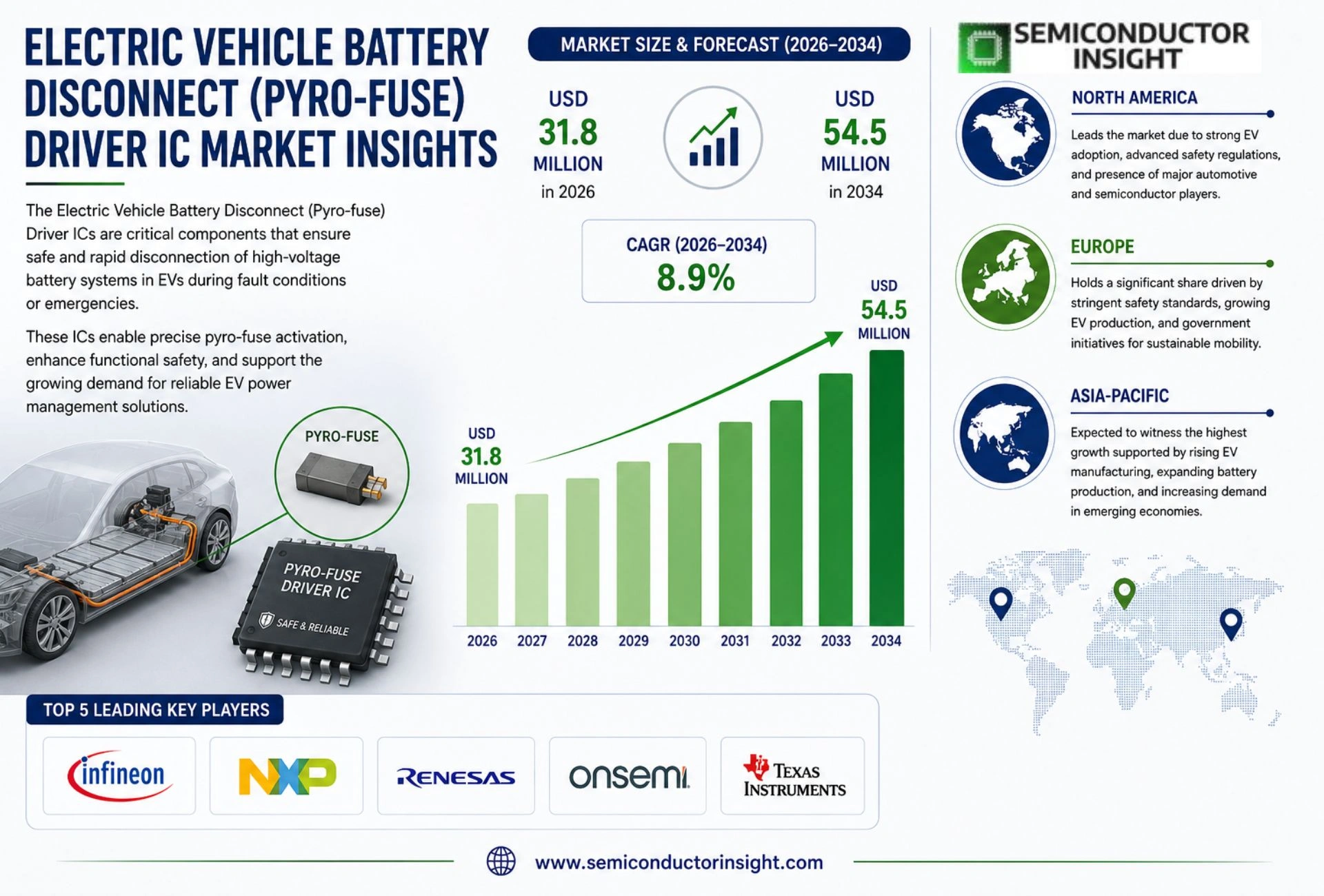
Electric Vehicle Battery Disconnect (Pyro-fuse) Driver IC Market size was valued at USD 29.5 million in 2025. The market is projected to grow from USD 31.8 million in 2026 to USD 54.5 million by 2034, exhibiting a CAGR of 8.9% during the forecast period.
Electric Vehicle Battery Disconnect (Pyro-fuse) Driver ICs are specialized semiconductor components designed to trigger pyrotechnic fuses in high-voltage battery systems. These ICs provide precise control, diagnostics, and safety functions to rapidly disconnect the battery pack during critical events such as short circuits, crashes, or thermal runaway, preventing potential fires or explosions while ensuring compliance with stringent automotive safety standards like ISO 26262.
The market is experiencing rapid growth due to several factors, including the accelerating adoption of electric vehicles worldwide, rising emphasis on battery safety systems, and increasing regulatory requirements for high-voltage protection in EVs. Furthermore, advancements in integrated driver solutions that combine power management, current sensing, and fault diagnostics are contributing to market expansion. Initiatives by key players in the market are also expected to fuel the market growth. For instance, leading semiconductor manufacturers have introduced highly integrated squib drivers with enhanced diagnostics and hardware-triggered activation for faster response times. Texas Instruments, STMicroelectronics, NXP Semiconductors, and Bosch are some of the key players that operate in the market with a wide range of portfolios.
MARKET DRIVERS
Rising EV Adoption and Battery Safety Mandates
The global shift toward electric vehicles has significantly boosted demand for advanced battery disconnect solutions, including pyro-fuse driver ICs. These specialized ICs enable rapid, reliable triggering of pyrotechnic fuses to isolate high-voltage battery packs during faults, crashes, or thermal events, addressing critical safety requirements in 400-800V architectures. Strict regulatory standards for battery thermal runaway prevention continue to drive OEM integration of these functional safety-compliant (ISO 26262) driver solutions.
Technological Advancements in BMS Integration
Leading semiconductor suppliers have introduced highly integrated squib and pyro-fuse driver ICs featuring built-in diagnostics, energy reservoir monitoring, and programmable firing profiles. Solutions such as Texas Instruments’ DRV3901-Q1 and similar offerings from STMicroelectronics and Bosch support faster decision-making and redundancy in Battery Management Systems (BMS), enhancing overall system reliability while reducing component count in next-generation EV platforms.
➤ Active trigger pyro-fuse systems, supported by advanced driver ICs, are projected to hold dominant market share as automakers prioritize instantaneous high-voltage disconnection over traditional melting fuses.
Growing emphasis on higher voltage architectures for faster charging and improved efficiency further accelerates the need for robust pyro-fuse driver ICs capable of precise control and comprehensive fault detection in demanding automotive environments.
MARKET CHALLENGES
Functional Safety and Qualification Complexity
Developing pyro-fuse driver ICs that meet stringent ASIL-D requirements involves extensive validation, diagnostics integration, and redundancy implementation. Automotive-grade qualification processes extend development timelines and increase costs for semiconductor manufacturers serving Electric Vehicle Battery Disconnect (Pyro-fuse) Driver IC Market.
Other Challenges
Integration with Evolving Battery Architectures
Rapid advancements in battery pack designs, cell chemistries, and voltage levels demand continuous adaptation of driver ICs, creating engineering challenges in maintaining compatibility and performance across diverse OEM platforms.
Supply Chain and Cost Pressures
Ensuring stable supply of specialized components while managing cost sensitivity in high-volume EV production remains a key hurdle, particularly as competition intensifies among IC suppliers.
MARKET RESTRAINTS
High Development Costs and Technical Barriers
The specialized nature of pyro-fuse driver ICs, requiring robust high-reliability features, diagnostics, and compliance with automotive safety standards, results in elevated R&D and manufacturing expenses. These factors can limit broader market penetration, especially among smaller EV manufacturers and emerging players focused on cost reduction.
MARKET OPPORTUNITIES
Expansion in High-Voltage and Commercial EV Segments
Growing adoption of 800V+ platforms in passenger and commercial electric vehicles, alongside expanding energy storage applications, creates substantial opportunities for next-generation pyro-fuse driver ICs with enhanced multi-channel capabilities, smarter diagnostics, and improved power efficiency. Innovations in integrated BMS solutions position suppliers to capture increasing demand.
Trends
Rising Integration of Advanced Safety Features in EV Battery Systems
Electric Vehicle Battery Disconnect (Pyro-fuse) Driver IC Market continues to evolve as automakers prioritize rapid and reliable disconnection mechanisms in high-voltage battery packs. These specialized ICs enable precise triggering of pyrotechnic fuses during critical events including short circuits, collisions, and thermal runaway conditions. Their role in delivering comprehensive diagnostics and safety compliance with standards such as ISO 26262 has become central to modern EV architectures, supporting both passenger safety and system integrity.
Other Trends
Advancements in Integrated Driver Solutions
Manufacturers are focusing on highly integrated squib driver ICs that combine power management, current sensing, and sophisticated fault diagnostics into compact packages. These innovations allow for faster response times through hardware-triggered activation pathways, reducing latency in emergency disconnect scenarios. Enhanced diagnostic capabilities also enable continuous monitoring of fuse status and system health, which helps manufacturers meet increasingly stringent automotive safety requirements while optimizing overall battery management system performance.
Growing Emphasis on Regulatory Compliance and High-Voltage Protection
Global regulatory frameworks continue to push for superior high-voltage protection technologies in electric vehicles, driving adoption of advanced pyro-fuse driver solutions. As EV platforms scale in both consumer and commercial segments, the need for robust battery disconnect systems that prevent fires and explosions has intensified. Leading semiconductor companies including Texas Instruments, STMicroelectronics, NXP Semiconductors, and Bosch are actively developing next-generation portfolios featuring improved integration and reliability characteristics. This competitive landscape fosters ongoing innovation in driver IC designs that balance functional safety with cost efficiency, supporting broader electric vehicle market expansion while addressing critical safety challenges in high-energy battery environments.
COMPETITIVE LANDSCAPE
Key Industry Players
Competitive Analysis of Electric Vehicle Battery Disconnect (Pyro-fuse) Driver IC Market
Electric Vehicle Battery Disconnect (Pyro-fuse) Driver IC Market is characterized by a concentrated competitive landscape dominated by established semiconductor leaders with deep automotive expertise. Texas Instruments stands out as a leading player with its highly integrated solutions such as the DRV3901-Q1 squib driver, offering advanced diagnostics and ISO 26262 compliance for rapid high-voltage battery disconnection. The market structure features a mix of global semiconductor giants and specialized automotive electronics providers, where innovation in safety functions, fault diagnostics, and hardware-triggered activation drives differentiation amid stringent regulatory requirements.
Other significant players include STMicroelectronics, NXP Semiconductors, and Bosch, which contribute specialized pyro-fuse driver ICs tailored for EV battery management systems. These companies focus on multi-channel capabilities, enhanced power management integration, and real-time monitoring to address thermal runaway and crash scenarios, complementing the broader ecosystem of pyro-fuse component manufacturers.
List of Key Electric Vehicle Battery Disconnect (Pyro-fuse) Driver IC Companies Profiled
- Texas Instruments
- Texas Instruments
- STMicroelectronics
- NXP Semiconductors
- Bosch Semiconductors
- Infineon Technologies
- Microchip Technology
- Analog Devices
- ON Semiconductor
- ROHM Semiconductor
- Melexis
- Elmos Semiconductor
- Allegro MicroSystems
- Renesas Electronics
- ams-OSRAM
Segment Analysis:
| Segment Category | Sub-Segments | Key Insights |
| By Type |
|
Multi-Channel Driver ICs stand out for their ability to manage multiple pyrotechnic fuses simultaneously, offering enhanced redundancy in complex battery architectures. These solutions deliver superior fault isolation capabilities across high-voltage packs while incorporating advanced current monitoring for proactive safety interventions. Their design supports seamless integration with diverse electronic control units, enabling faster response during critical events and improved overall system reliability in demanding electric vehicle environments. |
| By Application |
|
Battery Pack Protection emerges as the dominant application area due to its critical role in maintaining circuit integrity under high-voltage operations. Driver ICs in this segment excel at delivering precise triggering signals to pyro-fuses, ensuring immediate disconnection during short-circuit conditions. This application benefits from continuous advancements in diagnostic feedback loops that verify activation readiness, fostering greater confidence in system performance and supporting compliance with rigorous automotive functional safety requirements across various vehicle platforms. |
| By End User |
|
Tier-1 Suppliers represent the leading end user category as they focus on developing complete safety systems for electric vehicles. These organizations prioritize driver ICs that offer robust hardware-triggered activation and comprehensive self-diagnostics to meet stringent quality benchmarks. Their expertise in system-level integration allows for optimized pyro-fuse performance, reduced latency in emergency disconnects, and enhanced collaboration with semiconductor providers to customize solutions that address evolving safety challenges in next-generation battery technologies. |
| By Vehicle Type |
|
Passenger Electric Vehicles lead this segmentation through their emphasis on sophisticated high-voltage battery management for consumer safety and comfort. Driver ICs tailored for this category support compact designs that maintain high performance in space-constrained environments while providing detailed event logging for post-incident analysis. This focus drives innovations in low-power operation during standby modes and rapid activation sequences, ultimately contributing to higher consumer trust and smoother adoption of personal electric mobility solutions. |
| By Integration Level |
|
System-on-Chip Solutions are gaining prominence by combining pyro-fuse driving circuitry with power management and sensing functions on a single die. This approach minimizes component count and interconnection points, resulting in improved signal integrity and reduced electromagnetic interference. Manufacturers appreciate the streamlined validation processes and enhanced functional safety features that these highly integrated ICs provide, facilitating faster development cycles for advanced electric vehicle platforms while maintaining exceptional reliability under harsh automotive operating conditions. |
Regional Analysis: Electric Vehicle Battery Disconnect (Pyro-fuse) Driver IC Market
China leads innovation in pyro-fuse driver ICs through its massive scale of EV and battery production. Domestic suppliers focus on cost-effective, high-reliability solutions tailored for local OEMs, emphasizing rapid scalability and integration with LFP and NMC battery chemistries prevalent in the market.
Japanese and Korean firms excel in precision engineering and functional safety compliance for pyro-fuse driver ICs. Their emphasis on quality and advanced semiconductor processes results in superior performance characteristics suited for premium and high-voltage EV platforms.
The region’s tightly knit ecosystem enables seamless collaboration between IC designers, battery manufacturers, and vehicle assemblers. This integration accelerates customization of Electric Vehicle Battery Disconnect (Pyro-fuse) Driver ICs to meet specific regional safety and performance needs.
Supportive policies and ambitious electrification targets continue to propel demand for advanced safety electronics. Asia-Pacific is poised to maintain its leadership through sustained innovation in smart pyro-fuse technologies aligned with evolving EV architectures.
North America
North America exhibits strong growth potential Electric Vehicle Battery Disconnect (Pyro-fuse) Driver IC Market, fueled by increasing investments in domestic EV manufacturing and battery production facilities. The region prioritizes functional safety and regulatory compliance, driving demand for highly reliable pyro-fuse driver solutions that integrate advanced diagnostics and fail-safe mechanisms. Collaboration between automakers, semiconductor suppliers, and technology firms focuses on developing robust ICs capable of operating in diverse climatic conditions while supporting higher energy density battery systems. Strategic initiatives to localize supply chains enhance resilience and reduce dependency on imports, creating opportunities for specialized driver IC innovations tailored to North American safety standards and performance expectations.
Europe
Europe demonstrates sophisticated demand for Electric Vehicle Battery Disconnect (Pyro-fuse) Driver IC technologies, shaped by stringent safety regulations and ambitious carbon reduction goals. The region’s focus on premium electric vehicles and advanced battery management encourages the adoption of high-performance pyro-fuse drivers with enhanced monitoring capabilities and seamless BMS integration. European semiconductor expertise contributes to the development of energy-efficient and compact solutions that align with circular economy principles and extended product longevity requirements. Cross-border collaborations and research programs accelerate innovation, positioning Europe as a key player in setting global benchmarks for safety-critical automotive electronics.
South America
South America is gradually emerging Electric Vehicle Battery Disconnect (Pyro-fuse) Driver IC Market as EV adoption gains momentum in key countries. The region benefits from growing interest in sustainable mobility solutions and potential for local battery resource utilization. Market participants focus on cost-optimized yet reliable pyro-fuse driver ICs suitable for entry-level and mid-range electric vehicles adapted to regional infrastructure and operating conditions. Partnerships with global technology providers help introduce proven safety technologies while fostering gradual development of local expertise in battery safety electronics.
Middle East & Africa
The Middle East and Africa region shows nascent but promising developments Electric Vehicle Battery Disconnect (Pyro-fuse) Driver IC Market, supported by strategic diversification efforts toward green technologies and smart mobility. Rising investments in electric mobility infrastructure create demand for durable, high-temperature resistant pyro-fuse solutions suitable for challenging environmental conditions. Governments and private entities explore opportunities in EV ecosystem building, driving interest in safety components that ensure reliable battery disconnection. The market evolves through technology transfers and pilot programs that lay foundations for future growth in advanced driver IC applications.
Report Scope
This market research report provides a comprehensive analysis of the Electric Vehicle Battery Disconnect (Pyro-fuse) Driver IC Market , covering the forecast period 2026–2034. It offers detailed insights into market dynamics, technological advancements, competitive landscape, and key trends shaping the industry.
Key focus areas of the report include:
- Market Overview: The report begins with an overview outlining its current market scenario, key growth indicators, and industry transformation drivers. It discusses macroeconomic factors, demand–supply balance, regulatory landscape, and the strategic role of semiconductors in powering advancements across industries such as automotive, telecommunications, consumer electronics, and industrial automation.
- Market Size & Forecast: Historical data and future projections for revenue, unit shipments, and market value across major regions and segments.
- Segmentation Analysis: Detailed breakdown by product type, technology, application, and end-user industry to identify high-growth segments and investment opportunities.
- Regional Insights: Insights into market performance across North America, Europe, Asia-Pacific, Latin America, and the Middle East & Africa, including country-level analysis where relevant.
- Competitive Landscape: Profiles of leading market participants, including their product offerings, R&D focus, manufacturing capacity, pricing strategies, and recent developments such as mergers, acquisitions, and partnerships.
- Technology Trends & Innovation: Assessment of emerging technologies, integration of AI/IoT, semiconductor design trends, fabrication techniques, and evolving industry standards.
- Market Drivers & Restraints: Evaluation of factors driving market growth along with challenges, supply chain constraints, regulatory issues, and market-entry barriers.
- Stakeholder Insights: Insights for component suppliers, OEMs, system integrators, investors, and policymakers regarding the evolving ecosystem and strategic opportunities.
Primary and secondary research methods are employed, including interviews with industry experts, data from verified sources, and real-time market intelligence to ensure the accuracy and reliability of the insights presented.
FREQUENTLY ASKED QUESTIONS:
What is the current market size of Electric Vehicle Battery Disconnect (Pyro-fuse) Driver IC Market?
-> Electric Vehicle Battery Disconnect (Pyro-fuse) Driver IC Market was valued at USD 29.5 million in 2025 and is expected to reach USD 54.5 million by 2034.
Which key companies operate Electric Vehicle Battery Disconnect (Pyro-fuse) Driver IC Market?
-> Key players include Texas Instruments, STMicroelectronics, NXP Semiconductors, and Bosch, among others.
What are the key growth drivers?
-> Key growth drivers include accelerating adoption of electric vehicles worldwide, rising emphasis on battery safety systems, and increasing regulatory requirements for high-voltage protection in EVs.
Which region dominates the market?
-> Asia-Pacific is the fastest-growing region, while Europe remains a dominant market.
What are the emerging trends?
-> Emerging trends include advancements in integrated driver solutions with power management and fault diagnostics, highly integrated squib drivers with enhanced diagnostics, and hardware-triggered activation for faster response times.

Get Sample Report PDF for Exclusive Insights
Report Sample Includes
- Table of Contents
- List of Tables & Figures
- Charts, Research Methodology, and more...
 Download Sample Report PDF