Driving Recorder Memory Cards Market Insights
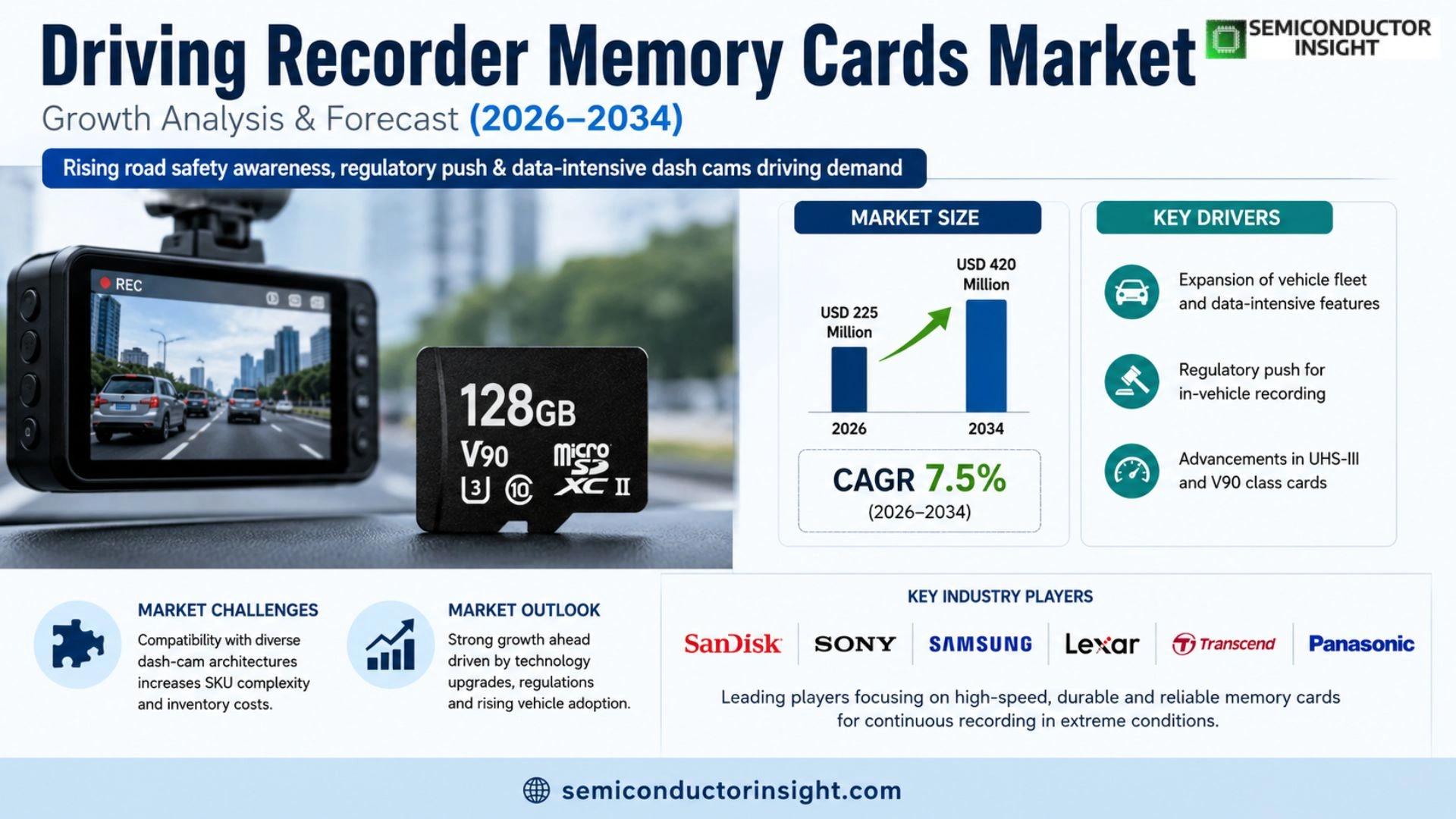
Global Driving Recorder Memory Cards market size was valued at USD 210 million in 2024. The market will rise from USD 225 million in 2026 to USD 420 million by 2034, reflecting a CAGR of 7.5% over the forecast horizon.
Driving Recorder Memory Cards are high‑performance flash storage modules engineered for continuous video capture in automotive dash‑cam systems. They comply with UHS‑I/UHS‑II standards, support FAT32 or exFAT file systems, and are built for high write endurance and temperature resilience required by vehicle environments.
The market expands because many jurisdictions in Europe and Asia have introduced mandatory dash‑cam regulations, while the cost decline of NAND flash drives broader consumer adoption of road‑safety technologies. Recent advances such as A2 classification and higher V‑rating specifications improve reliability under extreme temperatures, prompting manufacturers like SanDisk, Sony, Transcend, Lexar and Samsung to launch automotive‑grade product lines. New entrants focusing on AI‑enabled video compression further stimulate demand for larger capacity cards.
MARKET DRIVERS
Expansion of Vehicle Fleet and Data‑Intensive Features
The global rise in passenger‑car registrations and the steady adoption of advanced driver‑assistance systems have created a steady demand for reliable storage solutions. Driving Recorder Memory Cards Market participants benefit from fleets that now generate gigabytes of video per day, pushing OEMs to specify higher‑capacity, high‑speed cards that can keep pace with continuous recording.
Regulatory Push for In‑Vehicle Recording
Governments in several regions have introduced legislation that encourages on‑board dash cameras for commercial and public‑service vehicles. This regulatory climate forces manufacturers to equip products with memory cards that meet durability standards, thereby fueling sales of premium, weather‑sealed variants.
➤ “Reliability under extreme temperature swings is now a non‑negotiable spec for most fleet operators.”
Parallel to policy pressure, the rollout of UHS‑III and V90 class cards has lowered latency and increased write speeds, allowing seamless capture of 4K footage. Buyers are therefore willing to pay a premium for cards that guarantee no frame loss, reinforcing the upward trajectory of the Driving Recorder Memory Cards Market.
MARKET CHALLENGES
Compatibility with Diverse Dash‑Cam Architectures
Manufacturers face a fragmented ecosystem where dash‑cameras vary in interface standards, voltage tolerances, and file‑system preferences. This heterogeneity forces suppliers to maintain multiple SKUs, inflating inventory costs and complicating supply‑chain logistics.
Other Challenges
Pricing Pressure from Low‑Cost Producers
A wave of inexpensive, low‑performance cards manufactured in emerging markets competes on price rather than durability. While they attract price‑sensitive buyers, the influx erodes average selling prices and challenges premium brands to differentiate on quality.
Furthermore, end‑users often lack technical knowledge to evaluate endurance ratings, leading to premature replacements and higher churn rates for otherwise robust products.
MARKET RESTRAINTS
Limited Shelf Life of High‑Performance Cells
Memory cards that are marketed for continuous 24‑hour recording rely on NAND flash cells that degrade after a finite number of write cycles. As the total bytes written accumulate, failure rates rise, prompting consumers to replace cards more often than anticipated. This technical ceiling tempers long‑term demand growth.
MARKET OPPORTUNITIES
Integration of Encrypted Storage for Fleet Security
Enterprises are increasingly seeking encrypted memory solutions that protect recorded footage from tampering. Vendors that bundle hardware‑level encryption with tamper‑evident designs can command higher margins and open new contracts with logistics firms, municipal transport agencies, and insurance providers.
Driving Recorder Memory Cards Market Trends
Rising Preference for Higher‑Capacity Cards
Vehicle‑mounted video systems now record continuously for 24‑hour periods, creating a demand for memory solutions that exceed the traditional 32 GB ceiling. Manufacturers are responding by introducing 128 GB and 256 GB options that retain full‑resolution footage without compromising write speed. This shift matters because longer retention reduces the frequency of card swaps, lowering operating costs for fleet managers and enhancing data integrity for accident investigations. The trend also aligns with the broader move toward electric and autonomous vehicles, where onboard diagnostics generate additional data streams that must coexist on the same card. Companies that can combine high capacity with reliable endurance are likely to capture premium pricing, while those that lag may see margin pressure as customers migrate to more capable alternatives.
Other Trends
Format Diversification and Compatibility
Historically, FAT32 dominated the segment, but the emergence of exFAT and NTFS formats reflects a need for larger file‑system limits and faster indexing. exFAT, in particular, enables seamless handling of files larger than 4 GB, a requirement when recordings are stored in ultra‑high definition. By supporting multiple formats, card producers can address both consumer‑grade dashcams and professional telematics units, widening their addressable market. The practical implication for OEMs is a reduced risk of firmware incompatibility, while distributors gain flexibility to stock a single SKU that serves diverse applications. However, the coexistence of formats also introduces a testing burden, as each device must certify performance across all supported file‑systems.
Intensifying Competitive Landscape
The presence of long‑standing brands such as Sandisk, Sony, and Samsung is now matched by agile newcomers that specialize in automotive‑grade durability. Vertical integration is becoming more common, with some manufacturers sourcing NAND flash directly from semiconductor producers to control cost volatility. This strategic move influences pricing structures across Driving Recorder Memory Cards Market, compelling incumbents to either pursue cost efficiencies or differentiate through proprietary error‑correction algorithms. Parallel to price dynamics, sustainability mandates are prompting players to adopt recyclable packaging and low‑power manufacturing processes, a factor that increasingly influences procurement decisions of large fleet operators. Buyers that prioritize reliability, regulatory compliance, and environmental stewardship will shape the next wave of supply‑chain contracts, rewarding suppliers that can demonstrably meet those criteria.
COMPETITIVE LANDSCAPE
Key Industry Players
Driving Recorder Memory Cards – Competitive Overview
The market is anchored by a handful of global memory‑card manufacturers whose brand equity and extensive distribution channels give them a decisive edge in securing contracts with vehicle‑OEMs and aftermarket distributors. SanDisk, Sony and Samsung command the largest share of unit sales, leveraging advanced UHS‑II/UHS‑III controllers that meet the high‑frequency write demands of continuous video capture. Their ability to offer end‑to‑end warranty and firmware support has entrenched them as preferred suppliers for premium automotive brands. Parallel to the revenue leaders, a second tier of firms,Lexar, Transcend and Panasonic,focus on niche segments such as fleet‑management solutions, where durability certifications and temperature‑resistance specifications are paramount. These companies differentiate through targeted product portfolios that combine extended endurance ratings with cost‑effective pricing, allowing them to capture mid‑range vehicle lines and regional integrators.
Beyond the established tier, a cluster of emerging players is reshaping the competitive equation by exploiting rapid advancements in 3D‑stacked NAND and low‑power controller architectures. Companies like PHISON, MaXell, PQI, Kingston, Delkin and ADATA are investing in custom firmware that optimizes wear‑leveling for the constant rewrite cycles typical of dash‑cam applications. Their aggressive price positioning and partnerships with Chinese automotive assemblers have enabled a noticeable shift in market share toward more price‑sensitive segments, especially in emerging economies. Meanwhile, regional specialists such as PNY and Verbatim are reinforcing their foothold by offering certified secure‑erase features, catering to privacy‑focused fleet operators. The interplay of technology innovation, warranty practices, and strategic OEM alliances creates a dynamic landscape where incumbents must continuously upgrade product reliability, while challengers leverage cost advantages and niche compliance to expand their influence.
List of Key Driving Recorder Memory Cards Companies Profiled
- SanDisk
- Sony
- Transcend
- Lexar
- Samsung
- Verbatim
- PNY
- Panasonic
- PHISON
- MaXell
- PQI
- Kingston
- Delkin
- ADATA
- Hama
Segment Analysis:
| Segment Category | Sub-Segments | Key Insights |
| By Type |
|
FAT32 Format
|
| By Application |
|
Private Vehicle
|
| By End User |
|
Individual Drivers
|
| By Performance Tier |
|
High Speed
|
| By Form Factor |
|
microSD Card
|
Regional Analysis: Driving Recorder Memory Cards Market
North America
North America retains its position as the most mature arena for Driving Recorder Memory Cards Market. The region benefits from a combination of stringent vehicular safety regulations and a consumer base accustomed to high‑definition video capture. Automakers embed dash‑cam solutions as standard equipment in premium models, prompting OEMs to source high‑capacity, high‑reliability memory cards that can sustain continuous recording cycles. Parallel to this, a robust aftermarket ecosystem of third‑party dash‑cam manufacturers fuels demand for replaceable storage solutions, creating a steady replenishment loop.
A distinctive feature of the North American landscape is the fragmentation of distribution channels. Specialized automotive electronics retailers, e‑commerce platforms, and big‑box wholesalers each command a share of the market, compelling suppliers to tailor pricing and service agreements. Brands that combine warranty extensions with data‑recovery services capture premium pricing tiers, reflecting an evolving value‑added proposition.
Technological differentiation is another lever shaping market dynamics. Emerging standards for UHS‑II and UHS‑III write speeds align closely with the increasing resolution of 4K and 8K dash‑cam recordings, forcing memory‑card manufacturers to accelerate product development pipelines. Companies that secure early certification from leading dash‑cam makers obtain a competitive foothold, as integration testing timelines often dictate product launch windows.
The cumulative effect of regulatory pressure, sophisticated consumer expectations, and rapid technology cycles gives North America a strategic edge in the global arena, setting benchmarks that other markets subsequently emulate.
State‑level mandates requiring dash‑cam installation for commercial fleets have nudged fleet operators toward reliable storage solutions. Compliance checks frequently reference endurance ratings, prompting a shift toward memory cards that guarantee data integrity under extreme temperature variations.
Recent semiconductor shortages highlighted the vulnerability of component sourcing for high‑speed memory modules. Vendors that diversified their wafer‑fab partnerships have mitigated lead‑time disruptions, preserving inventory levels for automotive distributors.
Growing awareness of accident‑recording benefits, amplified by insurance incentive programs, encourages private vehicle owners to upgrade to higher‑capacity cards. This trend fuels repeat purchases as recording limits are regularly reached.
Brands that bundle durability certifications with extended warranty clauses differentiate themselves, allowing premium pricing in a market where reliability is often the decisive purchase factor.
Europe
Europe’s position in Driving Recorder Memory Cards Market reflects a blend of regulatory uniformity and fragmented consumer preferences. The European Union’s type‑approval framework obliges manufacturers to demonstrate data retention capabilities, steering OEMs toward memory cards with verified endurance. Meanwhile, a culturally diverse driver base prefers a spectrum of dash‑cam solutions, from minimalist single‑lens units to sophisticated multi‑camera rigs. This variance forces suppliers to maintain a wide SKU portfolio, balancing cost efficiencies with niche performance attributes. In addition, partnerships with automotive aftermarket chains anchor distribution, granting manufacturers access to both retail and service‑center channels.
Asia‑Pacific
The Asia‑Pacific corridor is witnessing accelerated uptake of dash‑cam technology, propelled by rising urban traffic density and heightened safety consciousness. While price sensitivity dominates consumer buying behavior, emerging middle‑class demographics are increasingly willing to invest in higher‑capacity storage to accommodate longer recording intervals. Local manufacturers leverage lower production costs to introduce competitively priced memory cards, yet they face pressure to meet international reliability standards demanded by global dash‑cam brands seeking regional market entry. Consequently, joint‑venture arrangements between domestic producers and foreign technology firms are becoming a hallmark of the region’s market evolution.
South America
In South America, market momentum stems from a growing fleet of commercial trucks that operate across extensive coast‑to‑coast routes. Logistics firms prioritize dash‑cam installations to mitigate liability disputes, thereby generating a steady demand for rugged memory cards capable of withstanding high humidity and temperature fluctuations. However, the region’s economic volatility influences inventory turnover, prompting distributors to adopt just‑in‑time procurement models. Brands that provide flexible credit terms and localized after‑sales support are better positioned to capture market share amid these fiscal constraints.
Middle East & Africa
The Middle East & Africa region presents a nuanced landscape where luxury vehicle adoption coexists with developing market segments. Wealthier consumers in the Gulf states favor premium dash‑cam setups that require ultra‑fast, high‑capacity memory cards to support 4K video streams, while emerging markets in Africa prioritize affordability and durability over maximum speed. Infrastructure projects that incorporate fleet management systems stimulate demand for standardized storage solutions, yet inconsistent power supply in remote areas raises concerns about data loss. Suppliers that engineer memory cards with enhanced shock resistance and low power consumption gain a strategic advantage across this diverse terrain.
Report Scope
This market research report provides a comprehensive analysis of the Driving Recorder Memory Cards Market , covering the forecast period 2026–2034. It offers detailed insights into market dynamics, technological advancements, competitive landscape, and key trends shaping the industry.
Key focus areas of the report include:
- Market Overview: The report begins with an overview outlining its current market scenario, key growth indicators, and industry transformation drivers. It discusses macroeconomic factors, demand–supply balance, regulatory landscape, and the strategic role of semiconductors in powering advancements across industries such as automotive, telecommunications, consumer electronics, and industrial automation.
- Market Size & Forecast: Historical data and future projections for revenue, unit shipments, and market value across major regions and segments.
- Segmentation Analysis: Detailed breakdown by product type, technology, application, and end-user industry to identify high-growth segments and investment opportunities.
- Regional Insights: Insights into market performance across North America, Europe, Asia-Pacific, Latin America, and the Middle East & Africa, including country-level analysis where relevant.
- Competitive Landscape: Profiles of leading market participants, including their product offerings, R&D focus, manufacturing capacity, pricing strategies, and recent developments such as mergers, acquisitions, and partnerships.
- Technology Trends & Innovation: Assessment of emerging technologies, integration of AI/IoT, semiconductor design trends, fabrication techniques, and evolving industry standards.
- Market Drivers & Restraints: Evaluation of factors driving market growth along with challenges, supply chain constraints, regulatory issues, and market-entry barriers.
- Stakeholder Insights: Insights for component suppliers, OEMs, system integrators, investors, and policymakers regarding the evolving ecosystem and strategic opportunities.
Primary and secondary research methods are employed, including interviews with industry experts, data from verified sources, and real-time market intelligence to ensure the accuracy and reliability of the insights presented.
FREQUENTLY ASKED QUESTIONS:
What is the current market size of Driving Recorder Memory Cards Market?
-> Driving Recorder Memory Cards market will rise from USD 225 million in 2026 to USD 420 million by 2034, reflecting a CAGR of 7.5%
Which key companies operate in Driving Recorder Memory Cards Market?
-> Key players include Sandisk, Sony, Transcend, Lexar, Samsung, Verbatim, PNY, Panasonic, PHISON, MaXell, among others.
What are the key growth drivers?
-> Key growth drivers include rising adoption of vehicle dash‑cam systems, increasing demand for high‑capacity and reliable storage solutions in private and commercial vehicles, and ongoing advancements in memory card technology.
Which region dominates the market?
-> North America and Asia are the largest regions, with the U.S. market estimated at USD million in 2025 and China projected to reach USD million in the same period.
What are the emerging trends?
-> Emerging trends include strong growth of the FAT32 format segment, expected to reach USD million by 2036 with a % CAGR over the next ten years, as well as increasing adoption of exFAT format and higher‑capacity cards for advanced driving recorder applications.
Get Sample Report PDF for Exclusive Insights
Report Sample Includes
- Table of Contents
- List of Tables & Figures
- Charts, Research Methodology, and more...
 Download Sample Report PDF