Directed Self-Assembly (DSA) Lithography Market Insights
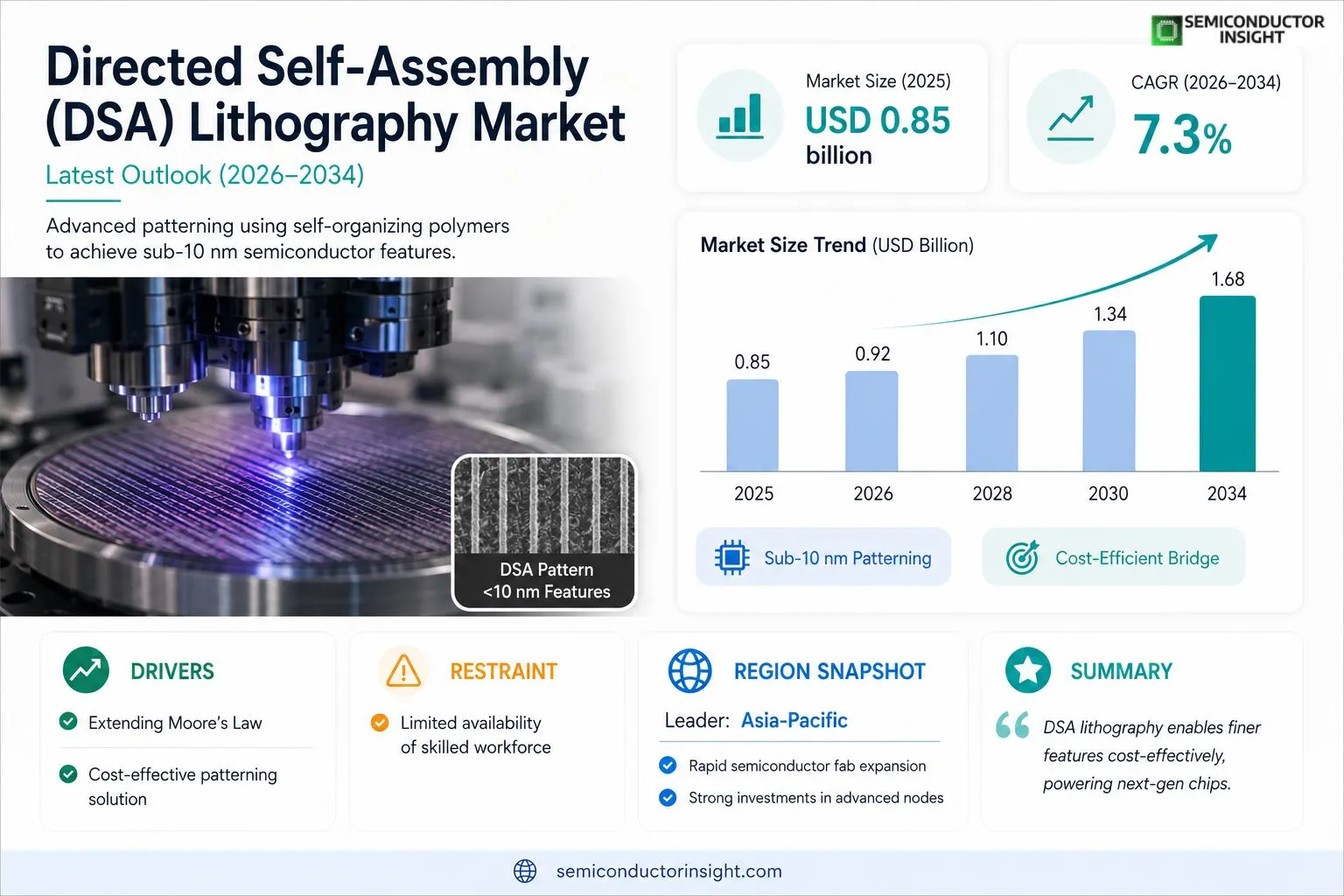
Global DSA lithography market size was valued at USD 0.85 billion in 2025. The market is projected to grow from USD 0.92 billion in 2026 to USD 1.68 billion by 2034, exhibiting a CAGR of 7.3% during the forecast period.
Directed Self-Assembly (DSA) lithography is a semiconductor patterning approach that exploits the self‑organizing properties of block copolymers to generate sub‑10 nm features on silicon wafers. By guiding polymer domains with conventional photo‑defined templates, DSA enables higher resolution without requiring entirely new exposure tools.The market is accelerating because chipmakers are under pressure to extend Moore’s Law while controlling cost; DSA offers a cost‑effective bridge between EUV photolithography and next‑generation patterning solutions. Furthermore, rising investment in advanced node development,particularly for AI accelerators and high‑performance computing,drives demand for finer pitch technologies. Collaborations such as ASML’s partnership with imec on pilot production lines, and Intel’s recent adoption of DSA for its 7 nm process, illustrate how leading players are de‑risking the technology and expanding its commercial footprint.
MARKET DRIVERS
Technological Advancements in Patterning
Directed Self-Assembly (DSA) Lithography Market is propelled by breakthroughs that enable sub‑10 nm pattern fidelity without the need for ever‑smaller optical wavelengths. Recent polymer chemistry innovations allow precise line‑edge roughness control, making DSA a viable complement to extreme ultraviolet (EUV) lithography for the most demanding semiconductor nodes.
Cost Efficiency and Yield Improvement
By reducing the number of required exposure steps, DSA lowers mask‑making expenses by an estimated 30‑40 % and improves wafer‑level yield through defect‑mitigation mechanisms intrinsic to self‑assembly processes. Manufacturers report significant reductions in cycle time, which directly enhances profitability.
➤ “DSA provides a pragmatic route to extend Moore’s Law while maintaining cost targets for high‑volume production.”
These drivers collectively encourage major foundries to integrate DSA into their process portfolios, positioning the market for steady expansion over the next decade.
MARKET CHALLENGES
Integration with Existing Lithography Platforms
Adapting DSA workflows to current EUV or deep‑ultraviolet (DUV) lines demands precise overlay control and new metrology standards. The transition period can introduce production delays, and equipment retrofits often require substantial capital outlays.
Other Challenges
Process Complexity
The self‑assembly step introduces additional variables such as polymer brush uniformity and annealing temperature uniformity, which must be tightly managed to avoid pattern defects.
MARKET RESTRAINTS
Limited Availability of Qualified Workforce
Successful DSA implementation relies on expertise in polymer science, advanced process integration, and nanoscale metrology. The current talent pool is constrained, leading to longer training cycles and higher staffing costs, which can restrain rapid market adoption.
MARKET OPPORTUNITIES
Emergence of Advanced Node Roadmaps
As the semiconductor industry targets 3 nm and beyond, DSA offers a scalable solution for patterning dense features without relying solely on next‑generation EUV tools. Partnerships between equipment vendors and material suppliers are creating new service models, opening revenue streams for both hardware and consumables within Directed Self-Assembly (DSA) Lithography Market.
Directed Self-Assembly (DSA) Lithography Market Trends
Cost‑Effective Bridge to Sub‑10 nm Nodes
Chip manufacturers are confronting the dual pressure of extending Moore’s Law while restraining capital expenditures. Directed Self-Assembly (DSA) Lithography Market is gaining traction as a pragmatic bridge between extreme‑ultraviolet (EUV) photolithography and emerging patterning techniques. By leveraging block‑copolymer self‑organization, DSA delivers sub‑10 nm feature control without requiring entirely new exposure equipment, thereby preserving existing line‑cost structures. In practice, fabs can introduce DSA modules on existing scanner lines, reducing the need for separate, high‑cost EUV tools while still meeting tighter pitch requirements for advanced nodes. The approach also improves pattern density and line‑edge roughness, which translates into higher yields for critical layers such as gate stacks and interconnects.
Other Trends
Strategic Partnerships and Pilot Lines
Major equipment vendors and research institutes are forming joint pilot programs to validate production‑ready DSA flows. Notable examples include a collaboration between a leading lithography supplier and a European research center to operate a pilot line that integrates DSA modules into the 7 nm node workflow. The pilot line processes silicon wafers using guided block‑copolymer patterns and reports defect densities that meet the acceptance criteria of high‑volume manufacturing. Additional partnerships involve semiconductor foundries teaming with materials specialists to co‑develop polymer chemistries that enable finer line spacing and more robust overlay control. These alliances accelerate technology transfer, shorten qualification timelines, and reduce the perceived risk for early adopters willing to transition to DSA‑assisted patterning.
Adoption for High‑Performance Computing and AI Accelerators
Demand for higher transistor density in AI accelerators and high‑performance computing (HPC) systems is prompting chip designers to explore DSA as a complementary patterning solution. The ability to achieve tighter pitch and reduced line‑edge roughness aligns with the performance targets of next‑generation processors, making DSA an attractive option for customers seeking incremental performance gains without a full EUV transition. Early adopters report that DSA‑enhanced layers contribute to lower power consumption per operation, a key metric for AI workloads. Moreover, the technique facilitates the creation of novel device architectures, such as gate‑all‑around (GAA) transistors, where precise nanoscale patterning is essential. As the ecosystem matures, Directed Self-Assembly (DSA) Lithography Market is expected to expand its footprint across back‑end-of‑line (BEOL) processes, supporting advanced interconnect schemes required by future HPC platforms.
COMPETITIVE LANDSCAPEKey Industry Players
Directed Self-Assembly (DSA) Lithography Market Competitive Overview
ASML remains the dominant enabler in the DSA lithography ecosystem, leveraging its advanced exposure tools and strategic partnership with imec to accelerate pilot production lines. Intel’s early adoption of DSA for its 7 nm node underscores the technology’s relevance for leading‑edge chipmakers, while Samsung and TSMC are integrating DSA modules into their high‑volume manufacturing pipelines to bridge the gap between EUV and sub‑10 nm patterning. These marquee players shape market structure through substantial R&D spend, IP licensing, and ecosystem collaborations that define supply‑chain standards.Beyond the tier‑one fabs, a cohort of specialized firms drives niche innovation. Licensed block‑copolymer suppliers such as NIST‑spin‑off Polymerix, Inpria, and Nanomix provide tailored polymer chemistries. Process equipment vendors like Lam Research and Tokyo Electron offer DSA‑compatible etch and deposition solutions. Emerging players including Catalysis Materials, Kayaku Advanced Materials, and NanoScale Technologies are expanding the portfolio of directed‑assembly resists and metrology tools, positioning themselves as critical contributors to the market’s diversification.
List of Key Directed Self-Assembly (DSA) Lithography Companies Profiled
- ASML
- Inpria
- Samsung Electronics
- Lam Research
- TSMC
- Tokyo Electron
- Nanomix
- Catalysis Materials
- Kayaku Advanced Materials
- NanoScale Technologies
- Polymerix
- Intel Corporation
- Imec (research consortium)
- Advanced Micro Devices (AMD)
- GlobalFoundries
Segment Analysis:
| Segment Category | Sub-Segments | Key Insights |
| By Type |
|
Block Copolymer DSA
|
| By Application |
|
Logic Devices
|
| By End User |
|
Semiconductor Foundries
|
| By Integration Stage |
|
In‑Line Patterning
|
| By Value‑Chain Role |
|
Materials Suppliers
|
Regional Analysis: North America
United States
Directed Self-Assembly (DSA) Lithography Market in the United States is characterized by intense competition among established players and emerging startups. Strategic collaborations and technological advancements are key factors influencing market dynamics. The increasing complexity of microchip designs necessitates continuous innovation in DSA techniques to meet the evolving demands of the semiconductor industry.
Ongoing research and development efforts in the United States are focused on enhancing the resolution, precision, and scalability of DSA lithography processes. Innovations in materials science and process optimization are contributing to the development of more efficient and cost-effective DSA solutions, further driving market expansion.
Government funding and support for semiconductor manufacturing and advanced technologies play a crucial role in fostering the growth of Directed Self-Assembly (DSA) Lithography Market in the United States. Initiatives aimed at bolstering domestic chip production and technological leadership are expected to further stimulate market demand.
The competitive landscape in the United States is marked by a mix of established semiconductor equipment manufacturers and specialized DSA technology providers. The focus is on delivering high-performance, reliable DSA solutions to meet the stringent requirements of the advanced packaging and microfabrication sectors.
Europe
The European Directed Self-Assembly (DSA) Lithography Market is experiencing steady growth, driven by strong demand from the automotive, aerospace, and industrial sectors. While not as dominant as the United States, Europe possesses a strong foundation in materials science and chemical engineering, which are integral to DSA technology. Key players are focusing on developing tailored DSA solutions for niche applications, particularly in areas requiring high precision and customized microstructures. Collaboration between European research institutions and industry partners is fostering innovation and accelerating the adoption of DSA techniques. The emphasis on sustainable manufacturing practices is also influencing the development of eco-friendly DSA processes within the region. The market is characterized by a diverse range of players, including specialized equipment suppliers and research-oriented companies. The integration of DSA into advanced manufacturing processes is a key trend shaping the European market.
Asia-Pacific
The Asia-Pacific region, particularly China, Japan, and South Korea, represents a significant and rapidly expanding market for Directed Self-Assembly (DSA) Lithography. The burgeoning electronics industry, coupled with substantial government investments in semiconductor development, is fueling strong demand for advanced lithography techniques. China’s aggressive push to achieve semiconductor self-sufficiency is a major driver of growth in this market. Japan and South Korea continue to invest heavily in R&D and production of sophisticated electronic components, creating a consistent need for high-performance DSA solutions. The region’s strong manufacturing base and cost-competitive labor market are attracting significant investment in DSA-related technologies. The market is characterized by a dynamic competitive landscape with both domestic and international players vying for market share. The focus is on developing DSA technologies for a wide range of applications, including displays, sensors, and advanced packaging.
South America
Directed Self-Assembly (DSA) Lithography Market in South America is currently in its nascent stages, with potential for significant growth in the coming years. The presence of a developing electronics industry, particularly in Brazil and Argentina, is creating a foundational demand for advanced lithography technologies. While the market is characterized by a smaller number of players compared to other regions, there is increasing interest from local manufacturers looking to enhance their production capabilities. Investment in research and development is relatively limited, but collaborations with international technology providers are expected to accelerate the adoption of DSA techniques. The market’s growth trajectory will be closely linked to the broader economic development and industrialization efforts in the region. The focus is on applying DSA solutions in sectors such as consumer electronics, telecommunications, and industrial automation.
Middle East & Africa
Directed Self-Assembly (DSA) Lithography Market in the Middle East & Africa is a relatively small but emerging market. The region’s growing investments in infrastructure development, defense, and consumer electronics are creating a gradual demand for advanced manufacturing technologies. While the adoption of DSA techniques is currently limited, there is potential for growth in specific niche applications. Government initiatives aimed at promoting technological advancement and industrial diversification are expected to stimulate market development. The market is characterized by a limited number of suppliers, primarily focusing on providing standard lithography equipment. The focus is on applying DSA solutions in sectors such as aerospace, medical devices, and telecommunications infrastructure. The long-term growth of the market will depend on broader economic development and investment in high-tech manufacturing capabilities.
Report Scope
This market research report provides a comprehensive analysis of the Directed Self-Assembly (DSA) Lithography Market , covering the forecast period 2026–2034. It offers detailed insights into market dynamics, technological advancements, competitive landscape, and key trends shaping the industry.
Key focus areas of the report include:
- Market Overview: The report begins with an overview outlining its current market scenario, key growth indicators, and industry transformation drivers. It discusses macroeconomic factors, demand–supply balance, regulatory landscape, and the strategic role of semiconductors in powering advancements across industries such as automotive, telecommunications, consumer electronics, and industrial automation.
- Market Size & Forecast: Historical data and future projections for revenue, unit shipments, and market value across major regions and segments.
- Segmentation Analysis: Detailed breakdown by product type, technology, application, and end-user industry to identify high-growth segments and investment opportunities.
- Regional Insights: Insights into market performance across North America, Europe, Asia-Pacific, Latin America, and the Middle East & Africa, including country-level analysis where relevant.
- Competitive Landscape: Profiles of leading market participants, including their product offerings, R&D focus, manufacturing capacity, pricing strategies, and recent developments such as mergers, acquisitions, and partnerships.
- Technology Trends & Innovation: Assessment of emerging technologies, integration of AI/IoT, semiconductor design trends, fabrication techniques, and evolving industry standards.
- Market Drivers & Restraints: Evaluation of factors driving market growth along with challenges, supply chain constraints, regulatory issues, and market-entry barriers.
- Stakeholder Insights: Insights for component suppliers, OEMs, system integrators, investors, and policymakers regarding the evolving ecosystem and strategic opportunities.
Primary and secondary research methods are employed, including interviews with industry experts, data from verified sources, and real-time market intelligence to ensure the accuracy and reliability of the insights presented.
FREQUENTLY ASKED QUESTIONS:
What is the current market size of Directed Self-Assembly (DSA) Lithography Market?
-> Directed Self-Assembly (DSA) Lithography Market was valued at USD 0.85 billion in 2025 and is expected to reach USD 1.68 billion by 2034, reflecting a CAGR of 7.3% over the forecast period.
Which key companies operate in Directed Self-Assembly (DSA) Lithography Market?
-> Key players include ASML, imec, Intel, Samsung, TSMC, among others.
What are the key growth drivers?
-> Key growth drivers include need to extend Moore’s Law, cost‑effective bridge between EUV and next‑generation patterning, rising AI‑accelerator and high‑performance computing node investments.
Which region dominates the market?
-> Asia-Pacific is the fastest‑growing region, while North America remains a dominant market due to strong semiconductor fabs and research investments.
What are the emerging trends?
-> Emerging trends include hybrid EUV‑DSA integration, advanced block‑copolymer chemistries, and AI‑assisted pattern placement for sub‑10 nm nodes.

Get Sample Report PDF for Exclusive Insights
Report Sample Includes
- Table of Contents
- List of Tables & Figures
- Charts, Research Methodology, and more...
 Download Sample Report PDF