Digital Stethoscope MEMS Microphone & DSP Market Insights
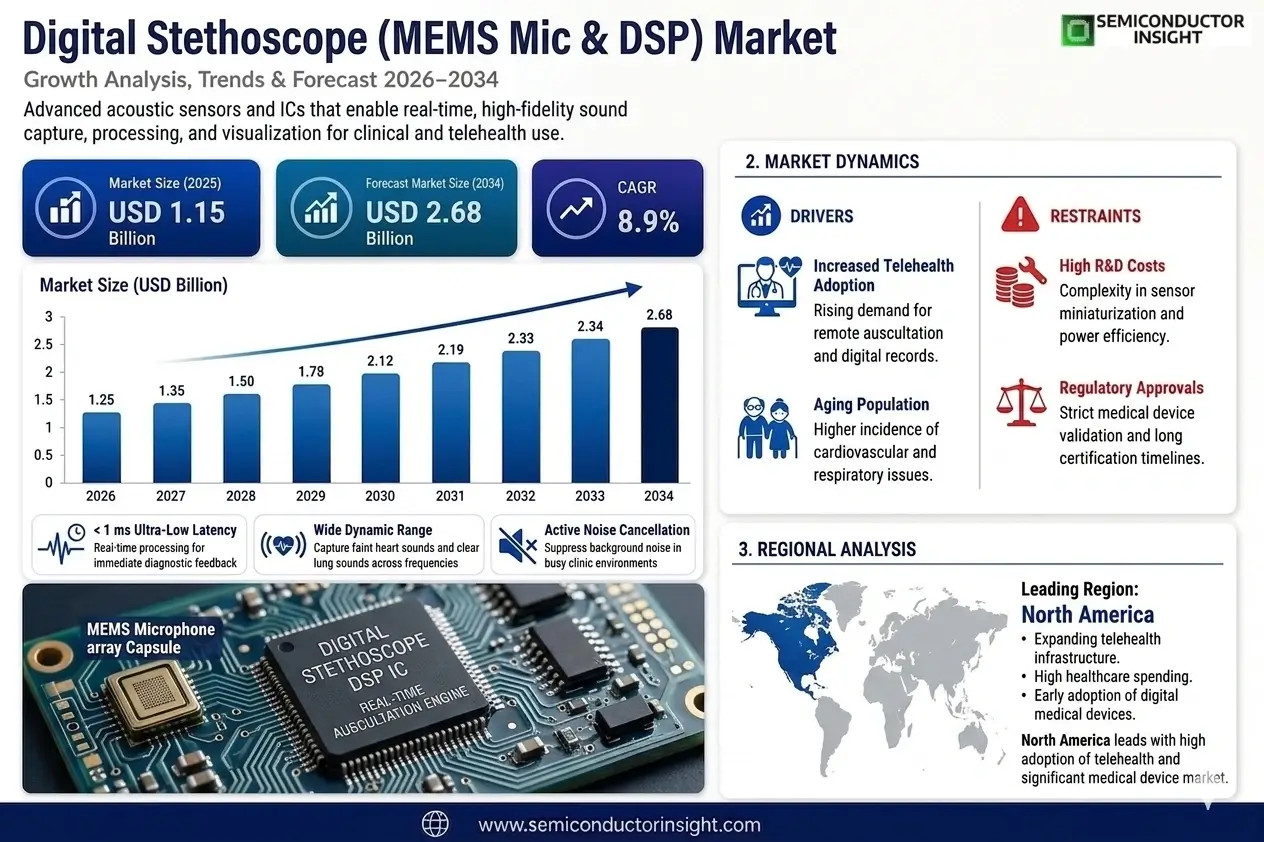
Global Digital Stethoscope MEMS Microphone & DSP Market size was valued at USD 412.6 million in 2025. The market is projected to grow from USD 448.3 million in 2026 to USD 1.02 billion by 2034, exhibiting a CAGR of 9.6% during the forecast period.
Digital stethoscopes integrated with Micro-Electro-Mechanical Systems (MEMS) microphones and Digital Signal Processing (DSP) technology represent a transformative advancement in auscultation-based diagnostics. MEMS microphones deliver superior acoustic sensitivity and miniaturized form factors, while DSP algorithms enable real-time noise filtering, sound amplification, and frequency analysis of cardiac and pulmonary sounds. Together, these components form the core technological foundation of next-generation digital stethoscopes used across clinical, remote, and telehealth settings.
The market is experiencing robust growth driven by the accelerating adoption of digital health technologies, rising prevalence of cardiovascular and respiratory diseases, and the global expansion of telemedicine infrastructure. Furthermore, advancements in MEMS fabrication techniques have significantly improved signal-to-noise ratios, making digital stethoscopes increasingly viable for point-of-care diagnostics. Key industry participants including 3M Littmann, Eko Health, and Thinklabs Medical continue to expand their product portfolios with AI-integrated and Bluetooth-enabled stethoscope solutions, further strengthening market momentum.
MARKET DRIVERS
Rising Adoption of Digital Auscultation Technologies in Modern Healthcare
Digital Stethoscope MEMS Microphone & DSP Market is experiencing robust growth driven by the accelerating shift from analog to digital auscultation platforms across hospitals, clinics, and telehealth environments. MEMS (Micro-Electro-Mechanical Systems) microphones have emerged as the preferred acoustic sensing technology in next-generation digital stethoscopes due to their compact form factor, high signal-to-noise ratio, and consistent frequency response across the clinically relevant 20 Hz to 1,000 Hz range. Healthcare institutions are increasingly prioritizing electronic stethoscopes that integrate Digital Signal Processing (DSP) capabilities to filter ambient noise and amplify cardiac and pulmonary sounds, enabling more accurate auscultation even in noisy clinical environments such as emergency departments and intensive care units.
Expansion of Telemedicine and Remote Patient Monitoring Programs
The global expansion of telemedicine infrastructure has become one of the most significant drivers for Digital Stethoscope MEMS Microphone & DSP Market. Remote patient monitoring programs increasingly require stethoscopes capable of transmitting high-fidelity auscultation data over digital networks, making MEMS microphone integration and onboard DSP algorithms essential design requirements. Clinicians conducting virtual consultations depend on digital stethoscopes to capture clear heart, lung, and bowel sounds that can be recorded, analyzed, and shared in real time. This demand has prompted medical device manufacturers to invest significantly in advanced MEMS transducer designs and AI-assisted DSP firmware that can differentiate between pathological and normal sound patterns, further strengthening the market’s long-term growth trajectory.
➤ The integration of MEMS microphone arrays and adaptive DSP noise cancellation in digital stethoscopes is redefining the standard of care in both point-of-care and remote diagnostic settings, creating sustained procurement demand across developed and emerging healthcare markets.
Additionally, government-backed digital health initiatives and increased investments in healthcare infrastructure modernization across North America, Europe, and Asia-Pacific are creating sustained procurement demand for DSP-enabled digital stethoscope platforms. The growing prevalence of cardiovascular and respiratory diseases worldwide further amplifies the clinical need for precise, interference-free auscultation tools, reinforcing the role of MEMS microphone technology and advanced signal processing as foundational components of the modern digital stethoscope ecosystem.
MARKET CHALLENGES
Technical Complexity in Achieving Clinical-Grade Acoustic Accuracy with MEMS Microphones
One of the foremost challenges facing Digital Stethoscope MEMS Microphone & DSP Market is achieving consistent clinical-grade acoustic fidelity under real-world conditions. While MEMS microphones offer significant size and power advantages over electret condenser alternatives, their sensitivity to mechanical vibration, humidity, and temperature variation can introduce signal artifacts that compromise the accuracy of DSP-processed auscultation data. Manufacturers must invest heavily in acoustic chamber design, sealing techniques, and multi-layer DSP filtering architectures to meet the stringent performance standards required for medical device certification. This engineering complexity increases development costs and time-to-market, representing a persistent barrier particularly for smaller medical device developers seeking to enter the digital stethoscope segment.
Other Challenges
Regulatory Compliance and Medical Device Certification Barriers
Digital stethoscopes incorporating MEMS microphones and DSP modules are subject to rigorous regulatory scrutiny from bodies such as the U.S. FDA, the European CE marking framework, and equivalent national health authorities in Asia-Pacific markets. The classification of AI-assisted DSP features as Software as a Medical Device (SaMD) in certain regulatory jurisdictions adds additional compliance layers, requiring extensive clinical validation studies and post-market surveillance programs that elevate the overall cost and complexity of bringing new Digital Stethoscope MEMS Microphone & DSP solutions to market.
Interoperability and Integration with Electronic Health Record Systems
Healthcare providers increasingly expect digital stethoscopes to integrate seamlessly with Electronic Health Record (EHR) systems, clinical decision support platforms, and telehealth applications. Achieving standardized data interoperability across diverse hospital IT ecosystems remains a significant technical and commercial challenge for MEMS microphone and DSP-enabled stethoscope manufacturers, requiring ongoing investment in software development, API compatibility, and compliance with healthcare data exchange standards such as HL7 FHIR.
MARKET RESTRAINTS
High Device Cost Limiting Adoption in Price-Sensitive Healthcare Markets
The premium pricing of advanced Digital Stethoscope MEMS Microphone & DSP devices relative to conventional acoustic stethoscopes remains a meaningful restraint on market penetration, particularly across low- and middle-income countries and budget-constrained primary care settings. The incorporation of high-performance MEMS microphone arrays, dedicated DSP chipsets, Bluetooth connectivity modules, and companion mobile applications contributes to a significantly higher bill of materials compared to traditional stethoscopes. While the long-term clinical and operational value proposition of digital auscultation is well established, upfront capital expenditure concerns continue to slow adoption among independent practitioners, rural healthcare facilities, and healthcare systems in emerging economies where procurement budgets are tightly constrained.
Limited Clinical Awareness and Training Gaps Among End Users
Despite the technological advancements embedded in modern Digital Stethoscope MEMS Microphone & DSP platforms, a significant portion of clinicians ,particularly those trained on conventional acoustic instruments ,remain unfamiliar with the full capabilities of digital auscultation tools. This knowledge gap leads to underutilization of advanced DSP features such as frequency filtering, sound visualization, and AI-assisted interpretation, diminishing the perceived return on investment for healthcare institutions. The absence of standardized training curricula for digital stethoscope use within medical education programs further compounds this restraint, slowing the rate at which MEMS microphone-based digital stethoscopes displace legacy devices in routine clinical practice.
MARKET OPPORTUNITIES
Integration of AI and Machine Learning Algorithms with DSP-Enabled Digital Stethoscopes
The convergence of artificial intelligence with MEMS microphone and DSP technology in digital stethoscopes represents one of the most transformative opportunities in the market. AI-powered auscultation algorithms trained on large annotated datasets of cardiac and pulmonary sounds can work in tandem with onboard DSP processors to provide real-time diagnostic support, flagging potential murmurs, arrhythmias, or adventitious lung sounds at the point of care. This capability is particularly valuable in primary care and resource-limited settings where specialist access is restricted. Medical device companies that successfully commercialize clinically validated, AI-augmented Digital Stethoscope MEMS Microphone & DSP platforms are well positioned to capture significant market share as healthcare systems seek scalable solutions to address growing diagnostic workload pressures.
Untapped Growth Potential in Emerging Markets and Pediatric Care Segments
Emerging markets across Asia-Pacific, Latin America, the Middle East, and Africa present substantial long-term growth opportunities for Digital Stethoscope MEMS Microphone & DSP Market, driven by expanding healthcare infrastructure investment, rising chronic disease burden, and increasing adoption of digital health technologies. As manufacturing efficiencies improve and component costs for MEMS microphones and DSP chipsets decline through economies of scale, digital stethoscopes are expected to become increasingly accessible to healthcare providers in these regions. Simultaneously, the pediatric care segment ,where acoustic precision and the ability to isolate subtle heart sounds are especially critical ,represents an underserved niche offering targeted product development and market differentiation opportunities for manufacturers focused on purpose-built MEMS microphone and DSP-optimized pediatric auscultation devices.
Trends
Rising Integration of AI and Bluetooth Connectivity Reshaping Digital Stethoscope MEMS Microphone & DSP Market
Digital Stethoscope MEMS Microphone & DSP Market is undergoing a significant transformation as healthcare providers and technology developers converge on smarter, more connected auscultation solutions. A defining trend is the rapid integration of artificial intelligence with MEMS microphone arrays and DSP algorithms, enabling automated detection and classification of cardiac murmurs, arrhythmias, and abnormal lung sounds. Leading companies such as Eko Health and 3M Littmann have introduced AI-assisted stethoscope platforms that deliver real-time diagnostic support to clinicians at the point of care, reducing reliance on specialist referrals and improving early detection rates. Bluetooth-enabled connectivity further allows seamless audio streaming to smartphones, electronic health record systems, and remote care platforms, positioning the digital stethoscope as a central tool within modern digital health ecosystems.
Other Trends
Telehealth Expansion Accelerating Demand for MEMS-Enabled Digital Stethoscopes
The global expansion of telemedicine infrastructure has created a substantial demand for high-performance digital stethoscopes equipped with MEMS microphones and advanced DSP capabilities. As remote patient monitoring becomes a standard component of chronic disease management, particularly for cardiovascular and respiratory conditions, clinicians require devices capable of capturing and transmitting broadcast-quality auscultation audio. MEMS microphones, known for their superior acoustic sensitivity and compact form factor, are increasingly preferred in this context. Their ability to maintain high signal-to-noise ratios across varied clinical environments makes them especially effective in telehealth applications where ambient noise control is critical.
Advancements in MEMS Fabrication Enhancing Signal-to-Noise Performance
Continuous innovation in MEMS fabrication techniques is a key trend shaping Digital Stethoscope MEMS Microphone & DSP Market. Improvements in microfabrication processes have enabled the production of MEMS microphones with enhanced frequency response, lower power consumption, and greater durability. These advances directly translate into stethoscopes capable of detecting subtle cardiac and pulmonary sounds with greater precision. DSP algorithms are simultaneously evolving to complement improved hardware, offering more refined noise cancellation, adaptive filtering, and real-time frequency analysis tailored specifically to clinical auscultation requirements.
Growing Prevalence of Cardiovascular and Respiratory Diseases Sustaining Market Momentum
The increasing global burden of cardiovascular and respiratory diseases continues to drive sustained interest in advanced diagnostic tools within Digital Stethoscope MEMS Microphone & DSP Market. As healthcare systems prioritize early and accurate diagnosis to manage chronic disease outcomes, digital stethoscopes integrated with MEMS microphones and DSP technology are gaining broader adoption across hospitals, outpatient clinics, and home care settings. Key industry participants including Thinklabs Medical are expanding product portfolios to address diverse clinical needs, reinforcing the market’s trajectory toward widespread deployment of next-generation auscultation devices.
COMPETITIVE LANDSCAPEKey Industry Players
Digital Stethoscope MEMS Microphone & DSP Market: Competitive Dynamics and Leading Industry Participants
Global Digital Stethoscope MEMS Microphone & DSP Market is characterized by a moderately consolidated competitive landscape, with a blend of established medical device conglomerates and specialized healthtech innovators vying for market share. 3M Littmann remains one of the most recognized names in the auscultation segment, leveraging its extensive clinical distribution network and brand equity to maintain a dominant position. Eko Health has emerged as a formidable innovator, integrating AI-powered cardiac analysis algorithms with MEMS microphone technology and Bluetooth connectivity to appeal to both hospital-based clinicians and telehealth practitioners. Thinklabs Medical distinguishes itself with its ultra-sensitive electronic stethoscope designs optimized for high-fidelity DSP-driven sound amplification. These leading players are continuously investing in R&D to improve signal-to-noise ratios, miniaturize form factors, and expand compatibility with electronic health record (EHR) platforms, collectively setting the technological benchmark for the broader market.
Beyond the dominant players, the competitive landscape also features several niche yet significant participants contributing to market evolution. Companies such as Welch Allyn (a Hillrom brand, now part of Baxter International) and Cardionics offer clinically validated digital stethoscope solutions targeting specialized care environments including cardiac care units and medical simulation training. Semiconductor and MEMS component suppliers including Knowles Corporation, TDK Corporation (InvenSense), and STMicroelectronics play a pivotal upstream role by providing high-performance MEMS microphone chips and DSP integrated circuits that underpin the product offerings of stethoscope manufacturers. Meanwhile, emerging players such as Stethee (PAC-MED) and CliniCloud are gaining traction in the consumer telehealth segment by offering app-connected stethoscopes with embedded DSP capabilities. The competitive intensity is further heightened by ongoing patent activity around MEMS acoustic sensing and AI-based phonocardiography, compelling both incumbents and new entrants to differentiate through proprietary algorithmic innovations and strategic partnerships with telehealth platforms.
List of Key Digital Stethoscope MEMS Microphone & DSP Companies Profiled
- 3M Littmann (3M Company)
- Eko Health
- Thinklabs Medical
- Welch Allyn (Baxter International)
- Cardionics
- Knowles Corporation
- TDK Corporation (InvenSense)
- STMicroelectronics
- Stethee (PAC-MED Technologies)
- CliniCloud
- Hillrom Holdings (Baxter International)
- American Diagnostics Corporation (ADC)
- Heine Optotechnik
- Riester (Rudolf Riester GmbH)
- Ambisea Technology
Segment Analysis:
| Segment Category | Sub-Segments | Key Insights |
| By Type |
|
Wireless/Bluetooth Digital Stethoscopes represent the leading and fastest-evolving product type within the market, driven by the convergence of MEMS microphone miniaturization and advanced DSP capabilities.
|
| By Application |
|
Cardiac Auscultation holds the dominant position among application segments, underpinned by the rising global prevalence of cardiovascular diseases and the critical need for accurate, real-time heart sound analysis.
|
| By End User |
|
Hospitals & Specialty Clinics constitute the leading end-user segment, serving as the primary adopters of advanced digital stethoscope technologies equipped with MEMS microphones and DSP capabilities.
|
| By Technology |
|
MEMS Microphone-Based Technology leads the technology segment, forming the foundational acoustic sensing layer of modern digital stethoscopes and enabling the miniaturization and performance improvements that define current market offerings.
|
| By Distribution Channel |
|
Direct Sales & OEM Partnerships represent the dominant distribution channel, as leading manufacturers such as 3M Littmann, Eko Health, and Thinklabs Medical leverage direct-to-institution relationships to ensure product customization, post-sale technical support, and integration with clinical IT systems.
|
Regional Analysis: Digital Stethoscope MEMS Microphone & DSP Market
North America
North America leads Digital Stethoscope MEMS Microphone & DSP Market in technological innovation, with a dense concentration of medical device startups and established corporations investing in advanced MEMS sensor miniaturization and AI-enhanced DSP algorithms. This innovation culture ensures continuous improvement in acoustic clarity, enabling clinicians to detect subtle cardiac and pulmonary anomalies with greater precision, reinforcing the region’s market dominance.
The rapid expansion of telehealth services across North America has created exceptional demand for digitally connected stethoscopes embedded with MEMS microphones and DSP capabilities. Healthcare providers increasingly rely on these devices to conduct remote auscultation, enabling cardiologists and general practitioners to assess patients in rural and underserved communities without requiring in-person visits, significantly expanding the addressable market.
The U.S. FDA’s structured yet increasingly streamlined approval processes for Class II medical devices have benefited manufacturers operating in Digital Stethoscope MEMS Microphone & DSP Market. De Novo pathways and 510(k) clearances provide predictable routes to commercialization, encouraging both domestic and international companies to prioritize North American market entry as a strategic first step.
North America’s consistently high per-capita healthcare expenditure supports premium product adoption across hospital networks and private practices. Group purchasing organizations and integrated delivery networks are increasingly evaluating digital stethoscope solutions featuring advanced MEMS and DSP technologies as part of broader digital health transformation initiatives, strengthening long-term procurement pipelines across the region.
Europe
Europe represents a significant and steadily growing market within Digital Stethoscope MEMS Microphone & DSP Market, supported by the region’s strong emphasis on precision medicine, preventive cardiology, and digital health transformation across both Western and Eastern European nations. Germany, France, the United Kingdom, and the Nordic countries are at the forefront of adoption, where national health services and private healthcare institutions are actively investing in advanced diagnostic tools. The European Union’s Medical Device Regulation framework, while demanding, ensures a high standard of product quality and clinical validation, fostering physician confidence in MEMS microphone-integrated digital stethoscopes. Cross-border telemedicine initiatives and EU-funded digital health programs are further catalyzing market penetration. The region’s aging population and elevated prevalence of cardiovascular diseases create persistent clinical demand for highly sensitive, DSP-enabled acoustic diagnostic devices capable of delivering reliable auscultation outcomes in both hospital and community care settings.
Asia-Pacific
The Asia-Pacific region is emerging as the fastest-growing market Digital Stethoscope MEMS Microphone & DSP Market, fueled by rapid healthcare infrastructure development, rising chronic disease burden, and increasing government investment in digital health modernization. China, Japan, South Korea, India, and Australia are among the key contributors, each presenting distinct growth drivers. China’s large-scale hospital expansion programs and domestic medical device manufacturing capabilities are accelerating regional supply chain development. Japan’s technologically sophisticated healthcare environment supports early adoption of advanced MEMS and DSP-integrated stethoscope solutions. India’s growing private healthcare sector and expanding telemedicine ecosystem are creating significant demand for cost-effective yet high-performance digital diagnostic devices. Government initiatives promoting e-health platforms across Southeast Asia are also widening the addressable market, making Asia-Pacific a critical strategic priority for global market participants seeking long-term volume growth.
South America
South America occupies a developing but increasingly relevant position within Digital Stethoscope MEMS Microphone & DSP Market. Brazil and Argentina lead regional adoption, supported by expanding private healthcare networks, rising physician awareness of advanced auscultation technologies, and growing investment in medical device distribution infrastructure. The region faces challenges including economic volatility, currency fluctuations, and fragmented regulatory landscapes across individual nations, which can slow the pace of market penetration for premium digital stethoscope products. Nevertheless, the persistent burden of cardiovascular and respiratory diseases across the continent underscores the genuine clinical need for MEMS microphone and DSP-enhanced diagnostic tools. International manufacturers are responding by developing regionally adapted pricing strategies and forming local distribution partnerships to improve market access. As healthcare systems in Brazil and neighboring countries continue to modernize, South America is expected to represent a progressively meaningful segment of the global market landscape.
Middle East & Africa
The Middle East & Africa region presents a nuanced growth profile within Digital Stethoscope MEMS Microphone & DSP Market, characterized by stark contrasts between high-investment Gulf Cooperation Council nations and resource-constrained sub-Saharan African markets. Countries such as Saudi Arabia, the United Arab Emirates, and Qatar are making substantial investments in advanced healthcare infrastructure as part of broader national diversification and digital health strategies, creating demand for premium medical diagnostic technologies including MEMS-integrated digital stethoscopes. South Africa and select North African markets are also demonstrating growing interest, particularly where private hospital networks and international health organizations are active. Across much of the broader African continent, affordability and infrastructure limitations remain key barriers; however, the expansion of mobile health initiatives and low-cost digital diagnostic programs is gradually improving access. The region’s overall trajectory points toward incremental but meaningful long-term participation Digital Stethoscope MEMS Microphone & DSP Market.
Report Scope
This market research report provides a comprehensive analysis of the Digital Stethoscope MEMS Microphone & DSP Market , covering the forecast period 2026–2034. It offers detailed insights into market dynamics, technological advancements, competitive landscape, and key trends shaping the industry.
Key focus areas of the report include:
- Market Overview: The report begins with an overview outlining its current market scenario, key growth indicators, and industry transformation drivers. It discusses macroeconomic factors, demand–supply balance, regulatory landscape, and the strategic role of semiconductors in powering advancements across industries such as automotive, telecommunications, consumer electronics, and industrial automation.
- Market Size & Forecast: Historical data and future projections for revenue, unit shipments, and market value across major regions and segments.
- Segmentation Analysis: Detailed breakdown by product type, technology, application, and end-user industry to identify high-growth segments and investment opportunities.
- Regional Insights: Insights into market performance across North America, Europe, Asia-Pacific, Latin America, and the Middle East & Africa, including country-level analysis where relevant.
- Competitive Landscape: Profiles of leading market participants, including their product offerings, R&D focus, manufacturing capacity, pricing strategies, and recent developments such as mergers, acquisitions, and partnerships.
- Technology Trends & Innovation: Assessment of emerging technologies, integration of AI/IoT, semiconductor design trends, fabrication techniques, and evolving industry standards.
- Market Drivers & Restraints: Evaluation of factors driving market growth along with challenges, supply chain constraints, regulatory issues, and market-entry barriers.
- Stakeholder Insights: Insights for component suppliers, OEMs, system integrators, investors, and policymakers regarding the evolving ecosystem and strategic opportunities.
Primary and secondary research methods are employed, including interviews with industry experts, data from verified sources, and real-time market intelligence to ensure the accuracy and reliability of the insights presented.
FREQUENTLY ASKED QUESTIONS:
What is the current market size of Digital Stethoscope MEMS Microphone & DSP Market?
-> Global Digital Stethoscope MEMS Microphone & DSP Market size was valued at USD 412.6 million in 2025 and is projected to grow from USD 448.3 million in 2026 to USD 1.02 billion by 2034, exhibiting a CAGR of 9.6% during the forecast period.
Which key companies operate in Digital Stethoscope MEMS Microphone & DSP Market?
-> Key players include 3M Littmann, Eko Health, and Thinklabs Medical, among others, who continue to expand their product portfolios with AI-integrated and Bluetooth-enabled stethoscope solutions.
What are the key growth drivers?
-> Key growth drivers include the accelerating adoption of digital health technologies, rising prevalence of cardiovascular and respiratory diseases, global expansion of telemedicine infrastructure, and advancements in MEMS fabrication techniques that have significantly improved signal-to-noise ratios.
Which region dominates the market?
-> Asia-Pacific is among the fastest-growing regions, driven by expanding healthcare infrastructure and telemedicine adoption, while North America remains a dominant market due to high digital health technology uptake and established clinical infrastructure.
What are the emerging trends?
-> Emerging trends include AI-integrated stethoscope solutions, Bluetooth-enabled wireless connectivity, real-time DSP-based noise filtering and frequency analysis, and the growing use of digital stethoscopes in telehealth and point-of-care diagnostic settings.

Get Sample Report PDF for Exclusive Insights
Report Sample Includes
- Table of Contents
- List of Tables & Figures
- Charts, Research Methodology, and more...
 Download Sample Report PDF