Data Cable Foundry Service Market Insights
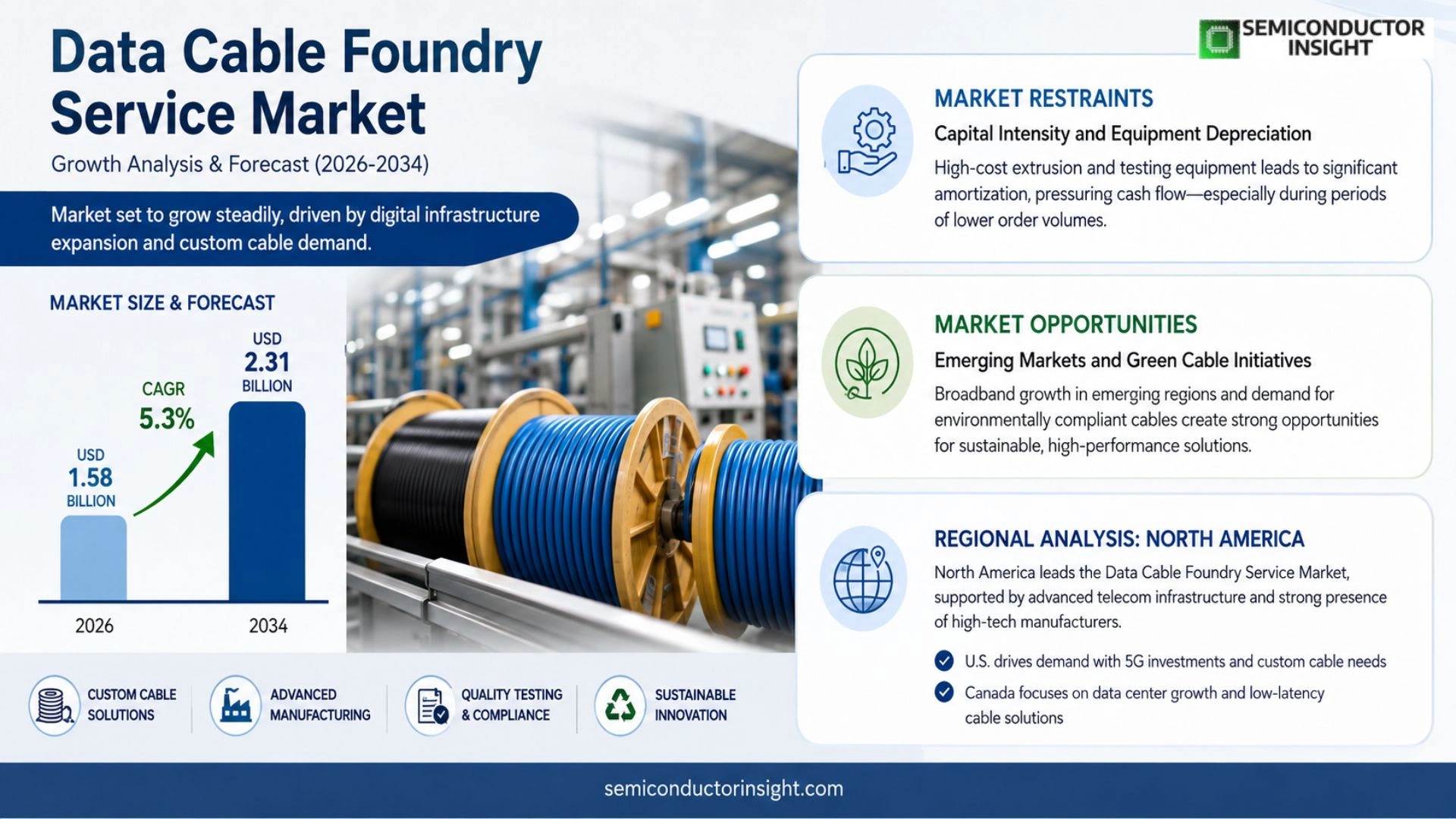
Global Data Cable Foundry Service market size was valued at USD 1.45 billion in 2025. It will expand from USD 1.58 billion in 2026 to USD 2.31 billion by 2034, delivering a compound annual growth rate of approximately 5.3 percent over the period.
Data cable foundry services refer to contract manufacturing of high‑speed copper and fiber‑optic interconnects that enable data transmission within smartphones, tablets, automotive infotainment units and enterprise networking gear.
The surge in bandwidth‑hungry applications,streaming media, cloud gaming and industrial IoT,has prompted original equipment manufacturers to outsource cable production where specialized foundries can meet tighter tolerance requirements and shorten time‑to‑market.
Key industry participants include PYS, DNS, Hon Hai Precision Industry, ZMI, CE‑Link, Hank and JAME among others.
While demand continues upward, firms face challenges such as component shortages and rising raw‑material costs that could temper margin expansion.
MARKET DRIVERS
Growth of Data‑Intensive Applications
The surge in cloud‑based services, artificial‑intelligence workloads, and real‑time analytics has amplified the need for ultra‑reliable data transmission. Enterprises are turning to Data Cable Foundry Service Market to obtain tailor‑made cable assemblies that can sustain higher frequencies and tighter latency budgets than off‑the‑shelf alternatives.
Supply‑Chain Consolidation and Cost Efficiency
Manufacturers are increasingly aggregating design, prototyping, and low‑volume production under a single foundry umbrella. This consolidation trims material waste, shortens engineering cycles, and provides pricing predictability that , especially for telecom roll‑outs , delivers measurable margin improvement.
➤ Clients that partner with an integrated foundry can reduce time‑to‑market by up to 30 % while preserving performance standards.
Beyond the immediate operational gains, the strategic alignment with specialized foundries enables firms to respond swiftly to evolving protocol standards, ensuring that network upgrades remain future‑proof without the burden of re‑engineering core cable infrastructure.
MARKET CHALLENGES
Technical Complexity and Standardization Gaps
Designing high‑density, shielded data cables requires deep expertise in material science and electromagnetic compatibility. The absence of universal standards across emerging 25 Gbps and 50 Gbps link speeds forces customers to rely on bespoke engineering, stretching internal resources and elevating project risk.
Other Challenges
Regulatory Compliance
Stringent environmental directives,such as RoHS and REACH,impose additional testing and certification steps. Failure to meet these requirements can delay shipments and erode customer confidence, particularly in the European and North‑American segments.
Skilled Workforce Shortage
The niche skill set needed for precision cable winding, optical fiber termination, and high‑temperature soldering is limited. Companies that cannot attract or retain such talent face bottlenecks that translate into longer lead times and higher labor rates.
MARKET RESTRAINTS
Capital Intensity and Equipment Depreciation
State‑of‑the‑art extrusion and testing machinery carries multi‑million‑dollar price tags. For players operating on slim margins, the amortization schedule for such assets can constrain cash flow, especially when order volumes dip during off‑peak periods.
MARKET OPPORTUNITIES
Emerging Markets and Green Cable Initiatives
Rapid broadband expansion in Southeast Asia and Sub‑Saharan Africa is unlocking a sizable pipeline of projects that demand locally sourced, environmentally compliant cable solutions. Foundry services that embed recyclable polymers and low‑halogen fire retardants are positioned to capture this upside, as operators prioritize sustainability alongside performance.
Data Cable Foundry Service Market Trends
Increasing Adoption of Pure‑Play Foundry Model
The shift toward a pure‑play foundry model is reshaping how manufacturers source data cable assemblies. Clients are favoring providers that specialize exclusively in high‑volume, standardized cable production, because these specialists can lock in tighter tolerances and shorten lead times. As consumer electronics cycles accelerate, the ability to tap a dedicated supply chain reduces inventory risk and aligns production capacity with volatile demand spikes. This trend is prompting a reallocation of capital from in‑house tooling to outsourced facilities, thereby raising the strategic importance of Data Cable Foundry Service Market for both OEMs and tier‑1 subcontractors.
Other Trends
Regional Consolidation in North America and Asia
Market participants are deepening their footprints in the United States and China, where the bulk of handset and tablet manufacturing remains concentrated. In the United States, service providers are leveraging proximity to major design hubs to offer rapid prototyping, while Chinese foundries benefit from integrated logistics networks that feed vast downstream assemblers. The convergence of these regional strengths is creating a competitive corridor that pressures smaller players to either specialize in niche specifications or merge with larger entities to maintain relevance.
Emergence of Vertical‑Integration Partnerships
Beyond pure‑play arrangements, a parallel movement is seeing data cable founders aligning directly with component manufacturers such as connector and shielding suppliers. These vertical‑integration partnerships allow for co‑development of next‑generation cable standards that meet the bandwidth and durability demands of emerging 5G and IoT devices. By sharing R&D costs and synchronizing production schedules, partners can shorten time‑to‑market and offer bundled cost structures that are difficult for isolated firms to match. For investors, this signals a need to monitor collaborative agreements as a leading indicator of where Data Cable Foundry Service Market will allocate resources in the next product generation.
COMPETITIVE LANDSCAPE
Key Industry Players
Data Cable Foundry Service – Competitive Overview
Hon Hai Precision Industry (Foxconn) remains the most influential contractor in the data‑cable foundry arena, leveraging its massive manufacturing footprint and deep relationships with mobile‑phone OEMs. Its ability to integrate design‑for‑manufacturing (DFM) expertise with high‑volume production gives it a pricing advantage that smaller rivals struggle to match. The firm’s recent investment in automated winding lines has sharpened its response time to shifting client specifications, pushing the overall market toward tighter lead‑times and higher quality thresholds.
Beyond the tier‑one giants, a cohort of specialized firms sustains the ecosystem. PYS and DNS focus on custom‑length solutions for niche tablet manufacturers, while ZMI and CE‑Link have carved out a reputation for high‑speed data‑cable assemblies that meet emerging 5G standards. Companies such as Hank, JAME, Nien Yi, ibroad, and Shensheng Technology provide region‑focused services across Asia and Europe, often partnering with local OEMs to deliver short‑run, value‑added bundles. Their agility enables rapid entry into emerging application segments, including wearables and automotive infotainment, where volume is modest but margins are attractive.
List of Key Data Cable Foundry Service Companies Profiled
- Hon Hai Precision Industry
- PYS
- DNS
- ZMI
- CE‑Link
- Hank
- JAME
- Nien Yi
- ibroad
- Shensheng Technology
- Vention
- Quanta Cable Systems
- FutureLink
- AltiTech
- BlueWave Solutions
Segment Analysis:
| Segment Category | Sub-Segments | Key Insights |
| By Type |
|
Pure Play Model
|
| By Application |
|
Mobile Phone Manufacturers
|
| By End User |
|
Manufacturers
|
| By Service Offering |
|
Production
|
| By Integration Level |
|
Embedded Cables
|
Regional Analysis: Data Cable Foundry Service Market
North America
The region hosts a dense network of foundries equipped with automated winding and extrusion capabilities, allowing firms to scale output without sacrificing precision.
Leading universities and corporate labs collaborate on next‑generation dielectric materials, shortening time‑to‑market for high‑frequency cable designs.
Expansion of cloud‑based services and the rollout of private 5G networks amplify the need for robust, low‑loss cabling across enterprise campuses.
A handful of vertically integrated players dominate, yet emerging boutique foundries carve out space by offering highly customized, low‑volume solutions.
Europe
European markets benefit from stringent electromagnetic‑compatibility directives, which push manufacturers toward premium cable solutions. Nations such as Germany and the United Kingdom leverage deep engineering expertise to develop low‑temperature co‑extrusion processes, catering to sectors like automotive and renewable energy. The region’s focus on sustainability translates into a preference for recyclable sheath materials, prompting foundries to integrate circular‑economy principles into their workflows. While demand remains steady, the emphasis on compliance and environmental stewardship shapes investment priorities for service providers.
Asia‑Pacific
Asia‑Pacific exhibits a rapid transition from volume‑driven production to value‑added services, as Chinese and Indian OEMs seek differentiated cable offerings for burgeoning data‑center landscapes. The rise of smart‑city initiatives across South Korea and Singapore creates a niche for high‑density fiber‑optic bundles, encouraging foundries to invest in precision laser‑cleaving technologies. Labor cost advantages are gradually offset by the need for higher quality assurance, prompting a shift toward automation and certification‑focused operations.
South America
In South America, Brazil leads the conversation, where telecom operators upgrade legacy networks to accommodate growing mobile broadband penetration. Foundry services are adapting by offering modular design kits that allow quick reconfiguration for diverse deployment scenarios, from urban fiber backbones to rural wireless backhaul. Economic volatility has cultivated a risk‑averse clientele that values long‑term service agreements and transparent supply‑chain visibility.
Middle East & Africa
The Middle East’s infrastructure surge, driven by mega‑projects in the Gulf, fuels demand for rugged, heat‑resistant cabling capable of withstanding extreme temperatures. Meanwhile, African markets see incremental adoption as governments prioritize digital inclusion, prompting modest but steady orders for scalable cable assemblies. Service providers highlight remote monitoring capabilities to assure performance across dispersed geographies, positioning themselves as trusted partners in nascent connectivity ecosystems.
Report Scope
This market research report provides a comprehensive analysis of the Data Cable Foundry Service Market , covering the forecast period 2026–2034. It offers detailed insights into market dynamics, technological advancements, competitive landscape, and key trends shaping the industry.
Key focus areas of the report include:
- Market Overview: The report begins with an overview outlining its current market scenario, key growth indicators, and industry transformation drivers. It discusses macroeconomic factors, demand–supply balance, regulatory landscape, and the strategic role of semiconductors in powering advancements across industries such as automotive, telecommunications, consumer electronics, and industrial automation.
- Market Size & Forecast: Historical data and future projections for revenue, unit shipments, and market value across major regions and segments.
- Segmentation Analysis: Detailed breakdown by product type, technology, application, and end-user industry to identify high-growth segments and investment opportunities.
- Regional Insights: Insights into market performance across North America, Europe, Asia-Pacific, Latin America, and the Middle East & Africa, including country-level analysis where relevant.
- Competitive Landscape: Profiles of leading market participants, including their product offerings, R&D focus, manufacturing capacity, pricing strategies, and recent developments such as mergers, acquisitions, and partnerships.
- Technology Trends & Innovation: Assessment of emerging technologies, integration of AI/IoT, semiconductor design trends, fabrication techniques, and evolving industry standards.
- Market Drivers & Restraints: Evaluation of factors driving market growth along with challenges, supply chain constraints, regulatory issues, and market-entry barriers.
- Stakeholder Insights: Insights for component suppliers, OEMs, system integrators, investors, and policymakers regarding the evolving ecosystem and strategic opportunities.
Primary and secondary research methods are employed, including interviews with industry experts, data from verified sources, and real-time market intelligence to ensure the accuracy and reliability of the insights presented.
FREQUENTLY ASKED QUESTIONS:
What is the current market size of Data Cable Foundry Service Market?
-> Data Cable Foundry Service market will expand from USD 1.58 billion in 2026 to USD 2.31 billion by 2034
Which key companies operate in Data Cable Foundry Service Market?
-> Key players include PYS, DNS, Hon Hai Precision Industry, ZMI, CE-Link, Hank, JAME, Nien Yi, ibroad, Shensheng Technology, among others.
What are the key growth drivers?
-> Key growth drivers include increasing demand for data cable solutions, technological advancements, and expansion of mobile and tablet manufacturers.
Which region dominates the market?
-> Asia is a leading region, with significant contributions from China and other Asian economies.
What are the emerging trends?
-> Emerging trends include growth of the Pure Play Model segment, adoption of IDM Model, and diversification into mobile phone and tablet applications.
Get Sample Report PDF for Exclusive Insights
Report Sample Includes
- Table of Contents
- List of Tables & Figures
- Charts, Research Methodology, and more...
 Download Sample Report PDF