
MARKET INSIGHTS
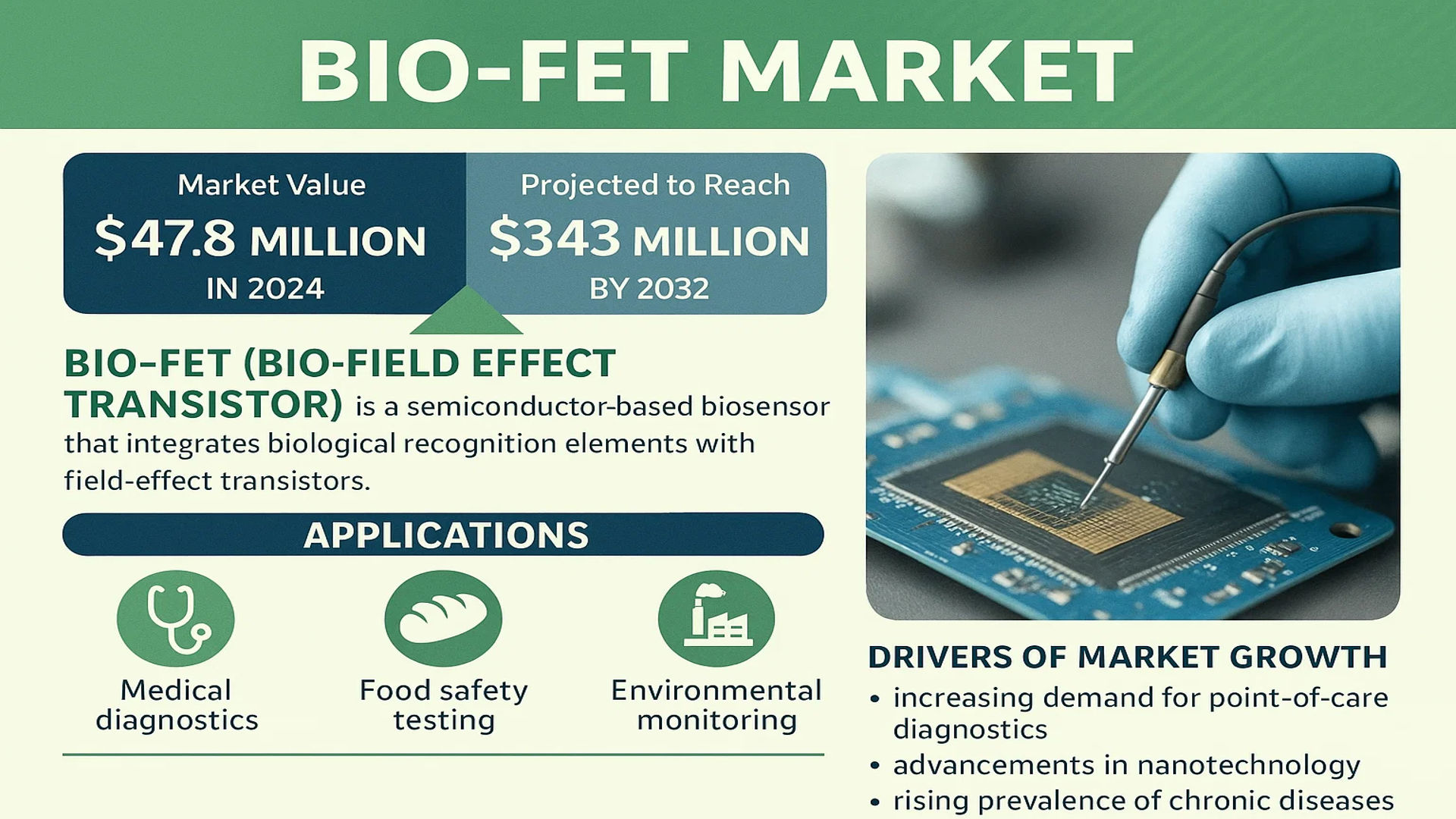
The global Bio-FET Market was valued at 47.8 million in 2024 and is projected to reach US$ 343 million by 2032, at a CAGR of 33.4% during the forecast period.
Bio-FET (Bio-Field Effect Transistor) is a semiconductor-based biosensor that integrates biological recognition elements with field-effect transistors. These devices detect biological interactions by converting them into measurable electrical signals, enabling rapid and sensitive analysis of biomolecules. Bio-FETs are widely used in medical diagnostics, food safety testing, and environmental monitoring due to their high accuracy and real-time detection capabilities.
The market growth is driven by increasing demand for point-of-care diagnostics, advancements in nanotechnology, and the rising prevalence of chronic diseases requiring early detection. However, high production costs and technical complexities pose challenges to widespread adoption. Key players like Imec, Microsens, and Dart Sensors are investing in miniaturization and improved sensitivity to expand applications in personalized medicine and wearable health monitoring.
MARKET DYNAMICS
MARKET DRIVERS
Expanding Applications in Medical Diagnostics Accelerate Bio-FET Adoption
The global Bio-FET market is experiencing robust growth primarily due to its increasing utilization in medical diagnostics. The technology’s ability to provide rapid, label-free detection of biomolecules with high sensitivity makes it invaluable for point-of-care testing. Recent studies indicate that enzymatic Bio-FET biosensors can detect biomarker concentrations as low as 1 pM, enabling early disease diagnosis. The Covid-19 pandemic further underscored the need for rapid diagnostic tools, with Bio-FET-based sensors proving effective for viral detection. Developments in nano-Bio-FET platforms now allow detection limits approaching single molecule sensitivity, creating new possibilities in clinical diagnostics.
Aging Population and Rising Chronic Diseases Fuel Market Expansion
The global increase in geriatric population and corresponding rise in chronic diseases presents a significant growth driver for Bio-FET technology. With over 20% of the population in developed nations projected to be over 65 by 2030, the demand for continuous health monitoring solutions is escalating. Bio-FET sensors enable real-time monitoring of critical biomarkers, particularly valuable for managing conditions like diabetes and cardiovascular diseases. The technology’s compatibility with wearable devices creates opportunities for continuous health tracking, addressing the needs of an aging society while reducing healthcare costs through preventive care approaches.
Technological Advancements in Nanofabrication Propel Market Forward
Breakthroughs in nanofabrication techniques are significantly enhancing Bio-FET performance while reducing production costs. The development of graphene-based Bio-FETs has improved sensitivity by several orders of magnitude compared to conventional silicon-based devices. Recent innovations in 3D nanostructuring and surface functionalization techniques have increased sensor specificity, addressing previous limitations in selective molecular detection. These technological improvements are making Bio-FET solutions increasingly attractive for both research and commercial applications across multiple industries.
MARKET RESTRAINTS
High Development and Manufacturing Costs Limit Market Penetration
Despite promising applications, Bio-FET technology faces significant cost-related barriers that hinder widespread adoption. The specialized materials and cleanroom facilities required for fabrication contribute to high production expenses. Current manufacturing yields remain below 70% for many Bio-FET designs, driving up unit costs. This economic challenge is particularly acute in price-sensitive healthcare markets, where cost-effectiveness is crucial for technology adoption. Without substantial reductions in production costs through scale or process innovations, price sensitivity may constrain market growth in developing regions.
Regulatory Complexity Creates Barriers to Commercialization
The regulatory landscape for medical biosensors presents another major restraint for Bio-FET market expansion. Diagnostic devices incorporating Bio-FET technology must navigate complex approval processes that vary significantly across regions. For medical applications, stringent clinical validation requirements can add years to product development cycles and increase costs by 30-40%. The lack of standardized testing protocols specifically for Bio-FET-based diagnostics further complicates regulatory strategies, creating uncertainty for manufacturers and investors alike.
MARKET CHALLENGES
Technical Hurdles in Selectivity and Stability Impede Progress
Bio-FET technology continues to grapple with fundamental technical challenges that affect real-world performance. Non-specific binding remains a persistent issue, with current biosensors showing cross-reactivity rates as high as 15-20% in complex biological matrices. Sensor drift over time, caused by degradation of biorecognition elements, limits operational stability to typically 2-4 weeks for many designs. These technical limitations constrain the technology’s reliability for critical applications such as continuous patient monitoring or standardized diagnostic testing.
Integration Challenges with Existing Healthcare Infrastructure
The successful deployment of Bio-FET solutions faces obstacles related to compatibility with established healthcare systems. Many current medical workflows and electronic health record systems lack native support for Bio-FET-generated data formats. Interoperability standards for biosensor outputs remain underdeveloped, creating integration challenges that can delay clinical adoption. Furthermore, the need for specialized data interpretation in some Bio-FET applications requires additional training for healthcare professionals, adding implementation costs and slowing acceptance rates.
MARKET OPPORTUNITIES
Emerging Applications in Agri-Food Sector Present Growth Potential
The agricultural and food industries represent significant untapped opportunities for Bio-FET technology. Applications in food safety monitoring, such as pathogen detection and pesticide residue analysis, are gaining traction as regulatory standards tighten globally. Bio-FET sensors capable of detecting contaminants at parts-per-billion levels could transform quality control processes throughout the food supply chain. The development of ruggedized field-deployable Bio-FET systems could enable real-time monitoring in agricultural settings, appealing to the precision farming market projected to exceed $12 billion by 2026.
Advancements in Environmental Monitoring Open New Markets
Environmental applications are emerging as a promising growth area for Bio-FET technology. The ability to detect heavy metals,organic pollutants, and biological contaminants in water sources addresses critical needs in environmental protection. Recent developments in self-powered Bio-FET systems enhance their suitability for remote monitoring applications. The integration of Bio-FET arrays with wireless IoT networks creates opportunities for comprehensive environmental sensing networks, particularly in industrial and municipal water management applications where real-time data is increasingly valued.
Strategic Collaborations Accelerate Commercialization Efforts
The Bio-FET market is witnessing increased collaboration between academic institutions, technology firms, and healthcare providers to accelerate commercialization. These partnerships are addressing key challenges through shared R&D investments and complementary expertise. Established semiconductor companies bringing manufacturing scale capabilities to Bio-FET production could dramatically reduce costs and improve consistency. Recent alliance formations focusing on specific applications like continuous glucose monitoring and infectious disease detection demonstrate the potential for strategic collaborations to unlock new market segments.
BIO-FET MARKET TRENDS
Rising Demand for Point-of-Care Diagnostics Spurs Bio-FET Adoption
The Bio-FET market is experiencing significant growth due to increasing demand for rapid and accurate point-of-care diagnostics, particularly in healthcare settings. With the global emphasis on early disease detection, Bio-FET biosensors have emerged as critical tools for detecting biomarkers associated with diseases such as cancer, diabetes, and infectious pathogens. The market, valued at 47.8 million in 2024, is projected to grow at a CAGR of 33.4% through 2032, reaching an estimated 343 million. This surge is fueled by advancements in semiconductor technology, which have enhanced the sensitivity and specificity of Bio-FET devices, enabling their use in complex biological environments. Furthermore, the COVID-19 pandemic has underscored the need for portable diagnostic tools, accelerating research and commercialization efforts in the sector.
Other Trends
Integration With AI and IoT for Smart Diagnostics
Another key trend shaping the Bio-FET market is the integration of artificial intelligence (AI) and the Internet of Things (IoT) to improve real-time data analysis and remote monitoring. AI-driven Bio-FET platforms can detect subtle changes in biological signals with higher precision, making them invaluable for personalized medicine applications. IoT-enabled biosensors allow seamless data transmission to healthcare providers, facilitating timely interventions. This convergence of biotechnology and digital health solutions is expected to revolutionize chronic disease management, particularly in cardiology and oncology, where continuous monitoring is essential.
Expansion in Environmental and Food Safety Applications
Beyond healthcare, the Bio-FET market is expanding into environmental monitoring and food safety due to increasing regulatory scrutiny and consumer demand for quality assurance. Bio-FET sensors are being deployed to detect contaminants, such as heavy metals and pesticides, in water and agricultural products. Their ability to provide rapid, on-site assessments without extensive laboratory infrastructure makes them ideal for compliance testing in industries like food processing and wastewater management. While technical challenges, such as signal drift in complex matrices, persist, ongoing R&D in nanomaterials and surface functionalization is expected to broaden their application scope.
COMPETITIVE LANDSCAPE
Key Industry Players
Innovation and Strategic Expansion Drive Competition in Bio-FET Market
The global Bio-FET market features a dynamic competitive landscape characterized by a mix of semiconductor leaders and biosensor specialists. The market witnessed a valuation of $47.8 million in 2024, and projections indicate robust growth to $343 million by 2032, driven by increasing demand for rapid medical diagnostics. Leading companies are capitalizing on this growth through technological advancements, partnerships, and market expansion strategies.
Imec (Belgium) stands out as a pioneer in nanotechnology, leveraging its expertise in semiconductor fabrication to develop high-precision Bio-FET sensors. The company’s collaborations with academic institutions and healthcare providers have solidified its position as an innovation leader in biosensor applications. Meanwhile, Microsens (Switzerland) has gained traction with its proprietary ISFET technology, particularly in pharmaceutical quality control applications.
The market also sees strong participation from emerging players like Wellinq (Netherlands) and Dart Sensors (UK), who are focusing on point-of-care diagnostic solutions. These companies differentiate themselves through miniaturized, cost-effective Bio-FET platforms designed for decentralized testing environments. Their growth reflects the broader industry shift toward portable diagnostic tools.
Investment activity has intensified as established players recognize Bio-FET’s potential. Several companies listed have recently expanded their R&D budgets by 20-30% annually to accelerate product development, particularly for infectious disease detection and oncology applications. This strategic focus positions Bio-FET technology as a critical component in the future of precision medicine.
List of Key Bio-FET Technology Companies
- Imec (Belgium)
- I-GEST (France)
- Microsens (Switzerland)
- Wellinq (Netherlands)
- Dart Sensors (UK)
- Fraunhofer Institute (Germany)
- Biosurfit SA (Portugal)
- Micronit Microtechnologies (Netherlands)
- Silicon Biosystems (Italy)
Segment Analysis:
By Type
ISFET Segment Dominates the Market Due to High Sensitivity in Biomedical Applications
The market is segmented based on type into:
- ISFET (Ion-Sensitive Field-Effect Transistor)
- Subtypes: pH-sensitive, enzyme-based, and others
- DNA-FET
- ImmunoFET
- Others
By Application
Medical Segment Holds Largest Share Due to Rising Demand for Point-of-Care Diagnostics
The market is segmented based on application into:
- Medical
- Subtypes: Disease diagnosis, drug monitoring, and others
- Food safety testing
- Environmental monitoring
- Subtypes: Water quality analysis, air pollution detection, and others
- Others
By End User
Hospitals and Diagnostic Centers Lead Due to Increased Adoption of Biosensor Technologies
The market is segmented based on end user into:
- Hospitals and diagnostic centers
- Research laboratories
- Pharmaceutical companies
- Food processing industries
- Others
By Technology
Label-free Detection Technology Gains Traction for Real-time Monitoring Capabilities
The market is segmented based on technology into:
- Label-free detection
- Optical detection
- Electrochemical detection
- Others
Regional Analysis: Bio-FET Market
North America
North America leads the global Bio-FET market, driven by robust healthcare infrastructure, substantial R&D investments, and a strong focus on point-of-care diagnostics. The U.S. holds the largest share, with government initiatives like the NIH’s $42 billion funding for biomedical research accelerating adoption. The region benefits from advanced semiconductor manufacturing capabilities and collaborations between biotech firms and sensor manufacturers. Challenges include high regulatory hurdles under FDA approvals, but the growing aging population (projected to reach 83 million by 2050) ensures sustained demand for rapid diagnostics. Key applications include glucose monitoring, cancer detection, and infectious disease testing. Companies like Imec and Dart Sensors are actively developing next-gen Bio-FET solutions to capitalize on these opportunities.
Europe
Europe’s Bio-FET market thrives on stringent regulatory frameworks (e.g., EU MDR) and academic-industry partnerships. Countries like Germany and the U.K. are innovation hubs, with research institutions integrating Bio-FETs into lab-on-chip platforms for precision medicine. The region’s emphasis on environmental monitoring also drives demand for portable biosensors. However, high production costs slow commercialization, particularly for small-scale diagnostics firms. Recent projects like Horizon Europe’s €95.5 billion budget for health technologies aim to bridge this gap, fostering scalable Bio-FET applications in sepsis detection and food safety.
Asia-Pacific
The fastest-growing market, Asia-Pacific, is fueled by China’s semiconductor advancements and India’s expanding healthcare access. China dominates with state-backed investments in nanobiosensors, while Japan focuses on robotics-integrated Bio-FETs for elderly care. Local manufacturers prioritize cost-effective ISFET variants for diabetes management, though inconsistent regulatory standards pose challenges. Southeast Asia’s infectious disease burden (e.g., dengue, COVID-19 variants) further stimulates demand for rapid testing, with startups like Wellinq piloting low-cost solutions in Thailand and Indonesia.
South America
A nascent market, South America shows potential through Brazil’s agricultural biosensor applications and Argentina’s biotech startups. Limited investment in semiconductor fabrication restricts local production, but partnerships with North American firms are unlocking portable diagnostic tools for zoonotic diseases. Economic instability and currency fluctuations, however, deter large-scale adoption. The region’s focus remains on affordable, decentralized testing for dengue and Chagas disease.
Middle East & Africa
Growth here is uneven, with Israel and the UAE leading through tech-driven healthcare initiatives. Israel’s strong semiconductor sector supports Bio-FET R&D for military and civilian use, while GCC nations invest in water-quality monitoring. Sub-Saharan Africa faces infrastructural gaps, though mobile health programs are gradually introducing biosensor-based solutions for malaria and HIV detection. The lack of local manufacturing units keeps dependence on imports high, but donor-funded projects are slowly changing the landscape.
Report Scope
This market research report provides a comprehensive analysis of the global Bio-FET market, covering the forecast period 2024–2032. It offers detailed insights into market dynamics, technological advancements, competitive landscape, and key trends shaping the industry.
Key focus areas of the report include:
- Market Size & Forecast: Historical data and future projections for revenue, unit shipments, and market value across major regions and segments. The global Bio-FET market was valued at USD 47.8 million in 2024 and is projected to reach USD 343 million by 2032, growing at a CAGR of 33.4%.
- Segmentation Analysis: Detailed breakdown by product type (ISFET, Others), application (Medical, Food, Environmental Monitoring, Others), and end-user industry to identify high-growth segments and investment opportunities.
- Regional Outlook: Insights into market performance across North America, Europe, Asia-Pacific, Latin America, and the Middle East & Africa, including country-level analysis where relevant.
- Competitive Landscape: Profiles of leading market participants, including their product offerings, R&D focus, manufacturing capacity, pricing strategies, and recent developments such as mergers, acquisitions, and partnerships.
- Technology Trends & Innovation: Assessment of emerging technologies in biosensing, integration of AI/IoT in Bio-FET devices, semiconductor design trends, and evolving industry standards.
- Market Drivers & Restraints: Evaluation of factors driving market growth (aging population, healthcare needs, biotechnology advancements) along with challenges (high production costs, technical complexity).
- Stakeholder Analysis: Insights for component suppliers, OEMs, system integrators, investors, and policymakers regarding the evolving ecosystem and strategic opportunities.
Primary and secondary research methods are employed, including interviews with industry experts, data from verified sources, and real-time market intelligence to ensure the accuracy and reliability of the insights presented.
FREQUENTLY ASKED QUESTIONS:
What is the current market size of Global Bio-FET Market?
-> Bio-FET Market was valued at 47.8 million in 2024 and is projected to reach US$ 343 million by 2032, at a CAGR of 33.4% during the forecast period.
Which key companies operate in Global Bio-FET Market?
-> Key players include Imec, I-GEST, Microsens, Wellinq, and Dart Sensors, among others.
What are the key growth drivers?
-> Key growth drivers include global aging population, increasing healthcare needs, advancements in biotechnology, and expanding applications in medical diagnostics and drug development.
Which region dominates the market?
-> North America currently leads the market, while Asia-Pacific is expected to witness the fastest growth during the forecast period.
What are the emerging trends?
-> Emerging trends include integration of AI in biosensing, miniaturization of Bio-FET devices, and development of point-of-care diagnostic solutions.

Get Sample Report PDF for Exclusive Insights
Report Sample Includes
- Table of Contents
- List of Tables & Figures
- Charts, Research Methodology, and more...
 Download Sample Report PDF





