Biosensors Market Insights
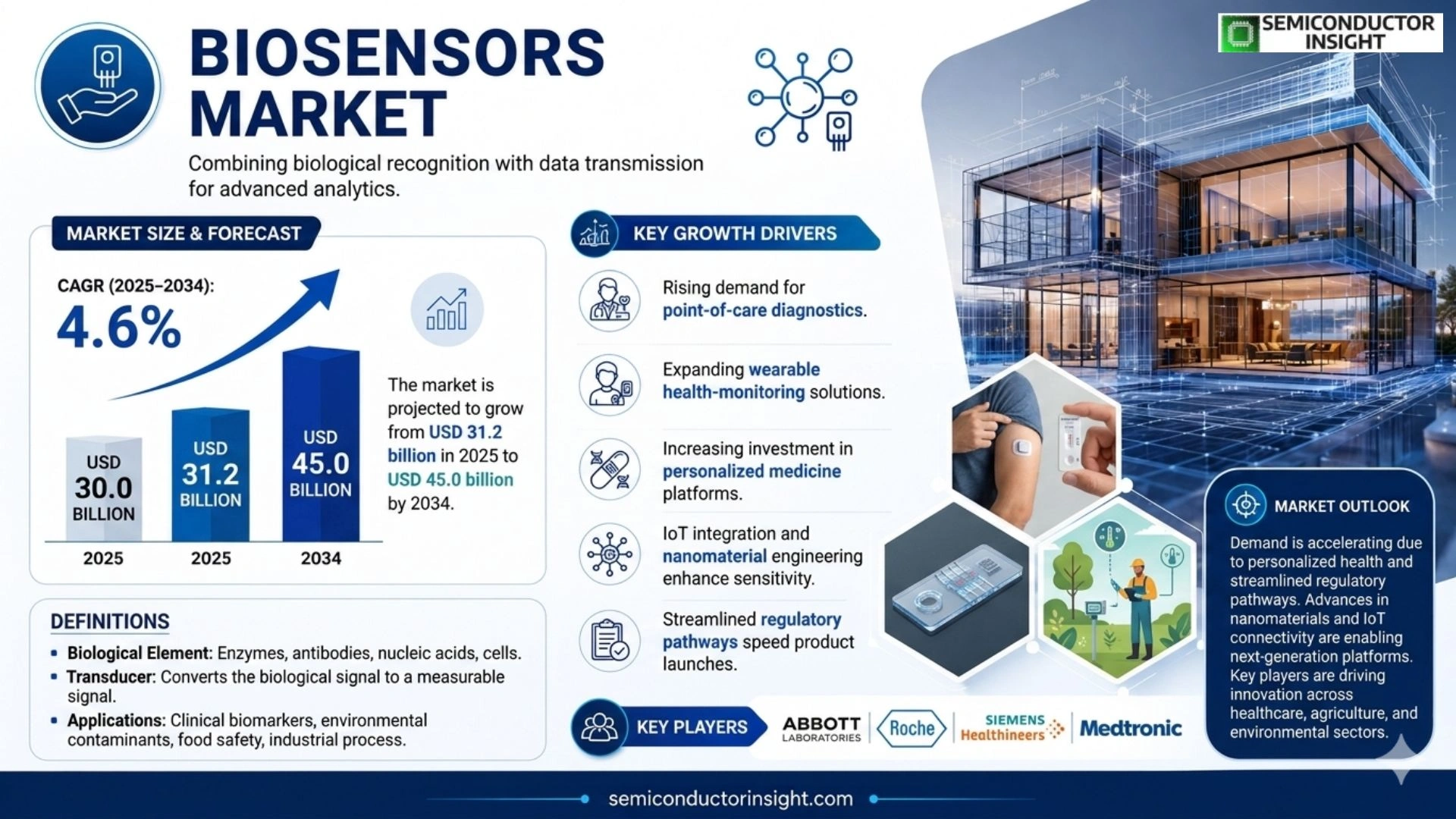
Biosensors Market size was valued at USD 30.0 billion in 2025. The market is projected to grow from USD 31.2 billion in 2025 to USD 45.0 billion by 2034, exhibiting a CAGR of 4.6% during the forecast period.
Biosensors are analytical devices that combine a biological recognition element,such as enzymes, antibodies, nucleic acids or cells,with a physicochemical transducer to generate a measurable signal proportional to the concentration of an analyte. They enable rapid, on‑site detection of clinical biomarkers, environmental contaminants, food safety parameters and industrial process variables.
The market is accelerating because of rising demand for point‑of‑care diagnostics, expanding wearable health‑monitoring solutions, and increasing investment in personalized medicine platforms. Moreover, advances in nanomaterial engineering and Internet‑of‑Things integration are enhancing sensor sensitivity and data connectivity. Key players such as Abbott Laboratories, Roche Diagnostics, Siemens Healthineers and Medtronic are launching next‑generation platforms that further stimulate adoption across healthcare, agriculture and environmental monitoring sectors. Because regulatory pathways are becoming more streamlined worldwide, manufacturers can bring innovative biosensor products to market faster.
MARKET DRIVERS
Growing Demand for Point‑of‑Care Diagnostics
Biosensors Market is being propelled by an increasing need for rapid, on‑site health monitoring. Advances in micro‑fabrication and wireless connectivity enable devices that deliver laboratory‑grade results within minutes, reducing patient turnaround time and health‑care costs.
Expansion of Wearable Health Technologies
Wearable platforms equipped with biochemical sensors are gaining traction in both consumer fitness and clinical monitoring sectors. Continuous glucose, lactate and electrolyte tracking are creating new revenue streams and encouraging investment in sensor miniaturization.
➤ “Innovation cycles in biosensor design have shortened to under 24 months, accelerating market entry and adoption.”
In parallel, regulatory frameworks are adapting to accommodate digital health solutions, providing clearer pathways for approval and fostering confidence among manufacturers and end‑users alike.
MARKET CHALLENGES
Stringent Validation and Certification Requirements
Ensuring analytical accuracy across diverse sample matrices remains a critical hurdle. Companies must invest heavily in clinical trials and comply with evolving standards, which can delay product launches and increase capital outlay.
Other Challenges
Data Security Concerns
The integration of biosensors with cloud platforms raises privacy issues; robust encryption and compliance with health data regulations are essential to maintain user trust.
MARKET RESTRAINTS
High Initial Capital Investment
Developing and scaling biosensor production lines demand substantial upfront spending on precision equipment and clean‑room facilities, which can deter entry for smaller firms.
Additionally, the reliance on proprietary nanomaterials and specialized reagents creates supply‑chain vulnerabilities, especially when demand spikes unexpectedly.
Finally, limited reimbursement frameworks in several regions reduce the economic incentive for healthcare providers to adopt advanced sensor solutions.
MARKET OPPORTUNITIES
Personalized Medicine Applications
Emerging therapeutic strategies increasingly rely on real‑time biomarker feedback, positioning biosensors as essential tools for dose optimization and treatment adherence monitoring.
Moreover, the rise of telehealth services creates a fertile environment for remote patient monitoring, where biosensor data can be seamlessly integrated into virtual care platforms.
Strategic collaborations between sensor manufacturers and pharmaceutical companies are expected to accelerate the development of companion diagnostics, opening new market segments and revenue models.
Biosensors Market Trends
Rise of Point‑of‑Care Diagnostics
The growing demand for rapid, on‑site clinical testing is reshaping Biosensors Market. Health systems worldwide are prioritizing decentralized diagnostics to shorten turnaround times and reduce hospital burden. Recent product launches from major manufacturers feature cartridge‑based platforms that deliver quantitative results within minutes, enabling physicians to make immediate treatment decisions. Adoption is especially strong in emergent care settings, where time‑critical biomarkers such as troponin and D‑dimer drive patient outcomes. The convergence of miniaturized optics, robust enzymatic assays, and cloud‑based reporting is further accelerating deployment across outpatient clinics and remote health units.
Other Trends
Wearable Health‑Monitoring Expansion
Continuous monitoring of physiological parameters has become a cornerstone of preventive care, extending the reach of Biosensors Market into consumer electronics. Advanced flexible substrates now support electrochemical detection of glucose, lactate, and cortisol directly from sweat or interstitial fluid. Integration with smartphones and dedicated health platforms allows real‑time data visualization and algorithm‑driven alerts. Market participants are leveraging partnerships with technology firms to embed sensors into smartwatches and fitness bands, creating a seamless feedback loop for users and clinicians alike. This trend is supported by regulatory incentives that recognize the role of wearable data in chronic disease management, prompting faster approval pathways for validated sensor modules.
Integration of Nanomaterials and IoT Connectivity
Nanomaterial engineering is delivering unprecedented sensitivity, turning previously undetectable analytes into actionable signals. Gold nanoparticles, graphene sheets, and quantum dots are being tailored to amplify transduction mechanisms, reducing detection limits by orders of magnitude. Simultaneously, the Internet‑of‑Things framework is linking biosensor outputs to centralized analytics platforms, facilitating predictive maintenance and large‑scale epidemiological tracking. These capabilities are expanding Biosensors Market beyond traditional healthcare, reaching agricultural monitoring, environmental contamination assessment, and industrial process control. Companies that combine nanotechnological advances with secure data pipelines are positioned to capture premium segments, as clients increasingly demand integrated, end‑to‑end sensing solutions.
COMPETITIVE LANDSCAPE
Key Industry Players
Biosensors Market Competitive Landscape – 2025‑2034 Outlook
Biosensors Market is currently dominated by a handful of large multinational corporations that command both extensive R&D capabilities and global distribution networks. Abbott Laboratories, Roche Diagnostics, Siemens Healthineers, and Medtronic lead the segment with integrated point‑of‑care platforms and wearable glucose monitoring solutions that capture the majority of hospital and consumer sales. Their scale enables rapid iteration of nanomaterial‑enhanced transducers, while regulatory approvals in the U.S., EU and Asia accelerate time‑to‑market. Collectively these leaders account for roughly 55 % of revenue in 2025 and set the technological agenda for the industry, focusing on multiplexed assays, IoT connectivity, and data‑driven analytics.
Beyond the tier‑one innovators, a diverse group of niche players contributes specialized expertise that enriches the ecosystem. Thermo Fisher Scientific and Bio‑Rad Laboratories supply high‑precision laboratory biosensor kits for clinical research, whereas Dexcom and Nova Biomedical focus on continuous glucose monitoring and wearable health‑monitoring devices. Emerging firms such as Illumina’s subsidiary Grail, Becton Dickinson, and Agilent Technologies are leveraging advances in genomics and microfluidics to create next‑generation pathogen detection sensors. Smaller innovators like Sensing Solutions, Philips Healthcare, and Johnson & Johnson’s Ethicon unit target specific verticals,including surgical site monitoring and environmental testing,thereby expanding the market’s application breadth and fostering competitive pressure on product pricing and feature sets.
List of Key Biosensors Companies Profiled
- Abbott Laboratories
- Roche Diagnostics
- Siemens Healthineers
- Medtronic
- Thermo Fisher Scientific
- Bio‑Rad Laboratories
- Dexcom
- Nova Biomedical
- Becton Dickinson
- Agilent Technologies
- Philips Healthcare
- Johnson & Johnson – Ethicon
- Illumina (Grail)
- Sensing Solutions
- Molecular Devices
Segment Analysis:
| Segment Category | Sub-Segments | Key Insights |
| By Type |
|
Electrochemical
|
| By Application |
|
Clinical Diagnostics
|
| By End User |
|
Hospitals & Clinics
|
| By Technology |
|
Nanomaterial‑Enhanced Sensors
|
| By Market Trend |
|
Point‑of‑Care Testing
|
Regional Analysis: North America
Rapid advancements in microfluidics, nanotechnology, and materials science are driving innovation in biosensors, leading to more sensitive, accurate, and cost-effective devices.
Biosensors Market in North America is subject to stringent regulatory frameworks from agencies like the FDA, requiring rigorous testing and approval processes for market entry.
The market is characterized by a mix of established players and emerging startups, fostering healthy competition and innovation in biosensor technologies.
Growing demand for remote patient monitoring, diagnostic testing at the point of care, and personalized healthcare are creating significant opportunities for Biosensors Market growth.
Europe
Europe represents a substantial market for Biosensors, with countries like Germany, the UK, and France leading the way. The strong emphasis on healthcare accessibility and a well-developed research ecosystem contribute to steady market growth. Government initiatives promoting digital health and precision medicine further drive demand for advanced biosensor solutions. The focus on preventative healthcare and early disease detection also plays a key role. Key players in Europe are concentrating on developing innovative biosensors for chronic disease management and wellness applications. The regulatory environment in Europe, particularly the Medical Device Regulation (MDR), necessitates strong quality control and compliance standards. Businesses in this region are emphasizing collaborations with academic institutions and clinical centers to validate biosensor performance and facilitate market adoption.
Asia-Pacific
The Asia-Pacific region, particularly China and Japan, is emerging as a high-growth market for Biosensors. The expanding healthcare infrastructure, rising disposable incomes, and increasing awareness of health issues are key drivers. Government investments in healthcare technology and a growing elderly population further fuel demand. The increasing prevalence of chronic diseases like diabetes and cardiovascular diseases in countries like China presents significant opportunities for biosensors. The market is seeing a rise in the adoption of point-of-care testing and remote patient monitoring solutions. Companies in this region are focusing on developing affordable and accessible biosensor technologies to cater to the large population base.
South America
South America presents a moderate growth opportunity for Biosensors Market. Countries like Brazil and Mexico are witnessing increasing healthcare expenditure and a growing demand for diagnostic solutions. The rising prevalence of chronic diseases and the need for improved healthcare access are key market drivers. The adoption of biosensors is gradually increasing in hospitals and clinical laboratories. Businesses in this region are focusing on establishing distribution networks and partnerships with local healthcare providers to expand market reach.
Middle East & Africa
The Middle East & Africa region represents a nascent market for Biosensors, with significant potential for growth. The increasing healthcare investments, rising awareness of health issues, and a growing population are key drivers. The demand for point-of-care diagnostics and remote patient monitoring solutions is expected to increase in the coming years. The market is relatively fragmented, with opportunities for new entrants and innovative biosensor technologies. Businesses in this region are focusing on addressing the specific healthcare needs of the local population and establishing partnerships with regional healthcare providers.
Report Scope
This market research report provides a comprehensive analysis of the Biosensors Market , covering the forecast period 2026–2034. It offers detailed insights into market dynamics, technological advancements, competitive landscape, and key trends shaping the industry.
Key focus areas of the report include:
- Market Overview: The report begins with an overview outlining its current market scenario, key growth indicators, and industry transformation drivers. It discusses macroeconomic factors, demand–supply balance, regulatory landscape, and the strategic role of semiconductors in powering advancements across industries such as automotive, telecommunications, consumer electronics, and industrial automation.
- Market Size & Forecast: Historical data and future projections for revenue, unit shipments, and market value across major regions and segments.
- Segmentation Analysis: Detailed breakdown by product type, technology, application, and end-user industry to identify high-growth segments and investment opportunities.
- Regional Insights: Insights into market performance across North America, Europe, Asia-Pacific, Latin America, and the Middle East & Africa, including country-level analysis where relevant.
- Competitive Landscape: Profiles of leading market participants, including their product offerings, R&D focus, manufacturing capacity, pricing strategies, and recent developments such as mergers, acquisitions, and partnerships.
- Technology Trends & Innovation: Assessment of emerging technologies, integration of AI/IoT, semiconductor design trends, fabrication techniques, and evolving industry standards.
- Market Drivers & Restraints: Evaluation of factors driving market growth along with challenges, supply chain constraints, regulatory issues, and market-entry barriers.
- Stakeholder Insights: Insights for component suppliers, OEMs, system integrators, investors, and policymakers regarding the evolving ecosystem and strategic opportunities.
Primary and secondary research methods are employed, including interviews with industry experts, data from verified sources, and real‑time market intelligence to ensure the accuracy and reliability of the insights presented.
FREQUENTLY ASKED QUESTIONS:
What is the current market size of Biosensors Market?
-> Biosensors Market was valued at USD 30.0 billion in 2025 and is expected to reach USD 45.0 billion by 2034.
Which key companies operate Biosensors Market?
-> Key players include Abbott Laboratories, Roche Diagnostics, Siemens Healthineers, and Medtronic, among others.
What are the key growth drivers?
-> Key growth drivers include rising demand for point‑of‑care diagnostics, expanding wearable health‑monitoring solutions, increased investment in personalized medicine, advances in nanomaterial engineering, and IoT integration.
Which region dominates the market?
-> The reference does not specify a dominant region.
What are the emerging trends?
-> Emerging trends include rapid on‑site detection of clinical and environmental biomarkers, integration of biosensors with AI/IoT platforms, and the development of nanomaterial‑enhanced sensor architectures.
Get Sample Report PDF for Exclusive Insights
Report Sample Includes
- Table of Contents
- List of Tables & Figures
- Charts, Research Methodology, and more...
 Download Sample Report PDF