Electrochemical Sensor IC Market Insights
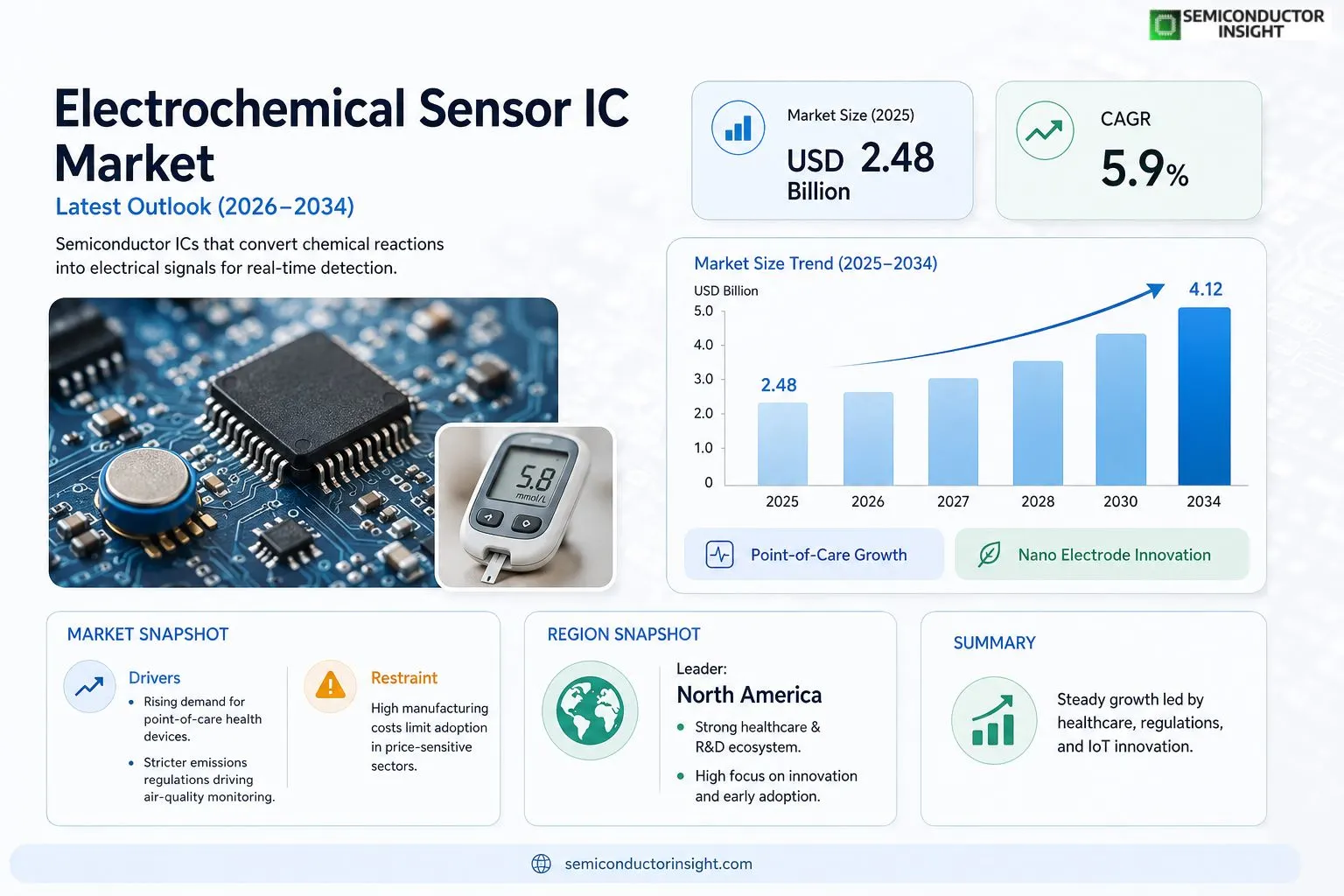
Global electrochemical sensor IC market size was valued at USD 2.48 billion in 2025. The market is projected to grow from USD 3.02 billion in 2026 to USD 4.12 billion by 2034, exhibiting a CAGR of 5.9% during the forecast period.
Electrochemical sensor integrated circuits (ICs) are semiconductor devices that convert chemical reactions into electrical signals for real‑time detection of gases, ions, or biomolecules. These ICs combine transducer elements, signal‑conditioning amplifiers, and digital interfaces on a single chip, enabling compact, low‑power sensing solutions for medical diagnostics, environmental monitoring, and industrial process control.
The market is accelerating because of rising demand for point‑of‑care health devices, stricter emissions regulations driving air‑quality monitoring, and expanding IoT deployments that require reliable on‑chip chemical sensing. Furthermore, advances in nanomaterial electrodes and AI‑enabled data analytics are enhancing sensor performance. Key players such as Texas Instruments, Analog Devices, STMicroelectronics, and Sensirion are investing heavily in R&D and strategic partnerships to broaden their portfolios.
MARKET DRIVERS
Rising demand in healthcare diagnostics
Electrochemical Sensor IC Market is being propelled by a surge in point‑of‑care testing devices, which require compact, low‑power sensor ICs for rapid blood‑glucose and cardiac biomarker analysis. Industry estimates place the global market size at roughly $2.5 billion in 2023, with a projected CAGR of 7 % through 2030, driven largely by aging populations and increased chronic disease prevalence.
Growth in environmental monitoring
Governments worldwide are tightening regulations on air and water quality, creating a robust pipeline of projects that rely on electrochemical sensor ICs for real‑time pollutant detection. The adoption of smart city initiatives further accelerates demand, as municipalities integrate sensor networks to comply with emerging emission standards.
➤ Analysts note that the convergence of healthcare and environmental applications is expanding the addressable market for electrochemical sensor ICs beyond traditional niches.
Strategic partnerships between semiconductor manufacturers and biotech firms are also shaping the landscape, enabling faster time‑to‑market for integrated sensor solutions and reinforcing the upward trajectory of Electrochemical Sensor IC Market.
MARKET CHALLENGES
Regulatory compliance hurdles
Achieving certification for medical and environmental applications demands extensive validation testing, which can extend product development cycles by 12‑18 months and increase costs. These regulatory barriers are particularly pronounced in regions with divergent standards, limiting rapid market entry for new sensor IC designs.
Other Challenges
Supply chain constraints
The reliance on specialty materials such as platinum and palladium for electrode fabrication introduces vulnerability to raw‑material price volatility. Recent disruptions have led to lead times exceeding six months for high‑purity metals, constraining production capacity for emerging sensor platforms.
MARKET RESTRAINTS
High manufacturing costs
Fabricating electrochemical sensor ICs involves complex micromachining steps and stringent cleanliness protocols, resulting in unit costs that are substantially higher than those of conventional digital ICs. This cost premium hampers price‑sensitive adoption in low‑margin sectors.Additionally, the limited availability of foundries equipped to handle electrochemical processes restricts economies of scale, further restraining price competitiveness across broader market segments.
MARKET OPPORTUNITIES
Integration with IoT platforms
The convergence of sensor ICs with Internet‑of‑Things (IoT) connectivity opens new revenue streams, particularly in remote health monitoring and smart infrastructure. Embedding electrochemical sensor ICs into edge devices enables continuous data acquisition, analytics, and predictive maintenance, driving demand for low‑power, highly integrated solutions.Emerging applications in wearable health monitors and consumer wellness devices also present a significant growth avenue. As battery technologies improve and form‑factor constraints relax, manufacturers can deploy ultra‑compact electrochemical sensor ICs to capture real‑time biochemical markers, expanding the market beyond traditional laboratory equipment.
Electrochemical Sensor IC Market Trends
Healthcare Diagnostics Expansion
Electrochemical Sensor IC Market is experiencing a pronounced shift toward point‑of‑care medical devices. Manufacturers are embedding sensor ICs into compact blood‑gas analyzers and portable glucose meters, driven by clinician demand for rapid, on‑site results. Integration of wireless connectivity enables seamless data transfer to electronic health records, reducing turnaround time and supporting telehealth initiatives. These developments are reinforcing the market’s focus on low‑power, high‑precision designs that meet stringent regulatory standards for patient safety.
Other Trends
IoT‑Enabled Environmental Monitoring
Industrial and municipal agencies are leveraging Electrochemical Sensor IC Market to meet tightening emissions regulations. Sensor ICs are being deployed in distributed networks that continuously track pollutant concentrations, leveraging low‑cost, battery‑operated nodes. The ability to relay real‑time data to cloud platforms allows for predictive maintenance of emission control systems and rapid response to exceedances. This trend is further accelerated by the growing adoption of smart‑city frameworks that prioritize air‑quality analytics.
Nanomaterial Electrode Advancements
Advances in nanostructured electrode materials are redefining performance limits within Electrochemical Sensor IC Market. Researchers are exploiting high surface‑area carbon nanofibers and metal‑oxide nanoparticles to achieve faster reaction kinetics and lower detection thresholds for gases and biomolecules. When combined with on‑chip signal‑conditioning amplifiers, these electrodes support ultra‑sensitive detection in applications ranging from wearable health monitors to industrial process control. The resulting improvements in selectivity and stability are prompting major players to file new patents and expand their product portfolios.Artificial intelligence and edge‑computing capabilities are increasingly being integrated with sensor IC platforms. By embedding lightweight inference engines directly on the chip, manufacturers enable immediate interpretation of raw electrochemical signals, reducing the need for external processing hardware. This integration enhances device autonomy, lowers power consumption, and opens pathways for real‑time decision‑making in remote or resource‑constrained environments. Collectively, these technological convergences are shaping a more connected and intelligent landscape for Electrochemical Sensor IC Market.
COMPETITIVE LANDSCAPEKey Industry Players
Electrochemical Sensor IC Market – Competitive Overview
Electrochemical Sensor IC Market is characterized by a few dominant semiconductor firms that command the majority of revenue and drive technology roadmaps. Texas Instruments leads the landscape with a broad portfolio that spans medical point‑of‑care devices, industrial gas monitors, and IoT‑enabled air‑quality solutions. Its deep‑submicron analog front‑ends and extensive design‑in‑silicon services create high entry barriers for newcomers. Analog Devices follows closely, leveraging its precision amplifiers and mixed‑signal expertise to address demanding biomedical applications. STMicroelectronics and Sensirion add significant depth through innovative nanomaterial electrode designs and integrated digital processing, positioning themselves as key suppliers for next‑generation wearable health monitors. Collectively, these leaders shape market standards, secure long‑term OEM contracts, and invest heavily in R&D to sustain a CAGR of nearly 6 % through 2034.Beyond the primary tier, a diverse set of niche players enriches the ecosystem with specialized capabilities. Sensirion’s focus on miniaturized gas‑sensor platforms complements Bosch Sensortec’s automotive‑grade reliability. AMS AG provides high‑performance sensor‑fusion ICs for consumer electronics, while NXP Semiconductors targets secure, low‑power sensor networking. Infineon Technologies and Renesas Electronics contribute robust power‑management and safety features for industrial deployments. ROHM Semiconductor, Maxim Integrated, Silicon Labs, Melexis, and FormFactor round out the competitive field, each delivering unique electrode chemistries, custom ASIC integration, or modular sensor‑interface solutions that cater to emerging niche markets such as environmental monitoring and smart‑city infrastructure.
List of Key Electrochemical Sensor IC Companies Profiled
- Texas Instruments
- Analog Devices
- STMicroelectronics
- Sensirion
- Bosch Sensortec
- AMS AG
- NXP Semiconductors
- Infineon Technologies
- Renesas Electronics
- ROHM Semiconductor
- Maxim Integrated
- Silicon Labs
- Melexis
- FormFactor
- Micron Technology
Segment Analysis:
| Segment Category | Sub-Segments | Key Insights |
| By Type |
|
Amperometric dominates due to its high sensitivity and fast response, making it ideal for medical diagnostics and real‑time gas detection.
|
| By Application |
|
Medical Diagnostics is a primary driver because clinicians demand compact, reliable sensors for blood‑gas analysis and wearable health monitors.
|
| By End User |
|
Healthcare Providers benefit from the integration of electrochemical sensor ICs into bedside monitors and wearable devices.
|
| By Technology |
|
Nanomaterial‑Enhanced Electrodes are reshaping performance expectations.
|
| By Regulation |
|
Emissions Compliance pushes adoption across automotive and industrial sectors.
|
Regional Analysis: North America
North America
The medical diagnostics sector is a primary driver of Electrochemical Sensor IC adoption in North America. The need for accurate and rapid point-of-care testing is escalating, creating substantial opportunities for manufacturers of these specialized ICs.
Growing environmental concerns and stricter regulations are boosting the demand for Electrochemical Sensor ICs used in water quality monitoring and air pollution detection systems across North America.
Industrial applications, including chemical processing and pharmaceutical manufacturing, utilize Electrochemical Sensor ICs for precise monitoring and control of critical parameters, enhancing efficiency and safety.
The food and beverage industry in North America increasingly employs Electrochemical Sensor ICs for quality control, freshness monitoring, and detecting contaminants.
Europe
Europe exhibits a steady growth trajectory in Electrochemical Sensor IC Market. The region’s strong focus on sustainability and technological advancement provides a conducive environment for innovation. Healthcare, environmental monitoring, and industrial automation are key end-use sectors driving demand.
Asia-Pacific
Asia-Pacific is emerging as a high-growth region for Electrochemical Sensor ICs, driven by rapid industrialization and increasing healthcare investments in countries like China and India. The expanding manufacturing sector and growing environmental awareness are further fueling market expansion.
South America
South America represents a moderately growing market for Electrochemical Sensor ICs, primarily driven by the expansion of the healthcare sector and increasing industrial activity in select countries.
Middle East & Africa
The Middle East & Africa region presents a relatively nascent market for Electrochemical Sensor ICs, with potential for growth linked to infrastructure development and healthcare improvements.
Report Scope
This market research report provides a comprehensive analysis of the Electrochemical Sensor IC Market , covering the forecast period 2026–2034. It offers detailed insights into market dynamics, technological advancements, competitive landscape, and key trends shaping the industry.
Key focus areas of the report include:
- Market Overview: The report begins with an overview outlining its current market scenario, key growth indicators, and industry transformation drivers. It discusses macroeconomic factors, demand–supply balance, regulatory landscape, and the strategic role of semiconductors in powering advancements across industries such as automotive, telecommunications, consumer electronics, and industrial automation.
- Market Size & Forecast: Historical data and future projections for revenue, unit shipments, and market value across major regions and segments.
- Segmentation Analysis: Detailed breakdown by product type, technology, application, and end-user industry to identify high-growth segments and investment opportunities.
- Regional Insights: Insights into market performance across North America, Europe, Asia-Pacific, Latin America, and the Middle East & Africa, including country-level analysis where relevant.
- Competitive Landscape: Profiles of leading market participants, including their product offerings, R&D focus, manufacturing capacity, pricing strategies, and recent developments such as mergers, acquisitions, and partnerships.
- Technology Trends & Innovation: Assessment of emerging technologies, integration of AI/IoT, semiconductor design trends, fabrication techniques, and evolving industry standards.
- Market Drivers & Restraints: Evaluation of factors driving market growth along with challenges, supply chain constraints, regulatory issues, and market-entry barriers.
- Stakeholder Insights: Insights for component suppliers, OEMs, system integrators, investors, and policymakers regarding the evolving ecosystem and strategic opportunities.
Primary and secondary research methods are employed, including interviews with industry experts, data from verified sources, and real-time market intelligence to ensure the accuracy and reliability of the insights presented.
FREQUENTLY ASKED QUESTIONS:
What is the current market size of Electrochemical Sensor IC Market?
-> Electrochemical Sensor IC Market was valued at USD 2.48 billion in 2025 and is expected to reach USD 4.12 billion by 2034.
Which key companies operate in Electrochemical Sensor IC Market?
-> Key players include Texas Instruments, Analog Devices, STMicroelectronics, and Sensirion, among others.
What are the key growth drivers?
-> Rising demand for point‑of‑care health devices, stricter emissions regulations driving air‑quality monitoring, expanding IoT deployments, advances in nanomaterial electrodes, and AI‑enabled data analytics.
Which region dominates the market?
-> The reference does not specify a dominant region.
What are the emerging trends?
-> Advancements in nanomaterial electrodes and integration of AI‑enabled data analytics for enhanced sensor performance.
Get Sample Report PDF for Exclusive Insights
Report Sample Includes
- Table of Contents
- List of Tables & Figures
- Charts, Research Methodology, and more...
 Download Sample Report PDF