Key Statistics
Key Takeaways
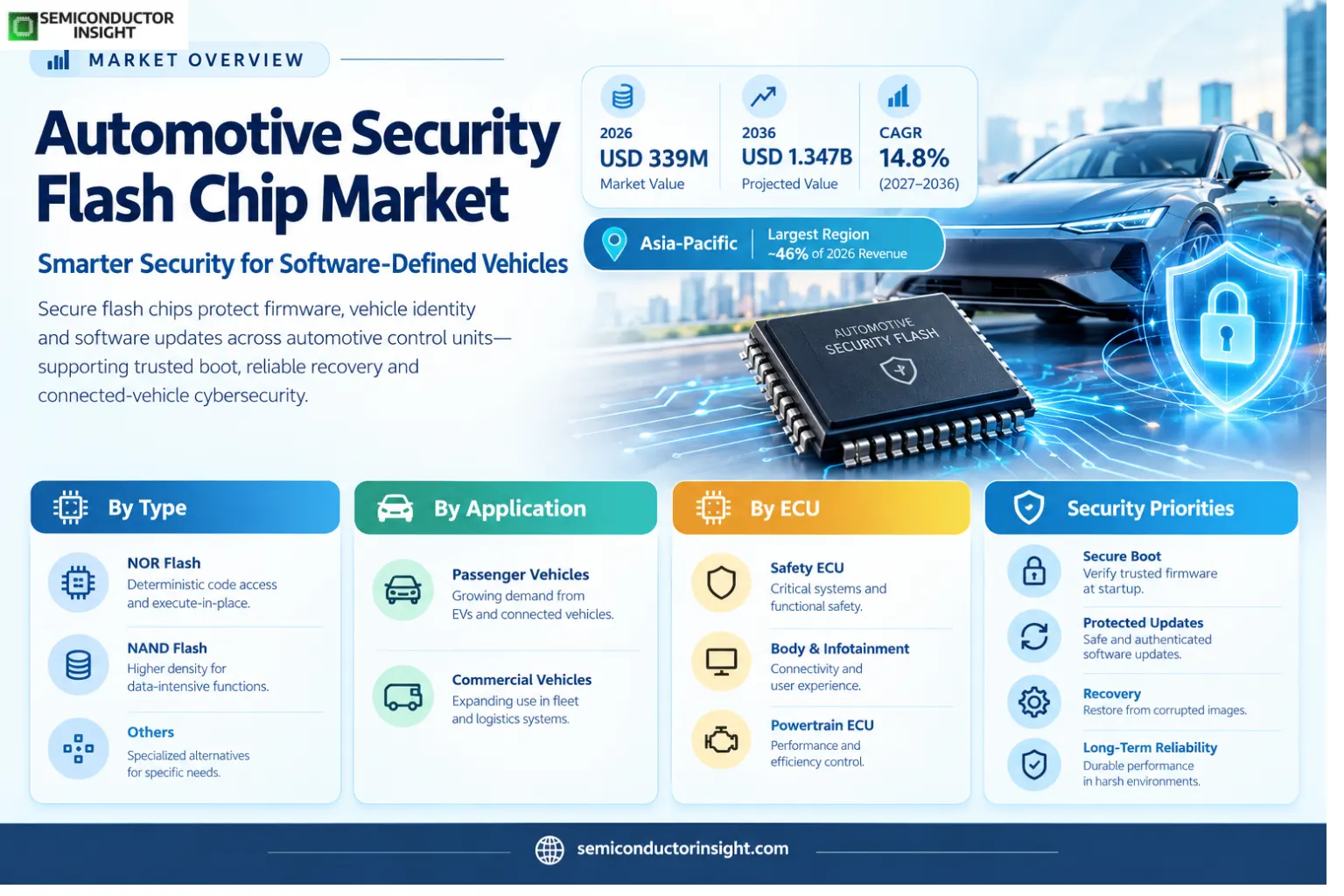
- Market value: The global automotive security flash chip market reaches USD 339 million in 2026 and is projected at USD 1,347 million by 2036, a 14.8% CAGR over 2027–2036, reflecting more vehicle software and authenticated firmware storage.
- NOR Flash: NOR Flash is the largest product type, with an estimated ~61% of 2026 value; NAND Flash accounts for ~32% and grows faster at an estimated ~16.5% CAGR as ADAS and digital-cockpit data volumes rise.
- Passenger vehicles: Passenger Vehicle applications lead at an estimated ~77% of 2026 revenue, while Commercial Vehicle systems represent ~23%; long fleet lifecycles make secure firmware recovery and supplier continuity important to both buyers.
- Asia-Pacific: Asia-Pacific holds an estimated ~46% share in 2026 and grows at an estimated ~16.5% CAGR, supported by 59.2 million vehicles produced in the region during 2025 and broad electrification investment.
- Qualification and cost: Automotive-grade endurance, security provisioning and lifecycle qualification constrain adoption; competing controller-integrated security features and NAND price volatility create pressure on the value captured by standalone memory devices.
Automotive Security Flash Chip Market Overview
Automotive security flash chip market was valued at USD 339 million in 2026 and is projected to reach USD 1,347 million by 2036, registering a CAGR of 14.8% over 2027–2036. Asia-Pacific represented the largest regional market at an estimated ~46% of 2026 revenue, reflecting its concentration of vehicle assembly, electronics sourcing and software-defined vehicle development.
Automotive security flash chips are nonvolatile memory components that preserve executable code, signed firmware images, calibration parameters and protected data across vehicle power cycles. In electronic control units, the relevant functions include authenticated boot, secure firmware replacement, recovery from a corrupted image and restricted access to device identity. The commercial product is the flash component itself, not the full ECU, security controller, cloud cybersecurity subscription or finished vehicle. Serial NOR remains especially useful for deterministic code access and execute-in-place operation, while higher-density NAND serves data-intensive functions.
The revenue boundary includes automotive-qualified NOR and NAND flash devices sold with security-relevant hardware or firmware features, including access protection, secure regions, integrity verification and update safeguards. Ordinary commodity memory without a relevant security role, discrete hardware security modules, microcontrollers with only embedded flash and complete infotainment or ADAS computers are excluded. This distinction prevents the value of an integrated vehicle platform from being attributed to its comparatively small storage component. A vehicle may contain several such memory sockets, but the market measures component revenue rather than vehicle production.
Infineon SEMPER Secure NOR illustrates the intersection of nonvolatile storage and a hardware trust boundary: its architecture combines secure boot, protected storage, a cryptographic engine and error correction with automotive qualification. Microchip SuperFlash emphasizes retention, erase performance and long supply support, while Macronix lists automotive serial NOR with temperature grades extending to 125 degrees Celsius. Those characteristics matter because boot code is frequently read, seldom replaced and expected to remain dependable for the full service life of a vehicle, even through repeated temperature cycles and supply interruptions.
Automotive assembly provides the volume backdrop, although the addressable revenue is a much narrower subset of the semiconductor bill of materials. OICA reported global production of 96.4 million vehicles in 2025, including 59.2 million in Asia-Pacific, while the IEA reported electric-car sales above 20 million during the same year. These figures describe potential deployment bases rather than security flash sales. The market converts vehicle platforms into memory demand when automakers specify authenticated updates, multiple protected images or independently recoverable software partitions for gateways, safety systems and digital cockpits.
Adoption is shaped by vehicle cybersecurity governance as much as memory density. ISO/SAE 21434 organizes cybersecurity engineering across the vehicle lifecycle, UN Regulation No. 155 addresses cybersecurity management for type approval, and UN Regulation No. 156 covers software update management. None of these instruments mandates a specific flash chip; instead, they create an engineering requirement for trustworthy storage and controlled updates. Suppliers that can document secure provisioning, AEC-Q100 qualification, longevity and failure recovery have a stronger path into design wins than devices competing on price alone.
Segment Analysis: By Type
By type, automotive security flash chips comprise NOR Flash, NAND Flash and Others. NOR Flash accounts for an estimated ~61% of 2026 revenue and expands at an estimated ~14.0% CAGR. NAND Flash represents ~32% and is the fastest-growing class at ~16.5% CAGR, while specialized alternatives hold ~7% as designers balance deterministic boot against higher-density data storage.
| Type | Function | Market position |
|---|---|---|
| NOR Flash | NOR devices hold bootloaders, signed code and recovery partitions that must remain readable before the main operating system is available. Their random-access characteristics support execute-in-place operation and predictable startup in gateways, body controllers and safety-related ECU architectures. Automotive-qualified variants commonly emphasize protected sectors, error correction and extended temperature operation rather than consumer storage density. Infineon SEMPER and Microchip SuperFlash provide two different technology approaches, showing how secure storage and reliability can be sold as a qualified component instead of a full processor. | Largest type in 2026 (~61% share; ~14.0% CAGR). NOR dominates the defined security-flash component value because firmware authenticity and startup resilience matter across many low-capacity automotive controllers. Infineon reported automotive SEMPER NOR products from 256 Mb to 2 Gb in its 2025 safety certification announcement, and Macronix lists automotive NOR devices qualified for Grade 1 temperature ranges. Competition centers on verified secure boot, long production availability, low read latency and evidence that the device can recover after a failed or malicious firmware update. |
| NAND Flash | NAND supplies higher-capacity nonvolatile storage for infotainment, ADAS data, telematics and vehicle-compute software images where gigabyte-scale capacity is useful. The security-relevant portion includes managed storage with protected partitions, authenticated firmware handling and reliable health reporting; the entire commodity automotive NAND universe is not counted. Kioxia announced automotive UFS 4.1 samples in July 2025 at 128 GB, 256 GB, 512 GB and 1 TB, illustrating the move toward dense managed storage inside next-generation vehicles. | Fastest-growing type (~32% share; ~16.5% CAGR). NAND gains value where vehicles combine camera processing, digital-cockpit workloads and software updates that exceed the practical density of small NOR devices. Kioxia automotive UFS 4.1 adds diagnostic functions and Grade 2 qualification, but its commercial value depends on integration into an actual automotive system rather than on mobile-device specifications alone. Supplier selection therefore depends on controller firmware, data integrity, temperature qualification and stable software compatibility, not solely on a nominal cost per stored bit. |
| Others | Other protected nonvolatile devices occupy specialized sockets that do not fit conventional serial NOR or managed NAND definitions, including certain embedded secure storage configurations and application-specific memory arrangements. The group is kept narrow to avoid double-counting memory already embedded in a vehicle security microcontroller or external security module. Engineering evaluation focuses on key isolation, update rollback behavior and qualification evidence, because an unusual memory architecture offers little benefit if it complicates the automaker’s cybersecurity case or software lifecycle. | Specialized segment (~7% share; ~13.0% CAGR). The addressable value is limited by the prevalence of integrated security engines in vehicle microcontrollers and by the lower cost of standardized serial NOR interfaces. A separate memory component can nevertheless be attractive when the ECU needs independent firmware recovery, a secondary trust anchor or isolation from the host processor. These designs remain commercially selective and generally require a clear security or serviceability advantage to justify an additional component, interface and validation burden. |
Additional Segmentation: End User
End-user purchasing follows the vehicle electronics supply chain. OEMs specify the trust architecture and approve memory vendors, Tier-1 suppliers purchase many production components for ECUs, and aftermarket channels address limited repair or upgrade requirements. These are separate commercial purchasing lenses, not additional physical memory types; an OEM decision can determine a Tier-1 purchase without creating two units of revenue.
| End User | Members | Commercial role |
|---|---|---|
| End User | OEMs · Tier-1 Suppliers · Aftermarket | OEMs hold an estimated ~60% of value influence through platform specification, while Tier-1 suppliers account for ~33% of direct purchasing relationships and aftermarket channels ~7%. The same physical part is counted once in component sales. Qualification files, long-term supply agreements and key-provisioning responsibilities shape the allocation because automotive security cannot be treated as a spot-market memory purchase. |
Additional Segmentation: Powertrain Type
Powertrain segmentation distinguishes installed security flash across ICE, hybrid and electric vehicles. ICE platforms remain a large production base, hybrids add power-management controllers, and EV platforms increase secure software and battery-management requirements. The same device technology can be designed into all three groups; the differences are software partitioning, lifecycle service and the number of protected ECUs rather than an intrinsic change in flash-cell physics.
| Axis | Members | Commercial role |
|---|---|---|
| Powertrain Type | ICE Vehicles · Hybrid Vehicles · EV Vehicles | ICE Vehicles are the estimated 2026 leader at ~46%, reflecting the large active production base. Hybrid Vehicles contribute ~25%, and EV Vehicles ~29%, with a higher opportunity for secure battery, charging and zonal-compute firmware. These modeled shares apply only to security flash component revenue; they do not claim to reproduce global powertrain production shares or full vehicle semiconductor spending. |
Additional Segmentation: ECU Type
ECU function determines what the memory protects. Safety ECUs prioritize deterministic startup and image integrity, powertrain ECUs emphasize calibrated code and tamper resistance, and body or infotainment systems increasingly manage larger update packages. Suppliers qualify devices against specific temperature, endurance and security requirements because a design that works in a cockpit may not meet the assurance expectations of braking or steering control.
| Axis | Members | Commercial role |
|---|---|---|
| ECU Type | Powertrain ECU · Safety ECU · Body & Infotainment ECU | Safety ECU represents an estimated ~38% of 2026 security-flash value, followed by Body & Infotainment ECU at ~33% and Powertrain ECU at ~29%. The classification follows the destination of the component rather than the automaker that ultimately buys the vehicle. Secure boot and rollback controls are especially relevant in safety systems, while storage capacity and software-update cadence carry greater weight in infotainment. |
Segment Analysis: By Application
Passenger Vehicle applications lead with an estimated ~77% of 2026 revenue and ~15.4% CAGR as connected infotainment, gateway and ADAS systems expand. Commercial Vehicle applications account for ~23% and grow at an estimated ~12.5% CAGR, with fleet telematics, long service intervals and security maintenance influencing purchasing. Fleet operators place particular value on authenticated update recovery because downtime can interrupt vehicle utilization and raise service costs.
| Application | Demand characteristics |
|---|---|
| Passenger Vehicle | Passenger cars and light personal vehicles represent the largest installation base for authenticated firmware and protected nonvolatile code. The same platform may require separate security flash in gateway, digital cockpit, safety and body controllers; the count depends on electronics architecture rather than a fixed number of chips per car. With IEA reporting more than 20 million electric cars sold globally in 2025, vehicle electrification adds new security-relevant control functions, although those vehicle sales are not themselves the memory market denominator. Estimated share ~77% in 2026. |
| Commercial Vehicle | Commercial vehicles emphasize lifecycle service, telematics integrity, fleet authentication and recovery after interrupted software updates. Buses and trucks may remain in operation through multiple firmware generations, making traceability of qualified memory and a reliable rollback image commercially important. The OICA vehicle statistics distinguish commercial-vehicle production from passenger cars; applying the same security-flash spend per unit would overlook differences in fleet communications, service contracts and electronics mix. Estimated share ~23% in 2026, with ~12.5% growth as cybersecurity management extends across vehicle classes. |
Procurement is usually tied to a platform design-in rather than a discrete end-user purchase. Vehicle OEMs determine cybersecurity requirements, Tier-1 electronics suppliers integrate the memory with host processors and boot firmware, and the memory vendor must document qualification and support. A second-source option can reduce supply risk, but changing flash parts may require revalidation of timing, security commands and data-retention behavior. The strongest suppliers therefore compete on documented lifecycle compatibility as well as price.
Regional Analysis
The estimated 2026 regional split is Asia-Pacific ~46%, Europe ~24%, North America ~19%, South America ~6%, and Middle East & Africa ~5%. Asia-Pacific is both the largest and the fastest-growing market at ~16.5% CAGR, reflecting concentrated vehicle assembly and electronics manufacturing; other regions differ in regulation, vehicle mix and component purchasing channels.
Which regions shape secure automotive flash demand and supplier selection?
Automotive security flash demand follows the geographic distribution of vehicle electronics design and assembly, but it cannot be inferred directly from total vehicle output. OICA counted 96.4 million vehicles manufactured worldwide in 2025, with more than 61% produced in Asia-Pacific. The share model assigns an estimated ~46% of component revenue to that region because premium security features and qualified memory can be sourced across several manufacturing hubs. Europe and North America retain substantial value through engineering-led security requirements and sophisticated vehicle software architectures.
For suppliers, the key regional differences concern who controls the design-in decision, how quickly secure firmware features are adopted and which qualification records are accepted. A single memory product may be manufactured in one country, integrated into an ECU in another and installed in a vehicle sold elsewhere. Regional value is therefore attributed to end-use demand rather than fabrication capacity, and estimated growth rates reflect differing uptake of authenticated updates, vehicle electrification and protected code storage.
| Region | Position | Growth outlook | Demand profile | What decides supplier selection |
|---|---|---|---|---|
| Asia-Pacific | Largest (~46% share) | ~16.5% CAGR | High-volume automotive assembly | For Asia-Pacific, the supplier selection decision combines AEC-Q100 evidence, a validated secure-boot implementation, host processor interface compatibility, long-term part availability and the cost of system requalification. Regional vehicle output influences addressable socket counts, but the revenue opportunity is determined by actual platform design wins and the memory security functions specified for the ECU. |
| Europe | Rank 2 (~24% share) | ~13.4% CAGR | Qualified platform design-in and integration | For Europe, the supplier selection decision combines AEC-Q100 evidence, a validated secure-boot implementation, host processor interface compatibility, long-term part availability and the cost of system requalification. Regional vehicle output influences addressable socket counts, but the revenue opportunity is determined by actual platform design wins and the memory security functions specified for the ECU. |
| North America | Rank 3 (~19% share) | ~12.6% CAGR | Qualified platform design-in and integration | For North America, the supplier selection decision combines AEC-Q100 evidence, a validated secure-boot implementation, host processor interface compatibility, long-term part availability and the cost of system requalification. Regional vehicle output influences addressable socket counts, but the revenue opportunity is determined by actual platform design wins and the memory security functions specified for the ECU. |
| South America | Rank 4 (~6% share) | ~14.2% CAGR | Qualified platform design-in and integration | For South America, the supplier selection decision combines AEC-Q100 evidence, a validated secure-boot implementation, host processor interface compatibility, long-term part availability and the cost of system requalification. Regional vehicle output influences addressable socket counts, but the revenue opportunity is determined by actual platform design wins and the memory security functions specified for the ECU. |
| Middle East & Africa | Rank 5 (~5% share) | ~12.5% CAGR | Qualified platform design-in and integration | For Middle East & Africa, the supplier selection decision combines AEC-Q100 evidence, a validated secure-boot implementation, host processor interface compatibility, long-term part availability and the cost of system requalification. Regional vehicle output influences addressable socket counts, but the revenue opportunity is determined by actual platform design wins and the memory security functions specified for the ECU. |
Competitive Landscape
Automotive security flash competition is led by qualified nonvolatile-memory suppliers, while security-controller and vehicle-compute manufacturers influence system design without necessarily supplying the external flash component. Product selection depends on secure boot, memory density, safety evidence, long-term availability and software compatibility. The relevant supplier landscape is more selective than the broad list of semiconductor companies participating in automotive electronics.
Infineon competes through SEMPER Secure NOR and related automotive NOR families that combine security capabilities with error correction and functional-safety documentation. Its May 2025 announcement of ASIL-D certification for SEMPER NOR supports a clear differentiation in safety-related ECU programs. Microchip positions SuperFlash on automotive qualification, retention and fast erase behavior, making it relevant to long-life firmware storage. These approaches address different customer priorities, from cryptographic enforcement to predictable manufacturing and maintenance economics.
Macronix provides automotive serial NOR parts with temperature and protection features, and its August 2025 ArmorBoot MX76 announcement added an explicit secure-boot and update-oriented product. Renesas supplies SPI NOR products used in automotive applications, while ISSI offers automotive-qualified flash and long lifecycle support. Suppliers must establish that a specific part number has the required security functions; a general automotive flash portfolio does not imply every listed device provides independent hardware root-of-trust capabilities.
Kioxia participates in the higher-density managed NAND portion through automotive UFS, including the UFS 4.1 sampling announcement of July 2025. Its products address infotainment, ADAS and vehicle computers where diagnostic capability and data throughput matter. Winbond W77Q provides a useful adjacent secure-flash technology reference, but the particular W77Q-NW family documentation does not establish automotive qualification for every part. This distinction is important when comparing cybersecurity functionality with actual eligibility for automotive production programs.
NXP and STMicroelectronics are important automotive security and controller ecosystem companies, yet a hardware security engine or automotive EEPROM is not automatically an external security flash chip. Micron’s historic automotive NOR portfolio demonstrates established technology and manufacturing expertise, but individual part lifecycle status must be checked before treating it as current supply. Buyers typically require device-specific documentation, second-source planning, secure provisioning and multiyear product-change control before a memory device becomes a production design win.
Tier structure
| Tier | Companies | Basis of competition |
|---|---|---|
| Tier 1 | Infineon Technologies · Microchip Technology · Macronix International | These suppliers have directly identifiable automotive NOR products and substantial technical documentation relevant to secure code storage. Infineon combines automotive secure NOR with explicit security and functional-safety capabilities, Microchip provides automotive SuperFlash memory, and Macronix offers automotive-grade NOR plus its ArmorBoot secure-boot product. Their competitive position depends on qualified device specifications and verified host integration rather than an unsupported percentage ranking of global revenue. |
| Tier 2 | Renesas Electronics · Integrated Silicon Solution (ISSI) · Kioxia | Renesas has automotive SPI NOR offerings, ISSI markets automotive-qualified flash with long-lifecycle support, and Kioxia supplies automotive managed NAND. These portfolios serve distinct memory sockets and should not be treated as technically interchangeable. The strongest differentiation comes from part-specific temperature qualification, secure storage features, device health reporting and compatibility with automotive software-update architectures, including production validation and serviceability after installation. |
| Tier 3 / Adjacent ecosystem | Winbond Electronics · NXP Semiconductors · STMicroelectronics · Micron Technology | Winbond secure flash provides relevant firmware-protection technology but automotive qualification must be confirmed for the selected part. NXP is primarily represented here through automotive hardware security engines, ST through adjacent automotive nonvolatile devices, and Micron through a historical automotive NOR announcement with lifecycle caveats. They remain in the broader profile set without being presented as current direct leaders of this precisely defined secure flash component market. |
Key companies profiled
- Microchip Technology
- NXP Semiconductors
- Infineon Technologies
- STMicroelectronics
- Renesas Electronics
- Kioxia
- Winbond Electronics
- Macronix International
- SK hynix
- Western Digital
- Texas Instruments
- onsemi
- ROHM Semiconductor
- GigaDevice
- Integrated Silicon Solution (ISSI)
Production Capacity Analysis
Automotive security flash supply depends on wafer-fabrication quality, security-feature implementation, package qualification and a stable multiyear product lifecycle. Manufacturing volume for ordinary NOR or NAND cannot be treated as dedicated secure automotive capacity; only qualified device families and their production allocations can serve the market. Secure provisioning and controlled part revisions create additional constraints beyond wafer fabrication throughput.
Nonvolatile memory is fabricated using specialized processes that prioritize cell endurance, retention and controlled variability. The security layer adds protected access regions, hardware cryptographic functions or authenticated update support depending on the device family. Infineon SEMPER Secure NOR and Macronix automotive products illustrate two supplier approaches, while Kioxia managed NAND adds an embedded controller and extensive firmware. Because each product has different wafer, package and qualification requirements, aggregate semiconductor capacity is an unreliable proxy for immediately available automotive secure-flash supply.
Automotive customers frequently expect component availability throughout long vehicle platform lifecycles. ISSI explicitly emphasizes long-term support, stable die revisions and product-change management for automotive embedded memory. Micron’s historical Manassas automotive NOR production shows why process ownership and manufacturing qualification have been important, but an older press release does not prove current output. Sourcing strategies therefore combine manufacturing-location reviews, qualified alternate parts, documented process changes and inventory planning for service requirements after initial vehicle production ends.
Upstream risks include wafer capacity allocation, specialty package availability, test throughput and the cost of requalifying a revised die. Security provisioning creates an additional interface between device manufacturing and the vehicle maker’s key-management process; a memory component cannot be substituted casually once secure boot signatures and update workflows are validated. Customers weigh manufacturing yield, AEC-Q100 evidence, functional-safety documents and recovery behavior alongside unit price, especially for safety-critical ECU programs with high field-recall exposure.
Market Dynamics
The market expands when vehicle software and cybersecurity requirements increase the number or value of protected external flash sockets. Growth is moderated by integrated controller security, long qualification cycles, semiconductor supply constraints and cost pressure. The impact analysis highlights the relative influence of software integrity requirements, component qualification and substitution pressure across the forecast windows.
MARKET DRIVERS
Drivers Impact Analysis*
| Market Drivers | Impact Rank | CAGR Contribution (%) | 2027–2029 | 2030–2032 | 2033–2036 |
|---|---|---|---|---|---|
| Connected vehicle firmware authentication | High | +6.00% | High | High | High |
| Software updates and secure recovery partitions | High | +4.00% | High | High | High |
| ADAS and zonal ECU software complexity | Medium-High | +3.10% | Medium | High | High |
| Automotive cybersecurity engineering requirements | Medium | +2.50% | High | Medium | Medium |
| Electric vehicle controller proliferation | Low-Medium | +1.90% | Medium | High | Medium |
| Others (fleet telematics, secure identity, extended memory qualification) | Low | +1.10% | Low | Medium | Medium |
Connected vehicle authentication
Every externally connected vehicle controller must establish that the code it executes and the credentials it uses have not been modified without authorization. Automotive secure NOR can hold signed firmware and protected identity material, while higher-density storage supports larger vehicle software packages. The growth mechanism is not connectivity alone; it is the additional qualified memory functionality selected by the OEM and Tier-1 supplier when implementing a verifiable chain of trust.
Secure updates and recoverable boot images
UN Regulation No. 156 addresses software update management, and NIST SP 800-193 provides broader principles for protecting, detecting and recovering compromised firmware. Automotive platforms applying these ideas may require an independent golden image, rollback counter or protected boot partition. Suppliers with documented authentication and recovery functions can win higher-value sockets than ordinary commodity flash, provided the host processor and update workflow complete the security architecture.
ADAS and zonal controller software growth
Software-defined vehicles consolidate control functions into powerful gateways and zonal computers while increasing the criticality of trusted startup. NOR can supply predictable boot code, and managed NAND can store larger operating images and diagnostic records. The IEA’s 2026 outlook describes the scale of electric-vehicle adoption, but secure memory value depends on how these new platforms distribute software among controllers and whether external devices are required for recovery.
Cybersecurity engineering and type approval
ISO/SAE 21434 organizes vehicle cybersecurity risk management across design, production, operation and maintenance. UN Regulation No. 155 provides a regulatory framework for vehicle cybersecurity management in applying jurisdictions. Neither mandates a particular memory brand, yet both encourage traceable technical decisions about firmware authenticity, protected storage and update integrity. A qualified secure flash product can make those decisions easier to substantiate through device-specific documentation and validated behavior.
MARKET RESTRAINTS
Restraints Impact Analysis*
| Market Restraints | Impact Rank | CAGR Contribution (%) | 2027–2029 | 2030–2032 | 2033–2036 |
|---|---|---|---|---|---|
| Controller-integrated security and memory substitution | High | -1.40% | High | High | Medium |
| Qualification expense and extended design cycles | Medium-High | -0.90% | High | Medium | Medium |
| Security-enabled device price premium | Medium | -0.80% | High | Medium | Medium |
| Others (supply volatility, software complexity, legacy architecture) | Low | -0.70% | Medium | Medium | Low |
Integration of security into host controllers
Automotive processors increasingly include secure enclaves, hardware security engines and embedded nonvolatile memory. NXP’s S32 hardware security engine illustrates how key management and boot verification can be integrated within a processor platform. When the controller already provides sufficient protected storage and recovery capability, the economic case for an additional secure flash device becomes weaker. External memory remains attractive when density, independent recovery or service separation justifies its cost and interface.
Lengthy automotive qualification cycles
AEC-Q100 testing, functional-safety evidence, security review and system integration can delay adoption well beyond the availability of a commercial memory sample. An automotive platform may require several years of continuity and change-control commitments. Supplier product announcements therefore do not translate immediately into qualified shipment volumes. Customers also must validate interactions between flash commands, boot ROM behavior, host cryptography and interrupted-update recovery under harsh temperature and power conditions.
Price premiums and sourcing pressure
Secure memory incorporates functions that standard flash may not provide, including protected regions, authenticated commands and cryptographic operations. These features add design, test and qualification costs while vehicle programs remain highly sensitive to bill-of-materials targets. NOR and NAND pricing cycles can complicate long-term purchasing negotiations, especially where a product must remain available for years. Buyers may accept a premium only when a security function reduces integration risk or field-service exposure.
Supply continuity and legacy electronics
Legacy ECUs often lack the interfaces or boot firmware needed to exploit a new secure flash architecture. Retrofitting an authenticated memory component can require processor changes, new key provisioning and revised service procedures. ISSI’s long-term-support emphasis reflects the commercial importance of stable embedded-memory supply, while older part-number listings show why lifecycle verification matters. The adoption barrier is therefore both technical and contractual rather than a simple shortage of flash bits.
MARKET OPPORTUNITIES
Independent firmware recovery
Secure flash can preserve a verified recovery image outside the host processor’s ordinary writable storage. That architecture is useful when an over-the-air update fails, power is interrupted or malware changes the main boot image. Infineon SEMPER Secure NOR and Macronix ArmorBoot demonstrate supplier interest in protected boot and update functions. The opportunity depends on automotive software teams adopting independent recovery as a formal platform requirement, rather than relying entirely on internal controller flash.
High-density managed automotive storage
Kioxia’s July 2025 automotive UFS 4.1 sampling announcement shows the move toward capacities from 128 GB to 1 TB for vehicle computers and infotainment. Larger software images, diagnostics and data logging create room for NAND products with security-relevant firmware handling. The component value proposition is strongest when data integrity, device-health monitoring and controlled updates are specified alongside capacity, not when a standard mobile storage part is merely installed in a car.
Fleet lifecycle authentication
Commercial vehicles can operate through repeated software updates, ownership changes and maintenance interventions. A protected memory partition can help preserve trusted firmware and service credentials across that lifecycle. The opportunity extends to telematics gateways and fleet control units where downtime is expensive, but the actual design win still depends on OEM approval and device qualification. Suppliers that provide stable documentation and long support periods may have an advantage over short-lived consumer memory offerings.
Broader automotive security standards adoption
As more jurisdictions apply vehicle cybersecurity management and software update requirements, suppliers can offer common qualified memory platforms across international vehicle programs. UN Regulation No. 155 already covers several vehicle categories and its 2024 extension decision illustrates an expanding policy perimeter. The commercial opportunity is not a legal requirement to buy external flash; it is the efficiency of reusing a validated secure-storage design across multiple vehicle lines and destinations.
Supply Chain Analysis
The automotive security flash value chain runs from memory-process design and wafer fabrication through packaging, qualification, secure-device provisioning, Tier-1 integration and vehicle deployment. The revenue boundary is the qualified nonvolatile component, not the value of host microcontrollers, firmware services or completed vehicle systems. Qualified suppliers must also maintain documentation and stable parts through production, service and subsequent software revisions.
Upstream qualification. The core memory process determines retention, endurance, error behavior and density, while the security architecture determines how firmware and keys can be protected. Infineon’s SEMPER Secure NOR uses hardware security functions alongside ECC, and Macronix automotive memory uses qualified process and package options. These choices affect wafer testing, validation effort and production flexibility. Suppliers cannot replace a secure automotive part with an ordinary consumer flash component merely because nominal capacity and pin count match.
Component manufacturing. Automotive qualification is performed at the part-family and package level, with specific temperature and reliability requirements. Macronix lists automotive Grade 1 devices operating from minus 40 to plus 125 degrees Celsius, and Infineon describes SEMPER functional-safety evidence. Managed NAND adds controller firmware, diagnostic capability and a different failure profile. Manufacturing quality systems must therefore cover both the silicon device and any internal firmware that participates in data integrity or protected updates.
Distribution and program access. A memory device usually reaches the vehicle through a Tier-1 module or electronic control unit, even when the OEM determines the architecture. Authorized channels must preserve part traceability, revision records and supply continuity. ISSI emphasizes stable die revisions and long-term availability for automotive customers, reflecting the cost of a late platform redesign. Supplier commercial terms are tied to design wins and program schedules rather than the daily pricing dynamics of generic retail storage.
Downstream integration. The host processor, boot ROM, update manager and secure flash must agree on signatures, memory access controls and recovery behavior. NXP’s hardware security engine illustrates the controller-side functions that can complement an external protected memory device. A flash supplier captures only its component value, while the OEM and Tier-1 supplier retain responsibility for complete vehicle cybersecurity. This separation of roles is essential for preventing double-counting of controller, storage and security-service revenue.
Recent Developments
- 20 May 2026 Published
The International Energy Agency released its Global EV Outlook 2026, reporting electric-car sales above 20 million in 2025 and projecting continued global adoption. This is an adjacent vehicle-platform demand indicator, not a measured shipment total for automotive security flash. Its relevance is the expanding number of software-managed electric vehicle systems that may require protected boot images, authenticated firmware and reliable nonvolatile storage. Source - 23 April 2026 Published
OICA reported 96.4 million vehicles produced globally in 2025, including around 59.2 million in Asia-Pacific, and highlighted an uneven geographic recovery. The data help locate the vehicle assembly base served by automotive memory suppliers without equating vehicle production share with secure-flash revenue. Platform electronics content, qualification and sourcing remain the mechanisms that convert assembly volumes into component orders. Source - 4 March 2026 Announced
Renesas introduced the 28-nanometer RH850/U2C automotive microcontroller for vehicle control and safety applications, with advanced security and connectivity capabilities. The product is an adjacent host-controller development rather than an external flash chip launch. It matters because controller-integrated security can either complement protected external firmware storage or reduce the need for a separate secure-memory socket, depending on the ECU architecture. Source - 6 August 2025 Announced
Macronix introduced ArmorBoot MX76, a NOR flash device offering secure boot, authentication, protected updates and SPI connectivity for automotive electronics and other embedded applications. The company described capacities up to 1 Gb and planned production later in 2025. The development illustrates competition to integrate security functionality directly into code-storage memory, reducing reliance on separate external security components for selected designs. Source - 30 July 2025 Announced
Kioxia announced sampling of automotive UFS 4.1 embedded flash devices in 128 GB, 256 GB, 512 GB and 1 TB capacities. The devices target infotainment, ADAS, telematics and vehicle computers, with automotive Grade 2 qualification. The development broadens high-density automotive storage options; only the portion serving protected software and data functions belongs in the security-flash revenue boundary. Source - 8 May 2025 Announced
Infineon reported that SGS-TÜV had certified its SEMPER NOR flash family to ASIL-D under the ISO 26262 functional-safety framework. The announcement covered devices from 256 Mb to 2 Gb and cited automotive uses including gateways and ADAS. This qualification supports supplier credibility in safety-related applications, although functional-safety certification and cybersecurity functionality remain distinct requirements that vehicle engineers must evaluate separately. Source - 26 January 2024 Reported
UNECE announced an extension of the scope of UN Regulation No. 155 to certain motorcycles, scooters and faster electric bicycles, building on a cybersecurity framework already applied to passenger cars, trucks and buses. The development shows how vehicle cybersecurity governance is broadening across road transport. It does not mandate secure flash specifically, but it raises the relevance of trustworthy firmware storage and documented update integrity. Source
REPORT SCOPE & SEGMENTATION
| Attribute | Details |
|---|---|
| Study Period | 2021–2036 |
| Historical Period | 2021–2025 |
| Base Year | 2026 |
| Estimated Year | 2027 |
| Forecast Period | 2027–2036 |
| 2026 Market Size | USD 339 million |
| 2027 Estimated Size | USD 389 million |
| 2036 Projected Size | USD 1,347 million |
| CAGR (2027–2036) | 14.8% |
| Unit | Revenue in USD million; security-relevant automotive flash component sales, excluding complete ECUs and security services |
| By Type | NOR Flash · NAND Flash · Others |
| By Application | Passenger Vehicle · Commercial Vehicle |
| By End User | OEMs · Tier-1 Suppliers · Aftermarket |
| By Powertrain Type | ICE Vehicles · Hybrid Vehicles · EV Vehicles |
| By ECU Type | Powertrain ECU · Safety ECU · Body & Infotainment ECU |
| By Region | Five-region global segmentation, with all published shares identified as 2026 analytical estimates. North AmericaUnited States · Canada · Mexico EuropeGermany · France · United Kingdom · Italy Asia-PacificChina · Japan · South Korea · India · Taiwan South AmericaBrazil · Argentina · Chile Middle East & AfricaUnited Arab Emirates · Saudi Arabia · South Africa |
| Key Companies Profiled | Microchip Technology · NXP Semiconductors · Infineon Technologies · STMicroelectronics · Renesas Electronics · Kioxia · Winbond Electronics · Macronix International · SK hynix · Western Digital · Texas Instruments · onsemi · ROHM Semiconductor · GigaDevice · Integrated Silicon Solution (ISSI) |
| Customization Scope | Country-level security-flash demand, part-family qualification, NOR/NAND revenue splits, automotive lifecycle sourcing and OEM/Tier-1 design-win assessment. |
Frequently Asked Questions
How large is the global automotive security flash chip market?
The global automotive security flash chip market is valued at USD 339 million in 2026 and is projected to reach USD 1,347 million by 2036, representing a 14.8% CAGR over 2027–2036. The revenue boundary covers security-relevant automotive flash memory components, including qualified NOR and NAND devices. It excludes the value of complete electronic control units, separate security controllers, cybersecurity services and finished vehicles.
Which type of automotive security flash chip has the largest market share?
NOR Flash holds the largest estimated 2026 type share at ~61%, with ~14.0% CAGR through 2036. Its leading position reflects predictable boot-code access, long retention, protected regions and compatibility with automotive ECU architectures. Infineon SEMPER Secure NOR and Microchip automotive SuperFlash illustrate the product landscape, although their individual device security capabilities and qualifications must be evaluated separately.
Which type of automotive security flash is growing fastest?
NAND Flash is the fastest-growing type, with an estimated ~16.5% CAGR and ~32% of 2026 component value. Higher-density storage supports software-rich digital cockpits, ADAS and vehicle computers, including managed UFS devices. Kioxia’s July 2025 automotive UFS 4.1 sampling announcement illustrates the direction of product development, but not every NAND storage application is included in the security-specific revenue boundary.
Which vehicle application generates the most security-flash demand?
Passenger Vehicle applications account for an estimated ~77% of 2026 revenue and grow at around ~15.4% CAGR, reflecting large production volumes and expanding software functionality. Commercial Vehicle applications represent ~23%, where fleet telematics and long service intervals are important. The classification follows the final vehicle use of a security-relevant memory component rather than the purchasing organization or location of wafer fabrication.
Which region leads the automotive security flash chip market?
Asia-Pacific is the largest regional market at an estimated ~46% of 2026 revenue and also has the fastest modeled regional growth at ~16.5% CAGR. OICA reported around 59.2 million vehicles produced in the region during 2025. Its concentration of vehicle manufacturing and electronics supply chains supports demand, but the regional revenue estimate is not a direct conversion of vehicle-production share.
Why do automotive cybersecurity standards matter for flash memory?
ISO/SAE 21434 structures cybersecurity engineering across the vehicle lifecycle, while UN Regulation No. 155 addresses vehicle cybersecurity management and UN Regulation No. 156 addresses software updates. These frameworks do not require one particular flash device. They nevertheless make protected firmware, authenticated updates and recoverability important design concerns, creating opportunities for qualified memory products that can support a documented vehicle security architecture.
What distinguishes secure NOR flash from ordinary automotive NOR?
Secure NOR can add authenticated access, protected regions, cryptographic functionality or a verified recovery path to the retention and read characteristics of automotive NOR. Infineon SEMPER Secure NOR provides examples of secure boot and protected storage, while Macronix ArmorBoot focuses on authentication and secure updates. An AEC-Q100 grade alone does not establish that a device provides the complete security capabilities required by an OEM.
How does secure flash support over-the-air vehicle updates?
A protected flash partition can hold a verified firmware image, preserve a recovery version and help prevent unauthorized rollback when paired with an appropriate host processor and update manager. UN Regulation No. 156 governs software update management, and NIST SP 800-193 describes broader firmware resilience principles. The memory component is one element of a system-level chain of trust rather than a complete cybersecurity solution.
Which companies participate in automotive security flash supply?
Infineon, Microchip and Macronix have directly identifiable automotive NOR portfolios with relevant security or protection functions. Renesas, ISSI and Kioxia address additional automotive flash applications, including managed NAND. NXP and other controller suppliers influence the surrounding security architecture but should not be counted as external secure-flash manufacturers solely because they offer hardware security engines or integrated memory inside microcontrollers.
What limits adoption of security-enabled automotive flash devices?
The main barriers are automotive qualification costs, long program cycles, host-controller integration, component price premiums and the possibility that integrated security hardware removes the need for an external protected memory device. Vehicle makers must also validate firmware compatibility, secure provisioning and recovery under interrupted power. Long-term availability is critical because a flash substitution can trigger extensive ECU requalification years after the initial design decision.
Research Sources & Evidence Base
Get Sample Report PDF for Exclusive Insights
Report Sample Includes
- Table of Contents
- List of Tables & Figures
- Charts, Research Methodology, and more...
 Download Sample Report PDF