Automotive Display Driver IC (DDI) Market Insights
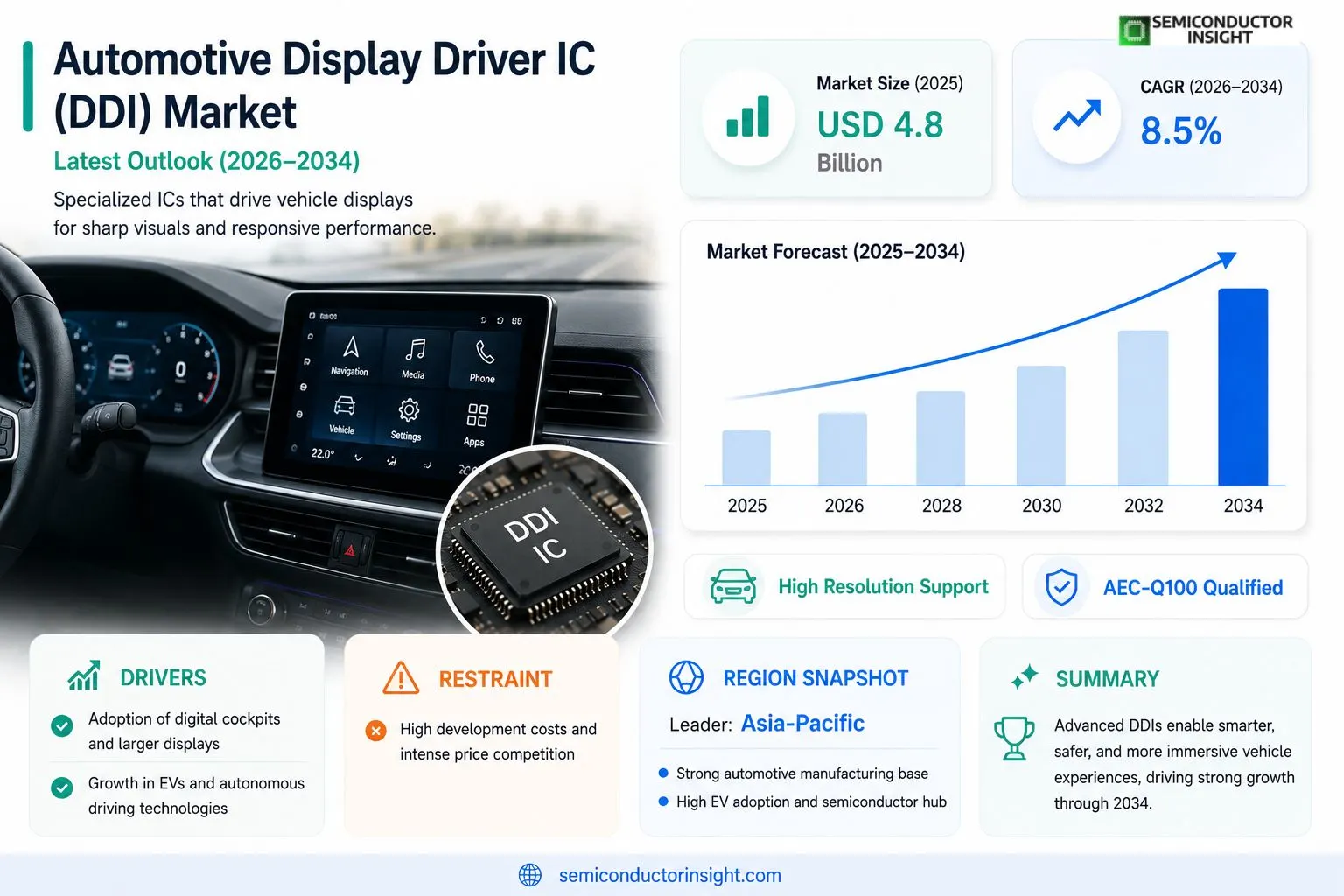
Global Automotive Display Driver IC (DDI) Market size was valued at USD 4.8 billion in 2025. The market is projected to grow from USD 5.2 billion in 2026 to USD 9.8 billion by 2034, exhibiting a CAGR of 8.5% during the forecast period.
Automotive Display Driver ICs (DDIs) are specialized semiconductor components that control and manage the visual output of displays in vehicles. These integrated circuits convert digital signals into the appropriate voltages and currents needed to drive pixels on screens, ensuring sharp images, accurate colors, and responsive performance across various in-vehicle displays. Key types include those for LCD, OLED, and emerging display technologies, often incorporating features like touch integration in TDDI solutions tailored for harsh automotive environments.
The market is experiencing robust growth due to several factors, including the rising adoption of digital cockpits, larger infotainment systems, and advanced driver assistance displays in modern vehicles. Increasing vehicle electrification and the push toward autonomous driving further accelerate demand, as more high-resolution screens become standard for instrument clusters, heads-up displays, and rear entertainment. Additionally, advancements in display technologies and the need for high-reliability, temperature-resistant components support continued expansion. Key players such as Himax Technologies, Novatek Microelectronics, Synaptics, and Rohm Semiconductor operate in the market with broad portfolios focused on automotive-grade solutions. For instance, Himax has established a leading position in automotive TDDI with significant unit shipments, highlighting the emphasis on safety-certified silicon for next-generation vehicle displays.
MARKET DRIVERS
Rising Adoption of Digital Cockpits and Advanced Displays
Automotive Display Driver IC (DDI) Market is experiencing robust growth driven by the increasing integration of digital instrument clusters, center stack displays, and head-up displays in modern vehicles. Average panel counts per vehicle have risen, particularly in premium and electric models, pushing demand for multi-channel DDIs capable of supporting high-resolution and touch-integrated panels. LTPS LCD and emerging AMOLED technologies are gaining traction for their superior brightness, slim designs, and power efficiency.
Shift Toward Electric Vehicles and Autonomous Driving
Global transition to electric vehicles (EVs) and autonomous technologies is significantly boosting the need for advanced Automotive Display Driver IC (DDI) solutions. These vehicles require reliable, high-performance displays for infotainment, navigation, and real-time ADAS data visualization. Automotive DDIs must meet stringent AEC-Q100 standards for temperature resilience and functional safety, supporting the software-defined cockpit trend.
➤ Government regulations on road safety and reduced driver distraction further accelerate the deployment of sophisticated display systems powered by advanced DDIs.
Overall, Automotive Display Driver IC (DDI) Market benefits from consumer demand for enhanced in-car experiences and the proliferation of connected vehicle features, with automotive applications showing one of the fastest growth rates among display driver segments.
MARKET CHALLENGES
Supply Chain Disruptions and Semiconductor Shortages
Automotive Display Driver IC (DDI) Market faces ongoing challenges from global supply chain volatility and periodic semiconductor shortages, which impact production timelines and component availability for automotive-grade chips. These disruptions affect the ability of manufacturers to meet rising demand from vehicle OEMs.
High Development Costs and Complexity
Designing and manufacturing advanced DDIs for automotive use involves sophisticated processes, high-quality materials, and extensive validation to ensure reliability under extreme conditions, leading to elevated costs.
Stringent Quality and Safety Standards
Automotive DDIs must comply with rigorous functional safety and durability requirements, increasing R&D investment and time-to-market pressures for suppliers in Automotive Display Driver IC (DDI) Market.
MARKET RESTRAINTS
Intense Competition and Pricing Pressures
Automotive Display Driver IC (DDI) Market encounters restraints from intense competition among established players and new entrants, which compresses average selling prices despite technological advancements. Manufacturers must continuously innovate while managing cost structures effectively.The complexity of integrating DDIs with evolving display technologies like higher-resolution OLED and multi-display architectures adds further pressure on development cycles and capital expenditure.
MARKET OPPORTUNITIES
Technological Advancements in HUDs and AR Displays
Significant opportunities exist in Automotive Display Driver IC (DDI) Market for solutions supporting augmented reality head-up displays (AR-HUDs) and larger, high-brightness panels. Growing shipments of instrument clusters and advanced HUDs create demand for specialized, high-bandwidth driver ICs. Expansion in emerging markets, coupled with the rise of software-defined vehicles, offers pathways for higher-value automotive DDI integrations that enhance safety, personalization, and user experience.
Automotive Display Driver IC (DDI) Market Trends
Rising Adoption of Digital Cockpits and Advanced Infotainment Systems
Automotive Display Driver IC (DDI) Market continues to evolve as vehicle manufacturers integrate more sophisticated digital cockpits and larger infotainment displays. These specialized semiconductor components play a critical role in managing visual output across various in-vehicle screens, converting digital signals into precise voltages and currents for sharp images, accurate colors, and responsive performance. The shift toward comprehensive digital interfaces in modern vehicles has heightened the need for reliable DDIs capable of supporting high-resolution LCD, OLED, and emerging display technologies, including touch-integrated TDDI solutions designed for demanding automotive conditions.
Other Trends
Vehicle Electrification and Autonomous Driving Push
Vehicle electrification and the advancement toward autonomous driving are key factors accelerating demand for robust Automotive Display Driver IC (DDI) solutions. As electric vehicles and autonomous systems proliferate, instrument clusters, heads-up displays, and rear entertainment screens require enhanced capabilities. DDIs must deliver consistent performance under extreme temperatures and vibrations while meeting stringent automotive safety certifications. This environment favors components that support multiple high-resolution displays, contributing to more intuitive driver interfaces and passenger experiences.
Technological Advancements in Display Driver Solutions
Advancements in display technologies are shaping Automotive Display Driver IC (DDI) Market, with emphasis on high-reliability and temperature-resistant designs. Industry participants like Himax Technologies, Novatek Microelectronics, Synaptics, and Rohm Semiconductor continue to develop automotive-grade portfolios. Himax, for instance, has strengthened its position in automotive TDDI through substantial unit shipments, underscoring the focus on safety-certified silicon for next-generation vehicle displays. These innovations enable better integration of touch functionality and support for evolving panel sizes in cockpits and infotainment systems. The ongoing development of components tailored for harsh operating environments ensures sharper visuals and improved responsiveness, aligning with broader industry efforts to enhance human-machine interfaces. As automakers prioritize differentiation through advanced visual systems, the role of specialized DDIs becomes increasingly central to enabling feature-rich, reliable in-vehicle displays across diverse vehicle segments.
COMPETITIVE LANDSCAPE
Key Industry Players
Fragmented Yet Specialized Competitive Landscape Led by Taiwanese Innovators
Automotive Display Driver IC (DDI) Market is characterized by a concentrated group of specialized semiconductor firms with strong expertise in high-reliability, automotive-grade solutions. Himax Technologies holds a leading position, particularly in Touch and Display Driver Integration (TDDI) technologies, benefiting from significant unit shipments and a focus on safety-certified components essential for digital cockpits, instrument clusters, and advanced infotainment systems. The market structure features a mix of fabless designers and integrated players who emphasize temperature resilience, high-resolution support, and compliance with stringent automotive standards such as AEC-Q100.
Other significant players include established Taiwanese suppliers and global semiconductor companies that bring complementary strengths in power efficiency, OLED drivers, and system-level integration. These firms compete through continuous innovation in display technologies for electric vehicles and autonomous driving applications, where larger, higher-resolution screens demand advanced DDI performance. Strategic partnerships with panel manufacturers and automakers further intensify competition while driving technological differentiation.
List of Key Automotive Display Driver IC Companies Profiled
- Himax Technologies, Inc.
- Novatek Microelectronics Corp.
- Synaptics Incorporated
- ROHM Semiconductor
- Raydium Semiconductor Corporation
- FocalTech Systems Co., Ltd.
- Silicon Works Co., Ltd.
- MagnaChip Semiconductor Corporation
- Samsung Electronics Co., Ltd.
- MediaTek Inc.
- Texas Instruments Incorporated
- Renesas Electronics Corporation
- Sitronix Technology Corporation
- Solomon Systech (International) Limited
- Fitipower Integrated Technology Inc.
Segment Analysis:
| Segment Category | Sub-Segments | Key Insights |
| By Type |
|
TDDI stands out as the leading segment due to its ability to seamlessly integrate touch sensing with display driving functions. This integration reduces component count and improves overall system reliability in demanding automotive conditions.
|
| By Application |
|
Infotainment Systems represent the leading application area as vehicles increasingly feature expansive central touchscreens serving multiple functions.
|
| By End User |
|
Passenger Vehicles lead this segment through widespread adoption of digital features across mainstream models.
|
| By Vehicle Type |
|
Electric Vehicles emerge as a key driver in this category owing to their reliance on sophisticated digital interfaces for battery management and energy monitoring.
|
| By Integration Level |
|
Integrated Touch Solutions lead due to their capability to manage complex multi-screen vehicle architectures efficiently.
|
Regional Analysis: Automotive Display Driver IC (DDI) Market
Asia-Pacific
Asia-Pacific’s integrated semiconductor and display manufacturing clusters provide unmatched agility for Automotive Display Driver IC (DDI) production. Proximity between foundries, panel makers, and automotive OEMs enables seamless collaboration on next-generation driver IC designs optimized for high-refresh-rate displays and multi-screen architectures in modern vehicles.
The rapid expansion of electric vehicles and advanced driver assistance systems creates sustained demand for specialized Automotive Display Driver IC (DDI) Market solutions. These technologies require precise color accuracy, high brightness, and low-latency performance that regional innovators consistently deliver through targeted R&D investments.
Technology centers across Japan, South Korea, and China drive continuous advancements in low-power DDI architectures and high-resolution support, positioning the region at the forefront of automotive display evolution for both luxury and economy vehicle segments.
Established local supplier networks and vertical integration strategies ensure stable availability of critical components, allowing Automotive Display Driver IC (DDI) Market in Asia-Pacific to maintain momentum even amid global disruptions.
North America
North America maintains a strong position in Automotive Display Driver IC (DDI) Market through its focus on premium vehicles and cutting-edge safety technologies. The region’s emphasis on connected and autonomous driving solutions drives demand for sophisticated display driver ICs capable of supporting complex user interfaces and real-time data visualization. Major automakers and tech companies collaborate on innovative cockpit designs that integrate multiple high-definition screens, requiring advanced DDI capabilities for seamless performance. Regulatory standards around vehicle safety and emissions encourage the adoption of energy-efficient display technologies, further stimulating market development in this mature automotive landscape.
Europe
Europe exhibits steady growth in Automotive Display Driver IC (DDI) Market, propelled by stringent environmental regulations and a consumer base that values luxury and technological sophistication. The region’s leadership in premium and electric vehicle segments creates opportunities for high-performance display solutions featuring exceptional image quality and integration with advanced infotainment systems. Collaborative efforts between automakers, semiconductor suppliers, and research institutions foster innovation in sustainable and reliable DDI technologies tailored for harsh operating conditions. Focus on digital cockpits and enhanced driver monitoring systems continues to shape demand patterns across key European markets.
South America
South America represents an emerging frontier for Automotive Display Driver IC (DDI) Market, with gradual adoption of modern vehicle technologies across expanding middle-class segments. Local manufacturing initiatives and increasing foreign investments in automotive assembly plants support growing incorporation of digital displays in both passenger and commercial vehicles. While infrastructure development varies, rising interest in safety features and comfort enhancements drives demand for cost-effective yet capable Automotive Display Driver IC solutions. Regional players focus on adapting global technologies to meet local preferences and environmental challenges, laying groundwork for future market expansion.
Middle East & Africa
The Middle East and Africa show promising potential in Automotive Display Driver IC (DDI) Market, particularly in luxury vehicle segments within Gulf countries and growing urban mobility projects across the continent. Hot climate conditions necessitate robust, heat-resistant display driver technologies that maintain performance under extreme temperatures. Infrastructure modernization and smart city initiatives in several nations encourage integration of advanced display systems in both private and public transportation. While overall adoption remains developing, strategic partnerships with global suppliers are introducing sophisticated Automotive Display Driver IC solutions to meet evolving consumer expectations for connected vehicles.
Report Scope
This market research report provides a comprehensive analysis of the Automotive Display Driver IC (DDI) Market , covering the forecast period 2026–2034. It offers detailed insights into market dynamics, technological advancements, competitive landscape, and key trends shaping the industry.
Key focus areas of the report include:
- Market Overview: The report begins with an overview outlining its current market scenario, key growth indicators, and industry transformation drivers. It discusses macroeconomic factors, demand–supply balance, regulatory landscape, and the strategic role of semiconductors in powering advancements across industries such as automotive, telecommunications, consumer electronics, and industrial automation.
- Market Size & Forecast: Historical data and future projections for revenue, unit shipments, and market value across major regions and segments.
- Segmentation Analysis: Detailed breakdown by product type, technology, application, and end-user industry to identify high-growth segments and investment opportunities.
- Regional Insights: Insights into market performance across North America, Europe, Asia-Pacific, Latin America, and the Middle East & Africa, including country-level analysis where relevant.
- Competitive Landscape: Profiles of leading market participants, including their product offerings, R&D focus, manufacturing capacity, pricing strategies, and recent developments such as mergers, acquisitions, and partnerships.
- Technology Trends & Innovation: Assessment of emerging technologies, integration of AI/IoT, semiconductor design trends, fabrication techniques, and evolving industry standards.
- Market Drivers & Restraints: Evaluation of factors driving market growth along with challenges, supply chain constraints, regulatory issues, and market-entry barriers.
- Stakeholder Insights: Insights for component suppliers, OEMs, system integrators, investors, and policymakers regarding the evolving ecosystem and strategic opportunities.
Primary and secondary research methods are employed, including interviews with industry experts, data from verified sources, and real-time market intelligence to ensure the accuracy and reliability of the insights presented.
FREQUENTLY ASKED QUESTIONS:
What is the current market size of Automotive Display Driver IC (DDI) Market?
-> Automotive Display Driver IC (DDI) Market was valued at USD 4.8 billion in 2025 and is expected to reach USD 9.8 billion by 2034.
Which key companies operate in Automotive Display Driver IC (DDI) Market?
-> Key players include Himax Technologies, Novatek Microelectronics, Synaptics, and Rohm Semiconductor, among others.
What are the key growth drivers?
-> Key growth drivers include rising adoption of digital cockpits, larger infotainment systems, advanced driver assistance displays, vehicle electrification, and the push toward autonomous driving.
Which region dominates the market?
-> Asia-Pacific is the fastest-growing region with major semiconductor suppliers, while North America and Europe remain dominant markets due to premium vehicle adoption.
What are the emerging trends?
-> Emerging trends include TDDI solutions, OLED display integration, high-reliability automotive-grade components, and temperature-resistant technologies for next-generation vehicle displays.

Get Sample Report PDF for Exclusive Insights
Report Sample Includes
- Table of Contents
- List of Tables & Figures
- Charts, Research Methodology, and more...
 Download Sample Report PDF