Key Statistics
Key Takeaways
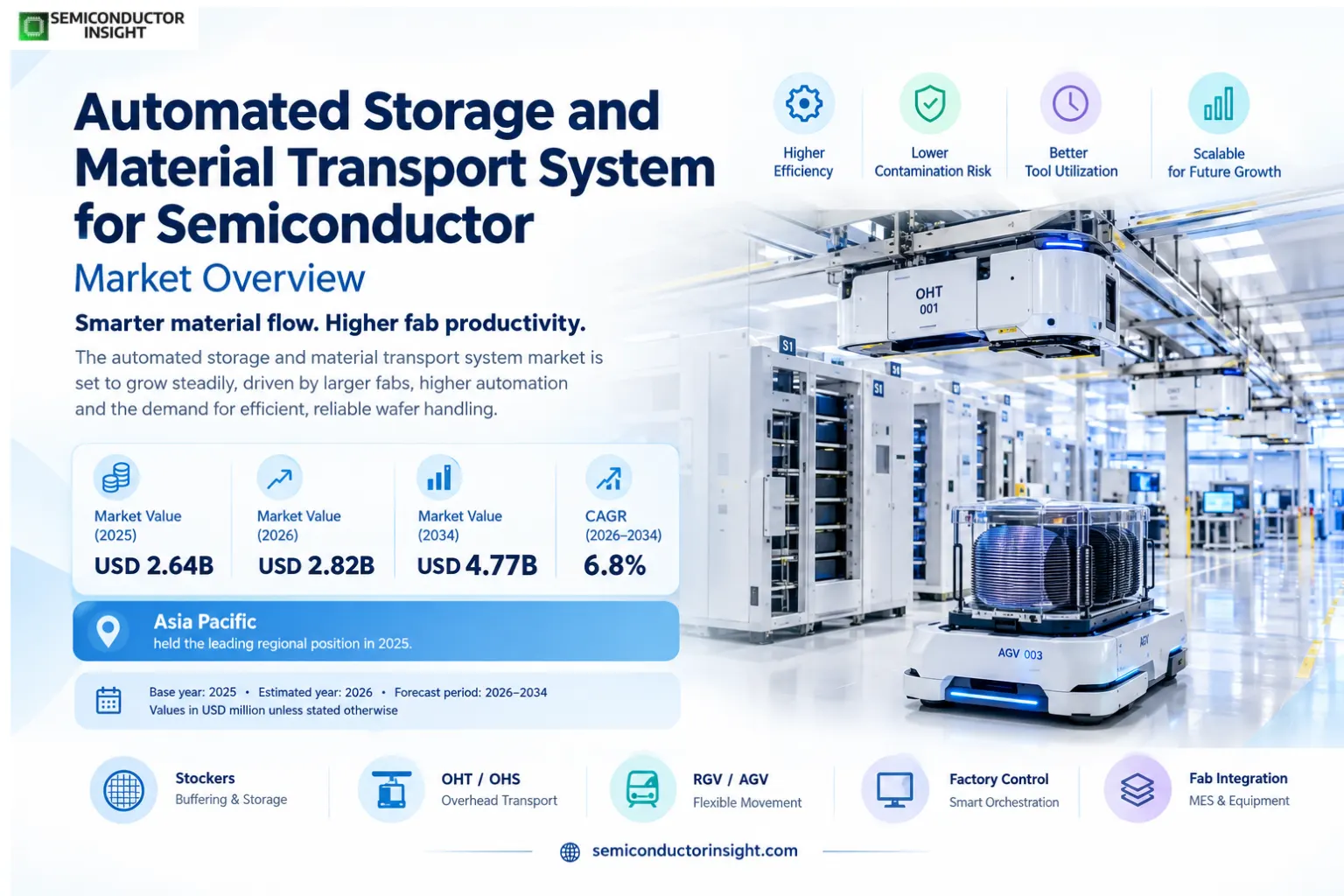
- Market trajectory: Automated Storage and Material Transport System for Semiconductor Market was valued at USD 2.64 billion in 2025 and is projected to reach USD 4.77 billion by 2034, representing a 6.8% CAGR over 2026–2034.
- Largest type: Overhead Hoist Transport (OHT) holds the strongest commercial position because 300 mm fabs rely on automated overhead movement to maintain high tool utilization and reduce manual wafer handling.
- Demand center: 300mm Fabs is the principal application segment, supported by leading-edge logic and memory factories require dense, highly automated wafer movement and storage.
- Regional position: Asia Pacific leads demand as Taiwan, South Korea, China and Japan contain a large concentration of advanced wafer-fab capacity and new fab investment.
- Growth driver: New 300 mm fabs, higher tool counts and tighter cycle-time targets are expanding cleanroom automation requirements.
- Primary restraint: High integration cost, fab-specific engineering and retrofit complexity can lengthen purchasing and commissioning cycles.
Automated Storage and Material Transport System for Semiconductor Market Overview
Automated storage and material transport system for semiconductor market was valued at USD 2.64 billion in 2025 and is estimated at USD 2.82 billion in 2026. It is projected to reach USD 4.77 billion by 2034, registering a CAGR of 6.8% over 2026–2034. Asia Pacific held the leading regional position in 2025.
Automated storage and material transport systems move and buffer wafer carriers, lots and related materials within semiconductor factories while minimizing manual handling. The system layer includes stockers, overhead hoist transport, overhead shuttles, rail-guided vehicles and automated guided vehicles coordinated through factory-control software. Its economic value is measured through tool utilization, cycle time, work-in-process visibility and reduced contamination or handling risk.
Automation intensity rises with wafer diameter, fab scale and process complexity. A modern 300 mm facility can contain hundreds of process tools and thousands of wafer moves, making reliable material flow a production-control requirement rather than a labor-saving accessory. Transport systems must synchronize with manufacturing execution systems, equipment interfaces and cleanroom constraints while maintaining redundancy and rapid recovery from faults.
The market follows semiconductor capital investment but has its own engineering cycle. Systems are specified early in fab design because rail layouts, ceiling structures, stocker locations and control architecture affect facility planning. Expansion therefore creates demand before wafer output begins, while brownfield retrofits require careful installation around operating tools and strict contamination controls.
Segment Analysis: By Type
By type, the market is segmented into Stocker, OHT, OHS, RGV and AGV. OHT systems hold the central role in advanced 300 mm fabs because overhead routing moves carriers directly between tools without consuming valuable floor space, while stockers provide controlled buffering and other vehicle formats serve specialized routes.
| Type | Technical role | Market position |
|---|---|---|
| Stocker | Automated buffer and storage for wafer carriers | Critical for work-in-process staging, route balancing and safe carrier storage. |
| OHT | Overhead hoist transport between tools and storage | Leading type. High-density, direct tool-to-tool movement in advanced 300 mm fabs. |
| OHS | Overhead shuttle movement along defined paths | Supports high-throughput interbay and selected intrabay transport architectures. |
| RGV | Rail-guided vehicle transport | Used where fixed floor-level or dedicated routes fit facility design. |
| AGV | Flexible automated guided vehicle | Useful for lower-volume, mixed or retrofit transport tasks where fixed rail is less attractive. |
System value depends on flow orchestration
Transport hardware creates value only when dispatch logic, storage locations and equipment interfaces work as one system. Vendors therefore compete on simulation, controls, fault recovery and factory-software integration as much as on mechanical speed. A poorly balanced layout can leave expensive process tools waiting even when nominal transport capacity appears sufficient.
Segment Analysis: By Application
By application, the market is segmented into 300mm Fabs and 200mm Fabs. Three-hundred-millimeter fabs represent the largest opportunity because advanced logic and memory facilities use high automation density, large tool populations and tightly controlled wafer-carrier logistics.
| Application | Demand characteristics |
|---|---|
| 300mm Fabs | Leading application. Extensive OHT and stocker networks support automated FOUP movement, high tool utilization and advanced factory control. |
| 200mm Fabs | Automation is growing through retrofit and expansion, particularly for power, analog, MEMS and specialty semiconductor production. |
Segment Analysis: By Process Stage
By process stage, systems serve Front-End Wafer Fabrication, Advanced Packaging/Back-End and Other Cleanroom Processes. Front-end wafer fabs remain the core market, but advanced packaging is becoming more automation-intensive as wafer-level and heterogeneous-integration flows add complex material-routing requirements.
| Process Stage | Commercial relevance |
|---|---|
| Front-End Wafer Fabrication | Highest automation intensity because wafers make repeated moves through lithography, deposition, etch, clean and metrology tools. |
| Advanced Packaging/Back-End | Growing opportunity as packaging lines adopt cleaner, more traceable and highly automated material flows. |
| Other Cleanroom Processes | Specialty device, research and supporting cleanroom operations use scaled or adapted transport systems. |
Segment Analysis: By Control Architecture
Control architecture is segmented into Centralized Control and Distributed/Intelligent Control. Central dispatch remains widely used, while distributed intelligence, predictive routing and simulation are gaining relevance as fab networks become larger and transport decisions must respond dynamically to tool status and congestion.
| Control Architecture | Commercial relevance |
|---|---|
| Centralized Control | Factory-level dispatcher coordinates routes, stockers and vehicle assignments using global production priorities. |
| Distributed/Intelligent Control | Local decision logic and advanced optimization improve resilience, congestion management and response to changing tool states. |
Regional Analysis
Asia Pacific leads the Automated Storage and Material Transport System for Semiconductor Market, with regional demand shaped by different combinations of manufacturing concentration, installed-base replacement, regulatory requirements and customer qualification. The market is therefore not a uniform global pool: supplier access depends on local production ecosystems, channel depth, technical support and the purchasing model used by major customers.
How does regional demand differ across the automated storage and material transport system for semiconductor market?
Asia Pacific leads because the region contains the largest concentration of high-volume wafer fabrication, including advanced logic and memory sites in Taiwan, South Korea, China and Japan. North America is gaining importance through new fab projects and capacity localization, while Europe combines specialty semiconductor expansion with strategic manufacturing programs. The market therefore closely tracks where new cleanroom capacity is built.
| Region | Position | Growth outlook | Demand profile | What decides supplier selection |
|---|---|---|---|---|
| Asia Pacific | Largest | High | Manufacturing and new-capacity led | Scale, qualification, local support |
| North America | Second growth center | Moderate to high | Technology and replacement led | Performance, support, compliance |
| Europe | Strategic growth | Moderate | Compliance and specialty led | Compliance, sustainability, engineering |
| South America | Limited | Selective | Import and distributor led | Landed cost, availability, service |
| Middle East & Africa | Early-stage | Selective to high | Project and infrastructure led | Reliability, integrator support, delivery |
Key Automated Storage and Material Transport System for Semiconductor Market Manufacturers and Competitive Landscape
Competition is concentrated among experienced semiconductor-factory automation suppliers because each project requires mechanical systems, controls, simulation, installation and long-term service. Daifuku and Murata Machinery have strong global positions, while Korean and regional automation firms compete through local engineering, customer proximity and integration experience.
Large AMHS contracts are won early in fab planning and can extend across multiple phases. Vendors need to model throughput, design rail networks, coordinate with building and tool layouts, and commission systems without compromising cleanroom readiness. This creates high barriers to entry because customer references and execution capability matter alongside equipment specifications.
Service capability is strategically important after installation. A transport fault can interrupt wafer flow across multiple tools, so customers value spare parts, software support, preventive maintenance and rapid incident response. Installed-base relationships therefore influence expansion awards and follow-on projects.
The competitive frontier is shifting toward software. Route optimization, digital simulation, equipment telemetry and predictive maintenance can raise effective transport capacity without proportionally adding mechanical hardware. Vendors able to connect AMHS data with manufacturing execution and fab analytics can deepen their role in factory productivity.
Tier structure
| Competitive tier | Representative companies | Basis of competition |
|---|---|---|
| Global leaders | Daifuku; Murata Machinery | Large installed bases, global service, full cleanroom transport portfolios and fab-scale integration. |
| Korean automation specialists | SFA Engineering; SMCore; SYNUS Tech; Shinsung E&G | Strong proximity to major memory and semiconductor manufacturing customers. |
| Regional / project specialists | Mirle Automation; Avaco; Kenmec; TOTA; KUKA | Local engineering, specialized vehicles, retrofit capability and selected customer programs. |
Companies profiled: Daifuku, Murata Machinery, SFA Engineering, Mirle Automation, SMCore, Avaco, SYNUS Tech, Shinsung E&G, Kenmec, TOTA, KUKA.
Automated Storage and Material Transport System for Semiconductor Market Production Capacity Analysis
Production capacity for semiconductor AMHS includes precision mechanical assemblies, rails, hoists, stockers, control electronics and software engineering. Unlike standardized factory equipment, large projects require significant application engineering and site installation, so engineering headcount and commissioning capacity can constrain growth as much as factory output.
The global fab pipeline supports a sustained demand base. SEMI reported 18 new semiconductor fab construction projects starting in 2025, including fifteen 300 mm facilities, while industry capacity was projected to reach 33.6 million 200 mm-equivalent wafers per month in 2025. New fabs require material-handling design well before volume production, creating forward demand for AMHS suppliers.
Suppliers are expanding manufacturing and engineering capacity near major semiconductor clusters. Daifuku announced in 2026 that expansion at its Shiga Works would raise domestic production capacity for its cleanroom business by 30%, illustrating the capital and service investment required to support new fab projects and installed-base demand.
Automated Storage and Material Transport System for Semiconductor Market Market Dynamics: Drivers, Restraints and Opportunities
The market is supported by new fab construction, rising 300 mm capacity and the economic need to keep expensive semiconductor tools supplied with wafers. Growth is moderated by project cyclicality, integration complexity and the long commissioning process. The strongest suppliers increasingly combine mechanical transport with simulation and intelligent control, making AMHS a factory-productivity platform rather than isolated material-handling equipment.
MARKET DRIVERS
Drivers Impact Analysis*
| Driver | Impact | Commercial mechanism |
|---|---|---|
| New 300 mm fab construction | High | Each greenfield fab requires transport and storage infrastructure before production ramp. |
| Higher automation intensity | High | Large tool counts and costly wafers increase the value of reliable automated movement. |
| Advanced packaging expansion | Medium | More complex back-end flows create new cleanroom material-handling opportunities. |
Fab construction creates system-level demand
AMHS is part of factory infrastructure, so new wafer fabs generate large integrated orders for rails, stockers, vehicles and controls. Because systems must be installed and commissioned before full tool ramp, order timing can lead semiconductor output by multiple quarters.
Tool utilization justifies automation investment
Advanced process tools carry high capital costs, making idle time expensive. Automated carrier movement reduces waiting between process steps and improves predictability, allowing fabs to extract more productive output from installed equipment without relying on manual transport.
Manufacturing traceability is becoming more important
Automated handling systems link carrier identity, route history and destination with factory software. This improves work-in-process visibility and reduces manual handling errors, a growing benefit as process flows become longer and advanced packaging introduces additional routing complexity.
MARKET RESTRAINTS
Restraints Impact Analysis*
| Restraint | Impact | Commercial mechanism |
|---|---|---|
| High integration cost | High | Large systems require extensive facility, controls and software engineering. |
| Project cyclicality | Medium | Orders depend on semiconductor capital-investment timing. |
| Brownfield retrofit complexity | Medium | Installing transport in operating cleanrooms can disrupt production and constrain layout options. |
Fab-specific engineering lengthens projects
AMHS cannot be deployed as a simple plug-in product. Rail paths, stocker locations, ceiling loads, tool interfaces and dispatch rules must fit each factory. Engineering changes late in construction can therefore increase cost and delay commissioning.
Semiconductor investment cycles affect order flow
A small number of large fab projects can materially influence annual demand. When chipmakers delay capital spending, AMHS suppliers may experience uneven bookings even though the long-term automation requirement remains intact.
Retrofit work is operationally difficult
Adding transport capacity to an active cleanroom requires contamination control, safe construction windows and coordination with production. Existing ceiling and floor layouts may restrict optimal routes, making brownfield projects more complex than greenfield installations.
MARKET OPPORTUNITIES
Advanced packaging automation
Chiplet, wafer-level and heterogeneous-integration flows are increasing the complexity of back-end material movement. AMHS vendors can adapt cleanroom handling, buffering and traceability technologies to packaging facilities that historically used more manual logistics.
AI-assisted routing and digital twins
Simulation and real-time optimization can identify congestion, rebalance stockers and improve vehicle dispatch. Software upgrades can expand effective system capacity without rebuilding the complete mechanical network, creating recurring value after initial installation.
200 mm fab retrofits
Power, analog and specialty semiconductor fabs continue operating mature 200 mm lines. Selective automation can reduce labor dependence and improve traceability without requiring the full transport density used in a leading-edge 300 mm facility.
Regional fab localization
New semiconductor investment in the United States, Europe, Japan and Southeast Asia creates opportunities for suppliers to expand local engineering and service. A broader geographic installed base can reduce dependence on any single customer cluster.
Automated Storage and Material Transport System for Semiconductor Market Supply Chain Analysis
Motors, rails, sensors, controls, cleanroom-compatible mechanical assemblies.
OHT vehicles, stockers, shuttles, guided vehicles and control cabinets.
Simulation, layout design, software interfaces, installation and commissioning.
Maintenance, spare parts, optimization, software upgrades and expansions.
The highest-value stages are system integration and lifecycle support because a fab-wide AMHS must work continuously with production software and hundreds of equipment interfaces. Mechanical components are important, but customer switching is constrained by installed infrastructure, control architecture and service dependencies.
Capacity planning therefore includes engineers and field-service teams as well as factories. Suppliers that establish regional service centers near semiconductor clusters can shorten commissioning and maintenance response, strengthening their position for expansion phases and future fabs from the same customer.
Recent Developments in the Automated Storage and Material Transport System for Semiconductor Market
April 2026 — Daifuku expanded cleanroom business production capacity
Daifuku announced a new building at Shiga Works and said the expansion would increase domestic production capacity for its cleanroom business by 30%, supporting semiconductor and flat-panel material-handling demand. Source.
January 2025 — SEMI identified 18 new fab construction projects for 2025
SEMI reported that 18 semiconductor fabs were expected to begin construction in 2025, including fifteen 300 mm facilities, providing a forward pipeline for factory automation and material-handling systems. Source.
2025 — Global 300 mm capacity continued expanding
SEMI projected global semiconductor capacity growth to 33.6 million 200 mm-equivalent wafers per month in 2025, reinforcing the scale of wafer movement and automation required across expanding fab networks. Source.
REPORT SCOPE & SEGMENTATION
| Attribute | Coverage |
|---|---|
| Market | Automated Storage and Material Transport System for Semiconductor Market |
| Base Year | 2025 |
| Estimated Year | 2026 |
| Forecast Period | 2026–2034 |
| By Type | Stocker, OHT, OHS, RGV, AGV |
| By Application | 300mm Fabs, 200mm Fabs |
| By Process Stage | Front-End Wafer Fabrication, Advanced Packaging/Back-End, Other Cleanroom Processes |
| By Control Architecture | Centralized Control, Distributed/Intelligent Control |
| Regions | North America, Europe, Asia Pacific, South America, Middle East & Africa |
| Companies Profiled | Daifuku, Murata Machinery, SFA Engineering, Mirle Automation, SMCore, Avaco, SYNUS Tech, Shinsung E&G, Kenmec, TOTA, KUKA |
Frequently Asked Questions
What is the size of the Automated Storage and Material Transport System for Semiconductor Market?
The market was valued at USD 2.64 billion in 2025 and is projected to reach USD 4.77 billion by 2034, with a CAGR of 6.8% during 2026–2034.
Which region leads the market?
Asia Pacific is the largest regional market, supported by Taiwan, South Korea, China and Japan contain a large concentration of advanced wafer-fab capacity and new fab investment.
Which type leads the automated storage and material transport system for semiconductor market?
Overhead Hoist Transport (OHT) holds the leading position because 300 mm fabs rely on automated overhead movement to maintain high tool utilization and reduce manual wafer handling.
Which application is the largest?
300mm Fabs is the principal application segment, driven by leading-edge logic and memory factories require dense, highly automated wafer movement and storage.
What are the main growth drivers?
New 300 mm fabs, higher automation intensity, tool-utilization economics and advanced packaging are the main demand drivers.
What are the main restraints?
High integration cost, semiconductor capital cycles and the difficulty of retrofitting operating cleanrooms can slow projects.
What additional segmentation is covered?
The analysis also covers Process Stage and Control Architecture, enabling comparison beyond type and application.
How is competition structured?
Competition is concentrated among experienced fab-automation suppliers with strong reference sites, controls software and local service capability.
What is changing in the supply chain?
Engineering, integration and field-service capacity are as important as hardware manufacturing because every large system must be designed and commissioned around a specific fab.
Which companies are profiled?
Daifuku, Murata Machinery, SFA Engineering, Mirle Automation, SMCore, Avaco, SYNUS Tech, Shinsung E&G, Kenmec, TOTA, KUKA.
Research Sources & Evidence Base
View supporting primary and industry sources
- SEMI: Eighteen New Semiconductor Fabs to Start Construction in 2025 — 2025 fab-construction and capacity outlook.
- SEMI: Global 300mm Semiconductor Fab Capacity Projected to Reach New High in 2025 — 300 mm capacity outlook and manufacturing scale.
- Daifuku: Daifuku expands Shiga Works cleanroom business production capacity — cleanroom automation capacity expansion.
- Daifuku: Cleanroom Systems — current semiconductor cleanroom transport portfolio.

Get Sample Report PDF for Exclusive Insights
Report Sample Includes
- Table of Contents
- List of Tables & Figures
- Charts, Research Methodology, and more...
 Download Sample Report PDF