Key Statistics
Key Takeaways
- High-precision ±0.5% tolerance products remain the value-rich segment because battery management, power conversion, industrial control and calibration-sensitive measurement systems place a premium on low temperature coefficient, repeatability and stable resistance under high current.
- Industrial measurement applications provide the broadest installed base, while automotive battery management and charging infrastructure add a higher-growth channel as electrified powertrains require increasingly accurate current sensing at multiple nodes.
- Asia Pacific is the largest regional market because it combines the densest electronics supply chain with China-led renewable and EV deployment, giving suppliers both high-volume assembly demand and advanced engineering programs.
- Thermal drift and material volatility remain practical restraints. High-current shunts must dissipate heat without shifting resistance, so alloy selection, geometry, joining quality and qualification testing directly influence usable accuracy and supplier margins.
- Product differentiation is moving toward lower TCR and higher current handling. Vishay’s 2025 WSBE launch illustrates the push toward automotive-qualified shunts with ±10 ppm/°C TCR and high current capability.
Ammeter Shunt Resistors Market Overview
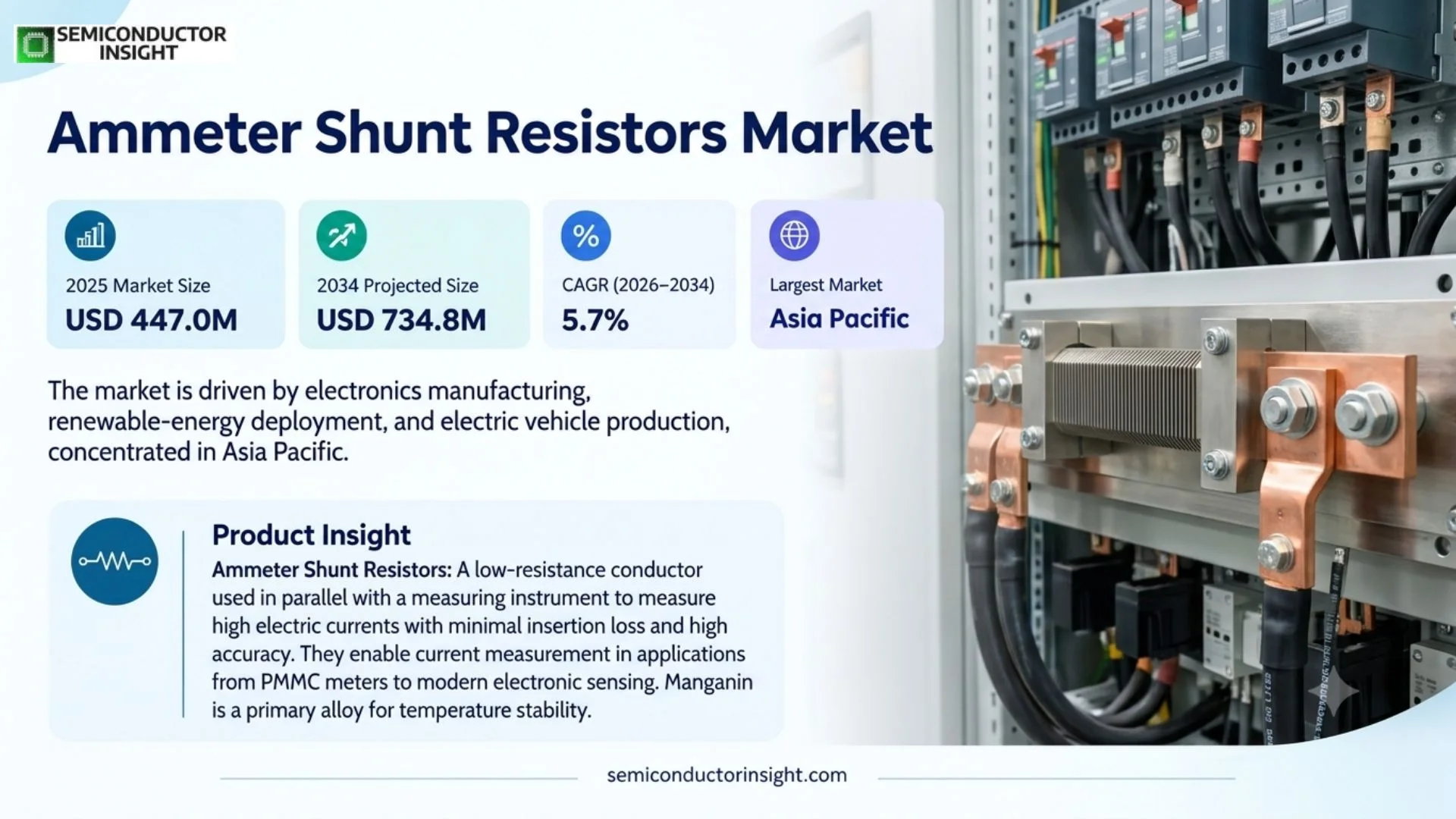
Ammeter Shunt Resistors Market was valued at USD 447.0 million in 2025 and is projected to reach USD 734.8 million by 2034, expanding at a 5.7% CAGR during 2026–2034. Asia Pacific is the largest demand center, supported by electronics manufacturing scale, renewable-energy build-out, electrified transport, and broad industrial current-measurement demand.
Ammeter shunt resistors are precision low-value resistors placed in parallel with a measuring circuit so that current can be inferred from the voltage drop across a known resistance. Their economic value is not tied to resistance alone: buyers evaluate temperature coefficient, power dissipation, terminal construction, long-term drift, pulse endurance and the ability to remain stable after soldering, vibration and thermal cycling. That makes qualification history and application engineering important competitive assets.
The market sits at the intersection of traditional panel instrumentation and modern electronic current sensing. Industrial drives, energy meters, battery systems, inverters, chargers and test equipment all need current data, but the design conditions differ sharply. A utility or industrial meter may prioritize calibrated stability over decades, whereas an EV battery pack places more weight on high current, low thermal error and automotive qualification. Suppliers that can support multiple form factors and tolerance grades are therefore better positioned than commodity-only manufacturers.
Demand is broadening as electrification increases the number of monitored power paths. Global electric-car sales exceeded 20 million units in 2025, while renewable capacity additions reached 800 GW, both of which expand the installed base of battery, inverter, charger and power-conversion systems that use precision current sensing. These end-market statistics do not translate one-for-one into shunt demand, but they explain why current measurement is becoming more embedded across power electronics.
Segment Analysis: By Type
By type, the market is segmented by resistance tolerance into -0.5% to 0.5%, -1% to 1%, and -5% to 5%. The tightest tolerance band carries the strongest value proposition in high-accuracy current measurement, while wider-tolerance products remain relevant where cost, simplicity and overload capability matter more than calibration-grade precision.
| Type | Technical role | Market position |
|---|---|---|
| Resistance Tolerance: -0.5% to 0.5% | Precision current measurement with tighter control of initial error and drift. | Largest value segment for industrial metering, battery systems and high-performance power electronics. Buyers pay for traceability, low TCR and stable calibration rather than nominal resistance alone. |
| Resistance Tolerance: -1% to 1% | Balanced accuracy and cost for general industrial and equipment monitoring. | A broad mid-market category used where tighter calibration is not essential but predictable performance under continuous load is still required. |
| Resistance Tolerance: -5% to 5% | Economy current indication and less demanding monitoring functions. | Price-sensitive segment with simpler qualification requirements. Demand persists in legacy instrumentation and basic electrical panels, although higher-value designs increasingly migrate toward tighter tolerance. |
Performance differentiation beyond tolerance
Tolerance defines only the starting accuracy. In high-current designs, the more durable competitive advantage comes from temperature coefficient of resistance, power rating, inductance, terminal geometry and resistance stability across thermal cycles. Automotive and energy customers increasingly specify these parameters together, which pushes suppliers toward engineered metal-strip and alloy systems rather than treating the shunt as a purely passive commodity.
Segment Analysis: By Application
By application, demand spans Permanent Magnet Moving Coil (PMMC), Moving Iron (MI), electrodynamometer, and rectifier-type ammeters. PMMC-related demand remains important because of its accuracy and linear response, while broader electronic current-sensing applications increasingly connect shunt elements to amplifiers, ADCs and digital control systems.
| Application | Demand characteristics |
|---|---|
| Permanent Magnet Moving Coil (PMMC) Ammeter | PMMC instruments require accurate current scaling and benefit directly from stable shunt values. The application favors tight tolerances, low thermal drift and predictable calibration, particularly in laboratory, process-control and panel-instrumentation environments where measurement error can affect equipment protection or operating decisions. |
| Moving Iron (MI) Ammeter | MI instruments are robust and common in AC measurement and general industrial panels. Shunts serving these applications compete on reliability and cost, with less emphasis on ultra-low TCR than advanced electronic sensing systems but strong demand for mechanical durability and repeatable overload behavior. |
| Electrodynamometer Type Ammeter | Electrodynamometer instruments serve precision and reference functions where stable current scaling is essential. Volumes are smaller than mass-market panel applications, but the specification intensity supports higher-value products and careful calibration, particularly for laboratories and power-quality measurement. |
| Rectifier Type Ammeter | Rectifier-based instruments convert AC to a measurable DC quantity. The associated shunts are selected to preserve accuracy across the usable range and temperature envelope, with demand linked to legacy equipment, service replacements and specialized measurement systems. |
Regional Analysis
Asia Pacific leads the market because electronics manufacturing, renewable power deployment and electric-vehicle production are concentrated in the region. North America and Europe remain important higher-specification markets where automotive qualification, industrial automation and grid modernization support premium current-sensing products.
How does regional demand differ across the ammeter shunt resistors market?
Regional demand differs more by end-market mix and qualification culture than by the basic function of a shunt. Asia Pacific is manufacturing-intensive and increasingly technology-intensive; North America is strong in industrial, aerospace and EV applications; Europe combines automotive electrification with energy-efficiency requirements; South America is more import-dependent; and Middle East & Africa demand is led by power infrastructure, industrial projects and renewable build-out.
| Region | Position | Growth outlook | Demand profile | What decides supplier selection |
|---|---|---|---|---|
| Asia Pacific | Largest | Highest | Manufacturing and electrification led | Cost, local supply, automotive/electronics qualification, engineering support |
| North America | Major | Steady | Industrial, EV and high-specification | AEC-Q200, traceability, distribution availability, low TCR |
| Europe | Major | Steady | Automotive and industrial efficiency | Quality systems, low drift, regulatory and OEM qualification |
| South America | Smaller | Moderate | Industrial modernization and renewables | Landed cost, distributor availability, ruggedness |
| Middle East & Africa | Emerging | Moderate | Energy and infrastructure projects | Project approvals, supply continuity, temperature robustness |
Detailed Regional Analysis
Competitive Landscape
Competition combines global passive-component leaders, precision-resistor specialists and regional manufacturers. The strongest positions are built on materials know-how, low-temperature-coefficient performance, automated high-volume production and long qualification histories in automotive and industrial electronics.
Murata, Vishay, Yageo, Panasonic and Bourns compete across broad component portfolios, giving them leverage with global OEMs and distributors. Their advantage is not only scale; the ability to bundle shunts with adjacent passive and sensing components reduces sourcing complexity for customers. That channel reach is difficult for small suppliers to reproduce even when their individual resistor performance is competitive.
Specialists such as Isabellenhütte, Susumu, Ohmite, Riedon and Caddock compete through precision, custom geometries and demanding application expertise. These firms can defend premium pricing where current measurement accuracy materially affects battery state estimation, metering accuracy, safety margins or system calibration. Their opportunity grows as more designs move from simple current indication to closed-loop power control.
Competition is also shifting toward application-specific qualification. Automotive customers expect AEC-Q200 and long-term supply commitments; industrial customers need stable performance under overload and temperature cycling; energy applications increasingly require high-current designs with low losses. Suppliers that can document these performance attributes in a production-ready package are better positioned than vendors competing mainly on catalog price.
| Competitive tier | Representative companies | Basis of competition |
|---|---|---|
| Global broad-line leaders | Murata, Vishay, Yageo, Panasonic, Bourns | Scale, distribution, broad passive portfolios and OEM qualification |
| Precision specialists | Isabellenhütte, Susumu, Ohmite, Riedon, Caddock | Low TCR, custom resistance values, power handling and application engineering |
| Regional/value suppliers | KOA, Viking Tech, MEGATRON and others | Cost, regional availability and selected industrial niches |
Companies profiled in the report
The profiled company set includes Murata Manufacturing, Vishay Intertechnology, Yageo Corporation, Panasonic, Bourns, Cyntec, Susumu, Ohmite, TT Electronics, ROHM Semiconductor, Viking Tech, Isabellenhütte, MEGATRON Elektronik, KOA Corporation, Caddock Electronics. The list is retained from the source report scope; competitive commentary differentiates suppliers by technology depth, qualification track record, regional channel access, and the application requirements they are positioned to serve rather than treating every company as interchangeable.
Production Capacity & Materials Analysis
Capacity is distributed across established passive-component manufacturing clusters, while true supply risk sits in specialty resistance alloys, metal processing, joining consistency and automated calibration rather than in nominal factory floor space alone.
Shunt production starts with controlled-resistivity metals or alloys, followed by stamping, machining or foil/strip processing, terminal attachment, trimming, plating and electrical test. Yield is sensitive to material composition and joining quality because tiny resistance deviations matter at milliohm levels. As a result, suppliers with vertically integrated metallurgical control can achieve more stable output than assemblers that depend heavily on externally sourced resistive elements.
Capacity additions are most valuable when they include automated measurement and traceability. Automotive and industrial customers increasingly require lot-level consistency, thermal-cycle performance and documentation, so a production line that merely increases units without improving process control may not qualify for the fastest-growing applications. Investment therefore tends to favor inspection, calibration and joining technology alongside physical throughput.
Market Dynamics
Market growth reflects a steady rise in the number of current-measurement points embedded in electrified systems, offset by thermal, materials and substitution pressures. The category benefits when higher current, tighter control and digital monitoring increase the value of accurate current data.
Market Drivers
Forces expanding addressable demand
| Driver | Directional impact* | Commercial mechanism |
|---|---|---|
| Electrification of vehicles and charging | High | More battery and power-conversion nodes require accurate high-current sensing. |
| Renewable and storage power electronics | High | Inverters, converters and energy-storage systems continuously monitor current for control and protection. |
| Industrial automation and energy monitoring | Medium | More monitored loads expand recurring demand across panels, drives and equipment. |
| Tighter accuracy requirements | Medium | Lower TCR and tighter tolerance move value toward engineered premium shunts. |
Vehicle electrification expands high-current sensing
Electric vehicles require current measurement for battery state estimation, traction power management, charging and protection. Global electric-car sales surpassed 20 million units in 2025, so the installed base of battery systems using precision current sensing continues to scale. This trend favors automotive-qualified shunts that can handle high current while limiting temperature-induced error.
Renewable power creates more conversion nodes
Solar PV, wind and energy storage rely on inverters and converters that measure current continuously. Global renewable additions reached 800 GW in 2025, with solar representing more than three-quarters of additions. Each new conversion stage increases the need for stable current feedback, creating a durable demand mechanism for shunts even as system architectures evolve.
Industrial automation increases measurement density
Factories are adding condition monitoring, variable-speed drives, power-quality systems and connected meters. These systems require current data not only for protection but also for energy optimization and predictive maintenance. The result is a gradual increase in sensing points per machine and per distribution panel, supporting broad-based demand across multiple tolerance and power classes.
Low TCR enables higher-value applications
As electronics become more compact and power dense, self-heating can create measurement drift. Lower temperature coefficient directly reduces that error, allowing shunts to replace more complex compensation schemes. Suppliers that achieve low TCR at high current can therefore capture designs in battery management, chargers and precision power systems where standard resistors would require additional calibration.
Market Restraints
Constraints on adoption and supplier economics
| Restraint | Directional impact* | Commercial mechanism |
|---|---|---|
| Thermal drift and self-heating | High | High current raises element temperature and can shift resistance if materials and geometry are not optimized. |
| Specialty alloy cost volatility | Medium | Metal inputs and precision processing influence margin and lead time. |
| Alternative sensing technologies | Medium | Hall-effect and magnetic sensing avoid insertion loss in selected applications. |
| Qualification burden | Medium | Automotive and industrial approvals extend design-in cycles and limit rapid supplier switching. |
Thermal management limits usable accuracy
A shunt intentionally develops a voltage drop, which means it also dissipates heat. At high current, even milliohm-level resistance can produce meaningful thermal loading. Designers must balance signal amplitude, power loss and temperature rise, while suppliers must control TCR and terminal heat flow. Poor thermal behavior can erase the accuracy advantage of a tighter initial tolerance.
Alternative current sensors compete where isolation matters
Hall-effect sensors, current transformers and fluxgate devices can measure current without placing a resistive element directly in the conduction path. These technologies are attractive when galvanic isolation, very high current or low insertion loss is more important than the cost and linearity advantages of a shunt. The result is application-by-application competition rather than a single universal sensing architecture.
Automotive qualification slows new entrants
Automotive battery and traction applications offer attractive volumes but require long qualification cycles, documented reliability and stable multi-year supply. That raises the commercial barrier for smaller suppliers and makes incumbent relationships sticky. New products must therefore prove both electrical performance and manufacturing consistency before they can convert technical interest into production revenue.
Market Opportunities
Battery management systems
High-current battery packs create premium demand for low-TCR, automotive-qualified shunts. Suppliers that can combine high power handling with stable calibration can win designs where current accuracy directly affects state-of-charge estimation and safety logic.
Fast-charging infrastructure
Higher charger power raises the value of accurate current monitoring for energy metering, thermal management and fault detection. This creates opportunities for larger-format shunts, busbar-integrated sensing and products designed for continuous high-current operation.
Smart energy meters and grid equipment
More distributed generation and storage require measurement at additional grid nodes. Utilities and equipment vendors increasingly value digital monitoring, creating opportunities for shunt modules paired with signal-conditioning electronics rather than stand-alone resistor elements.
Integrated current-sense assemblies
OEMs want to reduce component count and calibration effort. Busbar-plus-shunt assemblies, four-terminal Kelvin connections and factory-calibrated modules can move suppliers closer to the system level and support better margins than discrete commodity resistors.
Supply Chain Analysis
Resistance alloy & metal inputs
Element fabrication
Qualification & calibration
OEM / distribution
Upstream value concentrates in materials consistency because resistivity and temperature behavior determine whether the finished part can meet tight specifications. Alloy chemistry, rolling thickness and surface condition affect resistance stability, while copper terminals and joining processes influence parasitic resistance. Suppliers that control these inputs can reduce calibration spread and improve yield.
Midstream fabrication converts the material into a low-inductance, thermally stable current path. Four-terminal Kelvin layouts, electron-beam or laser joining and precise geometry are common differentiation points. The commercial bottleneck is not simply machine availability but the ability to reproduce milliohm or micro-ohm values at scale without introducing drift after thermal cycling.
Downstream qualification turns a metal component into an approved sensing element. Automotive AEC-Q200, industrial reliability tests and customer-specific validation create switching costs once a part is designed in. Distribution remains important for general industry, but strategic automotive and energy customers increasingly engage suppliers directly during the design phase.
Recent Developments
Report Scope & Segmentation
| Attribute | Coverage |
|---|---|
| Market | Ammeter Shunt Resistors |
| Base year | 2025 |
| Estimated year | 2026 |
| Forecast year | 2034 |
| Forecast period | 2026–2034 |
| 2025 market size | USD 447.0 million |
| 2034 market size | USD 734.8 million |
| CAGR | 5.7% |
| By Type | Resistance Tolerance: -0.5% to 0.5%, Resistance Tolerance: -1% to 1%, Resistance Tolerance: -5% to 5% |
| By Application | Permanent Magnet Moving Coil (PMMC) Ammeter, Moving Iron (MI) Ammeter, Electrodynamometer Type Ammeter, Rectifier Type Ammeter |
| Additional segmentation | By End User: Industrial, Energy & Power Utilities, Automotive, Laboratory & Research, Others |
| Regions | North America, Europe, Asia Pacific, South America, Middle East & Africa |
| Companies profiled | Murata Manufacturing, Vishay Intertechnology, Yageo Corporation, Panasonic, Bourns, Cyntec, Susumu, Ohmite, TT Electronics, ROHM Semiconductor, Viking Tech, Isabellenhütte, MEGATRON Elektronik, KOA Corporation, Caddock Electronics |
Frequently Asked Questions
What is the size of the Ammeter Shunt Resistors Market?
The market is valued at USD 447.0 million in 2025 and is projected to reach USD 734.8 million by 2034. The rebased series implies a 5.7% CAGR for 2026–2034. Growth reflects the increasing number of current-measurement points in industrial equipment, renewable power conversion, electric vehicles, charging infrastructure and connected energy systems.
Which tolerance segment is most important?
The -0.5% to 0.5% tolerance band is the most strategically important because tighter initial accuracy supports metering, battery systems and precision industrial measurement. Its commercial value rises further when combined with low temperature coefficient, high power handling and long-term resistance stability, which are increasingly decisive specifications in automotive and power-electronics designs.
Which region leads the market?
Asia Pacific is the largest region because it combines the world’s largest electronics manufacturing ecosystem with rapid deployment of electric vehicles, solar PV, energy storage and industrial automation. China is the central volume market, while Japan and South Korea contribute advanced component engineering and India is expanding power-electronics and metering demand.
Why are automotive applications attractive?
Automotive electrification increases the number and importance of high-current measurement points. Battery state estimation, traction systems and charging all require reliable current data. These applications also reward suppliers for AEC-Q200 qualification, low TCR and strong thermal performance, which can support higher value per component than general-purpose panel instrumentation.
What is the main technical restraint?
Thermal behavior is the central technical restraint because the shunt dissipates power as current flows through it. Temperature rise can change resistance and introduce measurement error, so designers must manage the trade-off between signal voltage, insertion loss, physical size and cooling. This makes material selection and geometry critical to performance.
How do shunts compete with Hall-effect sensors?
Shunts offer strong linearity, low cost and high accuracy but introduce a small resistive loss and are not inherently isolated. Hall-effect and other magnetic sensors can provide galvanic isolation and lower insertion loss, making them attractive in selected high-voltage or very-high-current applications. Many systems therefore choose technology based on isolation, accuracy and cost priorities.
What role do renewable systems play?
Renewable and storage systems use current measurement in inverters, converters, battery interfaces and protection circuits. Because solar and wind additions continue to rise, the installed base of power-electronic equipment also expands. This does not translate directly into a fixed number of shunts, but it creates a durable structural demand channel for precision sensing components.
What determines supplier competitiveness?
Competitive position depends on more than catalog resistance values. Low TCR, overload stability, four-terminal design, reliable joining, automotive or industrial qualification, global distribution and custom engineering all matter. Once a shunt is calibrated into a battery or industrial system, changing suppliers can require revalidation, which supports sticky customer relationships for qualified incumbents.
What is the 2026 estimated market size?
Using the published 2024 and 2032 headline market-size anchors, the internally consistent 2026 estimate is USD 472.4 million. This estimate is part of the same constant-growth series used for the 2025 base value of USD 447.0 million and the 2034 forecast of USD 734.8 million.
What are the most attractive product opportunities?
The strongest opportunities are automotive battery-management shunts, fast-charger current sensing, renewable and storage power conversion, smart energy meters and integrated busbar-shunt assemblies. These applications reward lower thermal drift, higher current capability and factory-calibrated solutions that reduce the customer’s design and compensation burden.
Research Sources & Evidence Base
View research sources used for this overview.
- International Energy Agency. Global EV Outlook 2026 – Trends in electric cars, 2025 electric-car sales and regional adoption evidence.
- International Energy Agency. Global Energy Review 2026 – Solar PV and wind, 2025 renewable and solar capacity additions.
- Vishay Intertechnology. WSBE Power Metal Strip Shunt Resistors, March 2025 product launch and low-TCR/high-current specifications.

Get Sample Report PDF for Exclusive Insights
Report Sample Includes
- Table of Contents
- List of Tables & Figures
- Charts, Research Methodology, and more...
 Download Sample Report PDF