Renewable Power Electronics Market Insights
Renewable Power Electronics market size was valued at USD 16.9 billion in 2025. The market is projected to grow from USD 17.3 billion in 2025 to USD 29.1 billion by 2034, exhibiting a CAGR of 6% during the forecast period.
Renewable Power Electronics encompass power‑conversion devices,such as solar inverters, wind turbine converters, grid‑forming converters, DC‑DC chargers and energy‑storage interfaces,that condition variable renewable generation into stable electricity suitable for grid integration or off‑grid use.The market is accelerating because of expanding solar‑PV capacity worldwide, aggressive wind‑farm deployments, supportive policies like net‑metering incentives and declining component costs driven by semiconductor advances.
Furthermore, utility‑scale projects demand high‑efficiency silicon‑carbide (SiC) modules, prompting major OEMs,Siemens Energy, ABB Ltd., Schneider Electric, Huawei Technologies and Sungrow Power,to launch next‑generation inverter families.
Recent collaborations such as ABB’s partnership with Tesla’s Megapack storage platform underscore the trend toward integrated power‑electronics solutions.
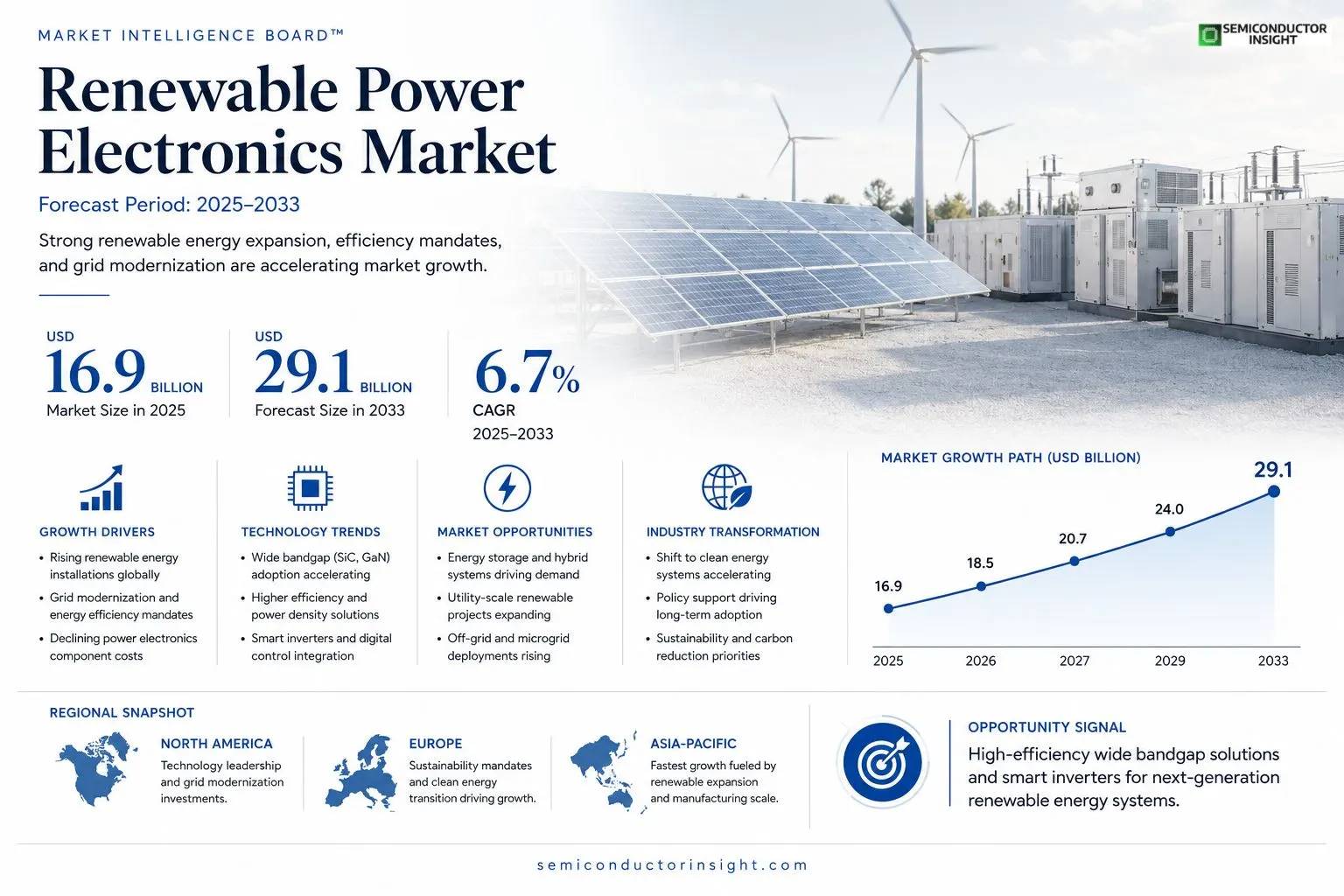
MARKET DRIVERS
Technology Advancements Driving Adoption
Renewable Power Electronics Market is benefiting from rapid improvements in silicon‑carbide (SiC) and gallium‑nitride (GaN) devices, which deliver higher efficiency and lower losses. These innovations enable power converters to achieve 95%‑plus efficiency, directly reducing operational costs for solar and wind farms.
Policy Support and Incentives
Government incentives across North America, Europe, and Asia‑Pacific continue to subsidize inverter installations and storage integration. Policy frameworks such as net‑metering and renewable portfolio standards accelerate capital deployment, creating a supportive environment for market participants.
➤ “The convergence of high‑performance semiconductor materials and robust policy backing is expected to push Renewable Power Electronics Market beyond $30 billion by 2030.”
Combined, these drivers are projected to generate a compound annual growth rate (CAGR) of roughly 10% over the next decade, reflecting strong demand from utility‑scale projects and emerging micro‑grid applications.
MARKET CHALLENGES
Supply Chain Constraints for Critical Materials
Limited availability of high‑purity silicon‑carbide wafers has led to longer lead times for manufacturers. Supply bottlenecks increase component costs, potentially delaying project timelines for renewable developers.
Other Challenges
Integration Complexity
Integrating advanced power electronics with existing grid infrastructure requires sophisticated control algorithms and extensive testing, raising engineering overhead for system integrators.Addressing these challenges will depend on strategic partnerships and diversification of material sources, which can mitigate risk and sustain market momentum.
MARKET RESTRAINTS
High Initial Capital Expenditure
The upfront investment for high‑efficiency converters and advanced cooling systems remains a significant barrier for smaller developers. Capital intensity can slow adoption rates, especially in emerging economies where financing options are limited.
Regulatory Uncertainty in Emerging Markets
Frequent revisions of energy policies and tariff structures in some regions create an unpredictable operating environment. Regulatory volatility discourages long‑term commitments, constraining market expansion.
MARKET OPPORTUNITIES
Energy Storage Integration
Coupling renewable power electronics with battery storage systems unlocks new value streams, such as peak‑shaving and frequency regulation. Hybrid solutions are projected to capture a growing share of Renewable Power Electronics Market, driven by grid stability requirements.
Emergence of Distributed Generation
Rural electrification programs and residential solar installations are creating demand for modular, scalable power converters. Localized manufacturing and OEM collaborations can tap this expanding segment, offering substantial upside potential.
Renewable Power Electronics Market Trends
Accelerating Adoptio n of Silicon‑Carbide Inverter Technology
Renewable Power Electronics Market is witnessing a rapid shift toward silicon‑carbide (SiC) based converters. SiC modules deliver higher efficiency, lower thermal losses, and greater power density compared with traditional silicon devices, enabling utility‑scale solar and wind projects to meet tighter grid compliance standards while reducing balance‑of‑system costs. Major OEMs such as Siemens Energy, ABB Ltd., and Schneider Electric have launched next‑generation inverter families that incorporate SiC switches, citing performance gains of up to 5 % in conversion efficiency. The trend is reinforced by declining SiC wafer prices driven by semiconductor‑fabrication advances, which make high‑performance hardware financially viable for a broader range of developers. Consequently, project planners are specifying SiC‑enabled inverters to achieve higher capacity factors and to future‑proof assets against evolving grid codes.
Other Trends
Integrated Storage‑Inverter Platforms
Another significant development in Renewable Power Electronics Market is the convergence of inverter and energy‑storage technologies. Partnerships such as ABB’s collaboration with Tesla’s Megapack illustrate a move toward bundled solutions that provide seamless power conversion, real‑time grid support, and remote monitoring within a single hardware envelope. Integrated platforms simplify project design, reduce installation timelines, and improve overall system reliability by eliminating interface mismatches between separate converters and battery management systems. OEMs are embedding DC‑DC chargers, bidirectional flow capabilities, and advanced grid‑forming algorithms directly into inverter chassis, allowing renewable assets to participate in ancillary services markets and to deliver firm capacity during periods of low generation.
Policy‑Driven Expansion of Distributed Generation
Regulatory incentives continue to shape Renewable Power Electronics Market, particularly in regions that have introduced aggressive net‑metering and feed‑in‑tariff policies. These measures encourage residential and commercial adopters to install rooftop solar and micro‑grid solutions, driving demand for compact, grid‑forming converters that can operate both in islanded and grid‑connected modes. Governments are also mandating higher power‑factor and low‑harmonic standards, prompting manufacturers to embed active filtering and reactive‑power control functions within their devices. As a result, the market is seeing a proliferation of modular inverter architectures that can be scaled from single‑phase residential units to multi‑megawatt community installations, supporting the broader transition toward decentralized, resilient energy systems.
COMPETITIVE LANDSCAPEKey Industry Players
Renewable Power Electronics Market Competitive Overview
Renewable Power Electronics Market is dominated by a handful of OEMs that command the majority of utility‑scale inverter and converter shipments. Siemens Energy, ABB Ltd., and Schneider Electric together account for roughly 45% of the total installed capacity, leveraging deep expertise in silicon‑carbide (SiC) modules and grid‑forming converter architectures. Huawei Technologies and Sungrow Power have rapidly expanded their market share in the Asia‑Pacific region by offering high‑efficiency, cost‑competitive inverter families that meet aggressive net‑metering policies. These leaders benefit from vertically integrated supply chains, extensive R&D investments, and strategic partnerships such as ABB’s collaboration with Tesla’s Megapack storage platform, which accelerates the convergence of power electronics and energy‑storage solutions. The market structure therefore reflects a classic oligopolistic pattern, where a few large manufacturers set technology standards while smaller firms chase niche applications and emerging geographies.Beyond the dominant quartet, a diverse set of niche players enriches the competitive landscape. Companies like Delta Electronics, GE Renewable Energy, and Mitsubishi Electric focus on specialized wind‑turbine converters and high‑voltage DC‑DC chargers for offshore projects. European specialists such as SMA Solar Technology and Enphase Energy excel in residential and commercial solar‑inverter segments, emphasizing micro‑inverter innovation and smart monitoring. Vestas, while primarily a turbine OEM, increasingly integrates its own power‑electronics platforms to improve turbine efficiency. Additional contributors,including Fuji Electric, Hitachi Energy, and Powercloud,provide customized grid‑integration solutions, advanced control software, and cloud‑based analytics that support the decarbonization agenda across utility and industrial customers.
List of Key Renewable Power Electronics Companies Profiled
- Siemens Energy
- ABB Ltd.
- Schneider Electric
- Huawei Technologies
- Sungrow Power
- Delta Electronics
- GE Renewable Energy
- Mitsubishi Electric
- SMA Solar Technology
- Enphase Energy
- Vestas
- Fuji Electric
- Hitachi Energy
- Powercloud
- Tesla (Megapack)
Segment Analysis:
| Segment Category | Sub-Segments | Key Insights |
| By Type |
|
Inverter Solutions drive market momentum, highlighted by:
|
| By Application |
|
Utility‑Scale Deployments dominate the application landscape, because:
|
| By End User |
|
Utility Operators shape development trends through:
|
| By Technology Trend |
|
Next‑Generation Semiconductors are a catalyst for performance gains, evident from:
|
| By Value‑Chain Role |
|
System Integrators are becoming pivotal, because:
|
Regional Analysis: North America
United States
The solar energy sector is a major consumer of Renewable Power Electronics Market components, including inverters, optimizers, and microinverters. Advancements in solar technology and the increasing deployment of rooftop solar systems are fueling demand for efficient and cost-effective power electronics solutions.
The wind energy industry relies heavily on power electronics for grid connection and control of wind turbines. The trend towards larger and more powerful wind turbines is driving the need for advanced power converters and control systems to ensure optimal performance and grid stability within Renewable Power Electronics Market.
The integration of energy storage systems with renewable energy sources is becoming increasingly important for grid reliability and stability. Power electronics play a crucial role in managing the charging and discharging of batteries and other energy storage technologies within Renewable Power Electronics Market.
The burgeoning electric vehicle market is creating significant demand for power electronics in on-board chargers, motor drives, and power management systems. The innovation in this area is focused on enhancing efficiency, reducing weight, and improving the overall performance of EVs within the broader Renewable Power Electronics Market.
Europe
Europe is at the forefront of the transition to renewable energy, presenting a substantial and dynamic Renewable Power Electronics Market. Stringent climate targets, coupled with supportive government policies like the European Green Deal, are driving significant investments in renewable energy infrastructure. The demand for efficient and reliable power electronics is particularly high in countries like Germany, the UK, and France, where solar and wind power generation are rapidly expanding. The focus is on smart grids, energy efficiency, and the integration of distributed renewable energy sources. Furthermore, the development of offshore wind power projects is creating new opportunities for power electronics solutions. Companies operating in Renewable Power Electronics Market in Europe are emphasizing innovation in areas such as grid stabilization, energy storage, and advanced inverter technologies.
Asia-Pacific
Asia-Pacific is emerging as the fastest-growing market for Renewable Power Electronics Market, driven by massive investments in renewable energy capacity, particularly in China, India, and Japan. Government initiatives promoting clean energy and the decreasing cost of renewable technologies are key factors fueling this growth. The demand for power electronics is concentrated in solar PV systems, wind power, and energy storage projects. China remains the largest market in the region, with significant investments in solar and wind power development. India’s ambitious renewable energy targets are creating substantial opportunities for Renewable Power Electronics Market. The region is witnessing increasing adoption of advanced power electronics technologies and a growing focus on grid modernization and energy management systems.
South America
South America presents a promising, yet developing, Renewable Power Electronics Market. Countries like Brazil and Chile are witnessing increasing investments in renewable energy projects, particularly hydropower, solar, and wind power. Supportive government policies and the availability of abundant renewable resources are driving market growth. The demand for power electronics is primarily focused on grid integration of renewable energy sources and the development of distributed generation systems. While the market is relatively nascent compared to other regions, it offers significant potential for growth in the coming years within Renewable Power Electronics Market.
Middle East & Africa
The Middle East and Africa represent an expanding Renewable Power Electronics Market, driven by the need for energy diversification and the abundance of solar and wind resources. Countries like Saudi Arabia, the UAE, and South Africa are investing heavily in renewable energy projects as part of their long-term energy strategies. The demand for power electronics is concentrated in solar PV systems, particularly in large-scale solar farms, and wind power projects. The region’s hot climate and high solar irradiance make it particularly well-suited for solar energy development. Renewable Power Electronics Market in the Middle East and Africa is expected to witness significant growth in the coming years, driven by increasing investments and supportive government policies.
Report Scope
This market research report provides a comprehensive analysis of the Renewable Power Electronics Market , covering the forecast period 2026–2034. It offers detailed insights into market dynamics, technological advancements, competitive landscape, and key trends shaping the industry.
Key focus areas of the report include:
- Market Overview: The report begins with an overview outlining its current market scenario, key growth indicators, and industry transformation drivers. It discusses macroeconomic factors, demand–supply balance, regulatory landscape, and the strategic role of semiconductors in powering advancements across industries such as automotive, telecommunications, consumer electronics, and industrial automation.
- Market Size & Forecast: Historical data and future projections for revenue, unit shipments, and market value across major regions and segments.
- Segmentation Analysis: Detailed breakdown by product type, technology, application, and end-user industry to identify high-growth segments and investment opportunities.
- Regional Insights: Insights into market performance across North America, Europe, Asia-Pacific, Latin America, and the Middle East & Africa, including country-level analysis where relevant.
- Competitive Landscape: Profiles of leading market participants, including their product offerings, R&D focus, manufacturing capacity, pricing strategies, and recent developments such as mergers, acquisitions, and partnerships.
- Technology Trends & Innovation: Assessment of emerging technologies, integration of AI/IoT, semiconductor design trends, fabrication techniques, and evolving industry standards.
- Market Drivers & Restraints: Evaluation of factors driving market growth along with challenges, supply chain constraints, regulatory issues, and market-entry barriers.
- Stakeholder Insights: Insights for component suppliers, OEMs, system integrators, investors, and policymakers regarding the evolving ecosystem and strategic opportunities.
Primary and secondary research methods are employed, including interviews with industry experts, data from verified sources, and real-time market intelligence to ensure the accuracy and reliability of the insights presented.
FREQUENTLY ASKED QUESTIONS:
What is the current market size of Renewable Power Electronics Market?
-> Renewable Power Electronics Market was valued at USD 16.9 billion in 2025 and is expected to reach USD 29.1 billion by 2034, exhibiting a CAGR of 6%.
Which key companies operate in Renewable Power Electronics Market?
-> Key players include Siemens Energy, ABB Ltd., Schneider Electric, Huawei Technologies, and Sungrow Power.
What are the key growth drivers?
-> Key growth drivers include expanding solar‑PV capacity, aggressive wind‑farm deployments, supportive net‑metering policies, declining component costs, and demand for high‑efficiency silicon‑carbide (SiC) modules.
Which region dominates the market?
-> The reference does not provide specific regional dominance data.
What are the emerging trends?
-> Emerging trends include integration of silicon‑carbide (SiC) technology, next‑generation inverter families, and collaborative integrated power‑electronics solutions such as ABB’s partnership with Tesla’s Megapack.

Get Sample Report PDF for Exclusive Insights
Report Sample Includes
- Table of Contents
- List of Tables & Figures
- Charts, Research Methodology, and more...
 Download Sample Report PDF