Ambient Light & Proximity Sensor IC Market Insights
Global Ambient Light & Proximity Sensor IC Market size was valued at USD 2.85 billion in 2025. The market is projected to grow from USD 3.0F5 billion in 2026 to USD 5.92 billion by 2034, exhibiting a CAGR of 9.8% during the forecast period.
Ambient Light & Proximity Sensor ICs are specialized semiconductor devices designed to detect surrounding light levels and the presence of nearby objects. These integrated circuits combine ambient light sensing capabilities with proximity detection, typically utilizing infrared or optical technologies, to enable automatic adjustments in device functionality. They play a critical role in optimizing display brightness, managing power consumption, and facilitating touchless interactions across various applications.
The market is experiencing robust growth due to several factors, including the proliferation of smartphones, wearables, and IoT devices that require precise environmental sensing for enhanced user experiences and energy efficiency. Rising adoption in automotive applications for advanced driver assistance systems and interior lighting controls further accelerates demand. Additionally, the expansion of smart home technologies and industrial automation contributes significantly to market expansion. Key players continue to innovate with more compact, low-power designs that integrate multiple sensing functions into single chips. For instance, advancements in sensor fusion technologies allow seamless combination of ambient light, proximity, and color detection, supporting next-generation consumer electronics and automotive innovations. Major companies such as ams-OSRAM, STMicroelectronics, Vishay Intertechnology, and Broadcom maintain strong positions through extensive portfolios of high-performance sensor IC solutions.
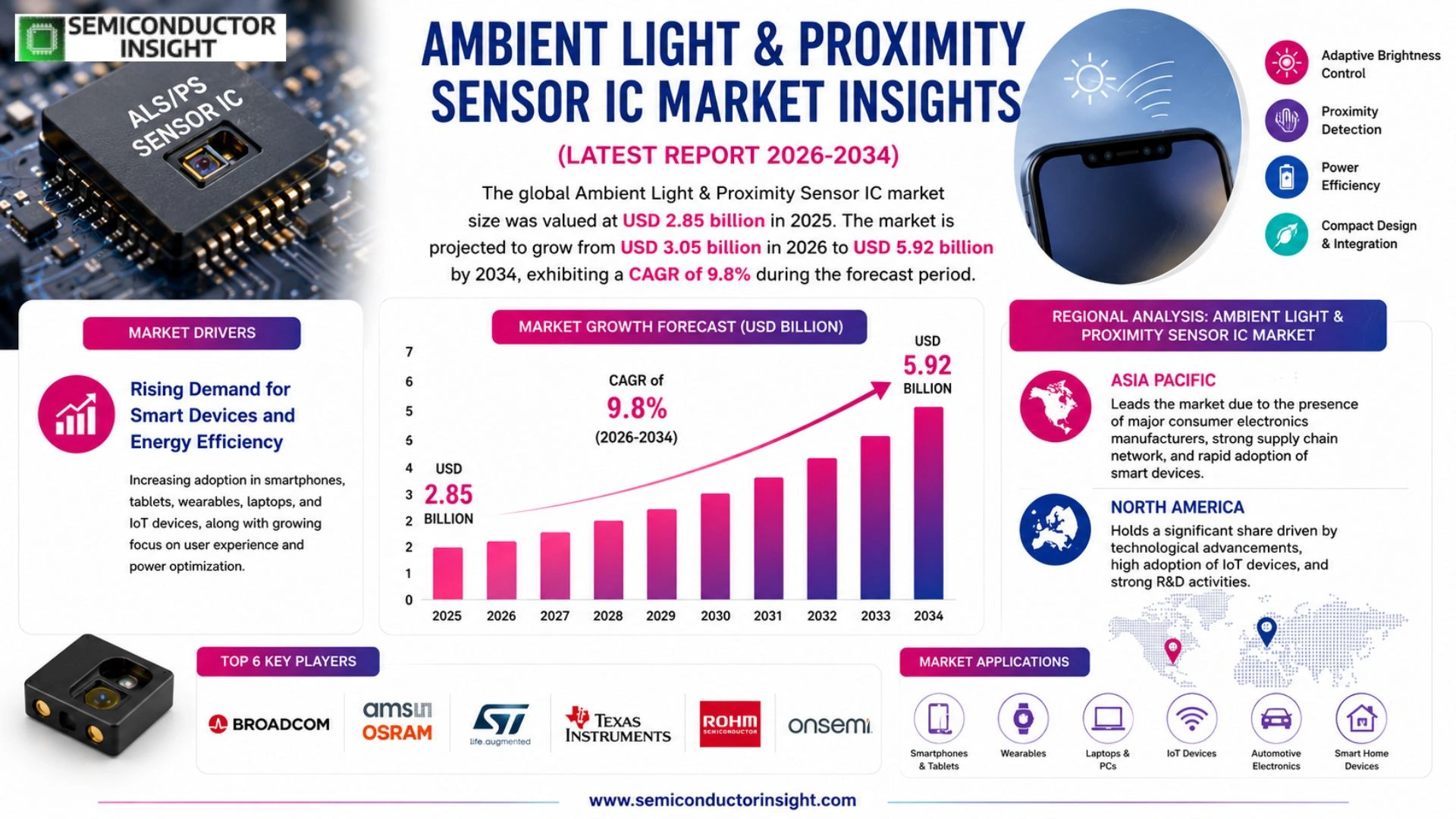
MARKET DRIVERS
Rising Demand in Consumer Electronics
Ambient Light & Proximity Sensor IC Market is experiencing robust growth fueled by widespread integration in smartphones, tablets, laptops, and wearables. These ICs enable automatic brightness adjustment and efficient power management, enhancing user experience while extending battery life in portable devices. As global smartphone penetration continues to rise, manufacturers prioritize advanced sensor solutions for adaptive display technologies, particularly in OLED screens.
Automotive and Industrial Automation Expansion
Automotive applications represent a significant driver, with Ambient Light & Proximity Sensor ICs deployed in advanced driver assistance systems, instrument clusters, and infotainment displays for improved visibility and safety. The push toward Industry 4.0 and smart manufacturing further accelerates demand, as these sensors support precise object detection and environmental monitoring in automated production lines. Market projections indicate steady double-digit CAGR supported by these sectors.
➤ The integration of ambient light sensors in automotive displays and bezel-less consumer electronics continues to propel market expansion through enhanced functionality and energy efficiency.
Additionally, the proliferation of IoT devices and smart home ecosystems creates sustained demand for compact, low-power Ambient Light & Proximity Sensor IC solutions that deliver reliable performance across diverse lighting conditions.
MARKET CHALLENGES
Performance in Varied Lighting Conditions
Ambient Light & Proximity Sensor ICs often face accuracy challenges in mixed or rapidly changing lighting environments, where differentiation between natural, artificial, and colored light sources can lead to inconsistent performance in displays and detection systems. This impacts reliability in consumer and automotive applications.
Other Challenges
Integration and Miniaturization Complexity
Embedding high-performance Ambient Light & Proximity Sensor ICs into increasingly compact devices requires sophisticated engineering, raising development costs and extending time-to-market for OEMs.
Supply Chain and Cost Pressures
Geopolitical tensions and semiconductor supply constraints create volatility, while price sensitivity in mass-market electronics limits adoption of premium integrated solutions.
MARKET RESTRAINTS
High Development Costs and Competition
Ambient Light & Proximity Sensor IC Market encounters restraints from substantial R&D investments needed for miniaturization and improved ambient light immunity. Intense competition among established semiconductor players pressures pricing, particularly in high-volume consumer electronics segments where cost optimization remains critical.
MARKET OPPORTUNITIES
Emerging Technologies and IoT Growth
Significant opportunities exist in the development of multi-function integrated sensors combining ambient light, proximity, and gesture recognition for next-generation wearables, AR/VR devices, and smart city infrastructure. Advancements in low-power designs and AI-enhanced signal processing open new application areas in healthcare monitoring and industrial predictive maintenance.
Trends
Proliferation of Smart Devices Driving Sensor Adoption
Ambient Light & Proximity Sensor IC Market is experiencing robust growth propelled by the widespread adoption of smartphones, wearables, and IoT devices. These specialized semiconductor devices combine ambient light sensing with proximity detection using infrared or optical technologies, enabling automatic display brightness adjustments, power management, and touchless user interactions. As consumer electronics demand precise environmental sensing for enhanced user experiences and energy efficiency, manufacturers are increasingly integrating these ICs into their product designs.
Other Trends
Expansion in Automotive and Industrial Applications
Rising adoption in automotive applications for advanced driver assistance systems and interior lighting controls is accelerating demand for Ambient Light & Proximity Sensor ICs. Similarly, the growth of smart home technologies and industrial automation relies on these sensors for reliable environmental monitoring and operational efficiency. This diversification across sectors underscores the versatility of integrated sensing solutions in modern technology ecosystems.
Technological Innovations in Sensor Fusion
Key players in Ambient Light & Proximity Sensor IC Market, including ams-OSRAM, STMicroelectronics, Vishay Intertechnology, and Broadcom, are focusing on developing more compact, low-power designs that integrate multiple sensing functions into single chips. Advancements in sensor fusion technologies enable seamless combination of ambient light, proximity, and color detection capabilities. These innovations support next-generation consumer electronics and automotive solutions by delivering higher performance while reducing overall system complexity and power consumption. The trend toward multifunctional ICs continues to shape competitive strategies, allowing companies to address evolving requirements for smarter, more efficient devices across various end-use applications. Industry participants are prioritizing research into improved accuracy and integration features to maintain their positions in this dynamic market landscape.
COMPETITIVE LANDSCAPE
Key Industry Players
Ambient Light & Proximity Sensor IC Market Features Strong Competition Among Leading Semiconductor Innovators
Ambient Light & Proximity Sensor IC Market is led by a concentrated group of established semiconductor manufacturers with deep expertise in optical sensing technologies. ams-OSRAM holds a dominant position through its comprehensive portfolio of highly integrated sensor solutions optimized for consumer electronics, automotive, and industrial applications. The competitive landscape is characterized by ongoing innovation in low-power designs, sensor fusion capabilities, and miniaturization to meet the demands of next-generation smartphones, wearables, and IoT devices. Companies leverage vertical integration and advanced manufacturing processes to maintain technological edges in accuracy, power efficiency, and multi-function integration.
Other significant players include STMicroelectronics, Vishay Intertechnology, and Broadcom, which compete effectively through specialized product lines targeting diverse end-use sectors. These firms continue to expand their market presence via strategic partnerships, R&D investments in advanced optical technologies, and tailored solutions for emerging applications such as automotive ADAS and smart home automation. The market structure supports both broad portfolio leaders and niche specialists focused on cost-effective or high-precision solutions.
List of Key Ambient Light & Proximity Sensor IC Companies Profiled
- ams-OSRAM AG
- STMicroelectronics N.V.
- Broadcom Inc.
- Vishay Intertechnology Inc.
- ON Semiconductor Corporation
- Texas Instruments Incorporated
- ROHM Semiconductor
- Infineon Technologies AG
- Analog Devices Inc.
- Panasonic Corporation
- Renesas Electronics Corporation
- Maxim Integrated
- LITE-ON Technology Corp.
- Silicon Laboratories Inc.
- Microchip Technology Inc.
Segment Analysis:
| Segment Category | Sub-Segments | Key Insights |
| By Type |
|
Integrated Ambient Light & Proximity Sensor ICs represent the dominant category due to their ability to deliver seamless multi-sensing capabilities within a compact footprint. These solutions enable sophisticated environmental awareness that supports automatic display adjustments and touchless operations. Manufacturers favor them for simplifying device design and reducing component count. Their enhanced sensor fusion features allow precise light measurement combined with reliable object detection across varying conditions. |
| By Application |
|
Consumer Electronics stands as the leading application segment as these sensors are essential for optimizing user interfaces and power efficiency in portable devices. They facilitate dynamic screen brightness control based on ambient conditions while enabling intuitive proximity-based features such as call auto-mute. The demand for immersive experiences drives continuous innovation in sensor accuracy and response time. Integration with advanced display technologies further enhances their value in premium devices. |
| By End User |
|
Smartphone and Tablet Manufacturers constitute the primary end user group due to the universal requirement for environmental sensing in mobile communication devices. These sensors contribute significantly to battery life extension through intelligent power management and deliver enhanced user comfort via adaptive interfaces. Their role in supporting camera functionality and gesture controls makes them indispensable. Continuous pursuit of thinner form factors pushes demand for highly miniaturized solutions. |
| By Technology |
|
Sensor Fusion Platforms emerge as the leading technology segment by combining multiple detection methods into unified intelligent systems. These platforms deliver superior performance through cross-validation of data from different sensing modalities. They excel in challenging environments where single-technology approaches may falter. The ability to process complex environmental inputs supports advanced features like adaptive lighting control and precise gesture recognition. |
| By Integration Level |
|
Highly Integrated Single-Chip Solutions lead this segment by offering space-efficient designs that minimize power consumption while maximizing functionality. These solutions streamline manufacturing processes for device makers and reduce overall system complexity. Their compact nature supports the ongoing trend toward sleeker product designs across consumer and automotive sectors. Advanced manufacturing techniques enable these chips to maintain high accuracy despite their reduced size. |
Regional Analysis: Ambient Light & Proximity Sensor IC Market
Asia-Pacific
Asia-Pacific’s unparalleled electronics manufacturing infrastructure enables cost-effective production of Ambient Light & Proximity Sensor ICs at scale. Clusters in Shenzhen, Seoul, and Tokyo facilitate seamless integration of these components into high-volume products, supporting rapid iteration and customization for diverse applications.
The region leads in developing ultra-low power and highly sensitive sensor ICs that meet demands for next-generation displays and touchless interfaces. Collaborative ecosystems between universities and enterprises drive breakthroughs in multi-spectrum detection and AI-enhanced proximity algorithms.
Explosive growth in smartphones, smart home devices, and automotive interiors creates sustained demand for integrated ambient light and proximity solutions. Consumer preference for adaptive displays and intuitive user interfaces further propels market expansion across the region.
Leading semiconductor firms form alliances with device OEMs to co-develop specialized sensor ICs, ensuring compatibility with emerging standards in IoT and connected vehicles while accelerating time-to-market for innovative applications.
North America
North America maintains a significant position in Ambient Light & Proximity Sensor IC Market through its focus on high-performance and premium applications. The region excels in automotive innovation, where these sensors enhance driver monitoring systems and adaptive lighting in luxury vehicles. Strong presence of technology companies drives demand for advanced sensor solutions in enterprise devices, medical equipment, and high-end consumer electronics. Research institutions contribute to cutting-edge developments in sensor fusion and AI integration, creating differentiated products that command higher value. Business strategies emphasize intellectual property development and strategic acquisitions to strengthen domestic capabilities in semiconductor design. The market here prioritizes reliability, precision, and compliance with stringent quality standards across industrial and healthcare sectors.
Europe
Europe demonstrates steady growth in Ambient Light & Proximity Sensor IC Market, supported by its leadership in automotive manufacturing and industrial automation. Countries like Germany, France, and the UK integrate these ICs extensively in smart factories and next-generation vehicles for enhanced safety features and energy management. Regulatory emphasis on sustainability encourages adoption of power-efficient sensor technologies in consumer appliances and building automation. European firms focus on specialized solutions for harsh environments and precision applications, differentiating through superior engineering and robust supply chain practices. Collaborative projects between industry and academia foster innovation in optical sensing technologies, while strict data privacy regulations influence development of secure proximity detection systems.
South America
South America is gradually expanding its footprint in Ambient Light & Proximity Sensor IC Market, primarily through increasing consumer electronics imports and local assembly operations. Brazil and Mexico serve as key entry points where rising middle-class demand for smartphones and smart home devices stimulates adoption of ambient light and proximity solutions. The region shows potential in agricultural technology applications, utilizing sensors for environmental monitoring equipment. Market participants adapt global technologies to address local needs in automotive aftermarket and industrial sectors. Business strategies center on partnerships with international suppliers and investments in technical training to build local expertise, setting the foundation for future self-sustained growth in sensor-enabled electronics.
Middle East & Africa
The Middle East & Africa region presents emerging opportunities in Ambient Light & Proximity Sensor IC Market, driven by smart city initiatives and digital transformation efforts. Gulf countries invest heavily in modern infrastructure incorporating intelligent lighting and building management systems that rely on these sensor ICs. Growing consumer markets in South Africa and Nigeria boost demand for affordable mobile devices featuring basic ambient light and proximity functionalities. The energy sector explores applications in remote monitoring equipment where reliable sensing capabilities prove valuable. Strategic focus remains on technology transfer agreements and infrastructure development to support wider adoption of IoT solutions across diverse climatic conditions and industrial applications.
Report Scope
This market research report provides a comprehensive analysis of the Ambient Light & Proximity Sensor IC Market , covering the forecast period 2026–2034. It offers detailed insights into market dynamics, technological advancements, competitive landscape, and key trends shaping the industry.
Key focus areas of the report include:
- Market Overview: The report begins with an overview outlining its current market scenario, key growth indicators, and industry transformation drivers. It discusses macroeconomic factors, demand–supply balance, regulatory landscape, and the strategic role of semiconductors in powering advancements across industries such as automotive, telecommunications, consumer electronics, and industrial automation.
- Market Size & Forecast: Historical data and future projections for revenue, unit shipments, and market value across major regions and segments.
- Segmentation Analysis: Detailed breakdown by product type, technology, application, and end-user industry to identify high-growth segments and investment opportunities.
- Regional Insights: Insights into market performance across North America, Europe, Asia-Pacific, Latin America, and the Middle East & Africa, including country-level analysis where relevant.
- Competitive Landscape: Profiles of leading market participants, including their product offerings, R&D focus, manufacturing capacity, pricing strategies, and recent developments such as mergers, acquisitions, and partnerships.
- Technology Trends & Innovation: Assessment of emerging technologies, integration of AI/IoT, semiconductor design trends, fabrication techniques, and evolving industry standards.
- Market Drivers & Restraints: Evaluation of factors driving market growth along with challenges, supply chain constraints, regulatory issues, and market-entry barriers.
- Stakeholder Insights: Insights for component suppliers, OEMs, system integrators, investors, and policymakers regarding the evolving ecosystem and strategic opportunities.
Primary and secondary research methods are employed, including interviews with industry experts, data from verified sources, and real-time market intelligence to ensure the accuracy and reliability of the insights presented.
FREQUENTLY ASKED QUESTIONS:
What is the current market size of Ambient Light & Proximity Sensor IC Market?
-> Ambient Light & Proximity Sensor IC Market was valued at USD 2.85 billion in 2025 and is expected to reach USD 5.92 billion by 2034.
Which key companies operate Ambient Light & Proximity Sensor IC Market?
-> Key players include ams-OSRAM, STMicroelectronics, Vishay Intertechnology, and Broadcom, among others.
What are the key growth drivers?
-> Key growth drivers include proliferation of smartphones, wearables, and IoT devices, rising adoption in automotive applications, smart home technologies, and industrial automation.
Which region dominates the market?
-> Asia-Pacific is the fastest-growing region with strong demand from consumer electronics manufacturing.
What are the emerging trends?
-> Emerging trends include compact low-power designs, sensor fusion technologies integrating ambient light, proximity, and color detection.

Get Sample Report PDF for Exclusive Insights
Report Sample Includes
- Table of Contents
- List of Tables & Figures
- Charts, Research Methodology, and more...