Key Statistics
Key Takeaways
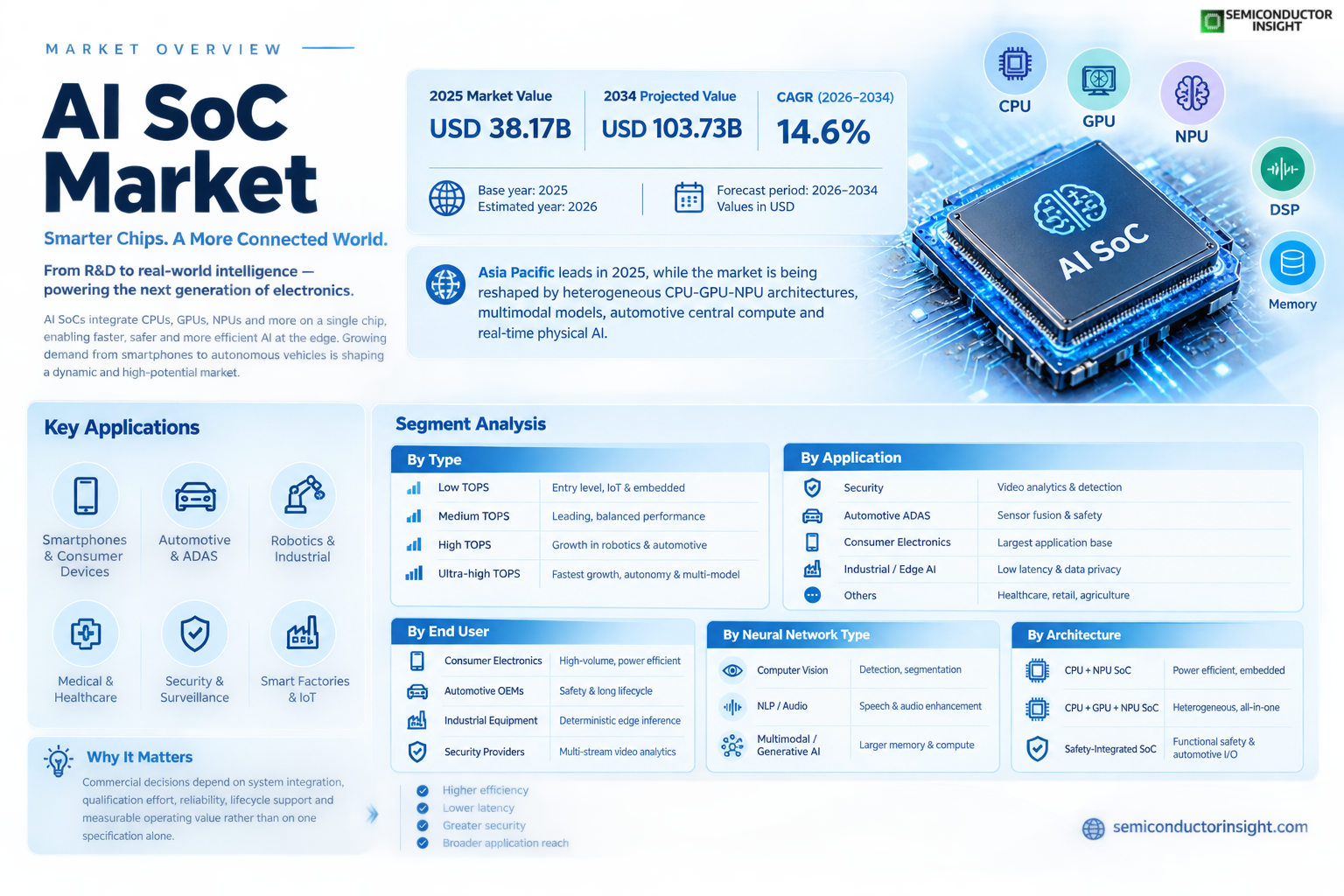
- Market size and growth: the market is valued at USD 38.17 billion in 2025 and is projected to reach USD 103.73 billion by 2034, with a 14.6% CAGR over 2026–2034.
- Medium TOPS is the leading type because mid-range AI compute offers the best balance of power, cost and inference performance across consumer, security and industrial edge devices.
- Consumer Electronics is the leading application because smartphones, cameras, wearables and smart-home devices integrate high-volume on-device inference with tight power budgets.
- Asia Pacific leads regionally, while Asia Pacific offers the strongest incremental growth.
- Primary driver: edge AI, robotics and software-defined vehicles are increasing demand for efficient on-device inference and heterogeneous compute
- Principal restraint: rapid model evolution, software fragmentation and high advanced-node development cost can shorten product relevance and raise design risk
Market Overview
AI SoC market was valued at USD 38.17 billion in 2025 and is projected to reach USD 103.73 billion by 2034, expanding at a 14.6% CAGR over 2026–2034. Asia Pacific leads in 2025, while the market is being reshaped by heterogeneous CPU-GPU-NPU architectures, multimodal models, automotive central compute and real-time physical AI..
AI systems-on-chip integrate general-purpose processing with dedicated accelerators such as NPUs, GPUs, DSPs or tensor engines on a single silicon platform. They enable vision, speech, sensor fusion and neural-network inference close to the data source, reducing latency and dependence on cloud connectivity. Performance ranges from low-TOPS embedded devices to very high-compute automotive and robotics platforms, with power efficiency often more important than peak throughput alone.
Product architecture is becoming more heterogeneous. Modern AI SoCs combine CPU cores, graphics, AI accelerators, image-signal processors, memory controllers, security blocks and high-speed I/O so workloads can be assigned to the engine that executes them most efficiently. Qualcomm’s automotive Elite platforms and NVIDIA’s Jetson Thor illustrate this direction, combining powerful general compute with dedicated AI acceleration for perception, generative models and real-time decision making.
Demand is expanding beyond smartphones and cameras into robotics, industrial machines, medical devices and vehicles. NVIDIA made Jetson Thor generally available in 2025 and reported a large robotics developer ecosystem, while NXP’s i.MX 95 integrates an eIQ Neutron NPU for safe and power-efficient edge computing. This broadening application base strengthens the market for scalable SoC families rather than one-off accelerator chips.
Segment Analysis: By Type
By type, the market is segmented into Low TOPS, Medium TOPS, High TOPS, Ultra-high TOPS. Medium TOPS holds the leading position based on current application breadth and purchasing economics.
| Type | Function / role | Market position |
|---|---|---|
| Low TOPS | Entry AI acceleration for simple classification, audio and low-complexity vision. | Value-focused segment for constrained IoT and embedded devices. |
| Medium TOPS | Mainstream edge inference for consumer electronics, cameras and industrial devices. | Leading type because it balances performance, energy use and bill-of-material cost. |
| High TOPS | Advanced vision, multi-sensor fusion and richer generative or perception workloads. | Strong growth in premium edge, robotics and automotive applications. |
| Ultra-high TOPS | Central compute for complex autonomy, robotics and multi-model inference. | Fastest-growing premium tier as physical AI and centralized vehicle architectures expand. |
Commercial implications by type
TOPS alone does not determine commercial value. Memory bandwidth, supported data types, software tooling, thermal design and model efficiency shape real-world performance. Medium-compute products lead broad deployment, while ultra-high-compute platforms capture disproportionate value in robotics and software-defined vehicles where fewer chips can consolidate multiple workloads.
Segment Analysis: By Application
By application, demand is segmented into Security, Automotive ADAS/Autonomous Driving, Consumer Electronics, General Edge/Industrial Control AI, Others. Consumer Electronics is the leading use case because it directly connects the technology to measurable operating, safety or performance benefits.
| Application | Demand characteristics |
|---|---|
| Security | Smart cameras and video analytics use local inference for detection, tracking and event classification. |
| Automotive ADAS/Autonomous Driving | Sensor fusion, driver monitoring and automated driving demand deterministic, safety-oriented AI compute. |
| Consumer Electronics | Largest application across smartphones, wearables, cameras and smart-home products. |
| General Edge/Industrial Control AI | Factories and robots use local AI to minimize latency and protect process data. |
| Others | Healthcare, retail, agriculture and communications add specialized edge-AI workloads. |
By End User
| End User | Commercial relevance |
|---|---|
| Consumer Electronics Manufacturers | High-volume product cycles favor power-efficient SoCs with strong multimedia and AI integration. |
| Automotive OEMs | Safety, long lifecycle and multi-sensor compute drive high-performance automotive SoCs. |
| Industrial Equipment Providers | Robotics and machine vision demand deterministic edge inference and long support periods. |
| Security Solutions Providers | Video analytics and surveillance require efficient multi-stream vision processing. |
By Neural Network Type
| Neural Network Type | Commercial relevance |
|---|---|
| Computer Vision | Object detection, segmentation and image enhancement drive many edge deployments. |
| Natural Language / Audio | Speech recognition, assistants and audio enhancement increasingly run locally. |
| Multimodal / Generative AI | Newer SoCs target transformer and multimodal workloads with larger memory and compute demands. |
By Architecture
| Architecture | Commercial relevance |
|---|---|
| CPU + NPU SoC | Power-efficient embedded platforms accelerate inference while retaining flexible CPU control. |
| CPU + GPU + NPU SoC | Heterogeneous platforms support graphics, AI and general compute in one device. |
| Safety-Integrated Automotive SoC | Adds functional-safety islands and automotive-grade I/O for ADAS and central compute. |
Regional Analysis
Asia Pacific leads the market because China, South Korea, Taiwan and Japan combine massive consumer-electronics production, semiconductor design activity and rapidly expanding automotive and industrial AI deployment. Asia Pacific is positioned for the fastest expansion as adoption increases in edge AI, smart devices, autonomous systems and localized semiconductor ecosystems.
How does regional demand differ across this market?
Asia Pacific leads through scale in consumer electronics, cameras, automotive systems and semiconductor manufacturing. North America is strongest in high-end AI architecture, software and robotics platforms. Europe emphasizes automotive safety, industrial automation and power-efficient edge computing. Smaller regions adopt AI SoCs primarily through imported end systems, with growth tied to smart-city, industrial and mobility investments.
| Region | Position | Growth outlook | Demand profile | Supplier selection |
|---|---|---|---|---|
| Asia Pacific | Largest | Fastest | Consumer, automotive and industrial scale | Power efficiency, cost, ecosystem |
| North America | Second | Strong | AI architecture and robotics | Software ecosystem and compute density |
| Europe | Third | Strong | Automotive and industrial AI | Safety, lifecycle and efficiency |
| South America | Smaller | Moderate | Security and industrial applications | Cost and availability |
| Middle East & Africa | Emerging | Strong | Smart cities and security | Integration and support |
Competitive Landscape
Competition is fragmented across GPU leaders, mobile SoC vendors, automotive specialists and regional edge-AI chip designers, with software ecosystems becoming as important as raw silicon performance.
NVIDIA, Qualcomm, AMD and Mobileye compete in high-value edge, automotive and robotics workloads, while Rockchip, SigmaStar, Fullhan, Ingenic, Horizon Robotics and Black Sesame Technologies target more application-specific and regionally optimized products.
Hardware-software co-design is critical. Developers compare not only TOPS but compilers, model support, quantization, libraries and long-term updates. A strong software stack can therefore create durable platform adoption even when competing chips offer similar peak arithmetic performance.
Automotive AI is a major convergence point. Qualcomm’s Snapdragon Ride Elite integrates high-performance CPU, GPU, NPU and safety functions, while newer centralized vehicle architectures reduce the number of discrete controllers and raise the performance expected from each SoC.
| Competitive tier | Representative participants | Competitive focus |
|---|---|---|
| High-performance platform leaders | NVIDIA, Qualcomm, AMD, Mobileye | Robotics, automotive and premium edge AI |
| Edge and vision specialists | Rockchip, SigmaStar, Fullhan, Ingenic | Cameras, embedded vision and consumer edge devices |
| Automotive AI specialists | Horizon Robotics, Black Sesame, NXP, Renesas | ADAS, central compute and safety-oriented platforms |
Companies Profiled
NVIDIA Corporation, Qualcomm Technologies, Mobileye, AMD, HiSilicon, Rockchip Electronics, SigmaStar Technology, Shanghai Fullhan Microelectronics, Ingenic Semiconductor, Horizon Robotics, Black Sesame Technologies, Texas Instruments, Renesas Electronics, NXP Semiconductors, Allwinner Technology
Production Capacity Analysis
Production depends on advanced and mature-node foundry capacity, high-speed memory interfaces, packaging, software validation and long-term access to IP cores and EDA tools.
High-performance AI SoCs often use advanced process nodes because power efficiency is critical, linking supply to a limited set of foundries. Mid-range edge products can use more mature nodes, which broadens manufacturing options but still requires substantial non-recurring engineering and mask investment.
Packaging and memory increasingly constrain system performance. Automotive and robotics platforms need high bandwidth and large memory footprints, so substrate, package thermal design and memory qualification can affect shipment ramps even when wafer supply is available.
Market Dynamics
The market is expanding rapidly, but performance leadership moves quickly as model architectures and software frameworks evolve.
A chip can become commercially obsolete before its silicon process is technically outdated if it lacks support for new models, data types or memory requirements. Suppliers therefore need frequent software releases and scalable product families. Customers increasingly prefer platforms that can run multiple workloads and receive long-term toolchain support rather than isolated accelerators with narrow programmability.
Market Drivers
Drivers Impact Analysis
| Driver | Impact | Commercial mechanism |
|---|---|---|
| Edge AI adoption | High | Local inference reduces latency, bandwidth use and privacy exposure across cameras, devices and machines. |
| Automotive intelligence | High | ADAS and central compute require high-performance, safety-oriented AI processing. |
| Robotics and physical AI | High | Real-time perception and generative reasoning push edge compute requirements upward. |
| Energy efficiency | High | Battery and thermally constrained products require more inference per watt. |
Edge AI adoption
Local inference reduces latency, bandwidth use and privacy exposure across cameras, devices and machines.
Automotive intelligence
ADAS and central compute require high-performance, safety-oriented AI processing.
Robotics and physical AI
Real-time perception and generative reasoning push edge compute requirements upward.
Energy efficiency
Battery and thermally constrained products require more inference per watt.
Market Restraints
Restraints Impact Analysis
| Restraint | Impact | Commercial mechanism |
|---|---|---|
| Advanced-node cost | High | Large AI SoCs require expensive design, masks and verification. |
| Software fragmentation | High | Different toolchains and model formats can slow customer adoption. |
| Rapid model evolution | Medium | New models can outgrow memory and compute assumptions made during chip design. |
| Export and supply constraints | Medium | High-end AI silicon can be affected by geopolitical and supply-chain restrictions. |
Advanced-node cost
Large AI SoCs require expensive design, masks and verification.
Software fragmentation
Different toolchains and model formats can slow customer adoption.
Rapid model evolution
New models can outgrow memory and compute assumptions made during chip design.
Export and supply constraints
High-end AI silicon can be affected by geopolitical and supply-chain restrictions.
Market Opportunities
Physical AI and robotics
Robots require compact platforms capable of vision, language and control inference in real time.
Automotive central compute
Consolidating cockpit and ADAS functions into fewer SoCs raises value per device.
Multimodal consumer AI
On-device language, vision and audio models create new smartphone and wearable use cases.
Industrial edge intelligence
Factories can run machine vision and predictive models locally without cloud latency.
Supply Chain Analysis
CPU/GPU/NPU cores, interconnect, compilers
Advanced and mature process nodes
Substrates, DRAM, thermal management
Devices, vehicles, robots, cameras
IP and software
Architecture IP, compilers and optimized libraries determine how efficiently models use the silicon.
Wafer fabrication
Node selection balances cost, performance and power. Advanced products depend on leading foundries.
Packaging and memory
High-performance AI workloads need bandwidth, power delivery and thermal control that increasingly shape package design.
OEM integration
Customers validate real application performance, software support and lifecycle stability before committing a platform.
Recent Developments
2026 — NVIDIA expands Jetson Thor family
New T3000 and T2000 modules target mainstream robotics and edge AI with compact Blackwell-based compute. Source
2026 — Qualcomm expands automotive AI design wins
Snapdragon Ride and Cockpit Elite platforms added new global automotive programs and agentic AI features. Source
2026 — NXP i.MX 95 combines safety and NPU acceleration
The i.MX 95 family integrates an eIQ Neutron NPU, security and safety features for industrial, automotive and medical edge computing. Source
Report Scope & Segmentation
| Attribute | Coverage |
|---|---|
| Market | AI SoC |
| Base Year | 2025 |
| Estimated Year | 2026 |
| Forecast Period | 2026–2034 |
| 2025 Market Size | USD 38.17 billion |
| 2026 Estimated Size | USD 41.23 billion |
| 2034 Forecast Size | USD 103.73 billion |
| CAGR | 14.6% (2026–2034) |
| By Type | Low TOPS, Medium TOPS, High TOPS, Ultra-high TOPS |
| By Application | Security, Automotive ADAS/Autonomous Driving, Consumer Electronics, General Edge/Industrial Control AI, Others |
| By End User | Consumer Electronics Manufacturers, Automotive OEMs, Industrial Equipment Providers, Security Solutions Providers |
| By Neural Network Type | Computer Vision, Natural Language / Audio, Multimodal / Generative AI |
| By Architecture | CPU + NPU SoC, CPU + GPU + NPU SoC, Safety-Integrated Automotive SoC |
| Regions | Asia Pacific, North America, Europe, South America, Middle East & Africa |
| Companies Profiled | NVIDIA Corporation, Qualcomm Technologies, Mobileye, AMD, HiSilicon, Rockchip Electronics, SigmaStar Technology, Shanghai Fullhan Microelectronics, Ingenic Semiconductor, Horizon Robotics, Black Sesame Technologies, Texas Instruments, Renesas Electronics, NXP Semiconductors, Allwinner Technology |
Frequently Asked Questions
What is the AI SoC market size in 2025?
The market is valued at USD 38.17 billion in 2025.
What is the projected market size by 2034?
The market is projected to reach USD 103.73 billion by 2034.
What is the CAGR from 2026 to 2034?
The market is expected to expand at a 14.6% CAGR.
Which region leads the market?
Asia Pacific is the largest region in 2025.
Which type leads the market?
Medium TOPS is the leading type.
Which application leads demand?
Consumer Electronics is the leading application.
What is the primary growth driver?
edge AI, robotics and software-defined vehicles are increasing demand for efficient on-device inference and heterogeneous compute.
What is the principal restraint?
rapid model evolution, software fragmentation and high advanced-node development cost can shorten product relevance and raise design risk.
Where are the strongest opportunities?
physical AI, multimodal edge inference, automotive central compute and power-efficient industrial AI.
Which companies are active in the market?
NVIDIA Corporation, Qualcomm Technologies, Mobileye, AMD, HiSilicon, Rockchip Electronics, SigmaStar Technology, Shanghai Fullhan Microelectronics.
Research Sources & Evidence Base
View primary and industry evidence used in this overview
- NVIDIA: Jetson Thor robotics and edge AI — Current edge-AI module roadmap and physical-AI use cases.
- Qualcomm: Snapdragon Ride and Cockpit Elite momentum — Automotive AI SoC adoption and architecture.
- NXP Semiconductors: i.MX 95 applications processor family — NPU-enabled edge computing, safety and security capabilities.

Get Sample Report PDF for Exclusive Insights
Report Sample Includes
- Table of Contents
- List of Tables & Figures
- Charts, Research Methodology, and more...
 Download Sample Report PDF