
Key Statistics
Key Takeaways
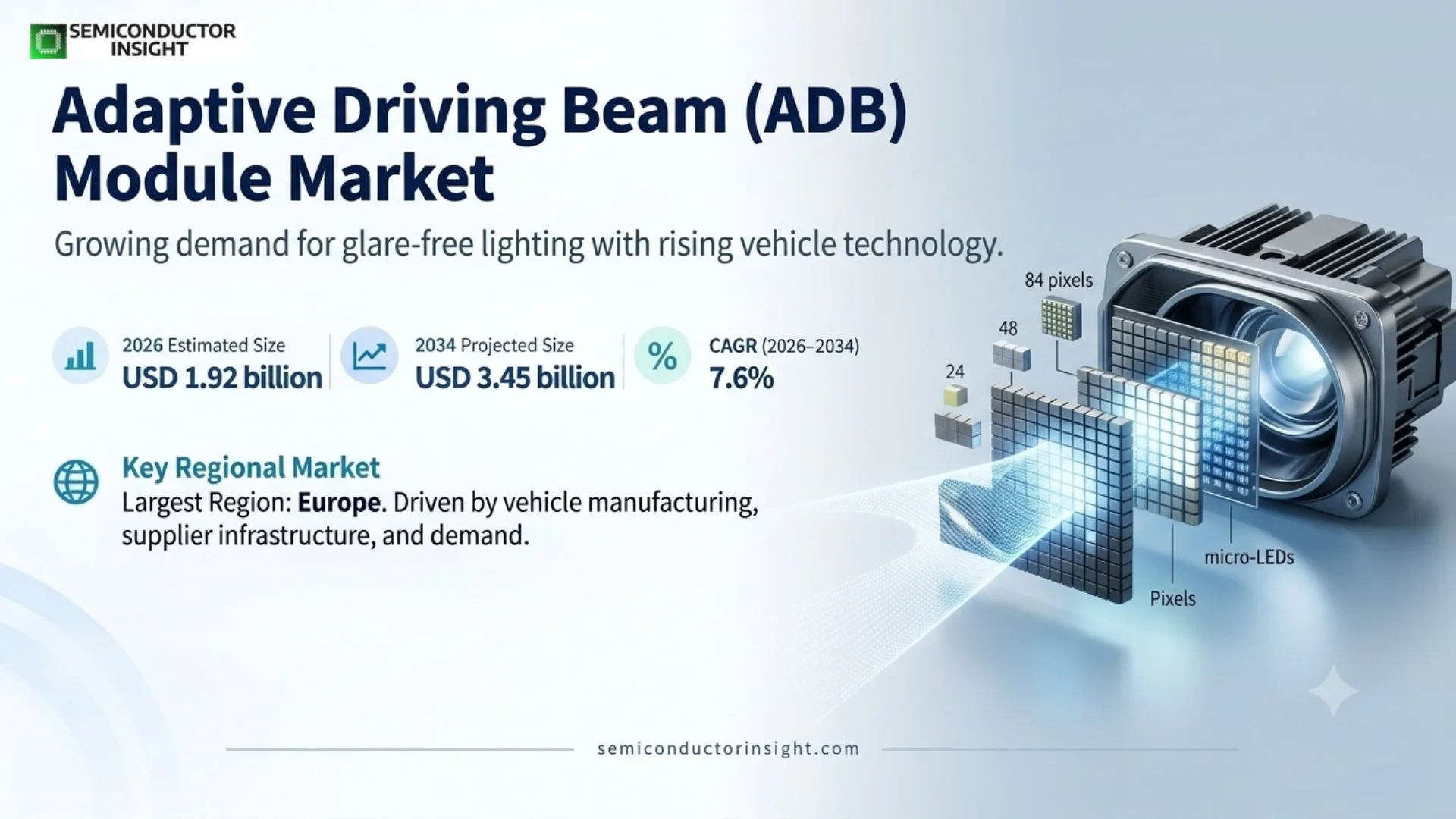
- Market size and growth: the market is valued at USD 1.92 billion in 2026 and is projected to reach USD 3.45 billion by 2034, representing a 7.6% CAGR during 2026–2034.
- Higher-pixel modules are moving ADB from simple glare-free high beam toward precise digital light distribution, road projection and object-aware illumination.
- LED matrix technology remains the leading architecture because it combines proven automotive reliability with improving pixel density, thermal performance and cost.
- Europe leads adoption through premium-vehicle penetration, UN lighting regulations and a strong Tier 1 lighting ecosystem, while the U.S. market opened structurally after NHTSA permitted ADB systems.
- Micro-LED is the key technology shift: ams OSRAM’s EVIYOS HD25 integrates 25,600 individually controllable pixels, demonstrating the resolution path beyond traditional 24–102-pixel modules.
Adaptive Driving Beam (ADB) Module Market Overview
Adaptive Driving Beam Module Market was valued at USD 1.75 billion in 2025 and is estimated at USD 1.92 billion in 2026. The market is projected to reach USD 3.45 billion by 2034, representing a CAGR of 7.6% during 2026–2034. Europe is the largest regional market, supported by the strongest concentration of manufacturing, end-use demand and supplier infrastructure.
Base year: 2025 · Estimated year: 2026 · Forecast period: 2026–2034 · Values in USD million unless otherwise stated
Adaptive driving beam modules dynamically shape high-beam illumination to preserve long-range visibility while reducing light directed toward other road users. A camera or sensor system detects preceding and oncoming traffic, and the lighting controller switches individual LED segments or pixels to create a dark zone around those vehicles while maintaining illumination elsewhere. The headlamp therefore becomes an electronically controlled safety system integrated with vehicle sensing, software and the electrical architecture rather than a fixed optical device.
Module architecture ranges from lower-resolution matrix LED systems to high-definition micro-LED sources with thousands of individually controlled pixels. ams OSRAM states that its EVIYOS HD25 provides 25,600 controllable pixels for high-resolution adaptive driving beam and road-projection functions. Higher resolution enables more precise masking and smoother beam transitions, but also raises thermal, control-ASIC, optical alignment and calibration complexity, increasing the importance of system-level integration between semiconductor and lighting suppliers.
Regulation is a major adoption catalyst. NHTSA amended FMVSS 108 in February 2022 to allow adaptive driving beam headlights in the United States, while UN Regulation No. 149 provides the technical framework for road-illumination devices in many international markets. Broader regulatory acceptance gives global vehicle platforms more freedom to deploy common ADB architectures, improving scale economics and helping the technology expand beyond premium vehicles as component costs decline.
Segment Analysis: By Type
By type, the market is segmented into 24-pixel, 48-pixel, 84-pixel, 102-pixel and other higher-resolution modules. Lower-pixel systems remain relevant in cost-sensitive vehicles because they deliver useful glare-free functionality with simpler optics and electronics. Higher-pixel modules provide finer beam control and are increasingly favored in premium and technology-led vehicles, while micro-LED platforms extend the category far beyond traditional segment counts and enable digital projection functions.
| Type | Market role | Commercial outlook |
|---|---|---|
| 24 Pixels | Entry-level matrix segmentation for glare-free high beam with lower electronics complexity. | Relevant for cost-sensitive platforms and early ADB adoption. |
| 48 Pixels | Improved masking resolution without the full cost of high-end systems. | Balanced cost-performance position across mid-range vehicles. |
| 84 Pixels | Finer light distribution and better object masking for premium systems. | Growing in higher-specification vehicles. |
| 102 Pixels | High-resolution traditional matrix category with more precise illumination control. | Premium applications and advanced safety positioning. |
| Others | Very high-resolution micro-LED arrays and proprietary pixel architectures. | Fastest technology evolution; supports road projection and precise beam shaping. |
Segment Analysis: By Application
Vehicle applications include sedans, SUVs, commercial vehicles and other platforms. SUVs are strategically important because higher mounting positions and premium trim penetration increase the value of glare control and long-range visibility. Sedans remain a large volume category, while commercial vehicles can benefit from improved nighttime visibility and reduced driver fatigue when durability and total ownership economics justify the higher cost of adaptive lighting.
| Application | Demand characteristics |
|---|---|
| Sedan | Broad passenger-car base with ADB moving from premium trims toward mid-range platforms. |
| SUV | Strong adoption because premium SUVs combine high lamp mounting, ADAS and customer willingness to pay for safety features. |
| Commercial Vehicles | Nighttime driving and long duty cycles create a safety case, although cost and serviceability remain important. |
| Others | Luxury, performance and specialty vehicles use advanced digital lighting for safety and brand differentiation. |
Segment Analysis: By Technology
Technology is moving from conventional matrix LEDs toward micro-LED and selected laser-assisted architectures. LED matrix remains the volume leader because automotive qualification, thermal management and optical design are mature. Micro-LED increases controllable pixel density by orders of magnitude and supports more precise beam shaping or road projection. Laser-assisted solutions remain specialized where very long-range illumination or compact optics justify additional system complexity and cost.
| Technology | Market role |
|---|---|
| LED Matrix | Current volume leader with mature automotive supply and cost scaling. |
| Micro-LED | High-resolution growth platform for digital light, road projection and precise masking. |
| Laser Assisted | Specialized premium technology for long-range or compact optical systems. |
Segment Analysis: By End User
OEMs dominate demand because ADB must be integrated with vehicle cameras, control software, electrical architecture and homologation from the design stage. The aftermarket remains smaller because retrofits require optical alignment, electronics integration and legal compliance, while fleet operators are relevant where better nighttime visibility can reduce risk across high-mileage vehicles. This makes ADB primarily an OEM design-in market rather than a conventional replacement-lighting category.
| End User | Purchasing logic |
|---|---|
| OEMs | Primary channel; system integration, homologation and platform design. |
| Aftermarket | Smaller retrofit opportunity limited by legal and integration requirements. |
| Fleet Operators | Potential demand where safety and nighttime utilization justify premium lighting. |
Regional Analysis
Europe is the largest regional market, supported by early regulatory acceptance, premium-vehicle concentration and major automotive lighting suppliers. Asia Pacific is a rapidly expanding manufacturing and adoption region led by China, Japan and South Korea, while North America has a strong growth runway following the U.S. rule change that formally allowed adaptive driving beam systems under FMVSS 108.
Regional ADB adoption depends on regulation, vehicle mix and the local lighting supply chain. Europe combines premium OEMs with mature homologation frameworks and long-standing matrix-light experience. China is moving quickly toward high-resolution digital lighting in premium EVs, while Japan and South Korea contribute major lamp and semiconductor suppliers. The United States has strong premium-vehicle demand but required the NHTSA regulatory change before broad OEM deployment could accelerate across locally sold vehicle platforms.
| Region | Position | Growth profile | Demand mechanism | Supplier selection |
|---|---|---|---|---|
| Europe | Largest | Strong | Premium cars and regulation | Homologation and optical performance |
| Asia Pacific | Fast growth | High | EVs, premium vehicles and local suppliers | Cost, pixel density and OEM integration |
| North America | Growth market | High | Post-rule adoption and premium vehicles | FMVSS compliance and validation |
| South America | Smaller | Selective | Premium imports | Cost and vehicle mix |
| Middle East & Africa | Emerging | Selective | Premium vehicles | Heat performance and import channels |
Competitive Landscape
Competition spans LED and semiconductor suppliers, Tier 1 headlamp manufacturers and regional lighting specialists. Product differentiation increasingly depends on pixel count, optical efficiency, thermal management, control electronics and software integration with ADAS sensors. Companies controlling both the light source and optical module can optimize performance more tightly, while OEM partnerships create durable design wins that often extend across an entire vehicle generation and are difficult to displace after homologation.
ams OSRAM competes at the semiconductor light-source level with EVIYOS micro-LED technology, while Hella, Koito, Marelli, Stanley, ZKW and Varroc operate as major lighting-system suppliers. Samsung, LG Innotek, Lextar and Chinese optoelectronics firms participate through LEDs, modules and electronics. The market therefore has several competitive layers, and value shifts depending on whether differentiation comes from the emitter, optical engine, control electronics or complete homologated headlamp.
High-resolution ADB raises the importance of control ASICs and software because thousands of pixels must be coordinated with camera data and vehicle-state information. The optical system must maintain precise light distribution across temperature and vibration while meeting glare limits. This favors suppliers with strong mechatronic integration rather than companies offering only a high-brightness LED component, particularly as digital-light functions become part of broader ADAS and vehicle-software architectures.
Localization is increasingly important in China, where domestic EV brands use advanced lighting as a visible technology feature. The 2025 integration of ams OSRAM’s EVIYOS HD25 and Marelli’s high-definition module into the NIO ET9 illustrates how semiconductor, lighting-system and vehicle OEM capabilities are combined to commercialize next-generation ADB. Similar collaborations can accelerate high-resolution adoption while creating long design cycles and supplier dependencies.
| Competitive tier | Representative companies | How they compete |
|---|---|---|
| Global lighting-system leaders | Hella, Koito, Marelli, Stanley Electric, ZKW, Varroc | OEM integration, optics, electronics and homologation. |
| Semiconductor / emitter leaders | ams OSRAM, Samsung Semiconductor, LG Innotek, Lextar | LED, micro-LED and control technologies enabling higher resolution. |
| Regional growth suppliers | Changzhou Xingyu, Lattice Power, Shenzhen Refond, Wuxi Yingdixin | Localized cost, China OEM access and growing module capability. |
Key Participants
The profiled competitive set includes ams OSRAM, Samsung Semiconductor, Marelli, Lextar, Changzhou Xingyu Automotive Lighting Systems, Lattice Power, Shenzhen Refond Optoelectronics, Wuxi Yingdixin Microelectronics Technology, Hella GmbH & Co. KGaA, Koito Manufacturing, Varroc Lighting Systems, Stanley Electric, ZKW Group, LG Innotek. Market participation varies by product depth, geography, qualification history and application specialization. The strongest suppliers combine technical engineering with dependable production, field support and customer-specific validation, while regional specialists can remain competitive where they possess unique design wins, process expertise or cost structures suited to a particular end-use segment.
Production Capacity Analysis
Production capacity in the adaptive driving beam (adb) module market depends on more than nominal factory throughput. Suppliers must combine qualified inputs, controlled assembly or processing, final inspection and customer-specific validation before output becomes commercially interchangeable. The practical bottleneck is therefore qualified capacity rather than installed machinery alone. This distinction is important in markets serving semiconductor, automotive or industrial customers because a new line may require months of process stabilization and customer approval before it can support high-volume programs.
Geographic capacity also affects commercial resilience. Customers increasingly prefer suppliers that can support major production clusters with local inventory, technical engineering and rapid replacement or failure-analysis capability. A diversified manufacturing footprint lowers disruption risk, but moving production between sites is not automatic when materials, tooling and process controls are tied to an approved specification. Leading companies consequently invest in both manufacturing scale and duplicate qualification capability rather than relying on a single centralized plant.
Upstream availability of automotive LEDs, micro-LED arrays, control ICs and precision optical materials can constrain finished-product growth even when downstream assembly capacity is adequate. Long lead-time inputs, specialized materials and application-specific components create exposure to supply shocks and price volatility. Buyers respond through dual sourcing, strategic inventory and earlier design qualification. Suppliers that secure critical inputs and maintain transparent lifecycle planning can convert supply assurance into a competitive advantage, particularly for programs expected to remain in production for several years.
| Capacity / supply factor | Market implication |
|---|---|
| Automotive Leds, Micro-Led Arrays, Control Ics And Precision Optical Materials | Availability and qualification of critical inputs determine how quickly finished capacity can expand. |
| Qualified manufacturing | Process control and customer approval define usable output rather than nominal equipment capacity. |
| Regional support | Local inventory and engineering reduce downtime, logistics risk and launch delays. |
| Lifecycle continuity | Long-term component and material planning protects customers from forced redesigns. |
Market Dynamics
Growth is driven by regulatory acceptance, premium safety features, EV technology differentiation and rapid increases in pixel density. Restraints include module cost, software and optical complexity, thermal management and region-specific homologation. The strongest opportunities are high-resolution micro-LED systems, wider adoption in mid-range vehicles and integration with camera, navigation and driver-assistance functions that allow lighting to respond more intelligently to road geometry and surrounding traffic.
MARKET DRIVERS
| Driver | Impact on growth | Commercial mechanism |
|---|---|---|
| Regulatory acceptance | High | Enables legal deployment across major vehicle markets. |
| Premium safety demand | High | OEMs use ADB to improve nighttime visibility and vehicle differentiation. |
| Micro-LED pixel density | High | Expands functionality from masking to high-definition digital light. |
Regulatory acceptance
NHTSA’s final rule amended FMVSS 108 to allow adaptive driving beam systems in new U.S. vehicles, removing a major barrier in the United States. UN Regulation No. 149 provides a technical framework for road-illumination devices across many international markets. As global vehicle platforms can support ADB in more regions, automakers gain better scale economics for common hardware and software architectures, supporting wider model coverage.
Premium safety demand
Premium vehicles increasingly use digital lighting to provide glare-free high beams, smoother adaptive patterns and distinctive visual signatures. ADB therefore supports both functional safety and brand differentiation. When consumers can directly experience the benefit during night driving, OEMs can justify higher trim pricing and then spread the technology into mid-range platforms as emitters, drivers and optical systems decline in cost.
Micro-LED pixel density
ams OSRAM’s EVIYOS HD25 provides 25,600 individually controllable pixels, far beyond conventional matrix-light segment counts. This resolution allows precise beam shaping and road projection, creating functions that lower-pixel modules cannot deliver. The technology shift increases semiconductor content per lamp and encourages closer integration of emitters, ASICs, optics and vehicle software, expanding value capture for suppliers with system-level capability.
MARKET RESTRAINTS
| Restraint | Impact on growth | Commercial mechanism |
|---|---|---|
| System cost | High | High-resolution emitters, optics and control electronics raise bill of materials. |
| Optical / software complexity | High | Precise masking requires calibration and integration with sensors and vehicle software. |
| Thermal management | Medium-High | Dense light sources and electronics create heat in constrained lamp housings. |
System cost
Moving from a basic segmented LED headlamp to hundreds or thousands of pixels adds emitters, control electronics, precision optics and processing. Premium vehicles can absorb the cost because ADB supports safety and brand positioning, but mass-market platforms require substantial cost reduction before high-definition systems become standard equipment. This creates a gradual technology cascade rather than immediate adoption across all passenger-vehicle segments.
Optical / software complexity
ADB relies on cameras, object detection, vehicle-state data and software that decides how to shape the beam. Poor sensor input or calibration can compromise the lighting function even when the LED module performs correctly. This system dependency increases validation time and ties lighting suppliers closely to ADAS and vehicle-electronics teams, raising development cost and making late supplier substitutions difficult.
Thermal management
Headlamp housings have limited space and must withstand vibration, moisture and large temperature swings. Higher pixel density and control electronics increase heat load, while optical precision must remain stable over vehicle life. Suppliers therefore need efficient emitters, robust thermal paths and durable alignment methods, which can slow cost reduction and complicate miniaturization even as semiconductor efficiency improves.
MARKET OPPORTUNITIES
Micro-LED digital light
High-density pixel arrays enable road projection, precise glare control and software-defined beam patterns that can command premium value. Suppliers that integrate emitters, ASICs and optics can capture more of the system value than component-only vendors while creating a platform for future software-enabled lighting functions.
Mid-range vehicle penetration
Cost reduction in matrix LED and control electronics can move ADB from premium trims into higher-volume passenger vehicles. The opportunity expands as global homologation becomes more consistent and OEMs reuse architectures across several nameplates or vehicle classes.
ADAS integration
Combining camera perception, navigation and lighting creates predictive beam shaping that can improve visibility before the driver reaches a curve or hazard. The commercial value rises when the lamp becomes part of the vehicle’s broader sensing and software stack rather than an isolated component.
North American adoption
The U.S. regulatory pathway is now open, giving OEMs a larger global addressable base for common ADB architectures. Suppliers with validated FMVSS-compliant systems can benefit as more vehicle platforms introduce adaptive lighting in the market.
Supply Chain Analysis
LED / micro-LED emitters and control ICs
Optical engine and thermal package
Tier 1 headlamp module integration
Vehicle OEM software, sensors and homologation
Upstream suppliers provide automotive-grade LEDs, micro-LED arrays, drivers, ASICs and optical materials. High-resolution systems need tighter emitter uniformity and control electronics capable of switching many pixels with low latency. Semiconductor yield and binning therefore affect both cost and optical consistency before the light source reaches a headlamp supplier, making upstream process quality directly relevant to finished beam performance and customer acceptance.
Tier 1 suppliers integrate emitters with lenses, reflectors, cooling structures, electronics and housings. They must calibrate the beam and maintain optical alignment through vibration, temperature cycling and moisture exposure. The finished module is then validated against vehicle electrical architecture, camera data and regional lighting requirements, making mechanical, optical and software engineering equally important to the production process and limiting the ability to substitute a component without system revalidation.
Vehicle OEMs connect the ADB controller to cameras, ADAS functions, steering angle, navigation and other inputs. Homologation verifies that the system provides useful high-beam illumination without causing unacceptable glare. Because the final function depends on the complete vehicle, design wins typically occur years before production and can remain tied to a supplier throughout the platform lifecycle, creating durable relationships but long qualification cycles.
Recent Developments
2026 – ams OSRAM demonstrates EVIYOS HD25 at CES 2026
The EVIYOS HD25 high-definition ADB LED integrates more than 25,000 individually addressable pixels, enabling precise beam distribution and road-projection functions in compact headlamps. Source
24 Jul 2025 – EVIYOS HD25 integrated into NIO ET9 headlamps
ams OSRAM and Marelli announced integration of the 25,600-pixel EVIYOS HD25 into NIO’s ET9, providing a production example of high-resolution micro-LED adaptive lighting. Source
15 Feb 2022 – NHTSA permits adaptive driving beam headlights
NHTSA issued the final rule allowing ADB systems on new U.S. vehicles and amended FMVSS No. 108, creating the regulatory basis for broader domestic deployment. Source
REPORT SCOPE & SEGMENTATION
| Base Year | 2025 |
| Estimated Year | 2026 |
| Forecast Year | 2034 |
| 2025 Market Size | USD 1.75 billion |
| 2026 Market Size | USD 1.92 billion |
| 2034 Market Size | USD 3.45 billion |
| CAGR | 7.6% during 2026–2034 |
| Largest Market | Europe |
| By Type | 24 Pixels; 48 Pixels; 84 Pixels; 102 Pixels; Others |
| By Application | Sedan; SUV; Commercial Vehicles; Others |
| By Technology | LED Matrix; Micro-LED; Laser Assisted |
| By End User | OEMs; Aftermarket; Fleet Operators |
Frequently Asked Questions
What is the adaptive driving beam module market size?
The market is valued at USD 1.92 billion in 2026 and is projected to reach USD 3.45 billion by 2034, representing a 7.6% CAGR during 2026–2034. The 2025 market size is USD 1.75 billion.
What does an adaptive driving beam system do?
ADB shapes the high-beam pattern in real time, reducing illumination toward detected road users while maintaining stronger light in unoccupied areas. The goal is better long-range visibility without causing excessive glare.
Which technology leads ADB modules?
LED matrix technology remains the volume leader because it has established automotive reliability and cost scaling. Micro-LED is the major technology shift because it enables thousands of independently controlled pixels.
Which region leads the market?
Europe leads because of early regulatory acceptance, premium-vehicle penetration and a strong automotive-lighting supplier base. Asia Pacific is growing quickly, while North America gained a larger opportunity after U.S. rules changed to permit ADB.
Why are higher pixel counts important?
More controllable pixels allow finer masking around other vehicles, smoother light distribution and advanced functions such as road projection. They improve functional precision but also increase optical, thermal and control complexity.
What limits ADB adoption?
The major constraints are module cost, integration with cameras and software, thermal management, optical calibration and regional homologation requirements.
Research Sources & Evidence Base

Get Sample Report PDF for Exclusive Insights
Report Sample Includes
- Table of Contents
- List of Tables & Figures
- Charts, Research Methodology, and more...
