Automotive Lighting IC Market Insights
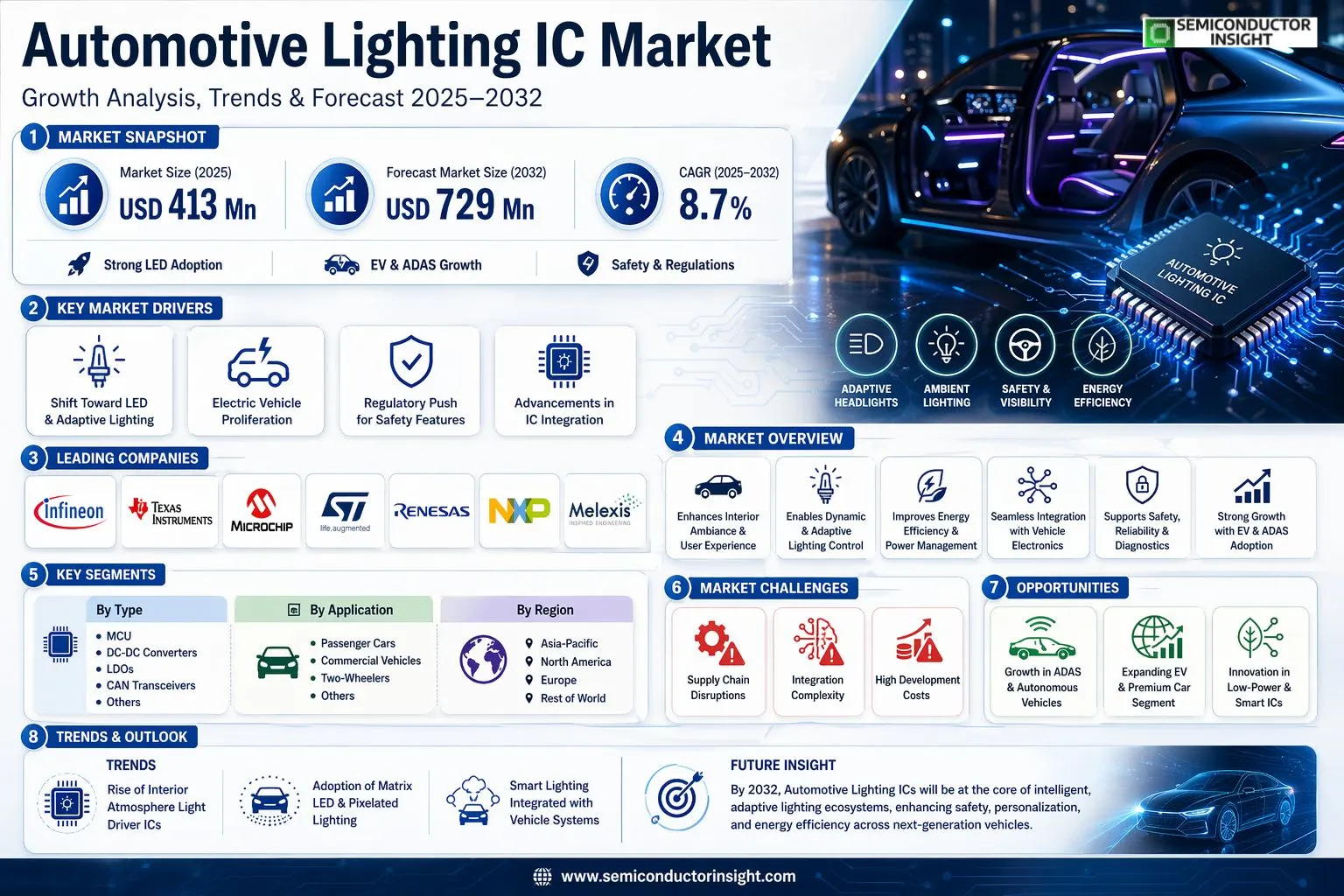
Global Automotive Lighting IC market size was valued at USD 413 million in 2025. The market is projected to reach USD 729 million by 2032, exhibiting a CAGR of 8.7% during the forecast period.
Automotive Lighting ICs are integrated circuits (ICs) specially designed to control and drive interior ambient lighting in automobiles. They are responsible for adjusting lighting effects in different areas of the car, such as the body, doors, center console, and more, to enhance visual comfort, user experience, and vehicle dynamics.
The market is experiencing rapid growth due to several factors, including surging demand for premium ambient lighting in passenger cars, rising electric vehicle adoption, and advancements in LED technologies. Furthermore, regulatory pushes for energy-efficient and adaptive lighting systems contribute to expansion. Key players like Infineon (Germany), Texas Instruments (USA), Microchip (USA), STMicroelectronics (Italy, France), Renesas Electronics (Japan), NXP Semiconductors (Netherlands), and Melexis (Belgium) dominate with innovative portfolios tailored to automotive needs.
MARKET DRIVERS
Shift Toward LED and Adaptive Lighting
Automotive Lighting IC Market is propelled by the widespread adoption of energy-efficient LED systems in vehicles. Automakers are increasingly integrating advanced driver assistance systems (ADAS) that rely on sophisticated ICs for dynamic lighting control, enhancing visibility and safety. Global vehicle production reached over 90 million units in 2023, with LED penetration exceeding 70% in new models.
Electric Vehicle Proliferation
With electric vehicles (EVs) projected to constitute 25% of global sales by 2028, demand for compact, high-efficiency lighting ICs has surged. These ICs enable precise power management for matrix LED headlights, reducing energy consumption by up to 40% compared to traditional halogens. Stringent emissions standards further accelerate this transition.
➤ Regulatory Push for Safety Features
Finally, mandates like Euro NCAP and NHTSA requirements for automatic high-beam assist and pedestrian detection lighting are fostering innovation in Automotive Lighting IC Market, driving investments in semiconductor solutions for next-generation vehicles.
MARKET CHALLENGES
Supply Chain Disruptions
Automotive Lighting IC Market faces volatility from semiconductor shortages, which intensified post-2020 and delayed production for major OEMs. Inventory levels remain strained, with lead times extending to 40 weeks for critical components, impacting overall vehicle output.
Other Challenges
Integration Complexity
Designing ICs for multi-functional lighting systems requires overcoming thermal management issues and ensuring compatibility with diverse vehicle architectures, often leading to higher R&D expenditures.Additionally, cybersecurity risks in connected lighting modules pose threats, as vehicles become more software-defined. Market players must balance cost pressures with the need for robust, reliable IC designs amid rising raw material prices.
MARKET RESTRAINTS
High Development Costs
Development of specialized ICs for automotive lighting involves substantial upfront investments, often exceeding $50 million per project due to rigorous qualification processes like AEC-Q100 standards. Smaller firms struggle to compete with established players.Regulatory compliance across regions adds layers of complexity, with varying approvals delaying time-to-market by 12-18 months. This restrains rapid scaling in Automotive Lighting IC Market.Moreover, dependency on rare earth materials for high-performance LEDs increases vulnerability to price fluctuations, capping profitability margins at around 15-20% for many suppliers.
MARKET OPPORTUNITIES
Expansion in ADAS and Autonomy
Integration of lighting ICs with Level 3+ autonomous driving systems opens avenues for intelligent beam shaping and lidar-compatible illumination. The ADAS market is expected to grow at 12% CAGR through 2030, boosting demand.Emerging markets in Asia-Pacific, with vehicle sales rising 8% annually, present untapped potential for cost-effective IC solutions tailored to local preferences.Sustainability trends favor recyclable, low-power ICs, enabling partnerships between chipmakers and OEMs to capture premium segments in Automotive Lighting IC Market.
Automotive Lighting IC Market Trends
Rise of Interior Atmosphere Light Driver ICs
Automotive Lighting IC Market is witnessing significant evolution through the adoption of specialized interior atmosphere light driver ICs. These integrated circuits are designed to control lighting effects across various vehicle interiors, including body panels, doors, and center consoles. By enabling dynamic adjustments to light intensity and color, they enhance passenger visual comfort and overall driving experience. Industry surveys highlight that such ICs address key demands for customizable ambiance, aligning with consumer preferences for premium interior features in modern vehicles.
Other Trends
Dominance of Leading Semiconductor Players
In Automotive Lighting IC Market, established manufacturers like Infineon, Texas Instruments, Microchip, STMicroelectronics, and Renesas Electronics hold substantial influence. These companies provide robust solutions tailored for automotive applications, focusing on reliability and integration. Recent industry insights from surveys of suppliers and experts indicate ongoing developments in product portfolios to meet stringent automotive standards, fostering competitive dynamics that drive innovation in lighting control technologies.
Growth in Key Product Segments and Applications
Product segments such as MCU, DCDC, LDO, and CAN are pivotal in Automotive Lighting IC Market, supporting efficient power management, microcontroller-based control, and vehicle communication networks. The MCU segment facilitates intelligent lighting sequences, while CAN integration ensures seamless connectivity with other vehicle systems. Applications span commercial vehicles and passenger cars, with passenger cars showing pronounced demand due to rising expectations for advanced interior features. Regional analyses reveal strong potential in Asia, particularly China and Japan, alongside established markets in North America and Europe, as manufacturers adapt to diverse regulatory and consumer needs. Challenges like supply chain complexities and technological hurdles are being navigated through strategic collaborations, positioning Automotive Lighting IC Market for sustained advancement in smart vehicle illumination.
COMPETITIVE LANDSCAPE
Key Industry Players
Dominating Automotive Lighting IC Market Landscape
Automotive Lighting IC Market exhibits a concentrated structure dominated by established semiconductor giants like Infineon Technologies, Texas Instruments, and STMicroelectronics, which collectively command a substantial share of global revenues. Valued at $413 million in 2025 and projected to reach $729 million by 2032 at a CAGR of 8.7%, the sector benefits from these leaders’ expertise in MCU, DC-DC converters, LDOs, and CAN-enabled ICs tailored for ambient lighting in passenger cars and commercial vehicles. Their scale enables robust R&D, ensuring compliance with stringent automotive standards and driving innovations in energy-efficient drivers for interior atmosphere lighting.
Beyond the top tier, niche players such as Microchip Technology, Renesas Electronics, NXP Semiconductors, Elmos Semiconductor, and Melexis bolster competition with specialized solutions for regional demands and application segments. Emerging firms like ISSI, Yingdixin Microelectronics, BYD Microelectronics, Silergy, and Tinychip Micro focus on cost-effective alternatives, particularly in Asia-Pacific markets, intensifying rivalry while addressing challenges in supply chains and integration with vehicle electronics. This dynamic fosters market growth through mergers, acquisitions, and tailored product developments amid rising EV adoption and smart interior trends.
List of Key Automotive Lighting IC Companies Profiled
- Infineon Technologies (Germany)
- Texas Instruments (USA)
- Microchip Technology (USA)
- STMicroelectronics (Italy, France)
- Renesas Electronics (Japan)
- ISSI (USA)
- NXP Semiconductors (Netherlands)
- Elmos Semiconductor (Germany)
- Melexis (Belgium)
- Yingdixin Microelectronics Technology (USA)
- BYD Microelectronics (USA)
- Silergy (USA)
- Tinychip Micro (China)
Segment Analysis:
| Segment Category | Sub-Segments | Key Insights |
| By Type |
|
MCU leads as it serves as the central processing unit for lighting control systems.
|
| By Application |
|
Passenger Cars dominate driven by consumer demand for enhanced aesthetics and safety.
|
| By End User |
|
OEMs lead through direct integration in new vehicle platforms.
|
| By Lighting Position |
|
Exterior Lighting holds the forefront for safety-critical applications.
|
| By Powertrain Type |
|
ICE Vehicles continue to spearhead with established infrastructures.
|
Regional Analysis: Automotive Lighting IC Market
Asia-Pacific
China and Japan anchor production with vast semiconductor fabs dedicated to Automotive Lighting ICs, enabling scalable output for LED drivers and matrix controllers. India’s expanding auto sector boosts localized assembly, reducing lead times and enhancing responsiveness to regional preferences for ruggedized components.
R&D centers pioneer next-gen ICs with AI-enhanced dimming and predictive diagnostics, supporting pixelated lighting for superior visibility. Collaborations between OEMs and chipmakers accelerate deployment of matrix LED systems in mainstream models.
Policies mandating advanced driver assistance features drive integration of lighting ICs with sensor fusion. Emission standards favor efficient IC designs, spurring eco-friendly phosphor control and low-power architectures across the value chain.
Integrated ecosystems minimize disruptions, with vertical integration ensuring reliable sourcing of substrates and packaging. Export-oriented strategies align Automotive Lighting IC specifications to international norms, capturing shares in emerging markets.
North America
North America sustains a mature Automotive Lighting IC Market, emphasizing premium and electric vehicles where high-end ICs enable sophisticated functionalities like laser-assisted high beams and holographic projections. U.S.-based innovators lead in software-defined lighting, integrating ICs with vehicle-to-everything communication for contextual illumination. The region’s focus on safety and luxury segments drives demand for redundant, cybersecurity-hardened controllers that withstand extreme temperatures. Collaborations with tech giants infuse automotive lighting with over-the-air updates, enhancing adaptability. Supply chains benefit from proximity to silicon valley fabs, though reliance on imports tempers volume growth. Market dynamics favor aftermarket upgrades, with custom ICs supporting retrofit LED conversions in aging fleets, positioning North America as a trendsetter for intelligent lighting ecosystems.
Europe
Europe’s Automotive Lighting IC Market thrives under rigorous regulatory frameworks prioritizing pedestrian safety and glare reduction, propelling adoption of adaptive matrix ICs in mainstream sedans and crossovers. German and French OEMs spearhead developments in pixel-light systems, leveraging ICs for precise beam patterning and dynamic cornering lights. Emphasis on sustainability accelerates low-voltage designs compatible with 48V architectures in mild hybrids. Regional clusters in automotive valleys foster partnerships between IC designers and lighting module assemblers, optimizing for homologation standards. Despite production shifts, Europe’s strength lies in high-value applications for autonomous vehicles, where ICs integrate with LiDAR for fused perception lighting. This environment cultivates premium innovation, influencing global benchmarks in compliance-driven Automotive Lighting IC evolution.
South America
South America emerges as a growth pocket in Automotive Lighting IC Market, fueled by expanding middle-class vehicle ownership and infrastructure upgrades in Brazil and Mexico. Local assembly plants prioritize cost-optimized ICs for halogen-to-LED transitions, focusing on durable designs resilient to dusty, high-humidity conditions. Regional dynamics hinge on import dependencies balanced by rising domestic fabrication, supporting sequential lighting sequences in pickups and compact cars. Government incentives for local content spur joint ventures, introducing basic adaptive features affordably. Challenges like economic volatility are offset by aftermarket vitality, where universal IC modules upgrade legacy systems. This trajectory positions South America for gradual sophistication in Automotive Lighting IC integration aligned with regional mobility trends.
Middle East & Africa
The Middle East & Africa region in Automotive Lighting IC Market reflects diverse dynamics, with the Gulf states driving luxury SUV demand for opulent ambient and projection lighting via advanced ICs. Harsh desert environments necessitate robust, high-temperature tolerant controllers for off-road applications. Africa’s urbanizing markets favor economical IC solutions for fog and auxiliary lights in public transport. Oil wealth funds R&D in energy-harvesting lighting, while infrastructure projects integrate smart ICs in fleet management. Fragmented supply chains evolve through trade hubs, adapting global tech to local voltages and dust-proofing needs. Overall, the region advances from basic replacements toward connected lighting, mirroring economic diversification and automotive penetration patterns.
Report Scope
This market research report provides a comprehensive analysis of Automotive Lighting IC Market, covering the forecast period 2025–2032. It offers detailed insights into market dynamics, technological advancements, competitive landscape, and key trends shaping the industry.
Key focus areas of the report include:
- Market Overview: The report begins with an overview outlining its current market scenario, key growth indicators, and industry transformation drivers. It discusses macroeconomic factors, demand–supply balance, regulatory landscape, and the strategic role of semiconductors in powering advancements across industries such as automotive, telecommunications, consumer electronics, and industrial automation.
- Market Size & Forecast: Historical data and future projections for revenue, unit shipments, and market value across major regions and segments.
- Segmentation Analysis: Detailed breakdown by product type, technology, application, and end-user industry to identify high-growth segments and investment opportunities.
- Regional Insights: Insights into market performance across North America, Europe, Asia-Pacific, Latin America, and the Middle East & Africa, including country-level analysis where relevant.
- Competitive Landscape: Profiles of leading market participants, including their product offerings, R&D focus, manufacturing capacity, pricing strategies, and recent developments such as mergers, acquisitions, and partnerships.
- Technology Trends & Innovation: Assessment of emerging technologies, integration of AI/IoT, semiconductor design trends, fabrication techniques, and evolving industry standards.
- Market Drivers & Restraints: Evaluation of factors driving market growth along with challenges, supply chain constraints, regulatory issues, and market-entry barriers.
- Stakeholder Insights: Insights for component suppliers, OEMs, system integrators, investors, and policymakers regarding the evolving ecosystem and strategic opportunities.
Primary and secondary research methods are employed, including interviews with industry experts, data from verified sources, and real-time market intelligence to ensure the accuracy and reliability of the insights presented.
FREQUENTLY ASKED QUESTIONS:
What is the current market size of Automotive Lighting IC Market?
-> Automotive Lighting IC Market was valued at USD 413 million in 2025 and is expected to reach USD 729 million by 2032.
Which key companies operate in Automotive Lighting IC Market?
-> Key players include Infineon (Germany), Texas Instruments (USA), Microchip (USA), ST Microelectronics (Italy, France), Renesas Electronics (Japan), ISSI (USA), NXP Semiconductors (Netherlands), Elmos (Germany), Melexis (Belgium), and Yingdixin Microelectronics Technology (USA), among others.
What are the key growth drivers?
-> Key growth drivers include demand for interior atmosphere lighting to enhance visual comfort, experience, and dynamics in automobiles.
Which region dominates the market?
-> Asia is the fastest-growing region, while Europe remains a dominant market.
What are the emerging trends?
-> Emerging trends include advancements in MCU, DCDC, LDO, and CAN-based lighting driver ICs for passenger cars and commercial vehicles.

Get Sample Report PDF for Exclusive Insights
Report Sample Includes
- Table of Contents
- List of Tables & Figures
- Charts, Research Methodology, and more...