Key Statistics
Key Takeaways
- Asia Pacific holds the leading regional position, with the report page placing the region above 40% of 2024 revenue; the manufacturing ecosystem in Taiwan, China, South Korea and Japan also supports dense design-to-fabrication supply chains.
- ASICs gain economic advantage when volumes are high and power, latency or die-area targets justify non-recurring engineering, while FPGAs retain strategic value where field programmability, rapid qualification and changing standards matter.
- Industrial automation is the leading application in the published segmentation, reflecting the value of deterministic control, machine vision, networking and long product lifecycles in factory equipment.
- Advanced nodes below 28 nm are increasingly important for high-performance devices, but mature nodes remain commercially relevant for cost-controlled industrial, medical and embedded applications.
- Global logic semiconductor sales reached USD 301.9 billion in 2025, according to SIA, showing the scale of the wider logic demand pool supporting ASIC design and programmable logic platforms.
- Security is becoming a product feature: FPGA suppliers are adding post-quantum cryptography, secure boot and hardware roots of trust as infrastructure, automotive and defense users harden long-lived systems.
ASIC and FPGA Market Overview
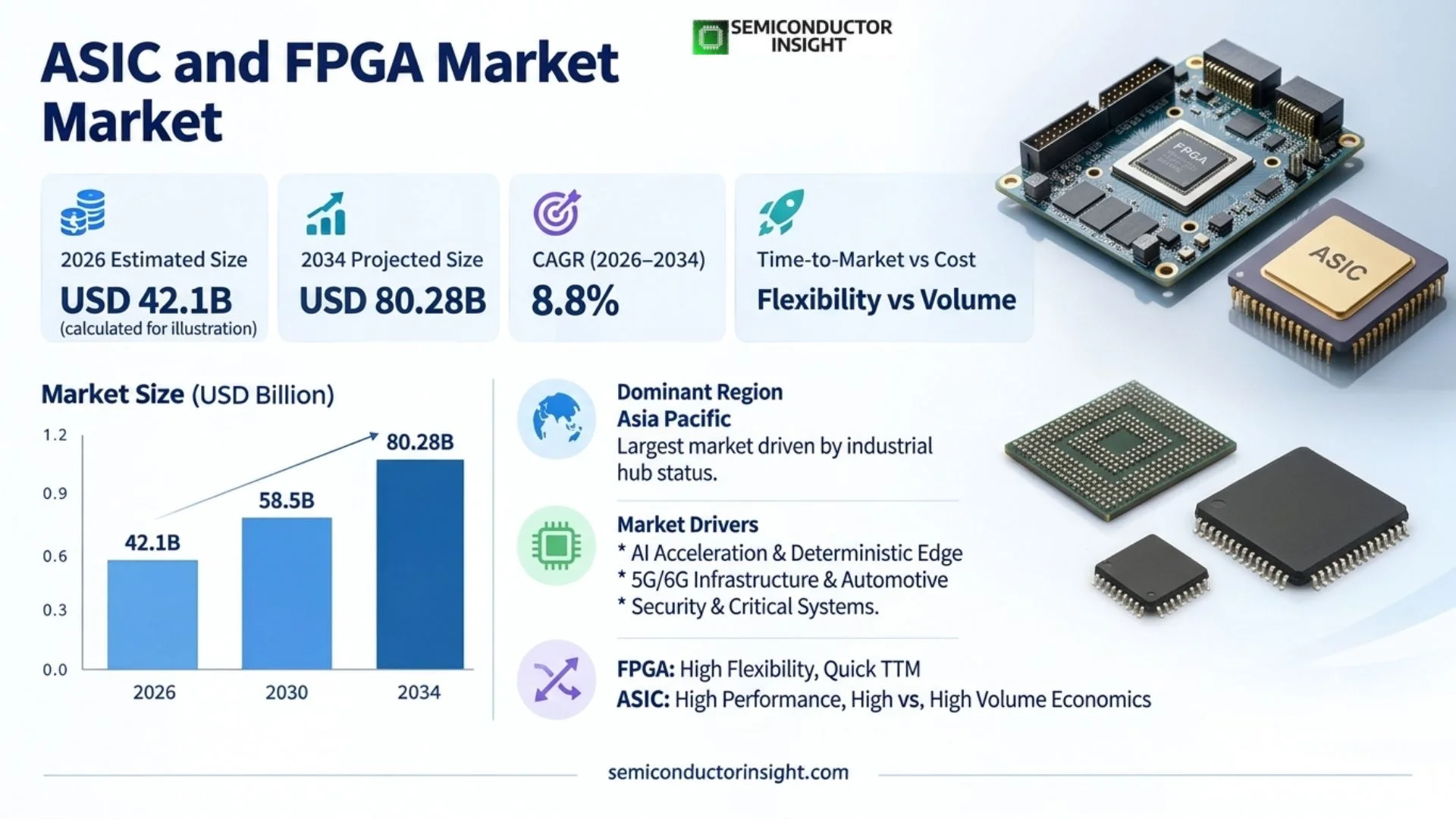
ASIC and FPGA market was valued at USD 37.54 billion in 2025 and is projected to reach USD 80.28 billion by 2034, expanding at a 8.8% during 2026–2034. Asia Pacific is the largest regional market, while demand is being reshaped by AI acceleration, deterministic edge processing, 5G/6G infrastructure, automotive electronics and security requirements that increasingly divide workloads between reconfigurable logic and fixed-function custom silicon.
ASICs and FPGAs solve the same broad problem-implementing digital logic-but with different commercial economics. An ASIC fixes the logic in silicon and can deliver strong performance, power efficiency and unit economics after the design is frozen. An FPGA contains programmable logic, memory, DSP resources and configurable interconnects, allowing developers to change hardware behavior after manufacture. Buyers therefore trade flexibility and time-to-market against non-recurring engineering cost, power, density and high-volume unit cost.
The market is increasingly shaped by heterogeneous computing. Data-center accelerators, telecom infrastructure, industrial vision systems and automotive domains combine CPUs, GPUs, dedicated ASIC blocks and programmable logic because no single architecture optimizes every workload. FPGAs can absorb changing protocols or low-latency preprocessing while ASICs take over stable, high-volume functions. That progression from programmable prototyping to optimized silicon is a recurring purchasing pattern rather than a simple winner-takes-all substitution.
Demand is also broadening beyond traditional compute. Embedded AI, motor control, aerospace signal processing, software-defined radio, medical imaging and connected industrial equipment require deterministic response and specialized interfaces. These requirements support a wide range of device classes, from low-power control FPGAs to high-end adaptive SoCs and from mature-node mixed-signal ASICs to advanced-node accelerator designs. Supplier advantage increasingly depends on software tools, IP libraries, security, packaging and ecosystem support in addition to raw logic density.
Segment Analysis: By Type
By type, the market is segmented into ASIC (Application-Specific Integrated Circuit) and FPGA (Field-Programmable Gate Array). ASICs are favored for stable, high-volume workloads where optimized power and unit economics justify the design investment; FPGAs remain essential where standards, algorithms or interfaces may change after deployment.
| Type | Technology structure | Market position and purchasing logic |
|---|---|---|
| ASIC (Application-Specific Integrated Circuit) Full-custom · Semi-custom · Programmable ASICs |
Custom logic is implemented for a defined workload, allowing the architecture, memory hierarchy, interfaces and accelerators to be optimized around performance, power and die area. The design is fixed at tape-out, so changes after fabrication require a new silicon revision rather than field reprogramming. | ASICs are strongest in high-volume applications where non-recurring engineering can be spread across many units. AI acceleration, automotive processing, connectivity, power management and consumer electronics create demand, but advanced-node tape-out cost and verification complexity raise the threshold for economically viable projects. |
| FPGA (Field-Programmable Gate Array) SRAM-based · Flash-based · Antifuse-based |
Programmable logic blocks, routing, embedded memories, DSP engines and hard IP are configured after manufacture. This enables rapid development, hardware updates and reuse of one silicon platform across multiple end products, while modern high-end devices increasingly integrate processor subsystems and high-speed interfaces. | FPGAs dominate prototyping, standards-sensitive infrastructure and lower-volume systems where flexibility carries economic value. High-end devices address data center, communications, aerospace and test applications; smaller devices support control, security and industrial functions where low power, instant-on behavior or long lifecycle availability can be decisive. |
Architecture, node and pricing logic
ASIC project economics are dominated by engineering, IP, verification, masks and wafer fabrication before the first commercial unit is shipped, whereas FPGA economics shift more cost into the device itself and reduce the commitment required before deployment. As volume rises and requirements stabilize, an ASIC can become the lower-cost architecture; when specifications change frequently, FPGA reusability can prevent redesign expense. This trade-off is why many product roadmaps use FPGAs for development or early deployment and migrate selected functions to ASICs only after demand and standards mature.
Segment Analysis: By Application
By application, the market covers Industrial Automation, Medical Devices, Aerospace and Defense, Telecommunications, and Consumer Electronics. Industrial automation leads the published segmentation because programmable control, deterministic networking, machine vision and long equipment lifecycles reward both configurable FPGA platforms and application-specific silicon.
| Application | Demand characteristics and commercial trigger |
|---|---|
| Industrial Automation | Factories use programmable logic and custom ICs for machine vision, motor control, deterministic networking, safety functions and real-time sensor processing. Long equipment lifecycles favor stable supply and reconfigurability, while higher-volume controllers can justify ASIC integration. Edge inference adds a new layer of demand because data often must be processed locally with predictable latency and power consumption. |
| Medical Devices | Imaging, diagnostics, patient monitoring and laboratory equipment value deterministic signal processing, long qualification cycles and interface flexibility. FPGAs can support evolving image pipelines and standards without changing the board, while ASICs are attractive in high-volume portable devices where battery life, size and cost are critical. Reliability documentation and lifecycle support weigh heavily in supplier selection. |
| Aerospace and Defense | Radar, communications, electronic warfare, avionics and space systems require high-throughput signal processing and often operate with long development cycles. FPGAs support reconfiguration and mission-specific updates, while ASICs can deliver optimized power and security for mature functions. Radiation tolerance, secure configuration, traceability and export-control compliance create higher qualification barriers than mainstream commercial electronics. |
| Telecommunications | Wireless radios, packet processing, fronthaul, transport and network security use FPGAs during standards transitions because logic can be changed as protocols evolve. ASICs become attractive for high-volume, stable functions once specifications mature. The transition toward 5G Advanced and 6G research therefore supports both architectures at different stages of the equipment lifecycle. |
| Consumer Electronics | High-volume consumer products can support custom silicon when functions stabilize and unit cost matters, particularly in connectivity, imaging and power-sensitive devices. FPGAs have a narrower role but remain useful in premium, fast-changing or low-volume platforms and in development systems. Short product cycles make time-to-market and design reuse important determinants of architecture choice. |
Additional segmentation dimensions
| Architecture | Market role |
|---|---|
| High-end FPGAs | Serve data-center acceleration, advanced communications, test, aerospace and other mission-critical workloads requiring high logic density, transceiver bandwidth, memory bandwidth and hardened interfaces. |
| Mid-range FPGAs | Balance cost, power and integration for industrial vision, communications edge equipment, video, robotics and embedded acceleration where high-end devices are uneconomic. |
| Low-end FPGAs | Address control-plane logic, bridging, board management, security, sensor aggregation and glue-logic replacement where low power, small packages and long supply lifecycles matter. |
| Technology node | Commercial implication |
|---|---|
| <28 nm | Supports high-performance FPGA fabrics and advanced ASICs where density, energy efficiency and high-speed interfaces justify greater design and manufacturing complexity. |
| 28 nm–90 nm | Remains important for cost-sensitive industrial, automotive, mixed-signal and embedded designs where mature IP, qualification history and supply stability can outweigh maximum transistor density. |
| Above 90 nm | Serves legacy, specialty and long-lifecycle applications where redesign cost, analog integration or qualification requirements preserve demand for mature manufacturing technologies. |
Regional Analysis
Asia Pacific is the largest ASIC and FPGA region, with the report page placing it above 40% of 2024 revenue. The region combines leading foundry capacity, electronics manufacturing, automotive production and communications infrastructure. North America remains the core design and FPGA innovation center, while Europe is differentiated by automotive, industrial and policy-backed semiconductor investment.
How does the ASIC and FPGA demand model differ by region?
Regional demand is not determined only by end-product consumption. ASIC economics depend on access to design talent, EDA tools, IP and foundry capacity, while FPGA demand is influenced by system engineering, distribution, defense qualification and infrastructure investment. SIA reported 2025 semiconductor sales growth of 45.0% in Asia Pacific/All Others, 30.5% in the Americas, 17.3% in China and 6.3% in Europe, illustrating the very different momentum of the underlying electronics ecosystems.
| Region | Position | Growth outlook | Demand profile | What decides supplier selection |
|---|---|---|---|---|
| Asia Pacific | Largest | High | Manufacturing + consumption | Foundry access, cost, local support, ecosystem depth |
| North America | Major design hub | High-value | Innovation + defense + data center | Performance, software tools, security, advanced interfaces |
| Europe | Specialty stronghold | Steady | Automotive + industrial | Functional safety, lifecycle, energy efficiency, supply resilience |
| South America | Smaller base | Selective | Telecom + industrial modernization | Availability, price, application support |
| Middle East & Africa | Emerging | Project-led | Telecom, data centers, defense, smart infrastructure | System integration, support, import logistics |
Competitive Landscape
Competition spans two distinct business models: merchant FPGA/adaptive-compute platforms sold across many customers and custom ASIC design ecosystems optimized for specific high-volume programs.Device performance matters, but switching costs are reinforced by toolchains, IP libraries, qualification history, software support and customer engineering investment.
At the high end of programmable logic, competition increasingly centers on memory bandwidth, hardened networking interfaces, integrated processors, AI-oriented compute blocks and system software. AMD’s Versal family and Altera’s Agilex portfolio illustrate this shift from a standalone FPGA fabric toward heterogeneous adaptive compute platforms. Lattice competes differently, emphasizing low-power control, security and compact devices for industrial, communications and automotive systems.
ASIC competition is more fragmented because many suppliers design application-specific devices around analog, mixed-signal, power, connectivity or embedded compute rather than selling one common platform. The economic moat often lies in system knowledge and reusable IP. Automotive and industrial suppliers can therefore compete effectively on reliability, safety support and mixed-signal integration even when they do not operate at the most advanced process node.
Tool ecosystem is a material commercial factor. FPGA customers invest in synthesis, timing closure, verification, IP and board designs that are not frictionless to port. ASIC teams similarly depend on EDA flows, foundry PDKs and verified interface IP. Suppliers that reduce design risk and time-to-market can preserve pricing power even as raw logic capacity becomes more widely available.
Key Participants
| Competitive group | Representative participants | Strategic position |
|---|---|---|
| High-end programmable logic | AMD/Xilinx, Altera | Adaptive SoCs and FPGAs for data center, communications, aerospace, defense and advanced embedded computing; differentiation centers on high-speed interfaces, memory bandwidth, tools and acceleration IP. |
| Low-power / control FPGA | Lattice Semiconductor, QuickLogic | Smaller devices for board control, security, embedded vision, sensor aggregation and low-power edge systems where package size, power and instant-on behavior can outweigh maximum density. |
| Broad ASIC / embedded semiconductor suppliers | Texas Instruments, Infineon, STMicroelectronics, NXP, onsemi, Renesas, Analog Devices | Custom and application-specific logic is integrated with analog, power, sensing, connectivity and MCU functions, especially in automotive, industrial and consumer systems. |
Companies profiled in the market scope include Texas Instruments, Infineon Technologies, STMicroelectronics, NXP Semiconductors, ON Semiconductors, Renesas Electronics, Analog Devices, Intel Corporation, Xilinx, Lattice Semiconductor and QuickLogic. Corporate ownership and branding have changed in programmable logic-Xilinx is part of AMD and Altera now operates as a pure-play FPGA company-so competitive assessment should use current product organizations while retaining the profiled company universe.
Production Capacity Analysis
ASIC and FPGA capacity is constrained less by a single dedicated production line than by access to appropriate foundry nodes, mask sets, packaging, test and high-quality substrate capacity. High-end devices compete for advanced wafer and advanced-packaging resources, while lower-cost industrial and control products can use mature nodes with different supply economics.
FPGA vendors typically commit to long-lived process platforms because customers require multi-year availability and must validate timing, power and bitstream behavior for a specific device family. That makes yield learning and package qualification important capacity variables. A sudden migration to a new node is rarely a simple substitute for constrained supply because the architecture, software tools, device pinout and customer qualification are tied to the original family.
ASIC capacity planning is project specific. High-volume accelerators and communications chips may require advanced foundry nodes and high-bandwidth packaging, while automotive, industrial and mixed-signal ASICs can depend on mature capacity with equally strict quality requirements. Supply resilience therefore comes from node strategy, second-source planning where technically possible, packaging redundancy and disciplined forecast commitments rather than from wafer starts alone.
Regional manufacturing concentration remains a strategic risk. Asia provides much of the world’s leading foundry and packaging base, while policy programs in the United States and Europe are attempting to broaden semiconductor manufacturing capacity. The effect on this market will be gradual because building fabrication capacity does not immediately create the design IP, EDA ecosystem and qualified packaging flows needed for complex ASIC and FPGA products.
Market Dynamics
The market expands when customers need more domain-specific compute but face different levels of design certainty. Stable, high-volume functions pull toward ASICs; changing standards, low latency and shorter development cycles support FPGAs. The fastest commercial opportunities sit where compute intensity rises faster than power budgets, forcing system architects to specialize hardware while preserving enough flexibility for evolving software and protocols.
Artificial intelligence changes the mix rather than simply enlarging one segment. Cloud inference can justify custom accelerators at very high scale, while edge systems often use FPGA or adaptive compute to combine preprocessing, sensor interfaces and evolving neural-network functions. Telecommunications follows a similar pattern: programmable logic is valuable during standards transitions, and fixed-function silicon becomes more economical after volume and specifications stabilize.
Market Drivers
Growth drivers and directional market impact
| Factor | Directional impact | Commercial mechanism |
|---|---|---|
| AI and edge acceleration | High | Domain-specific compute raises demand for both custom accelerators and reconfigurable preprocessing where latency and power matter. |
| 5G/6G and high-speed networking | High | Changing protocols and higher interface speeds reward programmable platforms during deployment and optimized ASICs at scale. |
| Automotive electronics | High | ADAS, zonal architectures and software-defined vehicles expand safety-qualified processing, connectivity and control silicon. |
| Industrial digitalization | Medium-High | Machine vision, robotics and deterministic networks require long-lifecycle, low-latency hardware acceleration. |
AI and edge acceleration
Inference workloads are moving into data centers, factories, vehicles and endpoints where general-purpose processors can struggle with deterministic latency or energy efficiency. ASICs can optimize stable, high-volume neural-network workloads, while FPGAs can implement custom data paths, preprocessing and rapidly changing models. The commercial result is a larger addressable logic pool and greater value for suppliers that combine hardware with compilers, libraries and verified reference designs.
5G, 6G and high-speed networking
Communications equipment must absorb new radio features, encryption, fronthaul standards and packet-processing requirements without replacing hardware for every standards update. FPGAs are well suited to this transition phase because field programmability protects system investment. As protocols stabilize and deployment volumes rise, vendors can migrate high-volume functions to ASICs, creating a recurring path from flexible development platforms to optimized silicon.
Automotive electronics
Software-defined vehicles increase the number and sophistication of electronic control domains, sensor-fusion pipelines and in-vehicle networks. FPGAs support rapid development, sensor interfaces and premium low-volume platforms, while ASICs can reduce power and unit cost in mature high-volume designs. Functional safety, cybersecurity and long lifecycle requirements also raise switching costs, rewarding suppliers that provide automotive qualification and software support.
Industrial automation
Industrial systems increasingly combine real-time control, machine vision, connectivity and edge analytics. Deterministic processing and long equipment lifecycles favor programmable logic, especially where customers need to support multiple protocols from one hardware platform. Higher-volume controllers can integrate functions into ASICs or application-specific standard products, but the diversity of machines preserves a broad role for configurable devices.
Market Restraints
Constraints and directional market impact
| Factor | Directional impact | Commercial mechanism |
|---|---|---|
| Advanced-node design cost | High | Mask, IP, verification and engineering expense can make custom silicon uneconomic below a threshold volume. |
| Tool and talent complexity | Medium-High | Hardware design, timing closure, verification and high-speed interfaces require scarce specialist skills. |
| Foundry and packaging concentration | Medium-High | Limited qualified capacity for advanced nodes and packaging can extend schedules or constrain product ramps. |
| Long qualification cycles | Medium | Automotive, medical, aerospace and industrial customers cannot switch devices quickly after qualification. |
High non-recurring engineering for advanced ASICs
Advanced ASIC development requires architecture work, RTL, verification, physical design, IP licenses, masks, silicon validation and packaging before meaningful production revenue begins. That cost raises the minimum expected volume and gross-margin opportunity required to justify a custom design. When demand is uncertain, system companies often remain on FPGA or merchant silicon longer, delaying the transition to optimized ASIC economics.
Design-tool and specialist talent requirements
FPGA and ASIC projects require skills in digital design, high-speed interfaces, timing closure, verification, security and system architecture. Tool automation continues to improve, but complex designs still depend on experienced engineers who understand hardware behavior across voltage, temperature and process variation. Talent constraints can stretch schedules and make customers prefer mature platforms with strong IP and vendor support.
Concentrated advanced manufacturing and packaging
Leading-node ASICs and high-end FPGAs depend on a relatively small set of advanced foundries and packaging technologies. Capacity shocks can therefore affect programs that have little ability to move to another node without redesign. The constraint is not only wafer supply: substrates, high-bandwidth memory, advanced packaging, test and high-speed SerDes IP can all become bottlenecks in high-performance products.
Qualification and lifecycle lock-in
Once an FPGA or ASIC is designed into an automotive, medical, industrial or aerospace platform, replacement can require board changes, software updates and renewed qualification. This protects incumbents but makes customers cautious about adopting new suppliers. New entrants must therefore prove product longevity, security, documentation and support rather than competing only on initial benchmark results.
Market Opportunities
Chiplet and heterogeneous integration
Chiplets allow system architects to combine reusable compute, I/O and accelerator dies rather than placing every function on one monolithic device. This opens opportunities for ASIC vendors to specialize individual dies and for FPGA suppliers to provide adaptable I/O or acceleration chiplets. Commercial success will depend on die-to-die interfaces, package economics, known-good-die quality and software that can manage heterogeneous resources.
Security and post-quantum control logic
Long-lived infrastructure, defense, industrial and automotive systems need secure boot, key management and cryptographic agility. FPGA vendors can differentiate by adding hardened roots of trust and post-quantum capabilities that can be updated as standards mature. ASIC providers can integrate security more efficiently once algorithms stabilize, creating a premium segment where trust, lifecycle and certification carry more value than raw logic capacity.
Edge AI for industrial and automotive systems
Edge inference requires localized processing with tight power, latency and data-privacy constraints. FPGAs can connect diverse sensors and adapt neural pipelines, while ASICs can optimize high-volume inference kernels. Suppliers that package reference models, toolchains and interfaces with the silicon can reduce customer development time and capture more value than component-only vendors.
Migration services from FPGA to ASIC
Many products begin with FPGA to reduce development risk and later seek lower power or unit cost as volume rises. Design houses and semiconductor suppliers that offer structured migration paths, reusable IP and verified interfaces can capture both phases of the product lifecycle. The opportunity is especially attractive in communications, industrial and specialized compute where standards stabilize after initial deployment.
Supply Chain Analysis
EDA, IP and architecture
Value capture begins before fabrication. Customers pay for proven processor cores, interface IP, security blocks, compilers and verification because these reduce schedule risk. FPGA vendors internalize much of this ecosystem around their own architecture, while ASIC teams combine commercial IP with foundry design kits. As designs become more heterogeneous, integration quality and software support can be as important as the transistor technology itself.
Wafer fabrication
ASIC and FPGA suppliers depend on foundries selected for node, yield, voltage range, analog capability and reliability. Leading devices need advanced lithography and high-speed transistors, while industrial and automotive logic may deliberately remain on mature nodes for qualification and cost reasons. Capacity cannot be moved freely between these categories, which makes node-specific supply planning a structural requirement.
Packaging and test
High-performance logic increasingly uses advanced packages to connect memory, I/O and multiple dies at bandwidths that conventional packages cannot support. This raises the importance of substrates, thermal design, known-good-die screening and test coverage. Packaging constraints can therefore delay a product even when wafer supply is available, particularly for data-center accelerators and premium FPGA families.
Distribution and system integration
OEMs purchase more than silicon. Evaluation boards, reference designs, tool licenses, field application engineers, security updates and guaranteed lifecycle supply all reduce the risk of choosing one architecture. This service layer is especially important in industrial, aerospace and communications markets where design teams support products for many years and cannot easily replace a qualified device.
Recent Developments
Lattice Semiconductor: Lattice introduced the MachXO5-NX TDQ secure-control FPGA family with CNSA 2.0-compliant post-quantum cryptography, crypto-agility and hardware root-of-trust capabilities. The launch shows that security architecture is becoming a primary selection criterion for long-lived infrastructure, industrial and automotive programmable logic. Source
Altera: Altera announced production availability across its Agilex FPGA and SoC FPGA families and expanded Agilex 5 D-Series density by up to 2.5x, reaching up to 1.6 million logic elements. The roadmap targets edge AI, high-resolution video and 5G/6G systems that need more logic and memory throughput within constrained power envelopes. Source
AMD: AMD announced Versal Premium Series Gen 2 with CXL 3.1, PCIe Gen6 and LPDDR5X support, positioning programmable logic as a high-bandwidth system-acceleration platform rather than a standalone fabric. Silicon samples were scheduled for the first half of 2026 with production shipments expected in the second half of 2026. Source
Report Scope & Segmentation
| Attribute | Scope |
|---|---|
| Report title | ASIC and FPGA Market Size, Share & Industry Analysis, By Type (ASIC (Application-Specific Integrated Circuit), FPGA (Field-Programmable Gate Array)), By Application (Industrial Automation, Medical Devices, Aerospace and Defense, Telecommunications, Consumer Electronics), By Architecture (High-end FPGAs, Mid-range FPGAs, Low-end FPGAs), By Technology Node (<28nm, 28nm–90nm, Above 90nm), and Regional Forecast, 2026-2034 |
| Marketsize | USD 37,540.1 million in 2025; USD 40,848.1 million estimated for 2026; USD 80,275.4 million projected for 2034; 8.8% CAGR for 2026–2034. |
| By Type | ASIC (Application-Specific Integrated Circuit): Full-custom, Semi-custom, Programmable ASICs; FPGA (Field-Programmable Gate Array): SRAM-based, Flash-based, Antifuse-based FPGAs. |
| By Application | Industrial Automation; Medical Devices; Aerospace and Defense; Telecommunications; Consumer Electronics. |
| By Architecture | High-end FPGAs; Mid-range FPGAs; Low-end FPGAs. |
| By Technology Node | <28nm; 28nm–90nm; Above 90nm. |
| Regions | North America; Europe; Asia Pacific; South America; Middle East & Africa. |
| Companies profiled | Texas Instruments; Infineon Technologies; STMicroelectronics; NXP Semiconductors; ON Semiconductors; Renesas Electronics; Analog Devices; Intel Corporation; Xilinx; Lattice Semiconductor; QuickLogic. |
Frequently Asked Questions
What is the ASIC and FPGA market size in 2025?
The global ASIC and FPGA market is valued at USD 37.54 billion in 2025 on the rebased 2026–2034 series. The market spans custom application-specific integrated circuits and field-programmable gate arrays used across industrial automation, medical devices, aerospace and defense, telecommunications and consumer electronics, with demand increasingly influenced by AI acceleration and specialized computing.
What will the ASIC and FPGA market reach by 2034?
The market is projected to reach USD 80.28 billion by 2034, representing an 8.8% compound annual growth rate over 2026–2034. Growth reflects rising logic content, domain-specific acceleration, communications upgrades and automotive electronics, while the balance between ASIC and FPGA adoption depends on volume, design stability, power targets and required reconfigurability.
Which region is the largest ASIC and FPGA market?
Asia Pacific is the largest region. The report page places the region above 40% of 2024 revenue, and the area also contains a dense concentration of foundry, packaging and electronics manufacturing capacity. This supports both high-volume custom ASIC programs and broad use of programmable logic in communications, industrial, automotive and consumer systems.
What is the difference between an ASIC and an FPGA?
An ASIC is custom silicon whose logic is fixed at manufacture, allowing optimization of power, performance, die area and high-volume unit cost. An FPGA contains programmable logic and interconnect that can be configured after manufacture. FPGAs reduce development commitment and support field updates, while ASIC economics improve when requirements stabilize and production volumes justify design cost.
Which application leads the market?
Industrial automation leads the published application segmentation. Factory systems require deterministic control, machine vision, robotics, communications and long product lifecycles, creating demand for both programmable logic and application-specific devices. FPGAs are valuable when protocols or algorithms change, while custom silicon can integrate stable functions in higher-volume controllers and edge-computing systems.
Why are advanced nodes important to this market?
Nodes below 28 nm provide greater transistor density and can improve performance and energy efficiency for high-end FPGAs and advanced ASICs. They also introduce higher mask, design, verification and manufacturing cost. Mature nodes therefore remain economically important in industrial, automotive and mixed-signal applications where reliability, qualification history and cost can matter more than maximum density.
What are the main growth drivers?
The principal drivers are AI and edge acceleration, 5G/6G networking, automotive electronics and industrial digitalization. Each increases the need for specialized low-latency logic. FPGA demand benefits from changing standards and fast deployment, while ASIC demand increases when workloads become stable enough and production volumes are large enough to justify optimization and engineering investment.
What are the main market restraints?
Advanced ASIC engineering cost, design-tool complexity, specialist talent requirements, concentrated foundry and packaging capacity, and long qualification cycles are the main constraints. FPGA programs reduce some non-recurring engineering risk but still require hardware-design expertise and can carry higher unit cost. Supply and lifecycle considerations can also limit rapid switching between device families.
Which companies are active in the ASIC and FPGA market?
The profiled company set includes Texas Instruments, Infineon Technologies, STMicroelectronics, NXP Semiconductors, ON Semiconductors, Renesas Electronics, Analog Devices, Intel Corporation, Xilinx, Lattice Semiconductor and QuickLogic. In current programmable logic competition, AMD includes Xilinx, while Altera operates as a pure-play FPGA company with the Agilex portfolio.
Where are the strongest opportunities through 2034?
The strongest opportunities are in heterogeneous and chiplet architectures, secure and post-quantum control logic, edge AI and structured migration from FPGA prototypes to optimized ASICs. Suppliers that combine silicon with software, reusable IP, advanced packaging and long lifecycle support can capture more value because customers increasingly buy a development platform rather than an isolated logic device.
Research Sources & Evidence Base
View research sources used for this overview.
- Semiconductor Industry Association. Global Annual Semiconductor Sales Increase 25.6% to $791.7 Billion in 2025, 2025 global and regional semiconductor sales plus logic-product revenue.
- European Commission. Chips Act, EU semiconductor investment framework and public/private investment figures.
- Brazilian National Telecommunications Agency (Anatel). 2025 management report infrastructure results, Brazil 5G coverage and fixed-broadband performance indicators.
- International Telecommunication Union. Facts and Figures 2025 – Internet use and urban/rural divide, connectivity context for emerging African infrastructure demand.
- AMD. Versal Premium Series Gen 2 announcement, CXL 3.1, PCIe Gen6 and LPDDR5X roadmap and availability timing.
- Altera. Altera Expands Agilex FPGA Portfolio and Streamlines Developer Experience, Agilex production availability and 2025 portfolio expansion.
- Lattice Semiconductor. MachXO5-NX TDQ PQC-ready FPGA family, 2025 programmable-logic security development.
Get Sample Report PDF for Exclusive Insights
Report Sample Includes
- Table of Contents
- List of Tables & Figures
- Charts, Research Methodology, and more...