Automotive LED Matrix Driver Market Insights
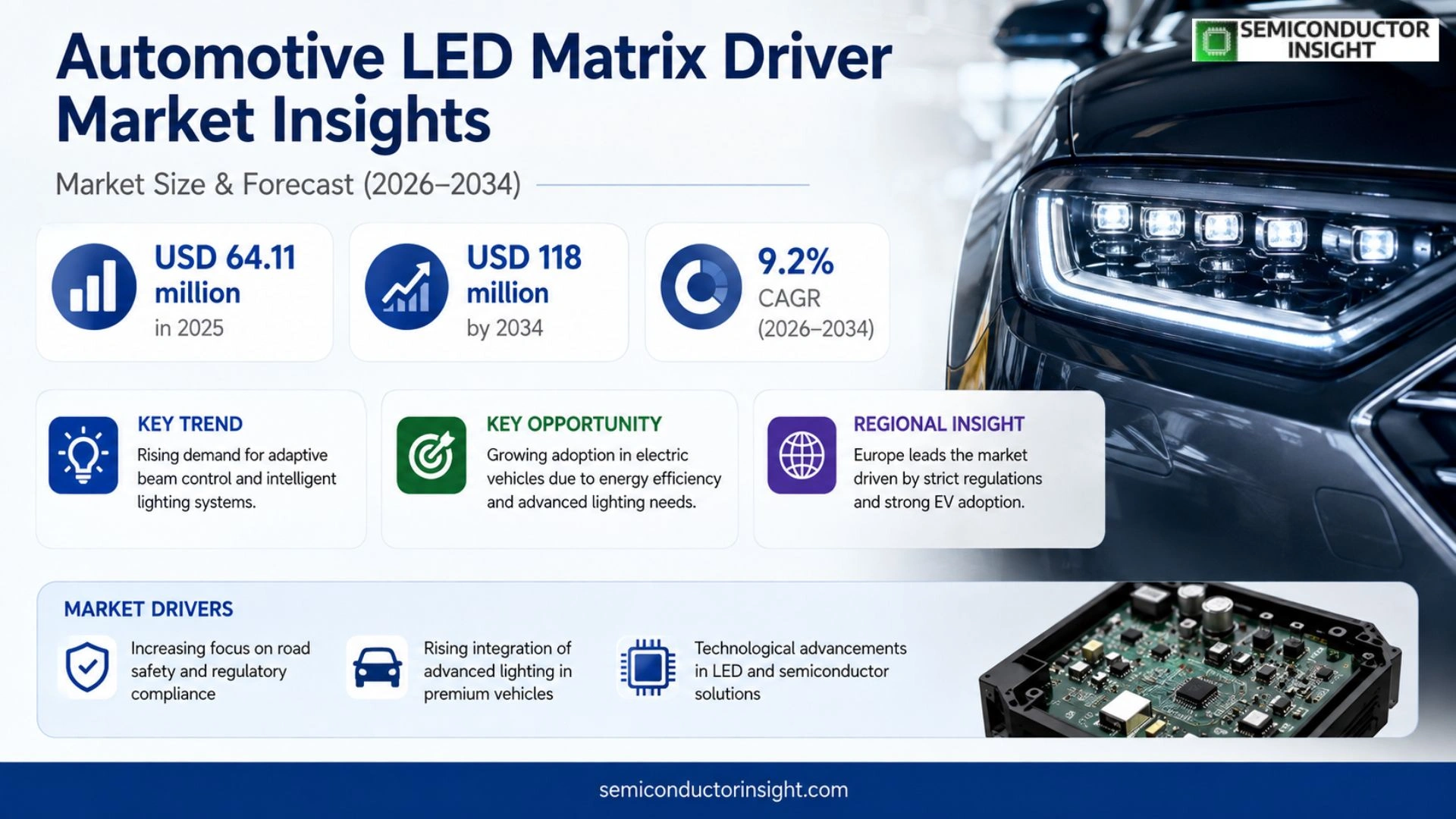
Automotive LED Matrix Driver market size was valued at USD 64.11 million in 2025 and is forecasted to reach USD 118 million by 2034, exhibiting a CAGR of 9.2% during the forecast period.
Automotive LED Matrix Driver is an automotive‑grade driver chip designed to control multi‑pixel LED arrays with independent channel addressing, enabling precise local dimming, adaptive beam shaping, and high‑resolution lighting control for advanced vehicle lighting systems.
The market expands as matrix headlights gain acceptance across passenger cars and commercial vehicles, while regulations promote adaptive lighting and consumers prioritize nighttime safety. Leading suppliers such as Infineon Technologies, Texas Instruments, NXP, Renesas Electronics, STMicroelectronics, ROHM, Analog Devices, ON Semiconductor, Microchip and Melexis are broadening their portfolios and allocating resources toward higher channel‑count designs.
MARKET DRIVERS
Increasing Adoption of Adaptive Lighting Systems
The push for vehicle safety has turned adaptive lighting into a standard expectation in premium models. Manufacturers are embedding matrix drivers to enable pixel‑level dimming, which translates into clearer road illumination around curves and faster response to on‑road hazards. Automotive LED Matrix Driver Market participants that deliver reliable firmware updates are seeing higher OEM preference because the technology directly improves driver visibility and reduces accident risk.
Cost Efficiency Through Integration
Consolidating driver functions within a single silicon package cuts wiring complexity and trims assembly time. The resulting savings,often 10‑15 % of overall lighting sub‑system cost,encourage volume orders from mass‑market brands seeking margin improvement. Companies that can guarantee low thermal footprints while maintaining high current capability are positioned to capture a larger share of the purchasing pipeline.
➤ “The next decade will see matrix drivers become the default architecture for vehicle headlamps, not a niche option,” noted a senior analyst at a leading consultancy.
Beyond safety, the aesthetic appeal of programmable light signatures is reshaping brand identity on the road. As consumers increasingly associate unique lighting patterns with brand loyalty, OEMs are allocating additional R&D dollars to develop proprietary driver algorithms, further accelerating market momentum.
MARKET CHALLENGES
Technical Complexity of High‑Resolution Control
Designing drivers that can address hundreds of LEDs individually demands sophisticated multiplexing and real‑time processing. The engineering effort translates into longer development cycles and higher upfront investment, which can deter smaller suppliers lacking deep ASIC expertise. Moreover, firmware validation under diverse temperature and vibration profiles adds another layer of risk.
Other Challenges
Supply Chain Constraints
The scarcity of high‑purity silicon wafers and specialized packaging materials has tightened lead times. Manufacturers that rely on single‑source vendors face production bottlenecks, forcing them to maintain larger safety stock and eroding the cost advantage of integrated solutions.
MARKET RESTRAINTS
Thermal Management Limitations
Even as driver efficiencies improve, the density of LED arrays generates heat that must be dissipated within tight vehicle packaging constraints. Inadequate thermal design can shorten component lifespan and trigger warranty claims, prompting OEMs to specify conservative operating margins. This caution slows the adoption rate of the most advanced matrix driver designs.
MARKET OPPORTUNITIES
Expansion Within Electric Vehicle Platforms
Electric vehicles prioritize energy efficiency and high‑tech interiors, making them a fertile ground for sophisticated lighting architectures. The lower thermal budgets of EV powertrains align well with the low‑loss characteristics of modern matrix drivers. Companies that tailor their products to the unique voltage architectures of EVs can secure early contracts and benefit from the rapid rollout of new EV models worldwide.
Automotive LED Matrix Driver Market Trends
Intensifying Demand for Adaptive Beam Control
The shift toward intelligent lighting systems is reshaping vehicle architecture. Automakers are integrating matrix heads that can modulate individual LEDs to create glare‑free high beams, dynamically adjust illumination zones, and comply with emerging safety standards. This functional shift creates a clear incentive for chip designers to deliver drivers with higher channel counts, sub‑microsecond response times, and built‑in diagnostic loops. When a driver can independently address each pixel, the vehicle can react to changing traffic conditions in real time, a capability that manufacturers now tout as a differentiator in premium and increasingly in mid‑range models. The cumulative effect is a steady lift in the required volume of sophisticated driver chips, prompting suppliers to prioritize performance‑centric silicon over legacy low‑density solutions.
Other Trends
Supply Chain Evolution
Upstream, the availability of advanced lithography equipment and high‑purity silicon wafers has become a decisive factor. Companies that secure capacity on ASML’s extreme‑ultraviolet tools can shorten development cycles and improve yield, directly influencing gross margins at the driver level. Midstream design teams are concentrating on thermal‑aware layout and integrated protection circuits, which reduce board‑level component count and simplify automotive‑grade validation. Downstream, Tier‑1 suppliers are consolidating multiple lighting functions into a single driver module, a move that eases integration for OEMs and enables faster rollout of matrix‑based headlamps across global platforms.
Broader Penetration into Mid‑Tier Vehicles
What was once a hallmark of luxury sedans is now appearing in family cars and light commercial vans. Cost‑optimization strategies, such as using multi‑channel driver architectures that share bias circuitry, have lowered the bill of materials enough to make matrix lighting economically viable for higher‑volume platforms. Simultaneously, regulatory bodies in Europe and North America are tightening illumination performance criteria, nudging manufacturers to adopt adaptive lighting as a compliance measure rather than an optional extra. This convergence of cost pressure and regulatory impetus expands the addressable market for driver chips, encouraging vendors to invest in scalable manufacturing footprints that can service both premium and mainstream segments.
COMPETITIVE LANDSCAPE
Key Industry Players
Automotive LED Matrix Driver market – competitive dynamics and strategic positioning
In the upper tier of the market, Infineon Technologies and Texas Instruments command the lion’s share of high‑volume contracts with premium OEMs such as BMW, Mercedes‑Benz, and Tesla. Their driver families integrate multi‑channel constant‑current architectures, on‑chip diagnostics, and auto‑grade thermal solutions, allowing automakers to meet stringent functional safety standards while reducing board‑level component count. Both firms leverage deep semiconductor supply‑chain ties,Infineon with ASML and Applied Materials, TI with its own fabless ecosystem,to sustain capacity utilization above 60 % and protect gross margins near 45 %. The resulting scale advantage feeds back into R&D cycles, where each incremental generation adds pixel‑level dimming granularity and faster response times, reinforcing the incumbents’ position as preferred partners for next‑generation adaptive lighting programs.
Below the tier‑1 block, a constellation of specialist manufacturers expands the market’s breadth. ROHM and NXP focus on compact, cost‑effective multi‑channel drivers targeting midsize passenger cars and entry‑level commercial vehicles, where price sensitivity outweighs ultra‑high channel counts. Melexis and ON Semiconductor differentiate through built‑in thermal‑optimisation modules that ease system‑level design for regional OEMs in China and India. Analog Devices and Microchip capitalize on their broader mixed‑signal portfolios to offer flexible driver‑controller hybrids for niche applications such as interior ambient lighting and off‑road lighting rigs. Emerging players like Skyworks Solutions and Silicon Labs inject innovation in power‑efficiency algorithms, nudging the competitive set toward a more diversified technology landscape.
List of Key Automotive LED Matrix Driver Companies Profiled
- Infineon Technologies
- Texas Instruments
- NXP Semiconductors
- ROHM Semiconductor
- Renesas Electronics
- STMicroelectronics
- Analog Devices
- ON Semiconductor
- Microchip Technology
- Melexis
- Skyworks Solutions
- Silicon Labs
- Maxim Integrated
- Vishay Intertechnology
- Diodes Incorporated
Segment Analysis:
| Segment Category | Sub-Segments | Key Insights |
| By Type |
|
Multi‑Channel
|
| By Application |
|
Passenger Cars
|
| By End User |
|
OEMs
|
| By Drive Technology |
|
Buck Driver
|
| By Qualification |
|
AEC‑Q100
|
Regional Analysis: Automotive LED Matrix Driver Market
Europe
The EU’s progressive vehicle lighting directives compel manufacturers to adopt adaptive LED matrix systems, creating a predictable demand curve for drivers that can respond to variable beam patterns. Compliance timelines are synchronized across member states, allowing suppliers to plan capacity expansions with confidence, while also fostering a competitive environment that rewards technical compliance.
A well‑established ecosystem of silicon fab facilities, precision assembly plants, and validation labs underpins the European market. Proximity between design houses and production sites shortens feedback loops, enabling rapid iteration of driver firmware that aligns with evolving vehicle architectures.
European buyers increasingly associate intelligent lighting with vehicle safety and brand prestige. This perception fuels demand for matrix drivers that support dynamic headlamp swiveling and interior mood lighting, prompting premium brands to allocate more budget to driver integration.
Research clusters in Scandinavia and Central Europe attract talent focused on power‑efficient driver topologies and robust communication protocols. Start‑ups emerging from these hubs often partner with legacy OEMs, accelerating the rollout of next‑generation driver solutions across the continent.
North America
In North America, Automotive LED Matrix Driver market is shaped by a pragmatic blend of regulatory encouragement and strong consumer appetite for advanced driver‑assistance features. U.S. safety standards promote adaptive lighting, yet manufacturers retain flexibility in implementation, resulting in a diverse portfolio of driver designs. The region benefits from a robust semiconductor manufacturing base, especially in the Southwest, which supplies high‑volume modules to both domestic and export markets. While cost sensitivity remains a factor, premium brands leverage matrix drivers to differentiate their models through enhanced nighttime visibility and customizable interior lighting, creating a tiered market where value‑added features command higher margins.
Asia‑Pacific
Asia‑Pacific exhibits the most rapid expansion in the Automotive LED Matrix Driver sphere, propelled by swift vehicle electrification across China, Japan, and South Korea. Government incentives for energy‑efficient lighting accelerate OEM adoption, while local chipmakers ramp up production capacity to meet surging demand. The region’s automotive manufacturers are experimenting with highly integrated driver solutions that combine power management and communication interfaces, aiming to reduce vehicle weight and simplify wiring harnesses. Market participants recognize that mastering matrix driver technology will be critical to maintaining competitiveness in a landscape where volume production and cost control dominate strategic planning.
South America
South America’s engagement with Automotive LED Matrix Driver market remains nascent, but recent policy shifts toward stricter vehicle lighting regulations are beginning to stimulate interest. Local OEMs, many of which rely on imported components, are evaluating cost‑effective driver architectures that can be assembled within regional plants. The market’s growth trajectory is closely linked to broader economic stability and the ability of distributors to secure reliable supply lines from established European and Asian manufacturers. Early adopters are focusing on high‑end segments, using matrix drivers to offer differentiated lighting experiences that appeal to affluent urban consumers.
Middle East & Africa
In the Middle East & Africa, Automotive LED Matrix Driver market is influenced by a combination of luxury‑vehicle concentration and emerging safety standards. Wealthy consumers in Gulf states favor premium lighting features, prompting high‑end manufacturers to integrate sophisticated drivers that enable dynamic headlamp functions and ambient cockpit illumination. Meanwhile, African markets are gradually aligning with global safety expectations, creating an opening for modular driver solutions that can be scaled across diverse vehicle classes. The region’s growth will depend on the establishment of localized assembly capabilities and the ability to balance high‑spec demand with cost‑efficient deployment.
Report Scope
This market research report provides a comprehensive analysis of the Automotive LED Matrix Driver Market , covering the forecast period 2026–2034. It offers detailed insights into market dynamics, technological advancements, competitive landscape, and key trends shaping the industry.
Key focus areas of the report include:
- Market Overview: The report begins with an overview outlining its current market scenario, key growth indicators, and industry transformation drivers. It discusses macroeconomic factors, demand–supply balance, regulatory landscape, and the strategic role of semiconductors in powering advancements across industries such as automotive, telecommunications, consumer electronics, and industrial automation.
- Market Size & Forecast: Historical data and future projections for revenue, unit shipments, and market value across major regions and segments.
- Segmentation Analysis: Detailed breakdown by product type, technology, application, and end-user industry to identify high-growth segments and investment opportunities.
- Regional Insights: Insights into market performance across North America, Europe, Asia-Pacific, Latin America, and the Middle East & Africa, including country-level analysis where relevant.
- Competitive Landscape: Profiles of leading market participants, including their product offerings, R&D focus, manufacturing capacity, pricing strategies, and recent developments such as mergers, acquisitions, and partnerships.
- Technology Trends & Innovation: Assessment of emerging technologies, integration of AI/IoT, semiconductor design trends, fabrication techniques, and evolving industry standards.
- Market Drivers & Restraints: Evaluation of factors driving market growth along with challenges, supply chain constraints, regulatory issues, and market-entry barriers.
- Stakeholder Insights: Insights for component suppliers, OEMs, system integrators, investors, and policymakers regarding the evolving ecosystem and strategic opportunities.
Primary and secondary research methods are employed, including interviews with industry experts, data from verified sources, and real-time market intelligence to ensure the accuracy and reliability of the insights presented.
FREQUENTLY ASKED QUESTIONS:
What is the current market size of Automotive LED Matrix Driver Market?
-> Automotive LED Matrix Driver market is forecasted to reach USD 118 million by 2034, exhibiting a CAGR of 9.2% during the forecast period.
Which key companies operate in Automotive LED Matrix Driver Market?
-> Key players include Infineon Technologies, Texas Instruments, NXP, Renesas Electronics, STMicroelectronics, ROHM, Analog Devices, ON Semiconductor, Microchip, Melexis, among others.
What are the key growth drivers?
-> Key growth drivers include advancements in adaptive matrix lighting, increasing safety regulations, growing consumer demand for intelligent vehicle illumination, and expanding adoption from premium to mid‑range passenger and commercial vehicles.
Which region dominates the market?
-> Asia is the leading region due to the high concentration of automotive manufacturers adopting matrix lighting, while Europe and North America also show strong uptake.
What are the emerging trends?
-> Emerging trends include high‑channel‑count driver chips with fast response, robust diagnostics, integration of AI for adaptive beam shaping, and regulatory support for glare‑free high‑beam systems.
Get Sample Report PDF for Exclusive Insights
Report Sample Includes
- Table of Contents
- List of Tables & Figures
- Charts, Research Methodology, and more...
 Download Sample Report PDF