TE And TM Mode Dielectric Ceramic Resonator Market Insights
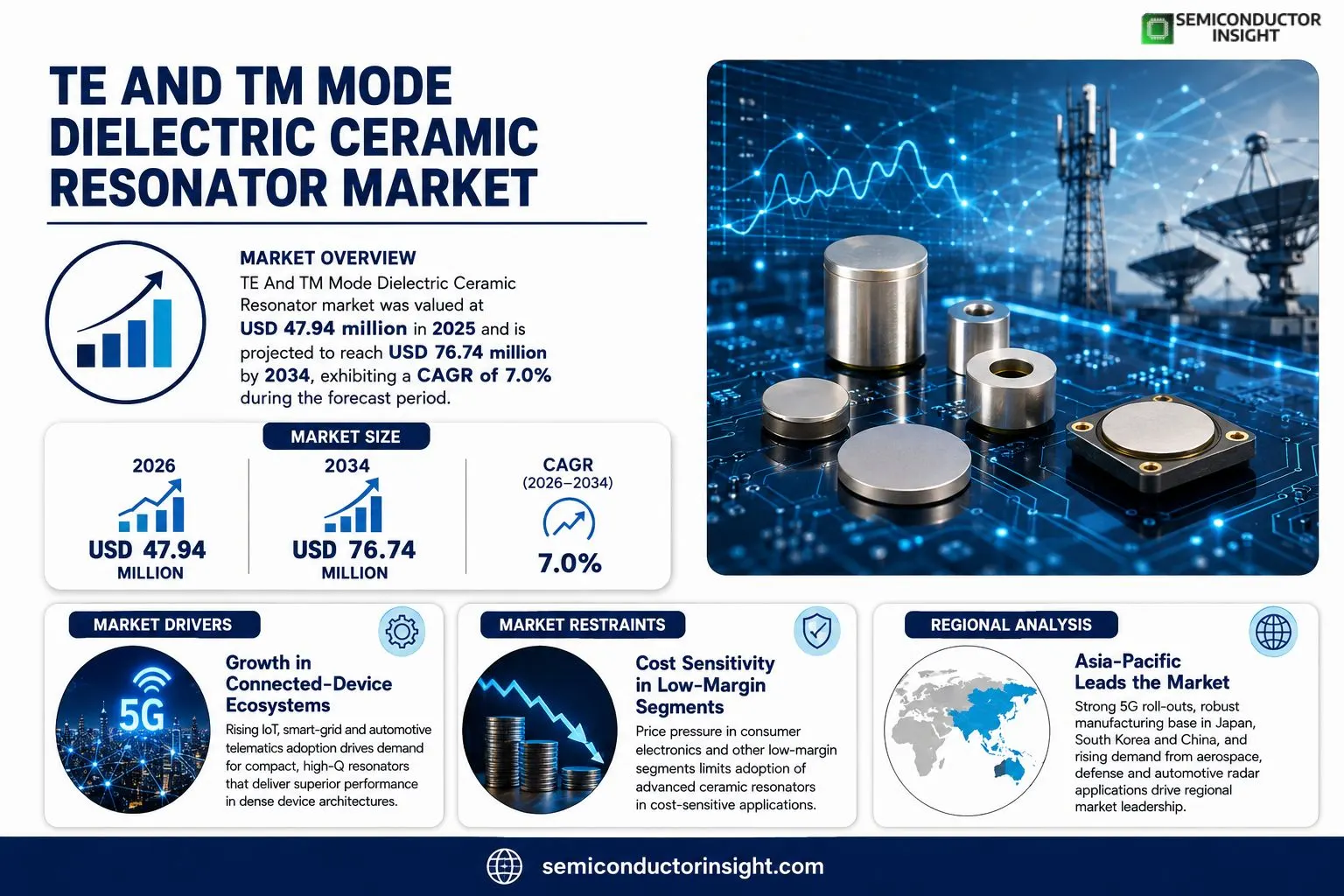
TE And TM Mode Dielectric Ceramic Resonator market was valued at USD 47.94 million in 2025 and is projected to reach USD 76.74 million by 2034, exhibiting a CAGR of 7.0% during the forecast period.
TE and TM mode dielectric ceramic resonators are high‑performance passive frequency‑selective components employed in RF, microwave and millimetre‑wave circuits. Their core function is to generate stable resonance at designated frequencies, enabling filters, duplexers, combiners, oscillators, low‑noise receiving chains and radar front ends to achieve low loss, high selectivity, miniaturisation and temperature stability. The devices rely on microwave dielectric ceramic material characterised by a high dielectric constant, low dielectric loss, elevated Q factor (or Qf) and a modest temperature coefficient of resonant frequency, packaged in geometries such as disks, cylinders or annular structures that couple with metal cavities or waveguide assemblies.
The upward trajectory stems from escalating requirements for spectral efficiency, reduced device footprint and reliable performance across emerging mobile‑communication standards, satellite‑link architectures and automotive radar solutions. Manufacturers are therefore expanding material‑formulation capabilities and offering custom‑dimension resonators to meet application‑specific tolerances.
MARKET DRIVERS
Growth in Connected‑Device Ecosystems
The expanding footprint of IoT sensors, smart‑grid controllers and automotive telematics creates a persistent need for compact frequency‑selective components. TE And TM Mode Dielectric Ceramic Resonator Market participants benefit because these resonators deliver high‑Q performance while occupying minimal board real‑estate, an attribute that directly supports the density pressures of modern electronic platforms.
Miniaturization of RF Front‑Ends
Manufacturers of handheld and wear‑able devices are shrinking RF front‑end modules to meet consumer expectations for slimmer profiles. Dielectric ceramic resonators, operating in both TE and TM modes, enable designers to replace bulkier crystal filters without sacrificing spectral purity, thereby accelerating product cycles and reducing bill‑of‑materials costs.
➤ “Design teams cite frequency stability and size reduction as decisive factors when selecting resonators for the next generation of smart devices.”
Another catalyst stems from the rising adoption of 5G‑enabled infrastructure. Base‑station architects are integrating resonators that can be tuned across multiple bands; the dual‑mode capability of TE And TM Mode Dielectric Ceramic Resonator Market offerings aligns with this flexibility requirement, encouraging broader deployment.
MARKET CHALLENGES
Stringent Performance Benchmarks
Designers increasingly demand resonators with tighter phase‑noise specifications and lower insertion loss. Achieving these targets while maintaining cost competitiveness forces suppliers to invest heavily in material purity and precision fabrication, a hurdle for smaller firms lacking scale economies.
Other Challenges
Supply‑Chain Volatility
Fluctuations in high‑grade ceramic raw‑material availability can induce lead‑time extensions, prompting OEMs to hold larger safety stocks and potentially delaying product launches.
MARKET RESTRAINTS
Cost Sensitivity in Low‑Margin Segments
Segments such as consumer electronics operate under razor‑thin margins, restricting the premium that can be applied to higher‑performance resonators. When price pressure intensifies, buyers may revert to legacy crystal solutions, curbing the overall penetration rate of advanced ceramic resonators.
MARKET OPPORTUNITIES
Emerging Applications in Space‑Qualified Systems
Satellite communication payloads are adopting radiation‑hard resonators capable of sustaining performance under extreme environments. The dual‑mode architecture of TE And TM Mode Dielectric Ceramic Resonator Market products meets the stringent thermal‑stability and frequency‑tolerance criteria demanded by space missions, opening a niche yet high‑value revenue stream.
Expansion into Automotive Radar
Advanced driver‑assistance systems (ADAS) rely on millimeter‑wave radar modules that require ultra‑stable reference components. Ceramic resonators that can be precisely tuned for both TE and TM propagation modes are positioned to replace traditional SAW filters, offering a pathway to capture a growing share of the automotive safety market.
TE And TM Mode Dielectric Ceramic Resonator Market Trends
Miniaturization and High‑Q Requirements Reshape TE And TM Mode Dielectric Ceramic Resonator Market
The adoption of 5G, satellite‑based backhaul, and automotive radar has forced equipment makers to squeeze resonators into ever smaller volumes while preserving Q‑factor above 30,000. TE resonators, favored for their low loss, are now being deployed in base‑station cavity filters that must operate across multiple bands. At the same time, TM resonators are gaining preference in compact front‑end modules because their geometry accommodates higher power density and tighter thermal paths. This dual pressure reshapes TE And TM Mode Dielectric Ceramic Resonator Market, prompting suppliers to offer hybrid product lines that combine high‑Q ceramic formulations with modular tuning mechanisms. OEMs that can secure a reliable source of tightly‑toleranced ceramics secure a competitive edge in network rollout schedules. Furthermore, the push for multi‑band operation encourages the use of dual‑mode resonators that can switch between TE and TM characteristics without hardware redesign, thereby shortening time‑to‑market for new handset platforms.
Other Trends
Material Formulation and Custom Design as Differentiators
Beyond the end‑user pressure, competition among manufacturers is increasingly anchored in material science. Companies such as MARUWA in Japan and Trans‑Tech in the United States differentiate by custom‑blending ceramic compositions that push dielectric constant above 30 while keeping loss tangent below 0.0002. Their product catalogs list TE21, TE30 series for high‑Q filters and TM45, TM80 series for miniaturized oscillators, each tied to precise dimensional tolerances. The ability to deliver resonators that meet both Q‑factor and temperature‑coefficient specifications reduces downstream redesign effort for filter cavity engineers. Consequently, firms that invest in high‑precision sintering and automated inspection are capturing a larger share of design‑win contracts. Such flexibility enables OEMs to consolidate inventory across product families, reducing holding costs and simplifying qualification processes for telecom operators rolling out heterogeneous networks, and improves overall supply chain resilience.
Geographic Competition Intensifies Around Material Precision
Regionally, Asia‑Pacific manufacturers benefit from dense 5G base‑station deployments and government‑backed radar programs, translating into higher order volumes for both TE and TM modules. European players maintain a foothold in aerospace and defense where certification standards such as AS9100D drive demand for traceable material batches. In North America, the growth of satellite‑enabled broadband services fuels orders for resonators that can operate from 1.5 GHz up to 100 GHz with minimal temperature drift. The overarching challenge remains the need for repeatable machining of sub‑millimeter cavities; any deviation inflates test cycles and erodes margins. Suppliers that align their engineering teams with OEM design groups and provide rapid prototyping are positioned to convert these market pressures into sustainable revenue streams. In addition, the emergence of open‑architecture RF front‑ends invites collaborative development models, where resonator manufacturers co‑engineer solutions alongside chipset designers, creating new revenue streams beyond volume sales and fostering long‑term partnerships.
COMPETITIVE LANDSCAPEKey Industry Players
TE And TM Mode Dielectric Ceramic Resonator – Competitive Overview
The market is anchored by a handful of firms that command the majority of high‑Q TE resonator supply for base‑station filters and satellite LNBs. MARUWA in Japan leverages its long‑standing expertise in ceramic formulation to offer a broad catalog of standard frequencies while also providing custom‑blend services for defense‑grade oscillators. In the United States, Skyworks’ Trans‑Tech division has built a reputation for tight dimensional tolerances that enable compact TM‑mode parts used in emerging 5G‑Advanced radios. Exxelia, headquartered in France, differentiates itself through an extensive mixed‑mode portfolio that spans from 1.5 GHz up to 100 GHz, supporting aerospace and automotive radar customers. These leaders benefit from vertically integrated production lines, which reduce lead‑time and allow rapid adaptation to shifting frequency allocations. Their market share is reinforced by established qualification programs (e.g., AS9100D, ISO/TS 16949) that satisfy the rigorous reliability standards of aerospace and defense integrators.Beyond the primary tier, a constellation of niche players adds depth to the supply chain. Token in Taiwan and THISLINK in South Korea specialize in medium‑permittivity ceramic codes that meet the power‑density constraints of next‑generation mobile modules. MCV Microwave focuses on customized cavity‑mounted resonators for high‑power radar front ends, while Daiken Chemical in Japan supplies proprietary dielectric powders that underpin many European manufacturers. Companies such as INBEST Ceramic, Jiaxing Glead, Jiangsu CaiQin, Guangdong Fenghua, Suzhou Dongshan Precision, ATR Technology, and Shenzhen Xianfeng Microwave contribute regional strength, often serving domestic telecom equipment makers with cost‑effective standard‑frequency parts. This fragmented layer intensifies competition on price and engineering support, prompting larger firms to collaborate with smaller specialists to broaden their product matrices and accelerate time‑to‑market for complex multi‑band solutions.
List of Key TE And TM Mode Dielectric Ceramic Resonator Companies Profiled
- MARUWA CO., LTD.
- Skyworks Solutions, Inc. (Trans‑Tech)
- Daiken Chemical Industry Co., Ltd.
- T‑Ceram, s.r.o.
- Exxelia SAS
- MCV Microwave
- Token Electronics Industry Co., Ltd.
- THIS Co., Ltd.
- THISLINK Inc.
- INBEST Ceramic
- Jiaxing Glead Electronics Co., Ltd.
- Jiangsu CaiQin Technology Co., Ltd.
- Guangdong Fenghua Advanced Technology (Holding) Co., Ltd.
- Suzhou Dongshan Precision Manufacturing Co., Ltd.
- ATR Technology
- Shenzhen Xianfeng Microwave Electronics Co., Ltd.
Segment Analysis:
| Segment Category | Sub-Segments | Key Insights |
| By Type |
|
TE Mode Resonators are regarded as the leading segment because they satisfy the most demanding high‑Q and low‑loss specifications required by high‑performance RF front‑ends.
|
| By Application |
|
Base Station Filtering and Combining emerges as the primary application segment, driven by the relentless quest for spectral efficiency and compact RF modules.
|
| By End User |
|
Communication Equipment Manufacturers dominate the end‑user landscape because they integrate resonators into a wide range of RF front‑end modules.
|
| By Resonant Mode |
|
High‑Q TE Focused Designs retain leadership due to their unmatched loss performance.
|
| By Dielectric Constant Class |
|
High Permittivity Class is the preferred choice for size‑critical designs.
|
Regional Analysis: TE And TM Mode Dielectric Ceramic Resonator Market
Europe
Europe retains its position as the most mature market for TE And TM Mode Dielectric Ceramic Resonators, largely because the continent houses a dense network of high‑frequency communication equipment manufacturers and a longstanding tradition of materials research. Companies based in Germany, the United Kingdom, and France have integrated resonators into next‑generation radar and satellite platforms, prompting a subtle shift toward more specialized, high‑Q components. The strategic emphasis on energy‑efficient wireless infrastructure, especially within the EU’s 5G rollout, encourages suppliers to refine ceramic formulations that balance temperature stability with compact form factors.
The regulatory environment in Europe adds another layer of complexity. Tight electromagnetic compatibility (EMC) standards require resonators that can maintain performance across broader temperature ranges, nudging manufacturers toward advanced compositional tweaks and tighter quality‑control loops. Meanwhile, collaborative research initiatives funded by Horizon Europe stimulate cross‑border knowledge sharing, fostering incremental improvements in tuner designs that directly benefit resonator reliability.
From a commercial perspective, European OEMs favor long‑term supply agreements that embed technical support, reflecting the industry’s preference for predictability over price competition. This dynamic creates a niche for niche‑player resonator firms that can provide custom tolerance windows and rapid prototyping services. As a result, the European market’s value lies not in sheer volume but in the depth of technical integration and the willingness of customers to pay a premium for performance assurance.
The region’s cluster of precision ceramics plants, especially in Italy and the Czech Republic, enables rapid iteration cycles. Proximity between fab facilities and design houses shortens feedback loops, allowing engineers to fine‑tune dielectric constants without extensive logistics delays.
European research labs have pioneered low‑loss ceramic composites that mitigate temperature drift. These breakthroughs feed directly into OEM specifications, addressing the stringent demand for frequency stability in 5G and satellite back‑haul systems.
By diversifying raw‑material sources across the continent, suppliers reduce exposure to geopolitical shocks. Strategic stockpiles of key oxides further cushion the market against short‑term disruptions.
The EU’s harmonized EMC directives force manufacturers to adopt tighter tolerances, which in turn drives investment in advanced testing infrastructure and elevates overall product reliability.
North America
In North America, TE And TM Mode Dielectric Ceramic Resonator Market is shaped by a blend of defense spending and aggressive consumer‑grade wireless deployments. U.S. defense contractors demand resonators that can endure extreme temperature swings, prompting domestic suppliers to emphasize ruggedization. Simultaneously, the commercial sector’s push for higher data rates raises expectations for low‑loss performance, nudging firms to explore novel grain‑boundary engineering techniques. Strategic partnerships between semiconductor firms and ceramic producers are emerging, aiming to embed resonator functionality directly into system‑on‑chip architectures, a move that could redefine traditional component sourcing models.
Asia‑Pacific
The Asia‑Pacific region presents a contrasting portrait, where rapid adoption of IoT devices fuels demand for compact resonators, yet the market remains fragmented. Manufacturers in China, South Korea, and Taiwan focus on cost‑effective production, often at the expense of stringent performance metrics. Nonetheless, a growing awareness of reliability among telecom operators is spurring incremental upgrades to material purity and process control. Regional trade agreements facilitate cross‑border component flow, but divergent standards pose hurdles for standardization, encouraging local firms to develop proprietary resonance solutions tailored to domestic network specifications.
South America
South America’s involvement in TE And TM Mode Dielectric Ceramic Resonator Market is still nascent, largely anchored by telecom infrastructure upgrades in Brazil and Argentina. Operators seeking to expand 4G and early‑stage 5G coverage require resonators that can operate reliably in humid, high‑temperature climates. Local distributors therefore prioritize suppliers with proven thermal stability, even if it entails higher unit costs. Emerging research collaborations between universities and multinational firms hint at a gradual shift toward indigenous material development, which could enhance regional self‑sufficiency over the next decade.
Middle East & Africa
In the Middle East & Africa, market activity revolves around defense and aerospace projects, especially in the Gulf Cooperation Council states. Harsh desert environments demand resonators with exceptional temperature tolerance and minimal frequency drift. Consequently, buyers often opt for premium European or Japanese offerings, while regional integrators explore joint ventures to gain technology transfer. Meanwhile, Africa’s limited telecom rollout creates modest but steady demand, with a focus on robust, low‑maintenance resonators suitable for remote base stations.
Report Scope
This market research report provides a comprehensive analysis of the TE And TM Mode Dielectric Ceramic Resonator Market , covering the forecast period 2026–2034. It offers detailed insights into market dynamics, technological advancements, competitive landscape, and key trends shaping the industry.
Key focus areas of the report include:
- Market Overview: The report begins with an overview outlining its current market scenario, key growth indicators, and industry transformation drivers. It discusses macroeconomic factors, demand–supply balance, regulatory landscape, and the strategic role of semiconductors in powering advancements across industries such as automotive, telecommunications, consumer electronics, and industrial automation.
- Market Size & Forecast: Historical data and future projections for revenue, unit shipments, and market value across major regions and segments.
- Segmentation Analysis: Detailed breakdown by product type, technology, application, and end-user industry to identify high-growth segments and investment opportunities.
- Regional Insights: Insights into market performance across North America, Europe, Asia-Pacific, Latin America, and the Middle East & Africa, including country-level analysis where relevant.
- Competitive Landscape: Profiles of leading market participants, including their product offerings, R&D focus, manufacturing capacity, pricing strategies, and recent developments such as mergers, acquisitions, and partnerships.
- Technology Trends & Innovation: Assessment of emerging technologies, integration of AI/IoT, semiconductor design trends, fabrication techniques, and evolving industry standards.
- Market Drivers & Restraints: Evaluation of factors driving market growth along with challenges, supply chain constraints, regulatory issues, and market-entry barriers.
- Stakeholder Insights: Insights for component suppliers, OEMs, system integrators, investors, and policymakers regarding the evolving ecosystem and strategic opportunities.
Primary and secondary research methods are employed, including interviews with industry experts, data from verified sources, and real-time market intelligence to ensure the accuracy and reliability of the insights presented.
FREQUENTLY ASKED QUESTIONS:
What is the current market size of TE And TM Mode Dielectric Ceramic Resonator Market?
-> TE And TM Mode Dielectric Ceramic Resonator Market was valued at USD 47.94 million in 2025 and is expected to reach USD 76.74 million by 2034, growing at a CAGR of 7.0% during the forecast period.
Which key companies operate in TE And TM Mode Dielectric Ceramic Resonator Market?
-> Key players include MARUWA CO., LTD., Skyworks Solutions, Inc., MCV Microwave, Exxelia SAS, Token Electronics Industry Co., Ltd., THISLINK Inc., Jiaxing Glead Electronics Co., Ltd., Jiangsu CaiQin Technology Co., Ltd., ATR Technology, among others.
What are the key growth drivers?
-> Growth is driven by the evolution of 5G and 5G‑Advanced mobile communications, expanding satellite communication networks, increasing adoption of radar and high‑frequency sensing, and the need for high‑Q, low‑loss, miniaturized components that improve spectral efficiency, device size, and temperature stability.
Which region dominates the market?
-> Asia‑Pacific leads the market, supported by strong 5G roll‑outs, extensive manufacturing base in Japan, South Korea, China, and increasing demand from aerospace, defense, and automotive radar applications.
What are the emerging trends?
-> Emerging trends include the development of custom‑blended dielectric materials for specific filter and oscillator designs, higher integration of TE and TM mode resonators in next‑generation mobile equipment, and increasing focus on high‑Q, high‑power adaptability for compact RF modules.
Get Sample Report PDF for Exclusive Insights
Report Sample Includes
- Table of Contents
- List of Tables & Figures
- Charts, Research Methodology, and more...
 Download Sample Report PDF