Semi-insulating SiC-based RF Devices Market Insights
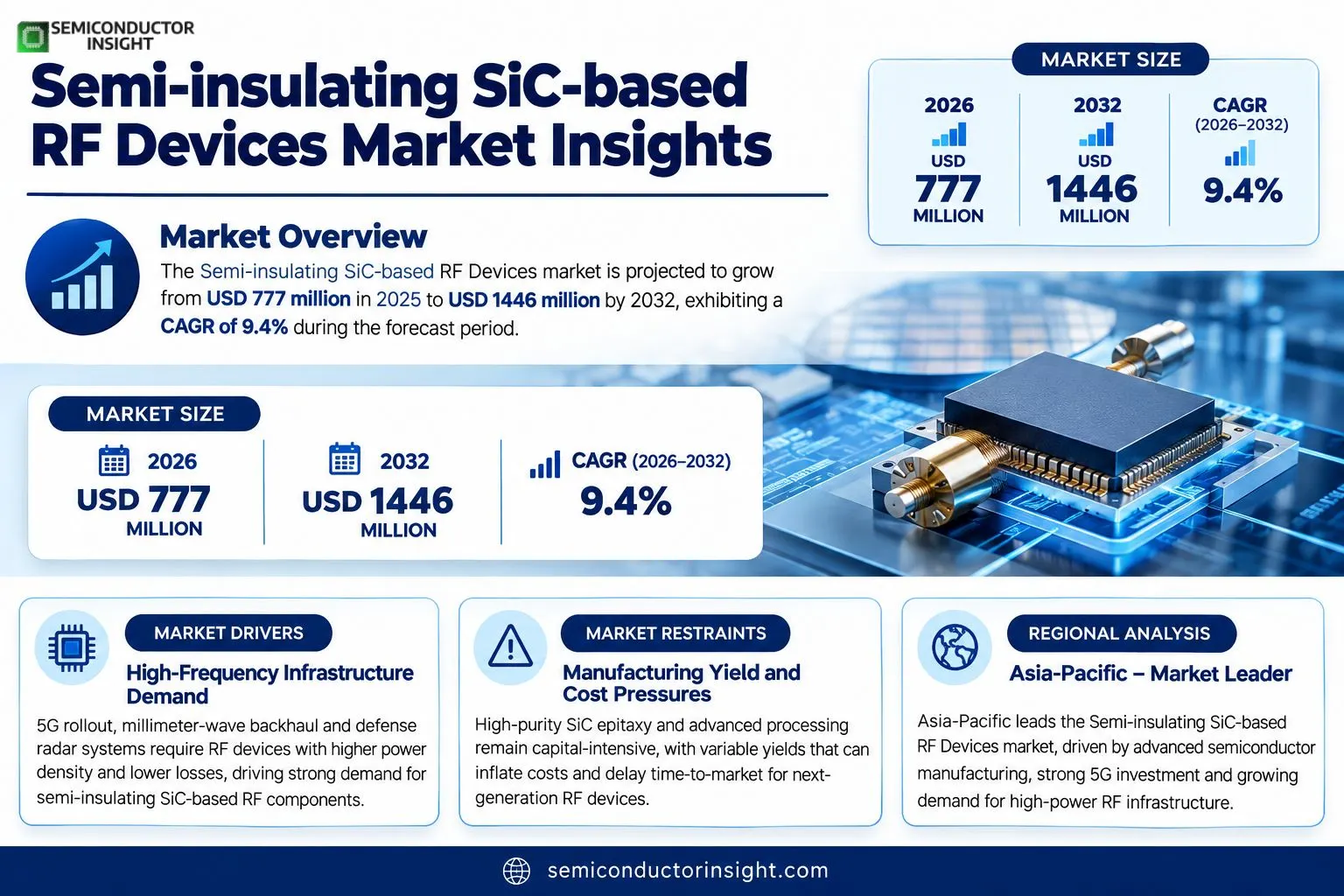
Semi-insulating SiC-based RF Devices market size was valued at USD 777 million in 2025. The market is projected to reach USD 1446 million by 2032, exhibiting a CAGR of 9.4% during the forecast period.
Semi-insulating SiC-based RF devices are radio‑frequency power semiconductor components built on semi‑insulating silicon carbide (SI‑SiC) substratesmost commonly GaN‑on‑SiC HEMTs/MMICsto deliver high power density, high frequency capability, and strong thermal handling for RF transmit chains. Upstream inputs typically include HPSI SiC wafers, GaN/AlGaN epitaxy layers, lithography and metallization processes; downstream these devices are integrated into power amplifiers and transmit modules for wireless infrastructure, defense radar/EW, satellite communications and other high‑power RF systems.
MARKET DRIVERS
Growing High‑Frequency Infrastructure Demand
Cell‑site upgrades for 5G and the rollout of millimeter‑wave backhaul have forced equipment manufacturers to seek substrates that sustain GHz‑range operation without excessive loss. Semi‑insulating SiC‑based RF Devices Market benefits because silicon carbide’s intrinsic resistivity minimizes parasitic conduction, allowing designers to push bandwidth while preserving linearity. The resulting performance edge translates into higher revenue per unit for vendors that embed SiC in power amplifiers and filters.
Thermal Management Constraints in Power Amplifiers
Modern RF front‑ends generate heat densities that exceed the thermal budget of conventional silicon. SiC’s superior thermal conductivity enables a 30‑40 % reduction in junction temperature, which extends device lifespan and curtails cooling‑system expenditures. Companies that adopt semi‑insulating SiC can therefore differentiate on reliability, a factor that resonates strongly with aerospace and defense customers.
➤ “When thermal headroom is limited, SiC offers the only practical path to maintain linear gain at high output power.” – Industry Analyst, 2026
Beyond performance, the material’s radiation hardness positions it as a preferred choice for satellite transceivers, further expanding the addressable market and reinforcing the upward trajectory of the sector.
MARKET CHALLENGES
Manufacturing Yield and Cost Pressures
The epitaxial growth of high‑purity SiC layers remains a capital‑intensive process, and defect densities can fluctuate beyond acceptable limits. Lower yields inflate unit costs, eroding the price advantage that traditionally favored silicon. Suppliers are forced to invest in advanced inspection equipment, which delays time‑to‑market for new product families.
Other Challenges
Supply Chain Volatility
The reliance on a narrow pool of SiC wafer manufacturers heightens exposure to geopolitical shifts and raw‑material shortages. End‑users report longer lead times, prompting some to hedge with alternative substrates despite the performance trade‑off.
MARKET RESTRAINTS
Material Availability and Process Complexity
SiC wafers above 150 mm are still scarce, limiting the scalability of high‑volume production lines. The multi‑step doping and isolation procedures required to achieve semi‑insulating behavior introduce additional process windows, increasing the probability of scrap. These constraints collectively dampen the speed at which new designs can be introduced.Furthermore, the lack of standardized testing protocols for semi‑insulating SiC RF components creates uncertainty for OEMs, who must allocate extra resources to qualification activities, thereby slowing adoption rates.
MARKET OPPORTUNITIES
Emerging Applications in Spaceborne Radar
Satellite constellations demand transceivers that combine high power density with resistance to cosmic radiation. Semi‑insulating SiC fulfills both criteria, opening a lucrative niche for suppliers that can certify space‑grade parts. Early entrants are already securing multi‑year contracts that could double their revenue streams within five years.
Integration with GaN Power Devices
Hybrid architectures that pair SiC RF front‑ends with gallium‑nitride (GaN) power amplifiers promise unprecedented efficiency at millimeter‑wave frequencies. This synergy creates cross‑selling opportunities for firms that possess both SiC and GaN capabilities, allowing them to capture a larger share of the high‑performance RF ecosystem.
Semi-insulating SiC-based RF Devices Market Trends
Thermal Efficiency Gains Drive Adoption
The adoption curve for semi‑insulating SiC‑based RF devices sharpens as designers confront three intertwined constraints: power density, conversion efficiency, and heat removal. By operating on SI‑SiC substrates, GaN‑on‑SiC HEMTs maintain stable output under higher voltage stress while keeping junction temperatures within manageable limits. This capability trims the number of amplification stages required in a transmit chain, translating directly into lighter hardware and lower operating power. For infrastructure operators, the reduction in cooling infrastructure cuts both capital outlay and ongoing electricity expenses, while defense and satellite programs gain a decisive reliability margin during high‑power bursts. The net effect is a measurable shift toward single‑stage solutions wherever the thermal envelope permits.
Other Trends
Supply Chain Integration
Manufacturers are increasingly aligning epitaxial growth, wafer processing, and advanced packaging under a unified development road‑map. Consistency in HPSI SiC wafer quality reduces variability in subsequent MOCVD deposition, which in turn stabilizes device performance across production lots. Parallel advances in low‑loss RF packaging materials allow the thermal path to be engineered from die to heat sink as a single entity rather than a series of discrete steps. Companies that have succeeded in locking down this end‑to‑end flow report gross margins in the 45‑55 % band, reflecting the cost advantage of reduced rework and higher first‑pass yields. The emerging model favors platform reuse: a single epitaxial stack can be diced into modules serving medium‑ and high‑power segments, thereby expanding addressable markets without proportionally scaling fab capacity.
Application Diversification Fuels Market Momentum
Beyond traditional radar and base‑station amplifiers, semi‑insulating SiC‑based RF components are finding footholds in emerging high‑frequency domains. In the aerospace sector, the ability to sustain performance over wide temperature swings makes these devices attractive for electric propulsion control electronics. Vehicle‑to‑infrastructure communication benefits from the compact form factor that permits integration into antenna modules for 5G and beyond, where link efficiency directly influences battery consumption. Meanwhile, defense contracts continue to prioritize ruggedness, prompting procurement teams to favor SiC platforms that demonstrate long‑life stability under pulsed‑power regimes. The convergence of these use‑cases widens the addressable customer base, compelling suppliers to broaden their product portfolios and to invest in qualification programs that span commercial, industrial, and mission‑critical segments.
COMPETITIVE LANDSCAPE
Key Industry Players
Semi‑insulating SiC‑based RF Devices – Competitive Overview
The market is anchored by a handful of vertically integrated firms that control both epitaxy and high‑frequency packaging. MACOM, leveraging its extensive GaN‑on‑SiC HEMT portfolio, commands a sizable share of high‑power amplifier shipments to 5G backhaul and defense radar programs. Qorvo follows closely, differentiating itself through a robust RF‑module line that couples SiC substrates with advanced linearization circuits, thereby enabling higher efficiency in dense network deployments. Both companies benefit from long‑term supply agreements with wafer producers and a deep engineering base that accelerates qualification cycles. Their scale affords gross margins in the mid‑forties, reinforcing a market structure where the top tier captures the majority of revenue while smaller players compete on niche grades or specialized frequency bands.Beyond the leaders, a diverse set of specialists enriches the ecosystem. Mitsubishi Electric and Ampleon focus on medium‑power GaN‑on‑SiC MMICs for aerospace telemetry, where weight and reliability are paramount. NXP and Sumitomo Electric have built niche capabilities around space‑grade SiC devices, emphasizing radiation hardness. UMS, Integra Technologies, and Microchip Technology supply custom‑design epitaxial wafers and thin‑film processes, often partnering with OEMs to deliver application‑specific solutions. European contenders such as Infineon, STMicroelectronics, and Skyworks add depth in industrial and automotive segments, leveraging regional manufacturing hubs to meet stringent supply‑chain requirements. This tiered competitive landscape creates a dynamic where collaboration and selective consolidation shape the path to market adoption.
List of Key Semi‑insulating SiC‑based RF Devices Companies Profiled
- MACOM Technology Solutions
- Qorvo, Inc.
- Mitsubishi Electric Corporation
- Ampleon
- NXP Semiconductors
- Sumitomo Electric Industries
- UMS (Ultra‑Material Solutions)
- Integra Technologies
- Microchip Technology Inc.
- Infineon Technologies AG
- STMicroelectronics
- Skyworks Solutions
Segment Analysis:
| Segment Category | Sub-Segments | Key Insights |
| By Type |
|
High Power drives market momentum.
|
| By Application |
|
Defense remains the leading application.
|
| By End User |
|
Telecom Operators are the primary end‑users for high‑efficiency RF infrastructure.
|
| By Power Density |
|
High Power Density offers decisive advantages.
|
| By Integration Approach |
|
Integrated Modules are gaining traction.
|
Regional Analysis: Semi-insulating SiC-based RF Devices Market
Asia‑Pacific
Capacity expansions in mainland China are driven by policy‑backed subsidies that target high‑frequency SiC modules. New clean‑room installations are scaling wafer output, allowing firms to satisfy both domestic and export orders without compromising yield.
Vehicle OEMs in Japan and South Korea are embedding SiC‑based RF front‑ends to meet stricter emission standards and tighter driver‑assist requirements, prompting component suppliers to tailor designs for compact form factors.
Telecom operators across the region are upgrading base stations to higher frequency bands, a shift that escalates demand for semi‑insulating substrates capable of delivering low loss at millimeter‑wave frequencies.
Joint research programmes between leading universities and chip makers are accelerating breakthroughs in defect‑reduction techniques, which directly improves device reliability for critical communication links.
North America
North America remains a vital market for advanced RF solutions, with a particular emphasis on defense and aerospace applications. The United States leverages a mature ecosystem of silicon carbide specialists and a strong intellectual‑property framework, fostering the development of high‑performance components for satellite transponders. While domestic production levels lag behind Asia‑Pacific, the region compensates through substantial R&D budgets and strategic alliances with European firms. Federal procurement programs are increasingly specifying semi‑insulating SiC technology to meet stringent reliability standards, prompting local manufacturers to invest in niche capacities. This approach sustains a high‑value niche even as import volumes rise, ensuring the market retains a strategic foothold in the broader supply chain.
Europe
European activity centers around precision RF equipment for scientific instrumentation and telecom back‑haul. Countries such as Germany and France host specialized foundries that prioritize low‑defect SiC wafers, catering to customers that demand ultra‑stable performance in harsh environments. The European Union’s Green Deal has spurred investment in energy‑efficient communications hardware, indirectly boosting demand for semi‑insulating devices that reduce power loss. Regulatory emphasis on sustainability is also influencing supplier choices, with firms seeking partners that can certify environmentally responsible manufacturing practices. Consequently, Europe’s market posture reflects a blend of high‑tech expertise and policy‑driven procurement that favors premium, application‑specific solutions.
South America
In South America, market momentum is modest yet growing, driven largely by telecom operators expanding 4G/5G coverage in Brazil and Mexico. Local assembly houses are beginning to source semi‑insulating SiC components to improve network resilience in remote regions where power quality fluctuates. Although regional fabs are limited, import channels are becoming more efficient as logistics networks adapt to higher volumes of specialized semiconductor shipments. Government initiatives aimed at digital inclusion are indirectly encouraging upgrades to RF infrastructure, creating a nascent demand base that could attract foreign investment if supply reliability improves.
Middle East & Africa
The Middle East & Africa segment shows a diverse set of drivers. In the Gulf Cooperation Council, oil‑rich economies are channeling funds into smart‑city projects that rely on high‑frequency communication links, prompting procurement of robust RF front‑ends. Meanwhile, African nations are deploying mobile broadband to underserved areas, where semi‑insulating SiC devices can extend tower lifespan by tolerating harsh climatic conditions. Limited local manufacturing means the region is heavily dependent on imports, but emerging partnerships with Asian suppliers are lowering lead times. As infrastructure spending rises, the market is poised to transition from a peripheral role to a more central one in regional telecommunications strategies.
Report Scope
This market research report provides a comprehensive analysis of the Semi-insulating SiC-based RF Devices Market , covering the forecast period 2026–2034. It offers detailed insights into market dynamics, technological advancements, competitive landscape, and key trends shaping the industry.
Key focus areas of the report include:
- Market Overview: The report begins with an overview outlining its current market scenario, key growth indicators, and industry transformation drivers. It discusses macroeconomic factors, demand–supply balance, regulatory landscape, and the strategic role of semiconductors in powering advancements across industries such as automotive, telecommunications, consumer electronics, and industrial automation.
- Market Size & Forecast: Historical data and future projections for revenue, unit shipments, and market value across major regions and segments.
- Segmentation Analysis: Detailed breakdown by product type, technology, application, and end-user industry to identify high-growth segments and investment opportunities.
- Regional Insights: Insights into market performance across North America, Europe, Asia-Pacific, Latin America, and the Middle East & Africa, including country-level analysis where relevant.
- Competitive Landscape: Profiles of leading market participants, including their product offerings, R&D focus, manufacturing capacity, pricing strategies, and recent developments such as mergers, acquisitions, and partnerships.
- Technology Trends & Innovation: Assessment of emerging technologies, integration of AI/IoT, semiconductor design trends, fabrication techniques, and evolving industry standards.
- Market Drivers & Restraints: Evaluation of factors driving market growth along with challenges, supply chain constraints, regulatory issues, and market-entry barriers.
- Stakeholder Insights: Insights for component suppliers, OEMs, system integrators, investors, and policymakers regarding the evolving ecosystem and strategic opportunities.
Primary and secondary research methods are employed, including interviews with industry experts, data from verified sources, and real-time market intelligence to ensure the accuracy and reliability of the insights presented.
FREQUENTLY ASKED QUESTIONS:
What is the current market size of Semi-insulating SiC-based RF Devices Market?
-> Semi-insulating SiC-based RF Devices Market was valued at USD 777 million in 2025 and is expected to reach USD 1446 million by 2032.
Which key companies operate in Semi-insulating SiC-based RF Devices Market?
-> Key players include MACOM, Mitsubishi Electric, Ampleon, Qorvo, NXP, Sumitomo Electric, UMS, Integra Technologies, Microchip Technology, among others.
What are the key growth drivers?
-> Key growth drivers include high power density, efficiency, thermal handling, expanding wireless infrastructure, defense radar and satellite communications demand, and the need for energy‑efficient RF solutions.
Which region dominates the market?
-> The reference does not specify a single dominant region; the market is ly distributed with significant activity in North America, Europe and Asia.
What are the emerging trends?
-> Emerging trends include co‑optimization of device, package and thermal stack, advanced GaN‑on‑SiC integration, and the shift toward integrated manufacturing platforms that enhance repeatability and system‑ready solutions.
Get Sample Report PDF for Exclusive Insights
Report Sample Includes
- Table of Contents
- List of Tables & Figures
- Charts, Research Methodology, and more...
 Download Sample Report PDF