Automotive Touch IC Market Trends, Business Strategies 2026-2036

Automotive Touch IC market was valued at USD 524 million in 2025 and will grow to USD 2002 million by 2034, exhibiting a CAGR of 21.3% during the forecast period.

PDF Icon Download Sample Report PDF
  • Quick Dispatch

    All Orders

  • Secure Payment

    100% Secure Payment

Price range: $1,500.00 through $4,250.00

Clear

Automotive Touch IC Market Insights

Automotive Touch IC market was valued at USD 524 million in 2025 and will grow to USD 2002 million by 2034, exhibiting a CAGR of 21.3% during the forecast period.

Automotive Touch ICs are specialized semiconductors embedded in vehicle human‑machine interface systems. Their primary function is to detect, filter, calculate and report finger or glove inputs, and in some designs also proximity gestures for center‑stack displays, instrument clusters, rear‑seat entertainment screens and capacitive button panels. Unlike consumer‑grade touch solutions, these chips emphasize water rejection, electromagnetic‑noise immunity, thick‑cover‑lens compatibility, support for irregular or large‑format displays, functional safety compliance and long‑term reliability under harsh cabin conditions. Current technology paths include standalone touch controllers, integrated touch‑display driver (TDDI) devices and touch capabilities built into MCUs or HMI platforms, each paired with firmware and tuning tools that enable system‑level robustness.
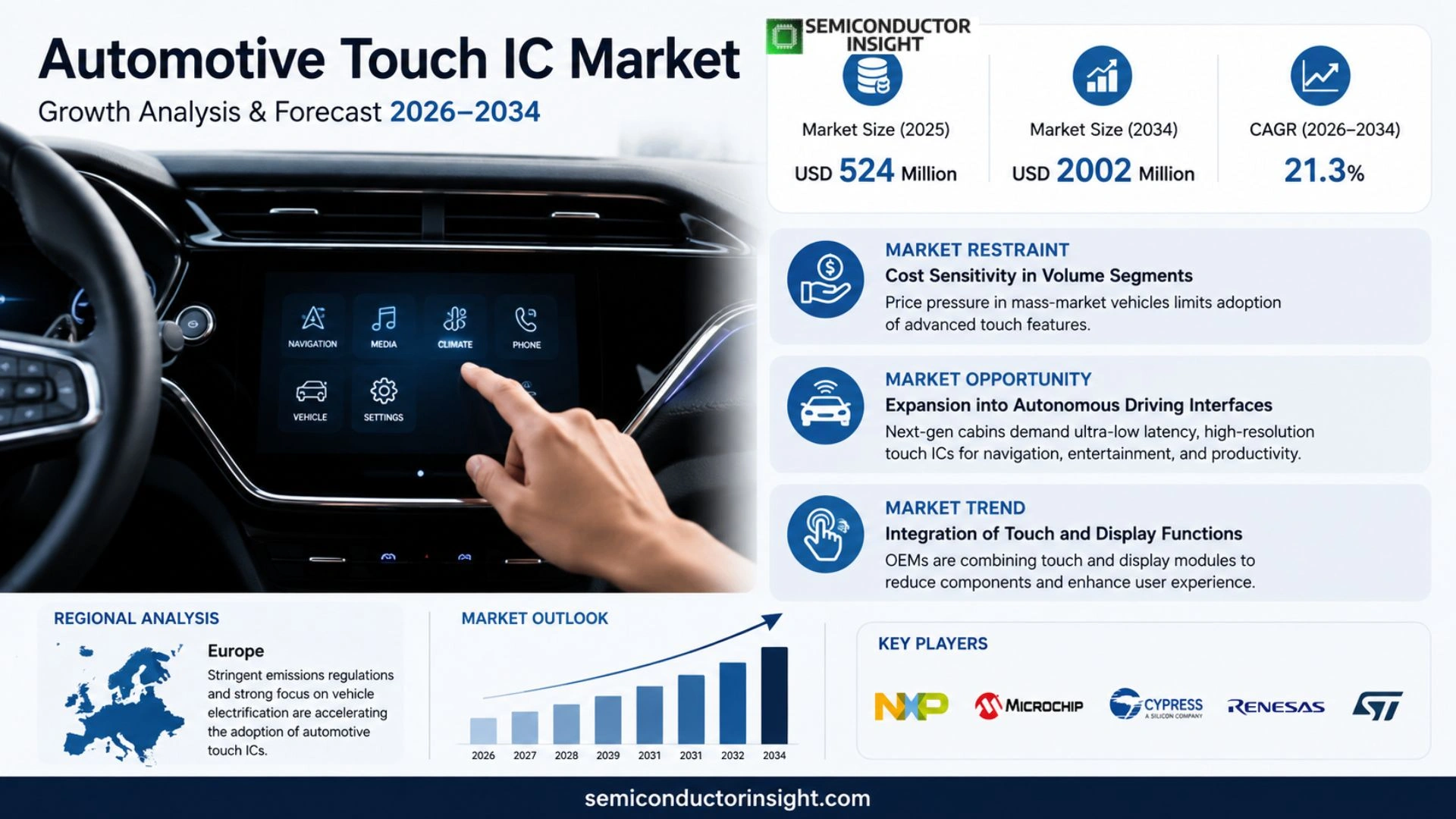
Automotive Touch IC Market Outlook

MARKET DRIVERS

Electrification of Vehicle Architectures

The shift toward electric powertrains has forced OEMs to redesign cockpit layouts, creating space for larger, more responsive touch interfaces. Manufacturers are leveraging these displays to integrate climate control, infotainment, and driver‑assist settings, which reduces wiring complexity and enhances user experience. This architectural evolution fuels demand for high‑precision Automotive Touch ICs that can operate reliably under wide temperature ranges.

Consumer Preference for Seamless Interaction

Buyers now expect vehicle dashboards to behave like smartphones: crisp, lag‑free, and intuitive. Touch ICs that support multi‑touch gestures and low‑power modes directly address these expectations, allowing automakers to differentiate premium models without sacrificing efficiency. The resulting competitive pressure accelerates component adoption across mid‑range segments as well.

➤ “A responsive touch layer has become as vital as the engine control unit in shaping brand perception.”

Beyond driver convenience, precise touch sensing contributes to safety by enabling quick access to critical alerts without diverting attention. Regulatory trends that encourage minimal driver distraction indirectly reinforce the need for reliable touch solutions, reinforcing a virtuous cycle of adoption.

MARKET CHALLENGES

Material Compatibility and Durability

Automotive interiors expose touch components to extreme humidity, vibrations, and UV radiation. Ensuring long‑term reliability of the IC package and the overlay glass demands rigorous testing, which raises development costs and elongates time‑to‑market for new models.

Other Challenges

Integration Complexity

Combining touch controllers with existing CAN/LIN networks requires bespoke firmware. OEMs often face firmware conflicts when retrofitting legacy platforms, limiting the speed at which newer touch ICs can be rolled out across model lines.

MARKET RESTRAINTS

Cost Sensitivity in Volume Segments

While premium brands readily absorb higher component prices, mass‑market manufacturers operate on thin margins. Price pressure forces suppliers to balance performance gains with cost, sometimes delaying the introduction of advanced touch features in entry‑level vehicles.

MARKET OPPORTUNITIES

Expansion into Autonomous Driving Interfaces

As autonomous systems mature, the cabin evolves into a mobile living room where touch interaction will coordinate navigation, entertainment, and even remote work tools. Automotive Touch IC Market participants that can deliver ultra‑low latency, high‑resolution sensing tailored for these new use cases stand to capture a growing share of the emerging autonomous‑vehicle segment.

Automotive Touch IC Market Trends

Integration of Touch and Display Functions

Automotive manufacturers are consolidating user‑interface modules to reduce component count and improve signal coordination. The shift toward touch‑and‑display‑driver‑integrated (TDDI) chips reflects a response to increasingly complex cockpit layouts, where LCD, AMOLED, and on‑cell panels coexist in the same vehicle. By embedding display driving logic within the touch controller, suppliers cut the bill of materials and lower latency between touch detection and visual feedback. This architectural change also eases software alignment, because a single firmware stack can calibrate both touch sensitivity and display timing. Customers such as Tier‑1 suppliers prize this integration for its impact on assembly line efficiency and long‑term serviceability, especially as curved and irregularly shaped screens become standard in premium models.

Other Trends

Emergence of Force‑Sensing and Proximity Features

Beyond conventional capacitive point detection, newer automotive touch ICs incorporate force‑sensing and proximity algorithms to enable richer interaction models. Force‑sensing allows drivers to adjust volume or climate controls with varying pressure, delivering a tactile dimension that mimics mechanical knobs while retaining a flat surface. Proximity detection, meanwhile, supports touchless gestures for infotainment functions, a capability increasingly demanded in hands‑free environments. These modalities rely on sophisticated signal‑processing ASICs and firmware that can discriminate intentional gestures from cabin noise, a requirement that pushes suppliers to deepen their software‑tool offerings. The added functionality translates into higher perceived value per vehicle, prompting OEMs to select vendors that provide end‑to‑end reference designs and post‑sale support.

Supply‑Chain Credibility and Regional Competitive Shifts

Certification regimes such as AEC‑Q100 and IATF 16949 are reshaping the competitive landscape. Companies that can demonstrate automotive‑grade validation, functional‑safety readiness, and robust quality‑management systems gain preferential treatment in procurement decisions. Geographically, U.S. firms dominate standalone controller design and software ecosystems, while Chinese suppliers accelerate market penetration through aggressive pricing and close ties to local vehicle platforms. Japanese players maintain a reputation for ultra‑reliable HMI solutions, and Taiwanese vendors excel in TDDI integration for high‑resolution displays. This regional differentiation encourages OEMs to adopt a multi‑source strategy, balancing cost, reliability, and technology leadership to mitigate risk while pursuing advanced digital‑cockpit features.

COMPETITIVE LANDSCAPE

Key Industry Players

Automotive Touch ICs reshaping digital‑cockpit architecture

Synaptics leads the market by bundling touch sensing with display driver functions in a single die, a configuration that trims bill‑of‑materials and tightens timing coordination for high‑resolution cockpit panels. Its TDDI portfolio targets premium models that demand curved and on‑cell displays, while the company also supplies standalone controllers for legacy LCD units. This dual‑track approach gives Synaptics a foothold across the value chain, from volume‑oriented Tier 1 suppliers to OEMs that require bespoke firmware and long‑term reliability assurances. The firm’s ability to pair algorithmic refinement with hardware integration has created a barrier for newcomers that lack comparable software ecosystems.

Beyond the front‑runner, a cadre of specialists competes on niche strengths. Zinitix and Goodix, both headquartered in South Korea and China respectively, excel at glove‑touch and proximity detection, attributes prized for SUV and off‑road cabins where users wear gloves. Microchip’s single‑chip controllers address large, irregular screens, while Infineon focuses on robust electromagnetic‑noise immunity for electric‑vehicle platforms. European players such as STMicroelectronics and NXP embed touch functions within broader automotive MCU families, giving system integrators a single source for safety‑critical HMI. Japanese firms Renesas and TouchNetix supply high‑reliability capacitive key matrices for instrument clusters, and Taiwan’s Sitronix and FocalTech push cost‑effective solutions for mid‑range models. Parade Technologies rounds out the landscape with custom ASICs that cater to OEMs seeking differentiated cockpit experiences.

List of Key Automotive Touch IC Companies Profiled

Segment Analysis:

Segment Category Sub-Segments Key Insights
By Type
  • Resistive Touch IC
  • Capacitive Touch IC
Resistive Touch IC offers robust operation in challenging cabin environments, excelling at water rejection and glove‑touch detection. It remains favored for cost‑sensitive segments where extreme precision is less critical. Capacitive Touch IC dominates premium applications, delivering low latency, multi‑touch capability, and seamless integration with curved or large‑format displays, supporting advanced gestures and haptic feedback. The shift toward higher integration pushes capacitive solutions to become core enablers of digital cockpit experiences.
By Application
  • Passenger Car
  • Commercial Vehicle
  • Luxury Cockpit
  • Others
Luxury Cockpit drives the most sophisticated touch IC requirements, demanding curved, on‑cell and force‑sensing capabilities, as well as seamless integration with haptic and proximity functions. Passenger Car adopts scalable solutions that balance cost and functionality, focusing on reliable glove‑touch performance. Commercial Vehicle emphasizes durability and electromagnetic immunity for rugged operating conditions. Overall, the market trends toward multi‑display coordination and richer interaction modalities across all vehicle classes.
By End User
  • Automakers
  • Tier‑1 Suppliers
  • Cockpit Module Makers
Tier‑1 Suppliers are pivotal in translating touch IC capabilities into system‑level solutions, valuing comprehensive firmware, reference designs, and long‑term reliability commitments. Automakers view the touch IC as a strategic element of brand experience, emphasizing safety‑grade validation and seamless integration with digital cockpit architecture. Cockpit Module Makers prefer modular, highly integrated ICs that reduce BOM complexity and enable rapid customization for diverse vehicle platforms.
By Integration Form
  • Standalone Touch Controller
  • Touch‑and‑Display Driver Integration (TDDI)
  • Touch MCU or HMI Platform
Touch‑and‑Display Driver Integration (TDDI) is gaining traction for its ability to collapse the touch and display driver into a single silicon package, dramatically simplifying system architecture and improving latency coordination. Standalone Touch Controller remains important for legacy platforms and niche applications where design flexibility is paramount. Touch MCU/HMI Platform offers the highest level of integration, embedding touch sensing directly within vehicle‑wide control processors and supporting extensive algorithmic customization.
By Target Interface Object
  • In‑Vehicle Displays
  • Capacitive Buttons & Surface Panels
  • Proximity & Touchless Interaction
  • Others
In‑Vehicle Displays demand large‑area, high‑resolution touch ICs that can tolerate thick cover glass and support multi‑touch gestures, becoming a cornerstone of the digital cockpit. Capacitive Buttons & Surface Panels focus on low‑power, high‑reliability operation, often serving as tactile replacements for mechanical switches. Proximity & Touchless Interaction introduces new user experiences, especially for hands‑free scenarios, requiring robust electromagnetic immunity and fast response. The diversification of target objects fuels ongoing innovation in algorithmic and hardware design.

Regional Analysis: Automotive Touch IC Market

Europe

Europe has become the focal point for automotive touch integrated circuit adoption, driven by a confluence of stringent emissions legislation and a mature vehicle electrification agenda. OEMs headquartered in Germany, France and the United Kingdom are integrating multi‑modal touch interfaces to differentiate premium models, while Tier‑1 suppliers are consolidating design expertise to meet the continent’s high reliability expectations. The region’s dense network of research institutions accelerates material innovations, allowing manufacturers to reduce latency and improve tactile feedback without inflating cost structures. Consumer demand for intuitive cabin experiences,especially in compact luxury segments,pushes manufacturers to embed larger touch panels, creating a feedback loop that incentivizes further component miniaturization. Meanwhile, the European Union’s emphasis on circular economy principles is prompting firms to prioritize recyclable substrates, subtly reshaping supply‑chain negotiations and prompting a shift toward localized sourcing. Collectively, these forces generate a competitive environment where speed of product rollout and alignment with regulatory trends dictate market positioning, compelling players to re‑engineer development cycles and invest in flexible manufacturing footprints.

Regulatory momentum
The EU’s updated safety directives compel automakers to incorporate touch‑enabled controls that meet both ergonomic and functional criteria, prompting a wave of redesigns across mid‑size sedan platforms.
Supply‑chain realignment
Proximity‑focused sourcing strategies are emerging as manufacturers seek to mitigate geopolitical risk while satisfying the region’s demand for sustainable component lifecycles.
Innovation clusters
Collaborative hubs in Munich and Stuttgart blend automotive engineering with semiconductor expertise, accelerating prototype testing and shortening time‑to‑market for new touch solutions.
Consumer experience focus
Premium buyers increasingly view touch interfaces as a status indicator, nudging brands to upscale tactile quality and integrate haptic feedback that mimics natural gestures.

North America
In North America, OEMs capitalize on a fragmented market structure that encourages rapid adoption of cutting‑edge infotainment suites. The United States’ comparatively loose regulatory climate enables manufacturers to experiment with larger, gesture‑driven touch displays, translating into a diversified product mix that ranges from entry‑level trucks to high‑performance electric sedans. Supplier alliances are forming around silicon‑photonic integration, allowing for thinner form factors without compromising durability,an advantage in regions where interior design trends favor sleek, minimalistic dashboards. Meanwhile, the growing emphasis on over‑the‑air updates encourages firms to embed modular touch IC architectures that can be refreshed remotely, thereby extending vehicle lifecycles and opening new revenue streams for software services.

Asia‑Pacific
Asia‑Pacific’s market character is defined by volume‑driven growth coupled with a surge in premium vehicle offerings. Manufacturers in Japan, South Korea and China are embedding high‑resolution touch panels to support advanced driver‑assistance system displays, a move that aligns with regional consumer expectations for connectivity. Localized production hubs reduce lead times and permit rapid iteration of tactile technologies, while governmental incentives for electric vehicle adoption indirectly stimulate demand for sophisticated cabin interfaces. The competitive pressure from domestic chipmakers drives continuous cost reduction, compelling multinational suppliers to differentiate through superior latency performance and customized firmware solutions.

South America
South America presents a landscape where cost sensitivity intertwines with an emerging appetite for digital cabin features. Automakers are cautiously integrating touch interfaces into midsize SUVs, balancing price points with consumer desire for modern ergonomics. Regional trade agreements are gradually easing component import tariffs, which encourages a modest influx of European and Asian touch ICs. However, the limited availability of high‑precision manufacturing facilities means that many firms rely on standardized modules, focusing on reliability over cutting‑edge functionality. This environment rewards suppliers who can deliver robust, low‑maintenance solutions that align with the region’s operational realities.

Middle East & Africa
In the Middle East & Africa, the automotive segment is shaped by a mix of luxury‑focused demand and nascent market development. High‑income consumers in the Gulf states prioritize opulent interiors, prompting OEMs to install expansive touch surfaces that complement advanced climate‑control and infotainment ecosystems. Conversely, African markets, still expanding their vehicle base, view touch integration as a differentiator for newer models, albeit at a premium price. Infrastructure constraints limit the rollout of OTA capabilities, steering manufacturers toward more self‑contained touch IC designs that emphasize durability under varied climatic conditions.

Report Scope

This market research report provides a comprehensive analysis of the Automotive Touch IC Market , covering the forecast period 2026–2034. It offers detailed insights into market dynamics, technological advancements, competitive landscape, and key trends shaping the industry.

Key focus areas of the report include:

  • Market Overview: The report begins with an overview outlining its current market scenario, key growth indicators, and industry transformation drivers. It discusses macroeconomic factors, demand–supply balance, regulatory landscape, and the strategic role of semiconductors in powering advancements across industries such as automotive, telecommunications, consumer electronics, and industrial automation.
  • Market Size & Forecast: Historical data and future projections for revenue, unit shipments, and market value across major regions and segments.
  • Segmentation Analysis: Detailed breakdown by product type, technology, application, and end-user industry to identify high-growth segments and investment opportunities.
  • Regional Insights: Insights into market performance across North America, Europe, Asia-Pacific, Latin America, and the Middle East & Africa, including country-level analysis where relevant.
  • Competitive Landscape: Profiles of leading market participants, including their product offerings, R&D focus, manufacturing capacity, pricing strategies, and recent developments such as mergers, acquisitions, and partnerships.
  • Technology Trends & Innovation: Assessment of emerging technologies, integration of AI/IoT, semiconductor design trends, fabrication techniques, and evolving industry standards.
  • Market Drivers & Restraints: Evaluation of factors driving market growth along with challenges, supply chain constraints, regulatory issues, and market-entry barriers.
  • Stakeholder Insights: Insights for component suppliers, OEMs, system integrators, investors, and policymakers regarding the evolving ecosystem and strategic opportunities.

Primary and secondary research methods are employed, including interviews with industry experts, data from verified sources, and real-time market intelligence to ensure the accuracy and reliability of the insights presented.

FREQUENTLY ASKED QUESTIONS:

What is the current market size of Automotive Touch IC Market?

-> Automotive Touch IC market was valued at USD 524 million in 2025 and will grow to USD 2002 million by 2034, exhibiting a CAGR of 21.3%

Which key companies operate in Automotive Touch IC Market?

-> Key players include ZINITIX Co., Ltd., Infineon Technologies AG, TouchNetix Limited, Synaptics Incorporated, Analog Devices, Inc., Microchip Technology Incorporated, Sitronix Technology Corporation, Renesas Electronics Corporation, NXP Semiconductors N.V., STMicroelectronics N.V., FocalTech Systems Co., Ltd., Parade Technologies, Ltd.

What are the key growth drivers?

-> Key growth drivers include the rapid adoption of digital cockpits, demand for larger and curved automotive displays, integration of touch with display driver (TDDI), need for robust water‑rejection and electromagnetic immunity, and the shift toward glove‑ and proximity‑sensing solutions.

Which region dominates the market?

-> Asia‑Pacific holds the largest market share due to strong automotive manufacturing bases, rapid commercialization by Chinese suppliers, and early adoption of advanced cockpit technologies, while Europe and North America remain significant contributors.

What are the emerging trends?

-> Emerging trends include integration of force‑sensing and haptic feedback, secure over‑the‑air firmware updates, support for OLED/microLED and on‑cell display technologies, and multi‑display coordination within the vehicle cabin.

Automotive Touch IC Market Trends, Business Strategies 2026-2036

Get Sample Report PDF for Exclusive Insights

Report Sample Includes

  • Table of Contents
  • List of Tables & Figures
  • Charts, Research Methodology, and more...

PDF Icon Download Sample Report PDF
SKU: 5a787e71b67d
Category:
License Type

Corporate License, Excel License, PDF and Excel Databook License

Download Sample Report

Table of Content

1 Introduction to Research & Analysis Reports
1.1 Automotive Touch IC Market Definition
1.2 Market Segments
1.2.1 Segment by Type
1.2.2 Segment by Integration Form
1.2.3 Segment by Target Interface Object
1.2.4 Segment by Application
1.3 Global Automotive Touch IC Market Overview
1.4 Features & Benefits of This Report
1.5 Methodology & Sources of Information
1.5.1 Research Methodology
1.5.2 Research Process
1.5.3 Base Year
1.5.4 Report Assumptions & Caveats
2 Global Automotive Touch IC Overall Market Size
2.1 Global Automotive Touch IC Market Size: 2025 VS 2034
2.2 Global Automotive Touch IC Market Size, Prospects & Forecasts: 2021-2034
2.3 Global Automotive Touch IC Sales: 2021-2034
3 Company Landscape
3.1 Top Automotive Touch IC Players in Global Market
3.2 Top Global Automotive Touch IC Companies Ranked by Revenue
3.3 Global Automotive Touch IC Revenue by Companies
3.4 Global Automotive Touch IC Sales by Companies
3.5 Global Automotive Touch IC Price by Manufacturer (2021-2026)
3.6 Top 3 and Top 5 Automotive Touch IC Companies in Global Market, by Revenue in 2025
3.7 Global Manufacturers Automotive Touch IC Product Type
3.8 Tier 1, Tier 2, and Tier 3 Automotive Touch IC Players in Global Market
3.8.1 List of Global Tier 1 Automotive Touch IC Companies
3.8.2 List of Global Tier 2 and Tier 3 Automotive Touch IC Companies
4 Sights by Type
4.1 Overview
4.1.1 Segment by Type – Global Automotive Touch IC Market Size Markets, 2025 & 2034
4.1.2 Resistive Touch IC
4.1.3 Capacitive Touch IC
4.2 Segment by Type – Global Automotive Touch IC Revenue & Forecasts
4.2.1 Segment by Type – Global Automotive Touch IC Revenue, 2021-2026
4.2.2 Segment by Type – Global Automotive Touch IC Revenue, 2027-2034
4.2.3 Segment by Type – Global Automotive Touch IC Revenue Market Share, 2021-2034
4.3 Segment by Type – Global Automotive Touch IC Sales & Forecasts
4.3.1 Segment by Type – Global Automotive Touch IC Sales, 2021-2026
4.3.2 Segment by Type – Global Automotive Touch IC Sales, 2027-2034
4.3.3 Segment by Type – Global Automotive Touch IC Sales Market Share, 2021-2034
4.4 Segment by Type – Global Automotive Touch IC Price (Manufacturers Selling Prices), 2021-2034
5 Sights by Integration Form
5.1 Overview
5.1.1 Segment by Integration Form – Global Automotive Touch IC Market Size Markets, 2025 & 2034
5.1.2 Standalone Touch Controller
5.1.3 Touch And Display Driver Integration
5.1.4 Touch MCU Or HMI Platform
5.2 Segment by Integration Form – Global Automotive Touch IC Revenue & Forecasts
5.2.1 Segment by Integration Form – Global Automotive Touch IC Revenue, 2021-2026
5.2.2 Segment by Integration Form – Global Automotive Touch IC Revenue, 2027-2034
5.2.3 Segment by Integration Form – Global Automotive Touch IC Revenue Market Share, 2021-2034
5.3 Segment by Integration Form – Global Automotive Touch IC Sales & Forecasts
5.3.1 Segment by Integration Form – Global Automotive Touch IC Sales, 2021-2026
5.3.2 Segment by Integration Form – Global Automotive Touch IC Sales, 2027-2034
5.3.3 Segment by Integration Form – Global Automotive Touch IC Sales Market Share, 2021-2034
5.4 Segment by Integration Form – Global Automotive Touch IC Price (Manufacturers Selling Prices), 2021-2034
6 Sights by Target Interface Object
6.1 Overview
6.1.1 Segment by Target Interface Object – Global Automotive Touch IC Market Size Markets, 2025 & 2034
6.1.2 In-Vehicle Displays
6.1.3 Capacitive Keys And Surface Panels
6.1.4 Proximity And Touchless Interaction
6.2 Segment by Target Interface Object – Global Automotive Touch IC Revenue & Forecasts
6.2.1 Segment by Target Interface Object – Global Automotive Touch IC Revenue, 2021-2026
6.2.2 Segment by Target Interface Object – Global Automotive Touch IC Revenue, 2027-2034
6.2.3 Segment by Target Interface Object – Global Automotive Touch IC Revenue Market Share, 2021-2034
6.3 Segment by Target Interface Object – Global Automotive Touch IC Sales & Forecasts
6.3.1 Segment by Target Interface Object – Global Automotive Touch IC Sales, 2021-2026
6.3.2 Segment by Target Interface Object – Global Automotive Touch IC Sales, 2027-2034
6.3.3 Segment by Target Interface Object – Global Automotive Touch IC Sales Market Share, 2021-2034
6.4 Segment by Target Interface Object – Global Automotive Touch IC Price (Manufacturers Selling Prices), 2021-2034
7 Sights by Application
7.1 Overview
7.1.1 Segment by Application – Global Automotive Touch IC Market Size, 2025 & 2034
7.1.2 Passenger Car
7.1.3 Commercial Vehicle
7.2 Segment by Application – Global Automotive Touch IC Revenue & Forecasts
7.2.1 Segment by Application – Global Automotive Touch IC Revenue, 2021-2026
7.2.2 Segment by Application – Global Automotive Touch IC Revenue, 2027-2034
7.2.3 Segment by Application – Global Automotive Touch IC Revenue Market Share, 2021-2034
7.3 Segment by Application – Global Automotive Touch IC Sales & Forecasts
7.3.1 Segment by Application – Global Automotive Touch IC Sales, 2021-2026
7.3.2 Segment by Application – Global Automotive Touch IC Sales, 2027-2034
7.3.3 Segment by Application – Global Automotive Touch IC Sales Market Share, 2021-2034
7.4 Segment by Application – Global Automotive Touch IC Price (Manufacturers Selling Prices), 2021-2034
8 Sights Region
8.1 By Region – Global Automotive Touch IC Market Size, 2025 & 2034
8.2 By Region – Global Automotive Touch IC Revenue & Forecasts
8.2.1 By Region – Global Automotive Touch IC Revenue, 2021-2026
8.2.2 By Region – Global Automotive Touch IC Revenue, 2027-2034
8.2.3 By Region – Global Automotive Touch IC Revenue Market Share, 2021-2034
8.3 By Region – Global Automotive Touch IC Sales & Forecasts
8.3.1 By Region – Global Automotive Touch IC Sales, 2021-2026
8.3.2 By Region – Global Automotive Touch IC Sales, 2027-2034
8.3.3 By Region – Global Automotive Touch IC Sales Market Share, 2021-2034
8.4 North America
8.4.1 By Country – North America Automotive Touch IC Revenue, 2021-2034
8.4.2 By Country – North America Automotive Touch IC Sales, 2021-2034
8.4.3 United States Automotive Touch IC Market Size, 2021-2034
8.4.4 Canada Automotive Touch IC Market Size, 2021-2034
8.4.5 Mexico Automotive Touch IC Market Size, 2021-2034
8.5 Europe
8.5.1 By Country – Europe Automotive Touch IC Revenue, 2021-2034
8.5.2 By Country – Europe Automotive Touch IC Sales, 2021-2034
8.5.3 Germany Automotive Touch IC Market Size, 2021-2034
8.5.4 France Automotive Touch IC Market Size, 2021-2034
8.5.5 U.K. Automotive Touch IC Market Size, 2021-2034
8.5.6 Italy Automotive Touch IC Market Size, 2021-2034
8.5.7 Russia Automotive Touch IC Market Size, 2021-2034
8.5.8 Nordic Countries Automotive Touch IC Market Size, 2021-2034
8.5.9 Benelux Automotive Touch IC Market Size, 2021-2034
8.6 Asia
8.6.1 By Region – Asia Automotive Touch IC Revenue, 2021-2034
8.6.2 By Region – Asia Automotive Touch IC Sales, 2021-2034
8.6.3 China Automotive Touch IC Market Size, 2021-2034
8.6.4 Japan Automotive Touch IC Market Size, 2021-2034
8.6.5 South Korea Automotive Touch IC Market Size, 2021-2034
8.6.6 Southeast Asia Automotive Touch IC Market Size, 2021-2034
8.6.7 India Automotive Touch IC Market Size, 2021-2034
8.7 South America
8.7.1 By Country – South America Automotive Touch IC Revenue, 2021-2034
8.7.2 By Country – South America Automotive Touch IC Sales, 2021-2034
8.7.3 Brazil Automotive Touch IC Market Size, 2021-2034
8.7.4 Argentina Automotive Touch IC Market Size, 2021-2034
8.8 Middle East & Africa
8.8.1 By Country – Middle East & Africa Automotive Touch IC Revenue, 2021-2034
8.8.2 By Country – Middle East & Africa Automotive Touch IC Sales, 2021-2034
8.8.3 Turkey Automotive Touch IC Market Size, 2021-2034
8.8.4 Israel Automotive Touch IC Market Size, 2021-2034
8.8.5 Saudi Arabia Automotive Touch IC Market Size, 2021-2034
8.8.6 UAE Automotive Touch IC Market Size, 2021-2034
9 Manufacturers & Brands Profiles
9.1 ZINITIX Co., Ltd.
9.1.1 ZINITIX Co., Ltd. Company Summary
9.1.2 ZINITIX Co., Ltd. Business Overview
9.1.3 ZINITIX Co., Ltd. Automotive Touch IC Major Product Offerings
9.1.4 ZINITIX Co., Ltd. Automotive Touch IC Sales and Revenue in Global (2021-2026)
9.1.5 ZINITIX Co., Ltd. Key News & Latest Developments
9.2 Infineon Technologies AG
9.2.1 Infineon Technologies AG Company Summary
9.2.2 Infineon Technologies AG Business Overview
9.2.3 Infineon Technologies AG Automotive Touch IC Major Product Offerings
9.2.4 Infineon Technologies AG Automotive Touch IC Sales and Revenue in Global (2021-2026)
9.2.5 Infineon Technologies AG Key News & Latest Developments
9.3 TouchNetix Limited
9.3.1 TouchNetix Limited Company Summary
9.3.2 TouchNetix Limited Business Overview
9.3.3 TouchNetix Limited Automotive Touch IC Major Product Offerings
9.3.4 TouchNetix Limited Automotive Touch IC Sales and Revenue in Global (2021-2026)
9.3.5 TouchNetix Limited Key News & Latest Developments
9.4 Synaptics Incorporated
9.4.1 Synaptics Incorporated Company Summary
9.4.2 Synaptics Incorporated Business Overview
9.4.3 Synaptics Incorporated Automotive Touch IC Major Product Offerings
9.4.4 Synaptics Incorporated Automotive Touch IC Sales and Revenue in Global (2021-2026)
9.4.5 Synaptics Incorporated Key News & Latest Developments
9.5 Analog Devices, Inc.
9.5.1 Analog Devices, Inc. Company Summary
9.5.2 Analog Devices, Inc. Business Overview
9.5.3 Analog Devices, Inc. Automotive Touch IC Major Product Offerings
9.5.4 Analog Devices, Inc. Automotive Touch IC Sales and Revenue in Global (2021-2026)
9.5.5 Analog Devices, Inc. Key News & Latest Developments
9.6 Microchip Technology Incorporated
9.6.1 Microchip Technology Incorporated Company Summary
9.6.2 Microchip Technology Incorporated Business Overview
9.6.3 Microchip Technology Incorporated Automotive Touch IC Major Product Offerings
9.6.4 Microchip Technology Incorporated Automotive Touch IC Sales and Revenue in Global (2021-2026)
9.6.5 Microchip Technology Incorporated Key News & Latest Developments
9.7 Sitronix Technology Corporation
9.7.1 Sitronix Technology Corporation Company Summary
9.7.2 Sitronix Technology Corporation Business Overview
9.7.3 Sitronix Technology Corporation Automotive Touch IC Major Product Offerings
9.7.4 Sitronix Technology Corporation Automotive Touch IC Sales and Revenue in Global (2021-2026)
9.7.5 Sitronix Technology Corporation Key News & Latest Developments
9.8 Renesas Electronics Corporation
9.8.1 Renesas Electronics Corporation Company Summary
9.8.2 Renesas Electronics Corporation Business Overview
9.8.3 Renesas Electronics Corporation Automotive Touch IC Major Product Offerings
9.8.4 Renesas Electronics Corporation Automotive Touch IC Sales and Revenue in Global (2021-2026)
9.8.5 Renesas Electronics Corporation Key News & Latest Developments
9.9 NXP Semiconductors N.V.
9.9.1 NXP Semiconductors N.V. Company Summary
9.9.2 NXP Semiconductors N.V. Business Overview
9.9.3 NXP Semiconductors N.V. Automotive Touch IC Major Product Offerings
9.9.4 NXP Semiconductors N.V. Automotive Touch IC Sales and Revenue in Global (2021-2026)
9.9.5 NXP Semiconductors N.V. Key News & Latest Developments
9.10 STMicroelectronics N.V.
9.10.1 STMicroelectronics N.V. Company Summary
9.10.2 STMicroelectronics N.V. Business Overview
9.10.3 STMicroelectronics N.V. Automotive Touch IC Major Product Offerings
9.10.4 STMicroelectronics N.V. Automotive Touch IC Sales and Revenue in Global (2021-2026)
9.10.5 STMicroelectronics N.V. Key News & Latest Developments
9.11 FocalTech Systems Co., Ltd.
9.11.1 FocalTech Systems Co., Ltd. Company Summary
9.11.2 FocalTech Systems Co., Ltd. Business Overview
9.11.3 FocalTech Systems Co., Ltd. Automotive Touch IC Major Product Offerings
9.11.4 FocalTech Systems Co., Ltd. Automotive Touch IC Sales and Revenue in Global (2021-2026)
9.11.5 FocalTech Systems Co., Ltd. Key News & Latest Developments
9.12 Parade Technologies, Ltd.
9.12.1 Parade Technologies, Ltd. Company Summary
9.12.2 Parade Technologies, Ltd. Business Overview
9.12.3 Parade Technologies, Ltd. Automotive Touch IC Major Product Offerings
9.12.4 Parade Technologies, Ltd. Automotive Touch IC Sales and Revenue in Global (2021-2026)
9.12.5 Parade Technologies, Ltd. Key News & Latest Developments
10 Global Automotive Touch IC Production Capacity, Analysis
10.1 Global Automotive Touch IC Production Capacity, 2021-2034
10.2 Automotive Touch IC Production Capacity of Key Manufacturers in Global Market
10.3 Global Automotive Touch IC Production by Region
11 Key Market Trends, Opportunity, Drivers and Restraints
11.1 Market Opportunities & Trends
11.2 Market Drivers
11.3 Market Restraints
12 Automotive Touch IC Supply Chain Analysis
12.1 Automotive Touch IC Industry Value Chain
12.2 Automotive Touch IC Upstream Market
12.3 Automotive Touch IC Downstream and Clients
12.4 Marketing Channels Analysis
12.4.1 Marketing Channels
12.4.2 Automotive Touch IC Distributors and Sales Agents in Global
13 Conclusion
14 Appendix
14.1 Note
14.2 Examples of Clients
14.3 DisclaimerList of Tables
Table 1. Key Players of Automotive Touch IC in Global Market
Table 2. Top Automotive Touch IC Players in Global Market, Ranking by Revenue (2025)
Table 3. Global Automotive Touch IC Revenue by Companies, (US$, Mn), 2021-2026
Table 4. Global Automotive Touch IC Revenue Share by Companies, 2021-2026
Table 5. Global Automotive Touch IC Sales by Companies, (Million Units), 2021-2026
Table 6. Global Automotive Touch IC Sales Share by Companies, 2021-2026
Table 7. Key Manufacturers Automotive Touch IC Price (2021-2026) & (US$/Unit)
Table 8. Global Manufacturers Automotive Touch IC Product Type
Table 9. List of Global Tier 1 Automotive Touch IC Companies, Revenue (US$, Mn) in 2025 and Market Share
Table 10. List of Global Tier 2 and Tier 3 Automotive Touch IC Companies, Revenue (US$, Mn) in 2025 and Market Share
Table 11. Segment by Type – Global Automotive Touch IC Revenue, (US$, Mn), 2025 & 2034
Table 12. Segment by Type – Global Automotive Touch IC Revenue (US$, Mn), 2021-2026
Table 13. Segment by Type – Global Automotive Touch IC Revenue (US$, Mn), 2027-2034
Table 14. Segment by Type – Global Automotive Touch IC Sales (Million Units), 2021-2026
Table 15. Segment by Type – Global Automotive Touch IC Sales (Million Units), 2027-2034
Table 16. Segment by Integration Form – Global Automotive Touch IC Revenue, (US$, Mn), 2025 & 2034
Table 17. Segment by Integration Form – Global Automotive Touch IC Revenue (US$, Mn), 2021-2026
Table 18. Segment by Integration Form – Global Automotive Touch IC Revenue (US$, Mn), 2027-2034
Table 19. Segment by Integration Form – Global Automotive Touch IC Sales (Million Units), 2021-2026
Table 20. Segment by Integration Form – Global Automotive Touch IC Sales (Million Units), 2027-2034
Table 21. Segment by Target Interface Object – Global Automotive Touch IC Revenue, (US$, Mn), 2025 & 2034
Table 22. Segment by Target Interface Object – Global Automotive Touch IC Revenue (US$, Mn), 2021-2026
Table 23. Segment by Target Interface Object – Global Automotive Touch IC Revenue (US$, Mn), 2027-2034
Table 24. Segment by Target Interface Object – Global Automotive Touch IC Sales (Million Units), 2021-2026
Table 25. Segment by Target Interface Object – Global Automotive Touch IC Sales (Million Units), 2027-2034
Table 26. Segment by Application – Global Automotive Touch IC Revenue, (US$, Mn), 2025 & 2034
Table 27. Segment by Application – Global Automotive Touch IC Revenue, (US$, Mn), 2021-2026
Table 28. Segment by Application – Global Automotive Touch IC Revenue, (US$, Mn), 2027-2034
Table 29. Segment by Application – Global Automotive Touch IC Sales, (Million Units), 2021-2026
Table 30. Segment by Application – Global Automotive Touch IC Sales, (Million Units), 2027-2034
Table 31. By Region – Global Automotive Touch IC Revenue, (US$, Mn), 2025 & 2034
Table 32. By Region – Global Automotive Touch IC Revenue, (US$, Mn), 2021-2026
Table 33. By Region – Global Automotive Touch IC Revenue, (US$, Mn), 2027-2034
Table 34. By Region – Global Automotive Touch IC Sales, (Million Units), 2021-2026
Table 35. By Region – Global Automotive Touch IC Sales, (Million Units), 2027-2034
Table 36. By Country – North America Automotive Touch IC Revenue, (US$, Mn), 2021-2026
Table 37. By Country – North America Automotive Touch IC Revenue, (US$, Mn), 2027-2034
Table 38. By Country – North America Automotive Touch IC Sales, (Million Units), 2021-2026
Table 39. By Country – North America Automotive Touch IC Sales, (Million Units), 2027-2034
Table 40. By Country – Europe Automotive Touch IC Revenue, (US$, Mn), 2021-2026
Table 41. By Country – Europe Automotive Touch IC Revenue, (US$, Mn), 2027-2034
Table 42. By Country – Europe Automotive Touch IC Sales, (Million Units), 2021-2026
Table 43. By Country – Europe Automotive Touch IC Sales, (Million Units), 2027-2034
Table 44. By Region – Asia Automotive Touch IC Revenue, (US$, Mn), 2021-2026
Table 45. By Region – Asia Automotive Touch IC Revenue, (US$, Mn), 2027-2034
Table 46. By Region – Asia Automotive Touch IC Sales, (Million Units), 2021-2026
Table 47. By Region – Asia Automotive Touch IC Sales, (Million Units), 2027-2034
Table 48. By Country – South America Automotive Touch IC Revenue, (US$, Mn), 2021-2026
Table 49. By Country – South America Automotive Touch IC Revenue, (US$, Mn), 2027-2034
Table 50. By Country – South America Automotive Touch IC Sales, (Million Units), 2021-2026
Table 51. By Country – South America Automotive Touch IC Sales, (Million Units), 2027-2034
Table 52. By Country – Middle East & Africa Automotive Touch IC Revenue, (US$, Mn), 2021-2026
Table 53. By Country – Middle East & Africa Automotive Touch IC Revenue, (US$, Mn), 2027-2034
Table 54. By Country – Middle East & Africa Automotive Touch IC Sales, (Million Units), 2021-2026
Table 55. By Country – Middle East & Africa Automotive Touch IC Sales, (Million Units), 2027-2034
Table 56. ZINITIX Co., Ltd. Company Summary
Table 57. ZINITIX Co., Ltd. Automotive Touch IC Product Offerings
Table 58. ZINITIX Co., Ltd. Automotive Touch IC Sales (Million Units), Revenue (US$, Mn) and Average Price (US$/Unit) & (2021-2026)
Table 59. ZINITIX Co., Ltd. Key News & Latest Developments
Table 60. Infineon Technologies AG Company Summary
Table 61. Infineon Technologies AG Automotive Touch IC Product Offerings
Table 62. Infineon Technologies AG Automotive Touch IC Sales (Million Units), Revenue (US$, Mn) and Average Price (US$/Unit) & (2021-2026)
Table 63. Infineon Technologies AG Key News & Latest Developments
Table 64. TouchNetix Limited Company Summary
Table 65. TouchNetix Limited Automotive Touch IC Product Offerings
Table 66. TouchNetix Limited Automotive Touch IC Sales (Million Units), Revenue (US$, Mn) and Average Price (US$/Unit) & (2021-2026)
Table 67. TouchNetix Limited Key News & Latest Developments
Table 68. Synaptics Incorporated Company Summary
Table 69. Synaptics Incorporated Automotive Touch IC Product Offerings
Table 70. Synaptics Incorporated Automotive Touch IC Sales (Million Units), Revenue (US$, Mn) and Average Price (US$/Unit) & (2021-2026)
Table 71. Synaptics Incorporated Key News & Latest Developments
Table 72. Analog Devices, Inc. Company Summary
Table 73. Analog Devices, Inc. Automotive Touch IC Product Offerings
Table 74. Analog Devices, Inc. Automotive Touch IC Sales (Million Units), Revenue (US$, Mn) and Average Price (US$/Unit) & (2021-2026)
Table 75. Analog Devices, Inc. Key News & Latest Developments
Table 76. Microchip Technology Incorporated Company Summary
Table 77. Microchip Technology Incorporated Automotive Touch IC Product Offerings
Table 78. Microchip Technology Incorporated Automotive Touch IC Sales (Million Units), Revenue (US$, Mn) and Average Price (US$/Unit) & (2021-2026)
Table 79. Microchip Technology Incorporated Key News & Latest Developments
Table 80. Sitronix Technology Corporation Company Summary
Table 81. Sitronix Technology Corporation Automotive Touch IC Product Offerings
Table 82. Sitronix Technology Corporation Automotive Touch IC Sales (Million Units), Revenue (US$, Mn) and Average Price (US$/Unit) & (2021-2026)
Table 83. Sitronix Technology Corporation Key News & Latest Developments
Table 84. Renesas Electronics Corporation Company Summary
Table 85. Renesas Electronics Corporation Automotive Touch IC Product Offerings
Table 86. Renesas Electronics Corporation Automotive Touch IC Sales (Million Units), Revenue (US$, Mn) and Average Price (US$/Unit) & (2021-2026)
Table 87. Renesas Electronics Corporation Key News & Latest Developments
Table 88. NXP Semiconductors N.V. Company Summary
Table 89. NXP Semiconductors N.V. Automotive Touch IC Product Offerings
Table 90. NXP Semiconductors N.V. Automotive Touch IC Sales (Million Units), Revenue (US$, Mn) and Average Price (US$/Unit) & (2021-2026)
Table 91. NXP Semiconductors N.V. Key News & Latest Developments
Table 92. STMicroelectronics N.V. Company Summary
Table 93. STMicroelectronics N.V. Automotive Touch IC Product Offerings
Table 94. STMicroelectronics N.V. Automotive Touch IC Sales (Million Units), Revenue (US$, Mn) and Average Price (US$/Unit) & (2021-2026)
Table 95. STMicroelectronics N.V. Key News & Latest Developments
Table 96. FocalTech Systems Co., Ltd. Company Summary
Table 97. FocalTech Systems Co., Ltd. Automotive Touch IC Product Offerings
Table 98. FocalTech Systems Co., Ltd. Automotive Touch IC Sales (Million Units), Revenue (US$, Mn) and Average Price (US$/Unit) & (2021-2026)
Table 99. FocalTech Systems Co., Ltd. Key News & Latest Developments
Table 100. Parade Technologies, Ltd. Company Summary
Table 101. Parade Technologies, Ltd. Automotive Touch IC Product Offerings
Table 102. Parade Technologies, Ltd. Automotive Touch IC Sales (Million Units), Revenue (US$, Mn) and Average Price (US$/Unit) & (2021-2026)
Table 103. Parade Technologies, Ltd. Key News & Latest Developments
Table 104. Automotive Touch IC Capacity of Key Manufacturers in Global Market, 2024-2026 (Million Units)
Table 105. Global Automotive Touch IC Capacity Market Share of Key Manufacturers, 2024-2026
Table 106. Global Automotive Touch IC Production by Region, 2021-2026 (Million Units)
Table 107. Global Automotive Touch IC Production by Region, 2027-2034 (Million Units)
Table 108. Automotive Touch IC Market Opportunities & Trends in Global Market
Table 109. Automotive Touch IC Market Drivers in Global Market
Table 110. Automotive Touch IC Market Restraints in Global Market
Table 111. Automotive Touch IC Raw Materials
Table 112. Automotive Touch IC Raw Materials Suppliers in Global Market
Table 113. Typical Automotive Touch IC Downstream
Table 114. Automotive Touch IC Downstream Clients in Global Market
Table 115. Automotive Touch IC Distributors and Sales Agents in Global Market

List of Figures
Figure 1. Automotive Touch IC Product Picture
Figure 2. Automotive Touch IC Segment by Type in 2025
Figure 3. Automotive Touch IC Segment by Integration Form in 2025
Figure 4. Automotive Touch IC Segment by Target Interface Object in 2025
Figure 5. Automotive Touch IC Segment by Application in 2025
Figure 6. Global Automotive Touch IC Market Overview: 2025
Figure 7. Key Caveats
Figure 8. Global Automotive Touch IC Market Size: 2025 VS 2034 (US$, Mn)
Figure 9. Global Automotive Touch IC Revenue: 2021-2034 (US$, Mn)
Figure 10. Automotive Touch IC Sales in Global Market: 2021-2034 (Million Units)
Figure 11. The Top 3 and 5 Players Market Share by Automotive Touch IC Revenue in 2025
Figure 12. Segment by Type – Global Automotive Touch IC Revenue, (US$, Mn), 2025 & 2034
Figure 13. Segment by Type – Global Automotive Touch IC Revenue Market Share, 2021-2034
Figure 14. Segment by Type – Global Automotive Touch IC Sales Market Share, 2021-2034
Figure 15. Segment by Type – Global Automotive Touch IC Price (US$/Unit), 2021-2034
Figure 16. Segment by Integration Form – Global Automotive Touch IC Revenue, (US$, Mn), 2025 & 2034
Figure 17. Segment by Integration Form – Global Automotive Touch IC Revenue Market Share, 2021-2034
Figure 18. Segment by Integration Form – Global Automotive Touch IC Sales Market Share, 2021-2034
Figure 19. Segment by Integration Form – Global Automotive Touch IC Price (US$/Unit), 2021-2034
Figure 20. Segment by Target Interface Object – Global Automotive Touch IC Revenue, (US$, Mn), 2025 & 2034
Figure 21. Segment by Target Interface Object – Global Automotive Touch IC Revenue Market Share, 2021-2034
Figure 22. Segment by Target Interface Object – Global Automotive Touch IC Sales Market Share, 2021-2034
Figure 23. Segment by Target Interface Object – Global Automotive Touch IC Price (US$/Unit), 2021-2034
Figure 24. Segment by Application – Global Automotive Touch IC Revenue, (US$, Mn), 2025 & 2034
Figure 25. Segment by Application – Global Automotive Touch IC Revenue Market Share, 2021-2034
Figure 26. Segment by Application – Global Automotive Touch IC Sales Market Share, 2021-2034
Figure 27. Segment by Application -Global Automotive Touch IC Price (US$/Unit), 2021-2034
Figure 28. By Region – Global Automotive Touch IC Revenue, (US$, Mn), 2025 & 2034
Figure 29. By Region – Global Automotive Touch IC Revenue Market Share, 2021 VS 2025 VS 2034
Figure 30. By Region – Global Automotive Touch IC Revenue Market Share, 2021-2034
Figure 31. By Region – Global Automotive Touch IC Sales Market Share, 2021-2034
Figure 32. By Country – North America Automotive Touch IC Revenue Market Share, 2021-2034
Figure 33. By Country – North America Automotive Touch IC Sales Market Share, 2021-2034
Figure 34. United States Automotive Touch IC Revenue, (US$, Mn), 2021-2034
Figure 35. Canada Automotive Touch IC Revenue, (US$, Mn), 2021-2034
Figure 36. Mexico Automotive Touch IC Revenue, (US$, Mn), 2021-2034
Figure 37. By Country – Europe Automotive Touch IC Revenue Market Share, 2021-2034
Figure 38. By Country – Europe Automotive Touch IC Sales Market Share, 2021-2034
Figure 39. Germany Automotive Touch IC Revenue, (US$, Mn), 2021-2034
Figure 40. France Automotive Touch IC Revenue, (US$, Mn), 2021-2034
Figure 41. U.K. Automotive Touch IC Revenue, (US$, Mn), 2021-2034
Figure 42. Italy Automotive Touch IC Revenue, (US$, Mn), 2021-2034
Figure 43. Russia Automotive Touch IC Revenue, (US$, Mn), 2021-2034
Figure 44. Nordic Countries Automotive Touch IC Revenue, (US$, Mn), 2021-2034
Figure 45. Benelux Automotive Touch IC Revenue, (US$, Mn), 2021-2034
Figure 46. By Region – Asia Automotive Touch IC Revenue Market Share, 2021-2034
Figure 47. By Region – Asia Automotive Touch IC Sales Market Share, 2021-2034
Figure 48. China Automotive Touch IC Revenue, (US$, Mn), 2021-2034
Figure 49. Japan Automotive Touch IC Revenue, (US$, Mn), 2021-2034
Figure 50. South Korea Automotive Touch IC Revenue, (US$, Mn), 2021-2034
Figure 51. Southeast Asia Automotive Touch IC Revenue, (US$, Mn), 2021-2034
Figure 52. India Automotive Touch IC Revenue, (US$, Mn), 2021-2034
Figure 53. By Country – South America Automotive Touch IC Revenue Market Share, 2021-2034
Figure 54. By Country – South America Automotive Touch IC Sales, Market Share, 2021-2034
Figure 55. Brazil Automotive Touch IC Revenue, (US$, Mn), 2021-2034
Figure 56. Argentina Automotive Touch IC Revenue, (US$, Mn), 2021-2034
Figure 57. By Country – Middle East & Africa Automotive Touch IC Revenue, Market Share, 2021-2034
Figure 58. By Country – Middle East & Africa Automotive Touch IC Sales, Market Share, 2021-2034
Figure 59. Turkey Automotive Touch IC Revenue, (US$, Mn), 2021-2034
Figure 60. Israel Automotive Touch IC Revenue, (US$, Mn), 2021-2034
Figure 61. Saudi Arabia Automotive Touch IC Revenue, (US$, Mn), 2021-2034
Figure 62. UAE Automotive Touch IC Revenue, (US$, Mn), 2021-2034
Figure 63. Global Automotive Touch IC Production Capacity (Million Units), 2021-2034
Figure 64. The Percentage of Production Automotive Touch IC by Region, 2025 VS 2034
Figure 65. Automotive Touch IC Industry Value Chain
Figure 66. Marketing Channels