Touch Screen Controller Market Insights
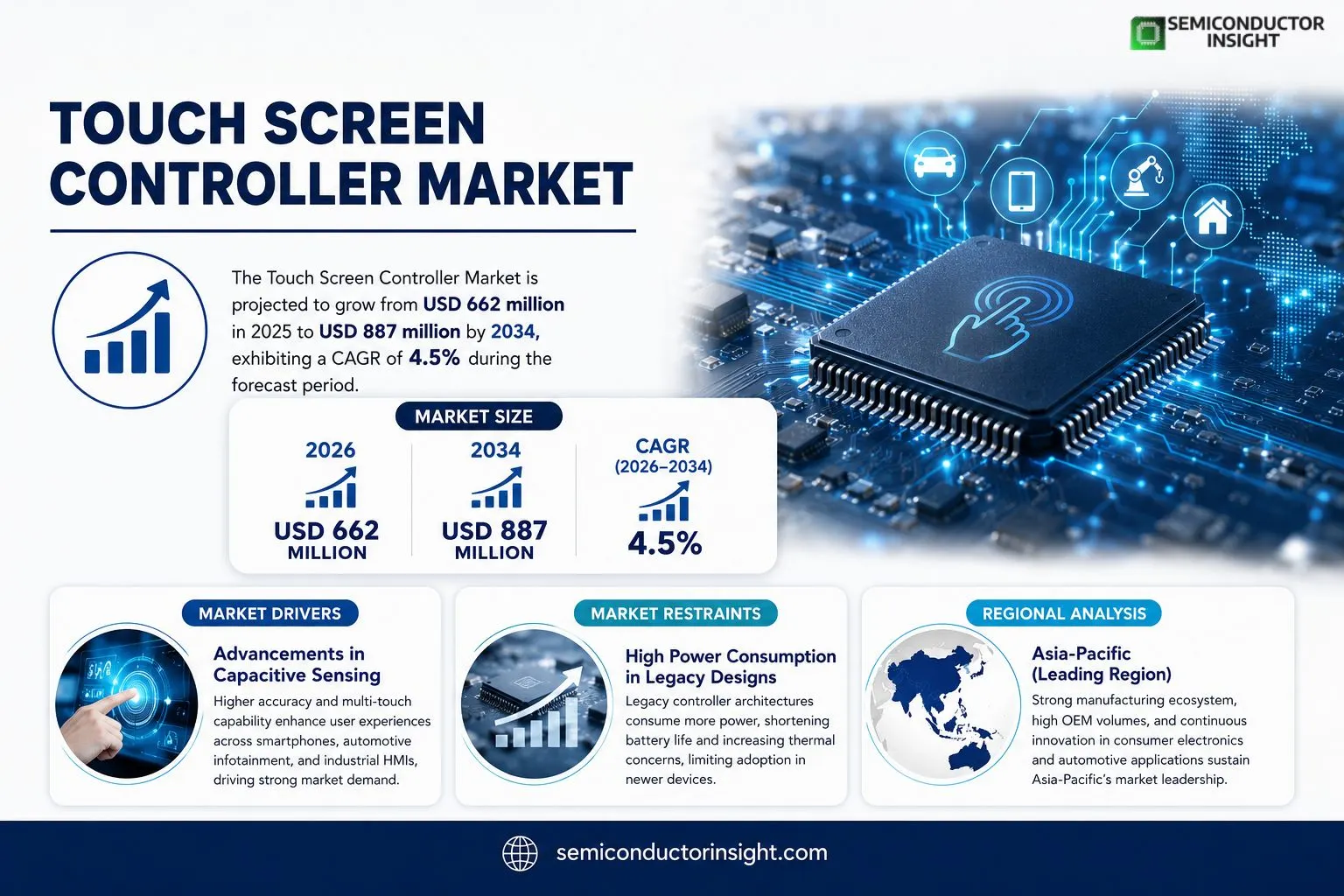
Touch Screen Controller Market size was valued at USD 662 million in 2025. The market is expected to reach USD 887 million by 2034, indicating a CAGR of 4.5 % over the forecast horizon.
Touch Screen Controllers are integrated circuits that detect touch inputs on capacitive or resistive panels and translate them into digital signals for host processors. They handle scanning, noise filtering, multi‑touch detection, gesture recognition and communicate via interfaces such as I²C, SPI or USB. Capacitive controllers dominate smartphones, tablets, automotive displays and industrial HMIs because of high sensitivity and multi‑touch support.The expansion of automotive cockpits, industrial HMI deployments and smart‑appliance adoption fuels demand, while smartphones provide the largest volume base despite slower unit growth. Requirements for low latency, high signal‑to‑noise ratio and robust operation under water or glove conditions push manufacturers toward higher‑value controllers and advanced firmware tuning services.
MARKET DRIVERS
Advancements in Capacitive Sensing
Touch Screen Controller Market benefits from relentless improvements in capacitive sensing accuracy. Higher resolution translates into smoother user experiences, prompting OEMs to integrate next‑generation controllers across smartphones, automotive infotainment, and industrial kiosks.
Shift Toward Seamless Human‑Machine Interfaces
Enterprises are prioritizing frictionless interaction, and Touch Screen Controller Market supplies the underlying firmware and ASICs that enable gesture recognition, multi‑touch, and haptic feedback. This trend reduces reliance on physical buttons, reshaping product design cycles.
➤ Manufacturers that embed adaptive algorithms into their controllers gain a measurable edge in device differentiation.
Beyond pure hardware, software‑defined calibration tools are lowering time‑to‑market for new form factors. Speedier launches empower brands to capture consumer interest before seasonal demand peaks, reinforcing the market’s growth momentum.
MARKET CHALLENGES
Escalating Component Costs
Raw material price volatilityespecially for silicon and specialized glasscompresses margins in Touch Screen Controller Market. Cost pressures force suppliers to balance performance upgrades with price elasticity, often leading to delayed adoption of premium features.
Other Challenges
Supply Chain Fragmentation
The reliance on geographically dispersed fabs introduces lead‑time uncertainties. When a single node faces capacity constraints, downstream assemblers experience bottlenecks, limiting the ability to meet rapid demand spikes.
Regulatory Compliance
Stringent electromagnetic interference (EMI) standards in automotive and medical sectors impose additional engineering overhead. Compliance costs can deter smaller players from entering niche segments of Touch Screen Controller Market.
MARKET RESTRAINTS
High Power Consumption in Legacy Designs
Older controller architectures still dominate many legacy devices, drawing more power than contemporary low‑energy alternatives. Excessive power draw not only shortens battery life but also raises thermal management concerns, discouraging OEMs from refreshing product lines.
MARKET OPPORTUNITIES
Emergence of Edge‑AI Integrated Controllers
The convergence of on‑chip AI inference with touch sensing opens a fresh avenue for Touch Screen Controller Market. Embedded AI can locally interpret complex gestures, reduce latency, and lower cloud bandwidth usage, making it attractive for autonomous vehicles and smart home appliances.Furthermore, the rise of flexible display substrates invites controllers that can bend without performance loss. Companies that pioneer flex‑compatible ASICs stand to capture a sizeable share of upcoming wearable and foldable device segments.
Touch Screen Controller Market Trends
Automotive Cockpit Displays Elevating Controller Requirements
Vehicle electrification and the migration to digital instrument clusters have shifted the demand curve for touch‑sensing ICs. OEMs now specify controllers that can tolerate water ingress, glove interaction, and high electromagnetic interference while maintaining millisecond‑level latency. The result is a migration toward higher‑value, capacitive solutions that embed advanced firmware for gesture interpretation and noise filtering. Production data shows a rise in unit shipments for automotive‑grade controllers, even as overall unit growth slows in the smartphone segment. Suppliers that can deliver rapid design‑in support and robust qualification packages are seeing longer contract windows, which in turn stabilizes revenue streams for firms entrenched in this niche.
Other Trends
Industrial HMI Moves to In‑Cell Touch Integration
Factories adopting Industry 4.0 interfaces are consolidating display driver ICs and touch controllers into a single silicon die. This in‑cell architecture reduces board space, cuts bill‑of‑materials, and improves signal‑to‑noise ratios by eliminating external routing. The trade‑off is a higher bar for thermal management and more complex firmware calibration, prompting a rise in specialized tuning services. Companies that maintain a library of reference designs for diverse electrode patterns are capturing a larger share of the industrial segment, where downtime costs drive customers to favor solutions with proven field performance. The shift also encourages tighter collaboration between display manufacturers and controller vendors, reshaping the traditional supplier hierarchy.
Supply‑Chain Constraints on Wafer Capacity and Packaging
Mid‑stream fabs report that QFN and WLCSP packaging slots are nearing saturation, a consequence of simultaneous demand from consumer electronics, automotive, and industrial customers. Limited wafer throughput forces manufacturers to prioritize higher‑margin orders, leaving price‑sensitive smartphone OEMs to negotiate tighter cost targets. This pressure accelerates the adoption of mixed‑signal design IP that can be re‑used across product families, thereby stretching existing capacity. End‑users are responding by diversifying their supplier base and by establishing buffer inventories for critical controller families. The dynamic underscores how capacity planning and packaging technology choices directly influence pricing tiers and lead times within Touch Screen Controller Market.
COMPETITIVE LANDSCAPE
Key Industry Players
Touch Screen Controller Market: Competitive Overview
The landscape is anchored by a handful of global IC firms that dominate volume shipments to smartphone OEMs and automotive Tier‑1 suppliers. Texas Instruments leverages its deep analog portfolio to supply high‑performance capacitive controllers that meet demanding latency and power‑efficiency specifications, securing a leading share in consumer electronics. Microchip, benefitting from its legacy in embedded solutions, has carved out a strong position in automotive and industrial HMI segments, where robustness against water, glove‑touch and EMI is non‑negotiable. STMicroelectronics and NXP complement the top tier by offering mixed‑signal ASICs that integrate touch detection with sensor‑fusion algorithms, enabling tighter coupling with display driver ICs and shortening time‑to‑market for OEMs.Beyond the headline names, a cohort of specialized suppliers injects innovation across niche applications. Goodix and Synaptics focus on ultra‑thin, on‑cell touch solutions for premium smartphones, pushing the envelope on sampling rates and gesture recognition. Azoteq supplies rugged controllers for medical devices and industrial panels, emphasizing configurable firmware that can be tuned to diverse electrode patterns. Analog Devices and Infineon provide high‑SNR parts for automotive infotainment, where electromagnetic resilience is paramount. Regional players such as Lite‑On (Taiwan), Renesas (Japan), and Cypress Semiconductor (now under Infineon) add depth to the supply chain, while emerging firms like Matrix Orbital address niche POS and kiosk markets with integrated touch‑to‑display modules.
List of Key Touch Screen Controller Companies Profiled
- Texas Instruments
- Microchip Technology
- STMicroelectronics
- NXP Semiconductors
- Analog Devices
- Infineon Technologies
- Goodix
- Synaptics
- Azoteq
- Lite‑On
- Renesas Electronics
- Matrix Orbital
- Honeywell
- Advantech
Segment Analysis:
| Segment Category | Sub-Segments | Key Insights |
| By Type |
|
Capacitive Controllers dominate due to their superior sensitivity and multi‑touch capability.
|
| By Application |
|
Automotive Displays emerge as a high‑value segment driven by electrification and smart‑cockpit trends.
|
| By End User |
|
Smartphone & Tablet OEMs remain the largest volume users, emphasizing cost efficiency and rapid integration.
|
| By Interface |
|
I2C/SPI Interfaces dominate due to their simplicity and widespread ecosystem support.
|
| By Integration Mode |
|
In‑Cell Integration is gaining traction as display manufacturers pursue thinner modules and higher optical clarity.
|
Regional Analysis: Touch Screen Controller Market
Asia‑Pacific
Tier‑one foundries in Taiwan and South Korea have honed wafer‑level integration techniques that shrink controller footprints while preserving signal integrity. Their capacity to switch between legacy and emerging process nodes within the same fab offers customers flexibility to align product cycles with cost targets, reinforcing the region’s cost‑competitiveness without sacrificing quality.
R&D centers in Japan and Singapore focus on multi‑touch detection algorithms and AI‑enhanced gesture recognition. By embedding predictive models directly into controller firmware, manufacturers can deliver smoother user experiences that differentiate premium devices, prompting OEMs to prioritize these innovations in their product roadmaps.
The region’s dense network of component suppliers, from glass laminators to micro‑LED producers, enables rapid substitution when a single source faces constraints. This redundancy lowers lead times and shields Touch Screen Controller Market from geopolitical shocks that might otherwise inflate procurement costs.
Harmonized safety standards across ASEAN and the Pacific Rim streamline certification, allowing manufacturers to launch products across multiple jurisdictions with minimal re‑testing. This regulatory coherence accelerates time‑to‑revenue for new controller families and encourages cross‑border collaborations.
North America
North America maintains a strategic foothold through its focus on high‑value applications such as medical imaging, aerospace interfaces, and premium consumer devices. Companies in the United States invest heavily in custom controller architectures that prioritize security and low‑latency response, catering to sectors where performance cannot be compromised. Concurrently, the region’s venture capital ecosystem fuels startups exploring novel sensor fusion techniques, which could redefine how touch inputs interact with augmented reality platforms. While labor costs surpass those in Asia‑Pacific, the emphasis on intellectual property generation and compliance with stringent data protection regulations positions North America as a hub for differentiated, high‑margin solutions within Touch Screen Controller Market.
Europe
European manufacturers draw competitive advantage from a strong tradition of engineering excellence and a regulatory environment that emphasizes sustainability. The EU’s eco‑design directives push vendors to create controllers with reduced power consumption and recyclable materials, aligning product development with broader green initiatives. Moreover, collaborative research programs across Germany, France, and the Nordics target advanced optical touch technologies for automotive dashboards, where durability and precision are paramount. Though market size lags behind Asia‑Pacific, Europe’s commitment to high‑quality standards and its deep integration with industrial automation sectors ensure a steady demand for sophisticated controllers.
South America
South America’s Touch Screen Controller Market activity is anchored by a growing consumer electronics base and increasing smartphone penetration. Local assemblers increasingly adopt modular controller designs sourced from neighboring Asia‑Pacific suppliers, enabling quicker adaptation to price‑sensitive markets. Brazil’s burgeoning automotive sector also calls for ruggedized touch interfaces, prompting regional firms to partner with global OEMs for joint development projects. While economic volatility imposes challenges, the region’s expanding middle class fuels a demand trajectory that encourages both import diversification and modest domestic capability building.
Middle East & Africa
In the Middle East & Africa, demand for touch controllers is driven by rapid infrastructure development and the rollout of smart city initiatives. Governments in the Gulf Cooperation Council are investing in interactive kiosks and digital signage, which rely on controllers capable of withstanding high temperature and dust conditions. African markets, meanwhile, see growth in mobile banking terminals where rugged, low‑power controllers are essential. Partnerships between regional system integrators and Asian manufacturers facilitate technology transfer, gradually nurturing a nascent ecosystem that can support localized customization without compromising on the reliability expected in critical public‑facing applications.
Report Scope
This market research report provides a comprehensive analysis of the Touch Screen Controller Market , covering the forecast period 2026–2034. It offers detailed insights into market dynamics, technological advancements, competitive landscape, and key trends shaping the industry.
Key focus areas of the report include:
- Market Overview: The report begins with an overview outlining its current market scenario, key growth indicators, and industry transformation drivers. It discusses macroeconomic factors, demand–supply balance, regulatory landscape, and the strategic role of semiconductors in powering advancements across industries such as automotive, telecommunications, consumer electronics, and industrial automation.
- Market Size & Forecast: Historical data and future projections for revenue, unit shipments, and market value across major regions and segments.
- Segmentation Analysis: Detailed breakdown by product type, technology, application, and end-user industry to identify high-growth segments and investment opportunities.
- Regional Insights: Insights into market performance across North America, Europe, Asia-Pacific, Latin America, and the Middle East & Africa, including country-level analysis where relevant.
- Competitive Landscape: Profiles of leading market participants, including their product offerings, R&D focus, manufacturing capacity, pricing strategies, and recent developments such as mergers, acquisitions, and partnerships.
- Technology Trends & Innovation: Assessment of emerging technologies, integration of AI/IoT, semiconductor design trends, fabrication techniques, and evolving industry standards.
- Market Drivers & Restraints: Evaluation of factors driving market growth along with challenges, supply chain constraints, regulatory issues, and market-entry barriers.
- Stakeholder Insights: Insights for component suppliers, OEMs, system integrators, investors, and policymakers regarding the evolving ecosystem and strategic opportunities.
Primary and secondary research methods are employed, including interviews with industry experts, data from verified sources, and real-time market intelligence to ensure the accuracy and reliability of the insights presented.
FREQUENTLY ASKED QUESTIONS:
What is the current market size of Touch Screen Controller Market?
-> Touch Screen Controller Market was valued at USD 662 million in 2025 and is expected to reach USD 887 million by 2034, at a CAGR of 4.5% during the forecast period.
Which key companies operate in Touch Screen Controller Market?
-> Key players include Microchip, STMicroelectronics, Texas Instruments, Future Electronics, Analog Devices, NXP, Semtech, Infineon Technologies, Honeywell, Advantech, Azoteq, Lumissil, NKK Switches, Matrix Orbital.
What are the key growth drivers?
-> Key growth drivers include continued expansion of automotive displays, industrial HMI adoption, smart appliance penetration, demand for larger high‑refresh‑rate screens, higher touch sampling rates, and vehicle electrification driving smart cockpit upgrades.
Which region dominates the market?
-> Asia‑Pacific remains the dominant region, driven by high smartphone and automotive OEM volumes, while Europe and North America follow with steady adoption.
What are the emerging trends?
-> Emerging trends include in‑cell/on‑cell touch architectures, tighter integration with display driver ICs, advanced firmware algorithms for noise immunity, low‑power designs, and enhanced glove‑touch and water‑proof capabilities.
Get Sample Report PDF for Exclusive Insights
Report Sample Includes
- Table of Contents
- List of Tables & Figures
- Charts, Research Methodology, and more...