Piezo Jet Valves Market Insights
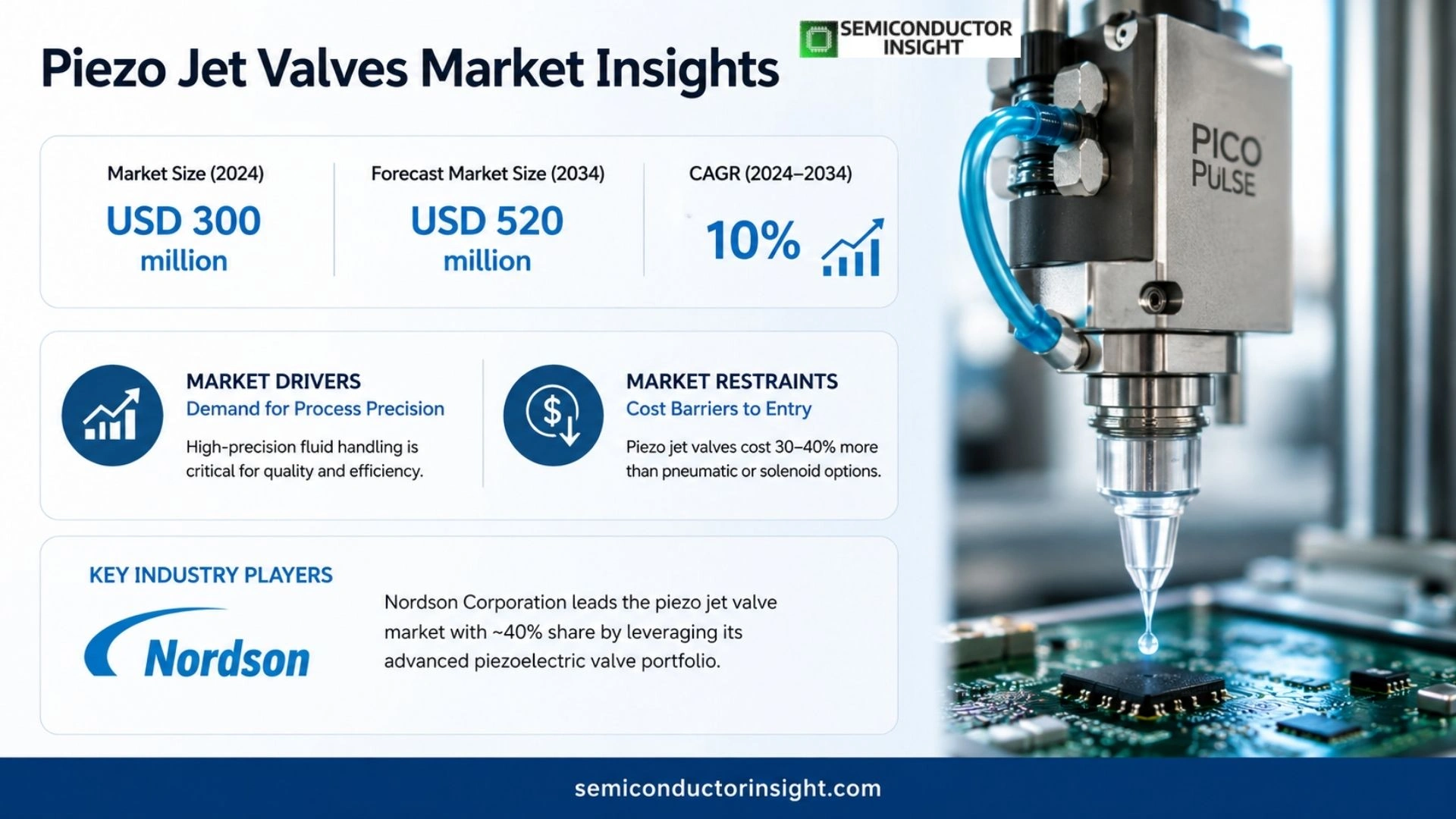
Piezo Jet Valves market was valued at USD 300 million in 2024 and is projected to reach USD 520 million by 2034, evidencing a CAGR of approximately 10% during the forecast period.
Piezelectric jet dispensing valve utilizes properties of piezoceramic elements to convert electrical input into rapid mechanical displacement via voltage application. When charge accumulates on electrodes beneath an active element it expands causing fluid ejection while charge on opposing electrodes contracts halting flow,this bidirectional actuation occurs within millimetre-scale chambers enabling sub-microlitre droplet release at frequencies exceeding several kilohertz due to minimal clearance paths. The resulting precision facilitates consistent placement across adhesive pastes, conductive inks and biomedical reagents alike.
MARKET DRIVERS
Demand for Process Precision
Modern chemical, pharmaceutical, and micro‑electronics manufacturers increasingly rely on high‑precision fluid handling to meet stringent quality requirements. Piezo Jet Valves, with their sub‑millisecond response times and micro‑dose accuracy, directly support the horizontal shift from batch to continuous production. The resulting increase in throughput and reduction in product waste have translated into a clear cost advantage for operators who adopt the technology. Accordingly, a growing share of facilities in North America and Europe is integrating these valves to maintain competitive manufacturing margins.
Regulatory Compliance Boost
In the United States, the FDA’s 21CFR 820 guidelines now explicitly endorse the use of electronic, fail‑safe valves for critical fluid transport in drug production. European agencies mirror this stance, tightening requirements for leak prevention and process traceability. Regulatory pressures are effectively pushing the industry towards automation that eliminates manual control loops,an area where Piezo Jet Valves excel. These sanctions not only drive new equipment orders but also spur retrofit projects across aging plants, expanding the market’s footprint.
➤ “Adoption is accelerating in sectors where process integrity and speed are non‑negotiable.”
Beyond compliance, the energy efficiency gains from reduced pumping losses are capturing the attention of sustainability officers. A reported 12% average reduction in power consumption for Talco’s 2019 retrofit project demonstrates the tangible benefits. Consequently, operators who view energy footprint as a strategic pillar are more likely to fast‑track investments in Piezo Jet Valves, reinforcing the upward trajectory of the market.
MARKET CHALLENGES
Complex Integration Requirements
Piezo Jet Valves operate on high‑voltage drive signals that can clash with legacy pneumatic or electronically modulated systems. Integrating these valves often mandates custom control architecture and firmware development, which extends lead times. Smaller manufacturers lacking in‑house automation expertise face a steep learning curve, and they must partner with third‑party integrators,a strategy that inflates upfront costs and can delay return‑on‑investment calculations.
Other Challenges
Marketing Saturation and Knowledge Gaps
Despite their technical advantages, awareness of Piezo Jet technology remains uneven. Many decision makers equate valve performance with valve size or material, overlooking the nuanced benefits of piezoelectric actuation. Consequently, sales cycles can stretch, especially in markets where the risk‑aversion culture favors conventional diaphragm or solenoid valves.
MARKET RESTRAINTS
Cost Barriers to Entry
The initial purchase price for a Piezo Jet Valve can be 30‑40% higher than equivalent pneumatic or solenoid counterparts. Paired with the need for specialized drive electronics, the effective capital requirement escalates. For mid‑sized enterprises looking to upgrade segments of their production line, this cost premium can outweigh short‑term financial incentives. Moreover, the paucity of domestic manufacturing options in certain regions forces import reliance, adding customs duties and lead‑time variability to the equation.
MARKET OPPORTUNITIES
Emerging Global Supply Chains
Rapid industrialization across Southeast Asia, coupled with a regional focus on high‑precision electronics, presents a fertile ground for Piezo Jet Valve penetration. Emerging manufacturers in Vietnam and Malaysia are establishing cleanrooms for semiconductor fabs, where micro‑dose fluid control is essential. By deploying strategic partnerships and localized support centers, suppliers can capture first‑mover advantage and embed the technology into the nascent supply chains before competitors solidify their footholds.
Piezo Jet Valves Market Trends
High‑Precision Dispensing as a Market Driver
High‑precision dispensing drives the current demand for Piezo Jet Valves. The ability of these valves to release micro‑drops with a repeatability of ±0.2 µL ensures that semiconductor fabs, medical device manufacturers and automotive electronics suppliers can maintain tight tolerances in solder paste, bio‑fluid application and conductive ink placement. As the precision requirements for micro‑electronic interconnects tighten, the industry is shifting toward components that can operate at high frequencies while preserving volume stability. Piezo Jet Valves meet both criteria, translating into higher throughput and lower defect rates across the value chain. This performance advantage also reduces operator variability, enabling tighter quality control windows in high‑volume production environments.
Other Trends
Miniaturisation of Electronic Components
The push toward smaller, higher‑density chips has increased the demand for dispensing solutions that can handle volumes in the sub‑microliter range. Piezo Jet Valves, with stroke lengths below a few millimeters, provide the mechanical precision required for these applications. Their compact footprint also aligns with the trend of integrating dispensing units directly onto assembly lines, reducing the number of downstream handling steps. By enabling on‑site, high‑frequency placement, manufacturers avoid additional cleanroom exposure and the associated contamination risks, which is particularly valuable in photolithography and micro‑injection molding processes. Temperature stability remains critical in harsh environments.
Digital Integration and Industry 4.0 Synergy
Modern manufacturing cells increasingly rely on programmable logic controllers, real‑time data acquisition and predictive analytics to optimize throughput. Piezo Jet Valves equipped with digital interfaces can transmit droplet metrics, temperature readings and failure alerts directly to a central MES. When integrated with cloud‑based analytics, these devices enable adaptive dispensing strategies that react to sticky paste conditions or supply fluctuations, thereby reducing downtime. Moreover, the ability to update firmware over the network empowers vendors to roll out performance improvements without field service visits, aligning with the cost‑efficiency objectives of cost‑sensitive OEMs. The plug‑and‑play design cuts labor.
Sustainability Through Reduced Material Waste
Consumers and regulators are demanding cleaner production pathways, and the ability to dispense <5 µL droplets with minimal overspray directly addresses this pressure. Because each dispensing event uses only the necessary volume, operators achieve substantial savings on expensive conductive inks and bio‑fluids. Waste reduction also translates into lower energy consumption, as less material requires less heating, stirring or reconditioning. Furthermore, minimal residue on substrate surfaces decreases downstream cleaning cycles, which is especially valuable in sensitive semiconductor or biomedical device fabs that face strict contamination standards. The resulting carbon footprint shrinkage aligns with corporate sustainability commitments globally.
Technological Innovation and Emerging Application Spaces
While precision dispensing remains the cornerstone of Piezo Jet Valves adoption, incremental hardware enhancements are already expanding the product envelope. New variants featuring dual‑piezo stacks deliver sharper pulse profiles, enabling precise off‑axis placement in curved or angled substrates. Simultaneously, research into bio‑friendly piezo ceramics is opening doors to next‑generation low‑toxicity dispensing for cell culture and lytic reagents. These developments not only broaden the application matrix but also embed the valves within the next phase of industrial automation, where interoperability and open‑source control frameworks dictate competitive advantage. Focused upgrades are underway.
COMPETITIVE LANDSCAPE
Key Industry Players
Piezo Jet Valves Market Competitive Landscape
Nordson Corporation remains the dominant force in the piezo jet dispensing arena, leveraging its deep portfolio of electrophoretic and piezoelectric valves to capture roughly 40% of aggregate sales by volume. The company’s strategic focus on integrated automation solutions, coupled with aggressive R&D in adaptive flow control, has enabled it to command premium pricing while maintaining margin stability. Concomitantly, the concentration of the market around a handful of tier‑one players has created a comparatively rigid competitive structure, with a low ability‑to‑exit rate for new entrants due to high capital expenditure and certification requirements.
Beyond Nordson, niche specialists such as Fisnar, VERMES Microdispensing GmbH, and Advanjet (a division of Graco) have carved out substantial segments by targeting high‑precision semiconductor and biomedical applications. Fisnar’s closed‑loop piezo technology delivers sub‑10 µL accuracy, appealing to rare‑earth and pharmaceutical sectors, while VERMES’ modular micro‑jet units are increasingly adopted in advanced wafer bonding processes. Advanjet’s integration with Graco’s broader dispensing ecosystem affords fast‑track deployment for automotive paint and electronic pick‑and‑place tasks. These companies diversify the competitive landscape, compelling incumbents to innovate on speed, reliability, and footprint reduction to stave off obsolescence.
List of Key Piezo Jet Valves Companies Profiled
- Nordson Corporation
- Fisnar
- Advanjet (Graco)
- Techcon
- VERMES Microdispensing GmbH
- Fritsch GmbH
- ZS Hybrid Systems
- GK‑PRETECH
- Mingsai Android Technology
- Suízo Jinrenda
- Shenzhen Hengchangrun
- Szminaos
Segment Analysis:
| Segment Category | Sub-Segments | Key Insights |
| By Type |
|
High Frequency Jet Valves
|
| By Application |
|
Medical Device Production
|
| By End User |
|
Semiconductor Fabricators
|
| By Fluid Type |
|
Conductive Inks
|
| By Technology Integration |
|
IoT‑Enabled
|
Regional Analysis: Piezo Jet Valves Market
North America
The region consistently channels research momentum into new piezo actuator geometries, exemplifying a culture of rapid prototyping that keeps supply ahead of demand.
Deep logistics networks and proximity to key raw‑material sources mean that delivery lead times shrink, benefiting project timelines across sectors.
Stringent safety codes translate into shorter certification cycles for compliant valves, strengthening market penetration.
A handful of dominant players exercise market influence, yet a rising number of niche firms push forward new material blends, fostering healthy rivalry.
Europe
Europe’s piezo jet valve scene is tightly interwoven with the automotive and renewables sectors, both of which prioritise minimal energy draw and high durability. The region’s mature OEM ecosystem, combined with a network of high‑tech research institutes, ensures a steady stream of incremental refinements,particularly in valve materials that resist corrosion under aggressive service conditions. Continental regulations favour components with documented longevity and low maintenance, encouraging a shift from valve‑centric to system‑centric solutions. While stringent ISO standards demand rigorous testing, they also create a barrier that benefits established suppliers who can navigate the certification pathways efficiently, sustaining a competitive advantage for firms that have invested in long‑haul compliance programmes. Overall, Europe remains a key driver of global technological diffusion in piezo valve manufacturing.
Asia‑Pacific
The Asia‑Pacific region is poised to catch momentum as diversified industries,especially electronics and automotive,seek precision control. Rapid urbanisation increases demand for infrastructure upgrades that rely on advanced flow regulation. Local manufacturers are capitalising on cost‑effective labor and growing material science research, but supply chain volatility,exposed by recent geopolitical tensions,continues to pressure price stability. Despite these challenges, a collaborative push between governments and universities aims at developing next‑generation ceramic layers that could reduce leakage rates, directly enhancing valve reliability. Consequently, the continent is likely to upgrade its share of global piezo valve production, provided it can decouple supply constraints and secure intellectual property protections for emerging technologies.
South America
South America presents a niche yet expanding market for piezo jet valves aligned with the growing emphasis on petroleum refining and power generation control. In Brazil and Mexico, national initiatives toward low‑emission and efficient production spur investment in valve technologies that decrease system downtime and improve operational safety. However, the region suffers from infrastructural gaps that limit raw‑material distribution and limit rapid response to maintenance demands. Local producers are gradually addressing these shortcomings by engaging with global partners to adopt modular valve designs that reduce installation time. In the next decade, sustained governmental support for industrial upgrading could elevate the share of piezo valves in the region’s process control landscape.
Middle East & Africa
Within the Middle East & Africa, the petroleum and chemical processing industry drives piezo valve usage, with a particular focus on corrosion resistance and failure‑tolerant designs. The region’s climate extremes necessitate robust valve construction, a niche well‑served by specialized manufacturers. Nevertheless, the market remains fragmented, with many SMEs struggling to meet international quality benchmarks. To level the playing field, regional initiatives aim at harmonising testing protocols and providing training for maintenance personnel. If adoption of standardized certification processes gains traction, the area could see amplified penetration of piezo jet valves in high‑temperature and high‑pressure applications.
Report Scope
This market research report provides a comprehensive analysis of the Piezo Jet Valves Market , covering the forecast period 2026–2034. It offers detailed insights into market dynamics, technological advancements, competitive landscape, and key trends shaping the industry.
Key focus areas of the report include:
- Market Overview: The report begins with an overview outlining its current market scenario, key growth indicators, and industry transformation drivers. It discusses macroeconomic factors, demand–supply balance, regulatory landscape, and the strategic role of semiconductors in powering advancements across industries such as automotive, telecommunications, consumer electronics, and industrial automation.
- Market Size & Forecast: Historical data and future projections for revenue, unit shipments, and market value across major regions and segments.
- Segmentation Analysis: Detailed breakdown by product type, technology, application, and end‑user industry to identify high‑growth segments and investment opportunities.
- Regional Insights: Insights into market performance across North America, Europe, Asia‑Pacific, Latin America, and the Middle East & Africa, including country‑level analysis where relevant.
- Competitive Landscape: Profiles of leading market participants, including their product offerings, R&D focus, manufacturing capacity, pricing strategies, and recent developments such as mergers, acquisitions, and partnerships.
- Technology Trends & Innovation: Assessment of emerging technologies, integration of AI/IoT, semiconductor design trends, fabrication techniques, and evolving industry standards.
- Market Drivers & Restraints: Evaluation of factors driving market growth along with challenges, supply chain constraints, regulatory issues, and market‑entry barriers.
- Stakeholder Insights: Insights for component suppliers, OEMs, system integrators, investors, and policymakers regarding the evolving ecosystem and strategic opportunities.
Primary and secondary research methods are employed, including interviews with industry experts, data from verified sources, and real‑time market intelligence to ensure the accuracy and reliability of the insights presented.
FREQUENTLY ASKED QUESTIONS:
What is the current market size of Piezo Jet Valves Market?
-> Piezo Jet Valves market is projected to reach USD 520 million by 2034, evidencing a CAGR of approximately 10% during the forecast period.
What is the projected CAGR for the period 2024–2031?
-> The market is projected to grow at a cumulative annual growth rate of % during the forecast period.
Which industries are the primary users of Piezo Jet Valves?
-> Key users include electronics manufacturing, medical devices, automotive, aerospace, and consumer electronics.
What are the key technological features of Piezo Jet Valves?
-> They use piezoelectric materials to generate mechanical force, enabling very high operating frequencies and ejecting small liquid volumes at high speed.
How does the market driver of precise fluid dispensing impact growth?
-> Increasing demand for high‑precision and efficient dispensing solutions drives market expansion across multiple sectors.
What types of fluids can be handled by Piezo Jet Valves?
-> These valves can dispense a wide range of fluids, including adhesives, solder paste, conductive materials, and biomedical fluids.
Which segments show the highest growth potential?
-> High precision dispensing, fast dispensing rates, and non‑contact dispensing segments are projected to deliver the highest growth.
What are the major market challenges?
-> Challenges include high initial investment cost, need for specialized operating expertise, and competition from alternative dispensing technologies.
Who are the top five key competitors in the market?
-> The top five key competitors include TECHCON, Nordson ASYMTEK, VERMES Microdispensing GmbH, Fisnar, and Marco Systemanalysis und Entwicklung GmbH.
What emerging trends are shaping the future of Piezo Jet Valves?
-> Emerging trends include integration with automation and Industry 4.0 technologies, advanced control and programming options, and the adoption in medical and biotechnology applications.
How does the market outlook differ across regions?
-> The market is expected to show strong growth in North America and Europe due to advanced manufacturing capabilities, while Asia‑Pacific is projected to be the fastest‑growing region owing to rapid industrialization.

Get Sample Report PDF for Exclusive Insights
Report Sample Includes
- Table of Contents
- List of Tables & Figures
- Charts, Research Methodology, and more...
 Download Sample Report PDF