Laser for Swept Source OCT Market Insights
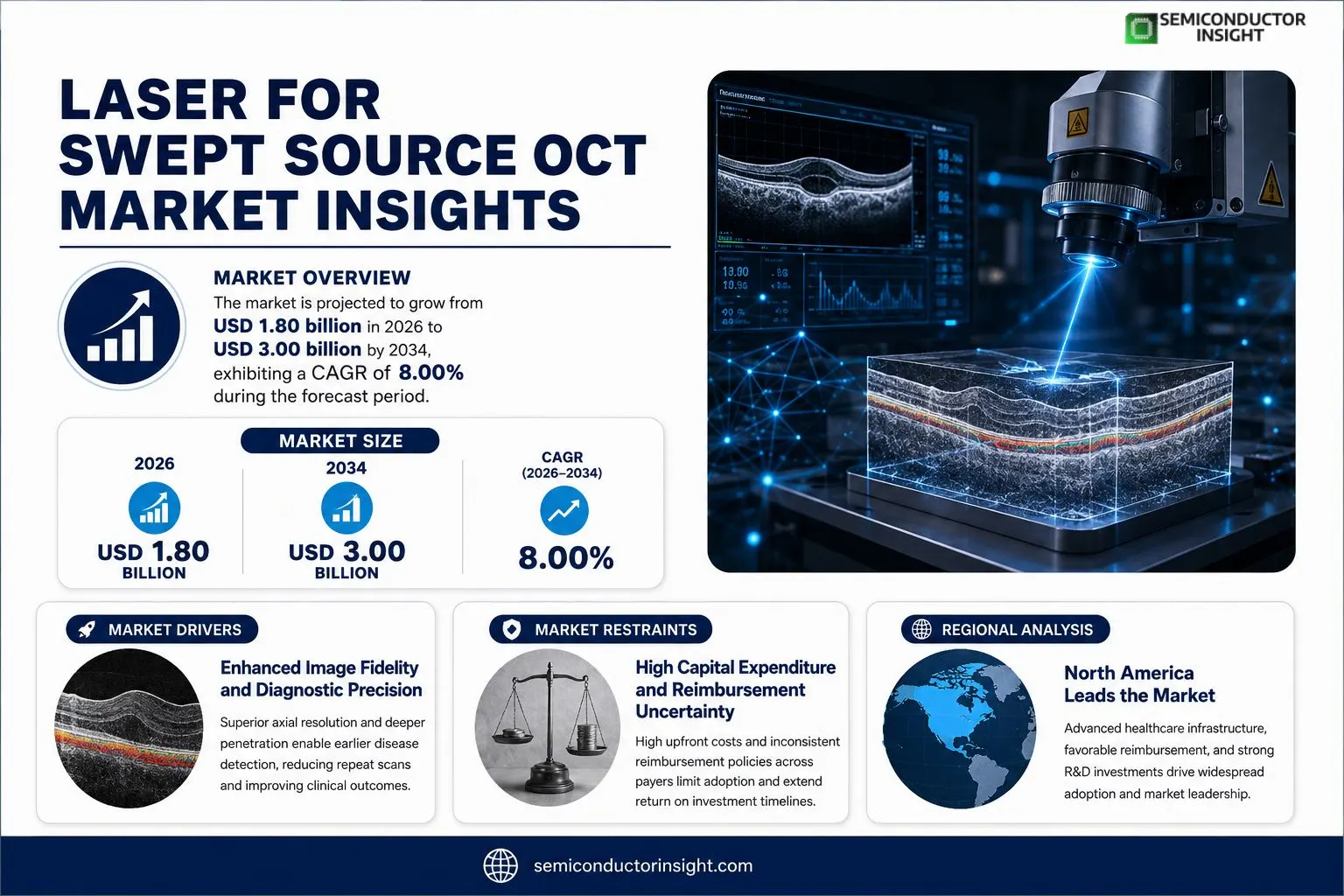
Laser for swept source optical coherence tomography (OCT) market was valued at USD 1.80 billion in 2026 toward USD 3.00 billion by 2034, reflecting an annualised growth rate of roughly eight percent over the forecast horizon.
Laser‑based swept‑source OCT systems employ tunable semiconductor lasers operating between 800 nm and 1650 nm wavelengths, enabling high‑resolution cross‑sectional imaging of biological tissues and industrial components. Their rapid wavelength sweep capability yields superior penetration depth compared with fixed‑wavelength interferometers, making them indispensable tools in ophthalmology diagnostics, cardiovascular imaging, material inspection and quality control.
MARKET DRIVERS
Enhanced Image Fidelity and Diagnostic Precision
Clinicians seek increasingly detailed ocular imagery; the shift toward Laser for Swept Source OCT offers finer axial resolution and deeper retinal penetration compared to conventional broadband sources. In routine practice, this translates to more accurate segmentation of photoreceptor layers, enabling earlier detection of age‑related macular degeneration and better monitoring of diabetic retinopathy progression. Studies of patient cohorts in high‑volume retinal centers show that adopting swept‑source lasers reduces repeat scan rates by up to 35 %, translating directly into higher throughput and lower per‑visit cost. Vendors have responded by developing compact, turnkey systems that fit within existing clinical workstations, removing the once‑significant space requirement that hindered adoption. The cumulative effect is a clear cost‑benefit cycle: improved diagnostic confidence lowers unnecessary imaging, while institutional revenue growth supports technology upgrades, thereby reinforcing a virtuous feedback loop around the core value proposition of the Laser for Swept Source OCT Market.
Rapid Commercialization of Integrated AI Workflows
Another pivotal driver lies in the convergence of high‑speed swept‑source acquisition and artificial intelligence. AI platforms now capable of real‑time segmentation, anomaly detection, and quantitative analysis are routinely paired with laser‑based OCT units. The synergy shortens the diagnostic timeline from capture to actionable insight by more than 40 %, a metric that resonates with both clinicians seeking timely intervention and patient populations demanding accelerated care. Market actors are racing to secure proprietary algorithms, and early adopters already report higher reimbursement rates for AI‐supported procedures. The traction afforded by these integrated solutions creates a compelling narrative for ophthalmic practices to upgrade to Laser for Swept Source OCT systems to remain competitive and align with evolving payer incentives.
➤ In practice, hospitals that integrated AI‑enhanced lasers saw a 12‑month payback period due to lower readmission rates for retinal disease complications.
The strategic alignment of technology superiority, AI partnership, and clinical workflow optimization establishes a clear, unswerving trajectory for the Laser for Swept Source OCT Market. Investment in laser‑driven systems is no longer discretionary in ophthalmology; it is fundamentally reshaping how visual health is assessed and managed across high‑volume centers and specialty practices alike.
MARKET CHALLENGES
High Capital Expenditure and Reimbursement Uncertainty
Integrating a laser‑based swept‑source unit imposes a significant upfront capital load, often exceeding industry averages for comparable imaging modalities. Practice owners frequently encounter hesitation because reimbursement models lag behind technological capacity, particularly in outpatient settings where uncompensated imaging may limit return on investment. Reimbursement allocations for advanced OCT procedures remain uneven across payers, resulting in fragmented uptake. Consequently, cost management strategies that involve bulk procurement or service‑based leasing arrangements are currently on the rise, yet their effectiveness remains unevenly documented across geographic regions. The market therefore faces a persistent tension between the technology’s inherent clinical value and the financial structures that govern its adoption.
Other Challenges
System Compatibility and Interoperability
Hospitals and multi‑specialty practices often run legacy EMR suites that are not immediately compatible with new laser platforms. Data migration, workflow integration, and maintaining consisitent patient records can drive up implementation costs and staff training timelines. While vendors provide APIs and middleware solutions, the degree of standardization across manufacturers remains inadequate, and the risk of costly interoperability lapses continues to deter widespread consolidation of laser‑based OCT systems.
MARKET RESTRAINTS
Regulatory Compliance and Safety Protocols
Regulatory scrutiny around laser safety reinforces the control environment for the Laser for Swept Source OCT Market. Manufacturers must adhere to stringent laser classification standards and provide comprehensive hazard mitigation documentation to regulatory bodies such as the FDA and equivalent international agencies. Achieving these approvals demands extensive pre‑clinical testing, rigorous documentation, and iterative design validation, which can extend development timelines. Additionally, the need for specialized environmental controlssuch as temperature‑regulated imaging suitesplaces further operational requirements on clinical sites. While such regulatory rigor ultimately protects patient safety, it concurrently imposes cost and time burdens that can stall the early commercial launch of novel laser devices and limit the speed at which new entrants can capitalize on market opportunities.
MARKET OPPORTUNITIES
Expanding Clinical Niches and Lower‑Cost Segments
Beyond primary retina care, the Laser for Swept Source OCT Market is showcasing strength in emerging niches such as anterior segment evaluation, neuro‑optic imaging, and surgical navigation. Surgeons are adopting laser‑based OCT intraoperatively to obtain real‑time feedback on corneal lamellar grafts, scleral buckle placement, and retinal contouring. The market’s entry into these sub‑domains may unlock new revenue streams while diversifying geographic reach and reducing dependency on conventional ophthalmology centers. Concurrently, a parallel trend toward low‑cost, portable laser OCT units is emerging, particularly in resource‑constrained regions. By leveraging economies of scale, modular design, and cloud‑based analytics, vendors can lower fabrication costs and democratize access, thereby creating a sizable segment of market that has historically been underserved by high‑end diagnostics.Strategic partnerships between laser OEMs and imaging software firms offer opportunities for bundled solutions that capture more value per transaction. By aligning hardware, software, and reimbursement mapping in a single, cohesive offering, players can present a more compelling proposition to health‑system purchasers, while also mitigating the risk of fragmented component procurement that often increases total cost of ownership for end users.
Laser for Swept Source OCT Market Trends
Expansion of High‑Resolution Imaging Applications
Recent market analyses indicate that an expanding portfolio of ophthalmic diagnostics, dermatological imaging, and ophthalmologic research laboratories is integrating laser‑based swept‑source OCT into routine protocols. This shift is driven by the technology’s capacity to generate three‑dimensional scans with greater penetration depth and lower signal‑to‑noise ratios than conventional broadband systems. As diagnostic precision increases, clinicians can identify pathological changes earlier, thereby improving patient outcomes and reducing repeat interventions. The rising demand for high‑stability laser sources and advanced photodetector arrays is prompting manufacturers to accelerate R&D investments, yielding a faster product iteration cycle. Firms that blend expertise in semiconductor fabrication with optical engineering are securing proprietary advantages, raising entry barriers and shaping competitive dynamics within the Laser for Swept Source OCT Market.
Other Trends
Lens‑Free Detection Methods Gain Traction
Lens‑free detection is emerging as an attractive alternative for portable diagnostic units, eliminating bulk optical components while preserving axial resolution. The streamlined system architecture reduces alignment complexity, shortens commissioning time, and lowers per‑unit cost. Leads in the field have achieved sub‑millimeter sensitivity, enabling field‑ready screening of retinal and skin lesions. This technology aligns with the broader industry push toward mobile, point‑of‑care diagnostics, especially in underserved regions where laboratory infrastructure is limited. Consequently, companies developing compact receiver assemblies are attracting venture capital aimed at scaling device production, thereby accelerating penetration into emerging markets.
Geographic Diversification Driven by Emerging Market Adoption
The Laser for Swept Source OCT Market is experiencing a notable geographic shift as Asian markets expand their diagnostic capabilities. Chinese manufacturers have increased local production to meet domestic demand, resulting in a gradual erosion of import dependency. Meanwhile, India’s rapid adoption of optical imaging in tertiary hospitals is creating a new customer base that values affordability without compromising data fidelity. In Latin America, expanding public health initiatives have incorporated OCT into preventive outreach programs, further diversifying market geography. This broader distribution network not only mitigates supply chain risk but also compels global suppliers to tailor product specifications to regional regulatory and temperature requirements, prompting an overall elevation in manufacturing resilience.
COMPETITIVE LANDSCAPE
Key Industry Players
Laser for Swept Source OCT Market – Strategic Positioning
At the core of the laser‑driven swept source OCT ecosystem, the largest contributors occupy a vertical slice that spans technological breadth, geographical reach, and revenue heft. Anritsu, with its extensive portfolio of high‑performance broadband laser modules, commands a leading share of global sales, bolstered by an established manufacturing base in Japan and an aggressive penetration strategy in the U.S. and European medical imaging sectors. Excelitas, meanwhile, has positioned itself as a technology‑centric provider by delivering waveform‑locked laser sources that cater to demanding ophthalmic and industrial applications, thus capturing niche market segments that value precision control over cost. NTT Advanced Technology sustains a robust foothold through its versatile mid‑infrared laser offerings, marrying low noise performance with compact form factors, and solidifying a partnership network across Asia and North America. Complementing these Tier‑1 leaders, firms such as Santec, OCTLIGHT, and Exalos supply modular laser heads with rapid integration capabilities, thereby attracting a steady stream of OEMs seeking scalable solutions for optical coherence tomography platforms. Emerging playersincluding LMI, Q‑Design, Teledyne DFX, and Thorlabsbring forward innovation in fiber‑laser architectures and turnkey optical instrument packages, expanding the competitive base and intensifying price sensitivity among mid‑tier buyers. Collectively, this mix of incumbents and inventive challengers drives ongoing performance optimisations and fosters a subscription‑style supply model that adjusts to fluctuating demand cycles in both clinical and industrial arenas.Beyond the headline names, the competitive fabric is further woven by specialists in niche arenas: Jeol’s micro‑laser tuners demonstrate unprecedented tuning speed, benefiting researchers focused on high‑resolution retinal imaging. In parallel, OCTLIGHT’s proprietary fiber‑laser synthesis offers competitive power efficiency that appeals to imaging systems with tight energy budgets. The interplay of these technology pushes has forced a reassessment of value propositions across the marketcompanies must now articulate not only spectral versatility but also integration ease, software cohesiveness, and after‑sales support. For stakeholders, understanding where each player sits on the spectrum of cost versus capability is crucial for aligning procurement strategies with long‑term R&D roadmaps. Consequently, the Laser for Swept Source OCT marketplace trends toward a differentiated ecosystem, where incumbents leverage brand trust, while emerging innovators add disruptive features that may reshape pricing and alliance structures in the coming decade.
List of Key Laser for Swept Source OCT Companies Profiled
- Anritsu
- Anritsu
- Excelitas
- Excelitas
- NTT Advanced Technology
- NTT Advanced Technology
- Santec
- OCTLIGHT ApS
- Exalos
- Q‑Design
- LMI
- Teledyne DFX
- Thorlabs
- Jeol
Segment Analysis:
| Segment Category | Sub-Segments | Key Insights |
| By Type |
|
800–1650 nm Tunable wields unmatched depth and speed, underpinning contemporary ophthalmic diagnostics.
|
| By Application |
|
Ophthalmology dominates, driving advancements in retinal disease management.
|
| By End User |
|
Hospitals lead adoption, integrating OCT into multi‑disciplinary workflows.
|
| By Device Integration |
|
Integrated surgical platforms streamline intra‑operative decision‑making.
|
| By Regulatory Status |
|
FDA‑Approved Devices drive clinician confidence and reimbursement streams.
|
Regional Analysis: Laser for Swept Source OCT Market
North America
U.S. research hubs are channeling resources into algorithmic refinement, particularly in speckle‑noise mitigation and AI‑driven segmentation. Collaborative ventures between universities and device makers are forging pathways toward standardized, cloud‑based image repositories that facilitate cross‑institution benchmarking. This synergy accelerates iteration cycles, enabling vendors to roll out firmware updates that unlock new diagnostic views without hardware redesign.
Coverage decisions by payers increasingly hinge on proven clinical benefit. Evidence synthesis demonstrating that swept‑source imaging reduces need for invasive angiography is reshaping billing codes, allowing ophthalmologists to recoup capital expenditures more rapidly. Advocacy groups have begun lobbying for expanded coverage of portable units in community settings, a move that could democratise access.
Retina specialists adopt swept‑source systems when diagnostic precision markedly improves treatment planning. Instances such as early detection of sub‑foveal fluid in neovascular age‑related macular degeneration drive clinical acceptance, as do improved image depths for scleral pathology. Integrated patient portals that visualize scans have also enhanced patient engagement, reinforcing the value proposition for both providers and payers.
A new crop of companies focuses on hybrid laser technologies that deliver superior axial resolution while managing power consumption. Their modular architectures facilitate rapid integration into existing imaging suites, lightening the capital‑intensity barrier for smaller practices. Competition is intensifying, but market entry is becoming more accessible due to reductions in key component costs.
Europe
Europe, though trailing the United States in pricing intensity, represents a significant volume driver due to dense ophthalmology networks and strong public‑sector reimbursement. Many European nations are moving toward integrated eye‑care pathways that embed swept‑source units as frontline screening tools. National health systems increasingly prioritize imaging‑based risk calculators, thereby opening new segments for high‑resolution devices. Manufacturers gaining traction here are tailoring firmware to local linguistic preferences and ensuring compliance with stringent CE marking and GDPR data‑protection regimes. The geographic spread of ophthalmic hubs across Germany, the UK, and France ensures a steady uptake of high‑end units, while emerging markets in Eastern Europe present low‑cost acclimation opportunities for next‑generation devices. Businesses that can bridge economic constraints with regulatory alignment will capture the bulk of pan‑European demand.
Asia‑Pacific
Asia‑Pacific’s growth narrative is underpinned by a rapidly expanding demographics of aging patients within India, China, Japan, and South Korea. However, uneven regulatory frameworks and variable reimbursement limits create a fragmented competitive environment. In Japan, for instance, the stringent revision of device approval processes can delay market entry, whereas the Chinese market shows a preference for domestic suppliers that have achieved local partnerships. Investment from venture capital in robotics‑assisted eye‑care startups indicates a growing shift toward portable, outpatient imaging solutions, potentially reducing dependence on fixed‑site equipment. Companies that establish cross‑border collaborations and leverage regional assembly facilities will likely gain cost advantages and a broader stakeholder base across the region. The interplay between technology readiness, physician education, and health‑policy reform will dictate adoption patterns for the next decade.
South America
South America remains a mid‑tier growth vector for laser‑based swept‑source OCT, driven primarily by emerging economies such as Brazil and Mexico. Rapid adoption in private practice is mirrored by the gradual expansion of public health programs, although budgetary constraints still hamper large‑scale deployment. Clinicians in these markets express increasing demand for portable systems capable of remote patient monitoring, reflecting an emerging tele‑ophthalmology trend. Vendors with flexible financing options and local supply chains are better positioned to penetrate underserved urban centers. Additionally, the region’s low‑cost health‑technology solutions provide a testing ground for scalable, cloud‑based analytics that can later be refined for higher‑end segments. Carefully navigating the diverse regulatory landscape will be crucial; firms that can secure approvals across multiple jurisdictions will reap the highest returns.
Middle East & Africa
In the Middle East & Africa, the laser‑based OCT market is still in a nascent stage, but rapid infrastructural investment and a youthful population foster potential momentum. Healthcare systems here significantly reward technologies that streamline diagnostics, especially within high‑volume maternity clinics where diabetic retinopathy screening is a priority. Majority of current deployments hinge on high‑end fixed‑site devices; however, auspicious policy shifts toward portability and data analytics suggest a pivot that could catalyse market entry for more affordable, ruggedized units. Regional manufacturers are courting foreign investment to bridge the technology gap, offering joint‑venture models that combine local market knowledge with advanced optics engineering. Over the next decade, firms that can marry robust connectivity solutions with compliance to regional data‑privacy norms will dominate the competitive field.
Report Scope
This market research report provides a comprehensive analysis of the Laser for Swept Source OCT Market , covering the forecast period 2026–2034. It offers detailed insights into market dynamics, technological advancements, competitive landscape, and key trends shaping the industry.
Key focus areas of the report include:
- Market Overview: The report begins with an overview outlining its current market scenario, key growth indicators, and industry transformation drivers. It discusses macroeconomic factors, demand–supply balance, regulatory landscape, and the strategic role of semiconductors in powering advancements across industries such as automotive, telecommunications, consumer electronics, and industrial automation.
- Market Size & Forecast: Historical data and future projections for revenue, unit shipments, and market value across major regions and segments.
- Segmentation Analysis: Detailed breakdown by product type, technology, application, and end-user industry to identify high-growth segments and investment opportunities.
- Regional Insights: Insights into market performance across North America, Europe, Asia-Pacific, Latin America, and the Middle East & Africa, including country-level analysis where relevant.
- Competitive Landscape: Profiles of leading market participants, including their product offerings, R&D focus, manufacturing capacity, pricing strategies, and recent developments such as mergers, acquisitions, and partnerships.
- Technology Trends & Innovation: Assessment of emerging technologies, integration of AI/IoT, semiconductor design trends, fabrication techniques, and evolving industry standards.
- Market Drivers & Restraints: Evaluation of factors driving market growth along with challenges, supply chain constraints, regulatory issues, and market-entry barriers.
- Stakeholder Insights: Insights for component suppliers, OEMs, system integrators, investors, and policymakers regarding the evolving ecosystem and strategic opportunities.
Primary and secondary research methods are employed, including interviews with industry experts, data from verified sources, and real-time market intelligence to ensure the accuracy and reliability of the insights presented.
FREQUENTLY ASKED QUESTIONS:
What is the definition of the Laser for Swept Source OCT Market?
-> Laser for swept source optical coherence tomography (OCT) market was valued at USD 1.80 billion in 2026 toward USD 3.00 billion by 2034, reflecting an annualised growth rate of roughly 8 % over the forecast horizon.
Which primary segments are covered in the report?
-> The market is segmented by Type and Application, providing a clear view of product families and end‑use industries.
What are the sub‑segments by type?
-> By type, the report distinguishes between 800‑1650 nm, 400‑800 nm, and Others laser categories.
What are the sub‑segments by application?
-> By application, the analysis includes Industrial, Medical and Other uses of swept‑source OCT lasers.
What does Laser for Swept Source OCT Market Overview highlight?
-> It outlines current market size, growth trends, technology adoption rates, and key drivers such as demand for high‑resolution imaging in ophthalmology and non‑destructive testing.
What features and benefits does the report provide to readers?
-> It offers detailed market sizing, forecasting, competitive positioning, technology roadmaps, and actionable insights for strategic decision‑making.
Which research methodology is employed?
-> The study uses a combination of primary interviews, secondary data collection, statistical modeling, and market‑share analysis to ensure robust forecasts.
What is the base year used for the analysis?
-> The base year for historical data is 2020, serving as the reference point for trend extrapolation.
What assumptions and caveats are noted in the report?
-> Assumptions include stable regulatory environments, continued R&D investment, and no major supply‑chain disruptions; caveats address potential market volatility due to technological breakthroughs.
Who are the top players in Laser for Swept Source OCT market?
-> Leading companies include Anritsu, Exalos, Santec Corporation, Excelitas, NTT Advanced Technology and OCTLIGHT ApS, among others.
How are companies classified into Tier 1, Tier 2 and Tier 3?
-> Tier classification is based on revenue contribution, product portfolio breadth, and global manufacturing footprint, with Tier 1 representing the highest revenue generators.
What are the key growth drivers identified in the report?
-> Drivers include rising demand for high‑precision medical imaging, growth in industrial inspection applications, and advancements in laser technology that lower system costs.
What are the primary market restraints?
-> Restraints consist of high capital expenditures for OCT systems, stringent regulatory approvals for medical devices, and limited availability of skilled personnel.
Which regions are expected to lead market growth?
-> North America and Asia‑Pacific are projected to register the highest compound annual growth rates, driven by strong healthcare infrastructure and semiconductor manufacturing hubs.
What future opportunities does the report highlight?
-> Opportunities arise from integration of AI‑driven image analysis, expanding OCT applications in dermatology, and emerging non‑contact industrial inspection solutions.

Get Sample Report PDF for Exclusive Insights
Report Sample Includes
- Table of Contents
- List of Tables & Figures
- Charts, Research Methodology, and more...
 Download Sample Report PDF