
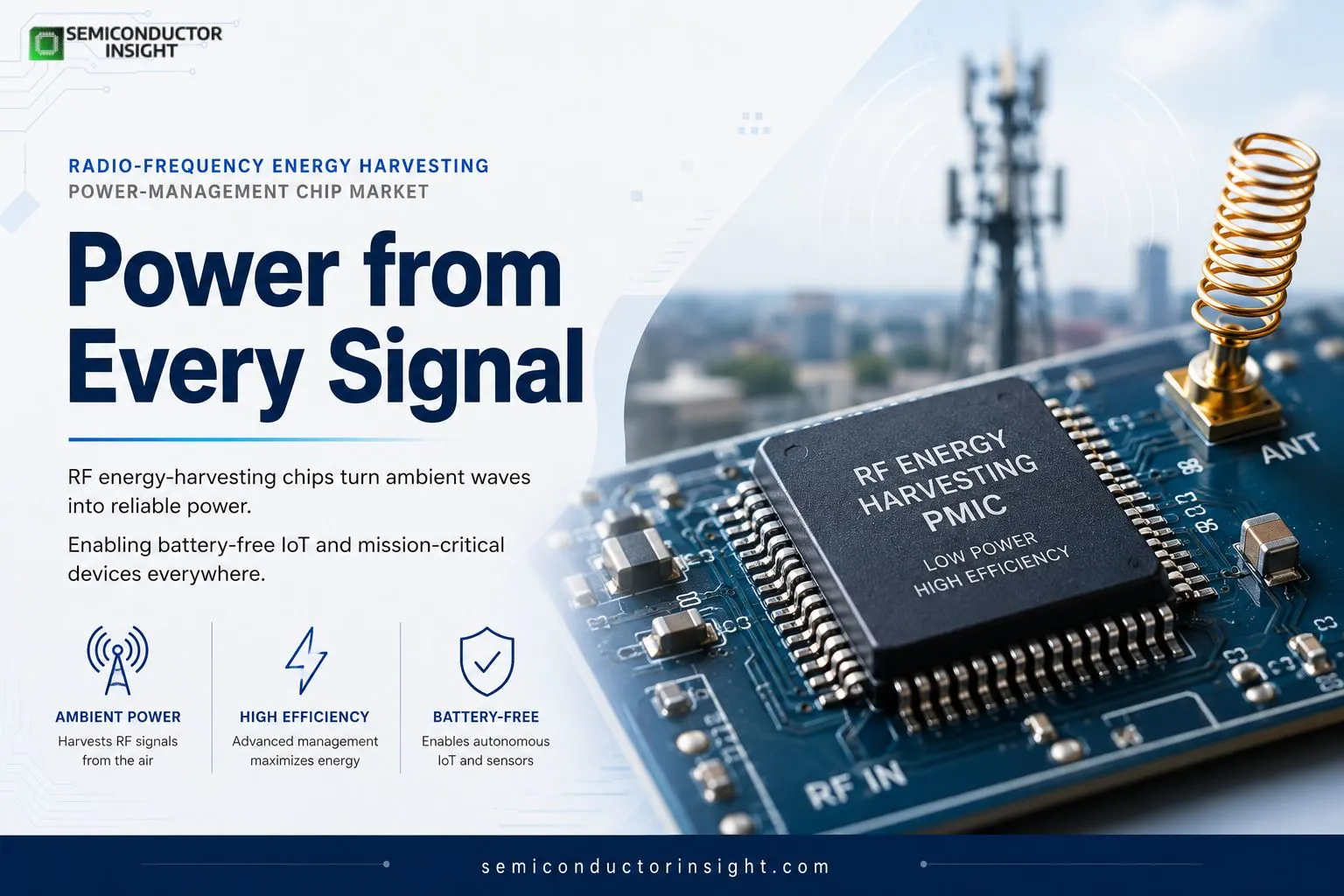
Why Radio Frequency Energy Harvesting Power Management Chip Solutions Are Transforming Wireless Sensors Globally?
The semiconductor landscape continues evolving rapidly as engineers seek sustainable ways to power the exploding number of connected devices without relying solely on batteries.
Radio-frequency energy-harvesting power-management chips stand at the forefront of this shift, converting ambient RF signals from Wi-Fi, cellular networks, and broadcasting towers into usable electricity for low-power electronics. These specialized integrated circuits manage everything from rectification and voltage boosting to efficient storage, enabling battery-free operation in challenging environments.
Understanding the Core Mechanics behind RF Energy Harvesting Chips
- At their heart, these chips integrate sensitive rectifiers that transform incoming electromagnetic waves into direct current.
- Advanced designs incorporate impedance matching networks to maximize power transfer even from weak signals, often operating effectively at input levels as low as -20 dBm or lower in optimized prototypes.
- Power management sections then regulate the output, using techniques like maximum power point tracking (MPPT) to adapt dynamically to fluctuating ambient conditions.
- Fabrication in processes such as 350 nm CMOS has demonstrated cold-start capabilities from voltages around 380 mV, with peak charging efficiencies reaching over 80% in recent laboratory implementations.
- Deployments in the real world are already promising. For example, systems tested close to TV broadcast towers have been able to continually run temperature sensors by harvesting adequate electricity from distances of many kilometres.
- In urban settings, researchers have evaluated harvesting from metro station environments where multiple RF sources overlap, creating richer energy landscapes for always-on sensors.
What Is TETRA Radio Systems?
TETRA, short for Terrestrial Trunked Radio, represents a professional mobile radio standard developed by the European Telecommunications Standards Institute (ETSI). Originally known as Trans-European Trunked Radio, it serves as a digital trunked system optimized for mission-critical communications used by police forces, fire departments, ambulance services, rail operators, and military units worldwide.
Operating typically in bands around 380-400 MHz in many regions, TETRA delivers secure voice and data with features like group calling, encryption, and high reliability in public safety networks. Its infrastructure generates consistent RF emissions that, in proximity, contribute to ambient energy fields potentially tappable by harvesting technologies for supplementary powering of auxiliary low-energy devices in the same ecosystems.
You Can Go Through Our Latest Updated Insights Here: https://semiconductorinsight.com/report/radio-frequency-energy-harvesting-power-management-chip-market/
How RF Harvesting Chips Enable Next-Generation IoT Autonomy?
Internet of Things deployments benefit enormously from these chips. Wireless sensor networks in smart buildings or industrial monitoring can eliminate battery replacement cycles entirely in areas with sufficient RF density. Hybrid approaches combining RF with other ambient sources like vibration or light further enhance reliability. Academic prototypes have powered entire sensor nodes from Wi-Fi signals alone, supporting data transmission at intervals suitable for environmental tracking.
In biomedical contexts, RF energy harvesting power management chips support implantable devices where battery changes pose risks. Research demonstrates integration into systems that could extend operational life for monitors tracking vital signs, reducing invasive procedures.
Enterprise Applications Transforming Industry Performance
- One notable effort involved an integrated RF harvesting system fabricated in AMS 350 nm technology.
- It achieved controlled charging up to 4.5 V with a broad input range, suitable for supercapacitors or rechargeable batteries.
- Testing confirmed continuous operation and adaptability across multiple energy sources beyond just RF.
- Powercast has commercialized reference designs featuring custom chipsets for RF-to-DC conversion, enabling wireless power delivery over distance for industrial sensors.
- Universities have prototyped chips targeting ISM bands like 915 MHz and 2.45 GHz for dual-band operation, achieving measurable power extraction even from modest ambient levels.
Integration Challenges and Semiconductor Advancements Driving Progress
Miniaturization remains key as designers pack rectifiers, converters, and management circuitry onto single dies. Advanced nodes help at higher frequencies, though trade-offs exist between sensitivity and efficiency. Self-compensation techniques in CMOS rectifiers push performance boundaries, with reported peak power conversion efficiencies exceeding 86% in recent designs.
Government initiatives supporting green electronics and wireless infrastructure indirectly boost adoption. Public safety networks, including TETRA deployments across Europe and beyond, create stable RF environments where harvesting could supplement edge devices without compromising primary communications.
Emerging Applications Reshaping Industries
Smart agriculture uses these chips for soil sensors in remote fields near cellular towers. Logistics tracking tags harvest energy during transit from vehicle or warehouse signals. Structural health monitoring on bridges or buildings leverages nearby broadcast infrastructure for perpetual operation.
In consumer electronics, prototypes explore powering wearables or smart home gadgets from household Wi-Fi routers, reducing electronic waste from disposable batteries.
Global Scenarios and Ongoing Developments
Europe leads in TETRA adoption for public safety, with extensive networks in countries like the UK and Germany providing dense RF coverage.
Asia-Pacific sees rapid 5G rollout complementing harvesting opportunities in dense urban areas. North American research focuses on integration with existing broadcast and telecom assets.
International collaborations through standards bodies continue refining protocols for efficient energy transfer. Field trials in London metro areas and suburban assessments highlight varying power densities based on location and time of day.
Future Pathways for RF Energy Harvesting Innovation
Ongoing work targets multi-band and broadband antennas paired with intelligent power management to handle diverse signal environments. Machine learning optimizations for dynamic matching could further improve yields. As 6G and beyond introduce new frequency allocations, compatible chips will unlock even greater potential for sustainable, maintenance-free electronics.
These developments position radio frequency energy harvesting power management chips as a cornerstone for the battery-light future of semiconductors, fostering longer device lifespans and reduced environmental impact across sectors

Comments (0)