MARKET INSIGHTS
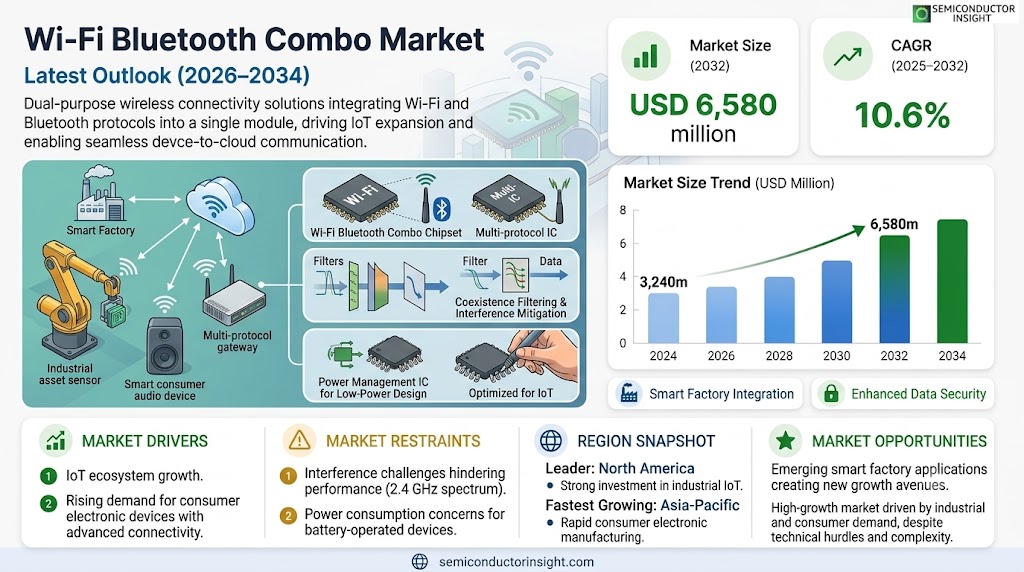
The global Wi-Fi Bluetooth Combo Market size was valued at US$ 3,240 million in 2024 and is projected to reach US$ 6,580 million by 2032, at a CAGR of 10.6% during the forecast period 2025-2032. The U.S. market accounted for 35% of global revenue in 2024, while China is expected to witness the fastest growth, reaching USD 1.2 billion by 2032.
Wi-Fi Bluetooth Combo modules are integrated circuits that combine Wi-Fi and Bluetooth functionalities into a single chipset, enabling seamless wireless communication in various applications. These modules support multiple protocols, including Wi-Fi 6/6E and Bluetooth 5.0/5.1/5.2, enhancing connectivity performance for IoT devices, automotive systems, and smart home appliances. The two primary types are WiFi+BLE Bluetooth Combination Modules and WiFi+Bluetooth+BLE Bluetooth Modules, catering to diverse industry needs.
The market growth is driven by rising demand for IoT-enabled devices, increasing adoption of smart home technologies, and advancements in automotive connectivity. However, challenges like spectrum congestion and security concerns may hinder expansion. Leading players, including Broadcom, NXP Semiconductors, and Infineon Technologies, dominate the market, collectively holding over 50% revenue share in 2024. Recent developments, such as Broadcom’s launch of low-power Wi-Fi 6/Bluetooth 5.2 combos for wearables, underscore the industry’s innovation trajectory.
MARKET DYNAMICS
MARKET DRIVERS
Proliferation of IoT Devices to Accelerate Wi-Fi Bluetooth Combo Market Growth
The global Internet of Things (IoT) ecosystem is expanding at an unprecedented rate, with over 43 billion connected devices projected to be in operation by 2025. This massive adoption is driving demand for dual-connectivity solutions like Wi-Fi Bluetooth combo modules, which enable seamless communication between diverse IoT endpoints. These modules are becoming essential for smart home applications, industrial automation, and wearable technology, as they provide the flexibility of high-bandwidth Wi-Fi alongside the low-power efficiency of Bluetooth. As smart cities and Industry 4.0 initiatives gain traction globally, the need for reliable, interoperable connectivity solutions continues to rise, positioning Wi-Fi Bluetooth combo technology as a critical enabler for next-generation connectivity.
Consumer Demand for Smart Devices Fueling Adoption
The consumer electronics sector is witnessing exponential growth in smart device adoption, with annual shipments surpassing 1.5 billion units globally. Wi-Fi Bluetooth combo modules are increasingly becoming standard in smartphones, tablets, and smart home devices because they offer users the convenience of dual connectivity options. Consumers now expect their devices to support both high-speed internet streaming via Wi-Fi and energy-efficient connections to peripherals through Bluetooth. This trend is particularly evident in the wireless headphone market where Bluetooth is used for audio streaming and Wi-Fi is utilized for firmware updates, creating a strong market pull for integrated solutions.
MARKET RESTRAINTS
Interference Challenges Hindering Optimal Performance
While Wi-Fi Bluetooth combo technology offers numerous advantages, interference remains a significant technical hurdle. Both technologies operate in the crowded 2.4 GHz spectrum, leading to potential signal degradation and reduced performance. In dense urban environments where hundreds of devices may be competing for bandwidth, this interference can result in slower data transfer rates and increased latency. These performance limitations pose particular challenges for time-sensitive applications such as industrial automation and real-time audio streaming, where reliable connectivity is mission-critical.
Other Restraints
Power Consumption Concerns
Despite advancements in low-power designs, managing simultaneous Wi-Fi and Bluetooth connections still poses power consumption challenges, particularly for battery-operated IoT devices. Engineers must carefully balance connectivity requirements with battery life, which can limit functionality in some applications.
Regulatory Compliance
Differing certification requirements across global markets increase time-to-market and compliance costs. Manufacturers must navigate complex radio frequency regulations that vary significantly by region, creating barriers for widespread deployment.
MARKET CHALLENGES
Component Shortages and Supply Chain Disruptions Impacting Production
The semiconductor industry continues to face supply constraints, particularly for advanced connectivity chipsets that power Wi-Fi Bluetooth combo modules. Lead times for certain components have extended beyond 30 weeks in some cases, disrupting production schedules across the industry. These shortages are compounded by geopolitical tensions affecting the global supply chain, making it difficult for manufacturers to meet the growing demand for connectivity solutions.
Other Challenges
Design Complexity
Integrating multiple wireless protocols into a single module increases design complexity, requiring specialized RF engineering expertise. This creates longer development cycles and higher R&D costs for new product introductions.
Compatibility Issues
Ensuring backward compatibility with legacy devices while supporting new wireless standards presents ongoing technical challenges for module developers.
MARKET OPPORTUNITIES
Emerging Smart Factory Applications Creating New Growth Avenues
The rapid digitization of manufacturing processes presents significant opportunities for Wi-Fi Bluetooth combo module providers. Industrial IoT applications in smart factories require robust wireless connectivity for machine monitoring, predictive maintenance, and asset tracking systems. These industrial environments often need both the extended range of Wi-Fi for infrastructure connections and the device-level pairing capabilities of Bluetooth. As manufacturers worldwide invest in digital transformation, the addressable market for industrial-grade combo modules continues to expand.
5G and Wi-Fi Convergence Driving Next-Generation Solutions
The ongoing rollout of 5G networks is creating synergies with Wi-Fi Bluetooth combo technologies, particularly in enterprise and smart city applications. Network operators and infrastructure providers are exploring ways to integrate these wireless technologies to create seamless user experiences. This convergence is particularly promising for applications requiring high-speed connectivity combined with low-power device communication, such as augmented reality systems and connected vehicle ecosystems.
WI-FI BLUETOOTH COMBO MARKET TRENDS
Rapid Expansion in IoT and Smart Devices Driving Market Growth
The widespread adoption of IoT-enabled smart devices is propelling the demand for Wi-Fi Bluetooth Combo modules globally. As manufacturers integrate wireless connectivity into everything from smart home appliances to industrial automation systems, the need for compact, energy-efficient modules that support dual connectivity (Wi-Fi and Bluetooth) has surged. The global market for these modules is expected to grow at a CAGR of over 10% by 2032, with automobile and consumer electronics sectors leading the way. Innovations in low-power wireless standards, such as Bluetooth Low Energy (BLE), are further enhancing the efficiency of these modules, making them ideal for battery-operated devices.
Other Trends
Automotive Industry Adoption
The automotive sector is increasingly leveraging Wi-Fi Bluetooth Combo modules for in-car infotainment, telematics, and vehicle-to-everything (V2X) communication. Features like real-time navigation, wireless charging synchronization, and remote diagnostics are driving the integration of these modules in modern vehicles. With the rise of electric and autonomous vehicles, the demand for reliable wireless connectivity solutions is expected to push automotive applications to account for nearly 25% of market revenue in the next six years.
Growing Preference for Compact and Multi-Functional Modules
The shift toward smaller, high-performance wireless modules is a defining trend in the Wi-Fi Bluetooth Combo market. Manufacturers are focusing on developing compact designs with extended range and interference resistance, catering particularly to wearable technology and smart home ecosystems such as voice assistants and security systems. The increasing use of Bluetooth 5.2 and Wi-Fi 6 technologies is improving data transfer speeds and reducing latency, enabling seamless operation in dense device environments.
COMPETITIVE LANDSCAPE
Key Industry Players
Semiconductor Giants and IoT Innovators Drive Market Expansion
The global Wi-Fi Bluetooth combo market exhibits a dynamic competitive landscape, characterized by established semiconductor leaders and nimble IoT module specialists. Broadcom and NXP Semiconductors currently dominate the market share through their extensive intellectual property portfolios and strategic partnerships with consumer electronics manufacturers. According to recent industry analysis, the top five players collectively held approximately 45% of global revenue share in 2024.
Infineon Technologies has demonstrated remarkable growth through its AI-powered connectivity solutions, particularly in the automotive sector where its combo modules enable advanced telematics. Meanwhile, Espressif Systems continues to disrupt the market with cost-optimized solutions for smart home applications, capturing significant share in emerging economies.
Several notable trends shape the competitive dynamics: First, traditional chipset manufacturers are increasingly collaborating with module makers to deliver turnkey solutions. Second, the demand for dual-mode (Wi-Fi 6/BLE 5.2) products is driving R&D investments across the industry. Third, regional players are gaining traction by offering localized support and customized firmware.
Strategic acquisitions continue to reshape the landscape, with U-blox‘s recent purchase of Thingstream and Laird Connectivity‘s expansion into industrial IoT applications demonstrating the industry’s consolidation trend. These moves allow companies to offer comprehensive connectivity stacks rather than discrete components.
List of Leading Wi-Fi Bluetooth Combo Solution Providers
- Broadcom Inc. (U.S.)
- Infineon Technologies AG (Germany)
- NXP Semiconductors N.V. (Netherlands)
- H&D Wireless AB (Sweden)
- SparkLAN Communications Inc. (Taiwan)
- Laird Connectivity (U.S.)
- U-blox Holding AG (Switzerland)
- Wi2Wi Inc. (U.S.)
- Feasycom (China)
- Fibocom Wireless Inc. (China)
- Espressif Systems (China)
Segment Analysis:
By Type
WiFi+BLE Bluetooth Combination Module Segment Leads Due to Its Versatile Connectivity Applications
The Wi-Fi Bluetooth Combo market is segmented based on type into:
- WiFi+BLE Bluetooth Combination Module
- Subtypes: Single-band, Dual-band, and Tri-band variants
- WiFi+Bluetooth+BLE Bluetooth Module
- Embedded IoT Modules
- System-on-Chip (SoC) Solutions
- Others
By Application
Consumer Electronics Products Segment Dominates with Growing Smart Device Adoption
The market is segmented based on application into:
- Automobile
- Subtypes: Infotainment systems, Telematics, ADAS
- Consumer Electronics Products
- Subtypes: Smartphones, Wearables, Smart Home Devices
- Printer
- Smart Access Control
- Household Appliances
- Others
By Technology
IoT-Enabled Solutions Segment Grows Rapidly with Smart Infrastructure Development
The market is segmented based on technology into:
- Bluetooth 5.0 & Below
- Bluetooth 5.1 & Above
- WiFi 5 (802.11ac)
- WiFi 6 (802.11ax)
- Others
By End User
Industrial Applications Show Significant Growth Potential with Industry 4.0 Adoption
The market is segmented based on end user into:
- Residential
- Commercial
- Industrial
- Healthcare
- Others
Regional Analysis: Wi-Fi Bluetooth Combo Market
Asia-Pacific
The Asia-Pacific region dominates the global Wi-Fi Bluetooth Combo market, accounting for the highest revenue share due to rapid technological adoption and strong manufacturing capabilities. Countries like China, Japan, and South Korea lead in semiconductor innovation, with China alone contributing over 40% of global module production. The demand is primarily driven by consumer electronics proliferation, smart home devices, and government initiatives promoting IoT deployment. However, intense price competition among local players and regulatory complexities create challenges for international vendors. Emerging economies like India and Vietnam are witnessing accelerated growth due to increasing smartphone penetration and digital transformation across industries.
North America
North America represents the second-largest market, characterized by advanced R&D infrastructure and early adoption of next-gen wireless technologies. The U.S. holds approximately 30% of global patent filings for combo chip designs, with companies like Broadcom and Qualcomm leading innovation. Demand stems from enterprise IoT solutions, automotive connectivity, and medical devices requiring reliable dual-mode wireless functionality. While the market is mature, strict FCC certification processes and high-performance requirements create barriers for new entrants. Recent investments in private 5G networks are creating new integration opportunities for Wi-Fi/Bluetooth combo solutions in industrial settings.
Europe
Europe maintains a strong position in the market, with Germany and the UK leading in industrial and automotive applications. The region benefits from standardized ETSI regulations that ensure interoperability while maintaining stringent RF emission standards. Automotive OEMs extensively adopt combo modules for infotainment and telematics systems, with the EU mandating V2X communication capabilities in new vehicles. The healthcare sector also presents growth potential, leveraging combo modules for wireless medical devices. However, complex GDPR compliance for connected devices and high labor costs limit manufacturing expansion in the region.
South America
South America shows moderate growth potential, led by Brazil’s developing electronics manufacturing ecosystem. While infrastructure limitations and economic volatility constrain market expansion, increasing smartphone adoption and government digitalization programs are driving demand. The automotive sector shows particular promise, with Brazilian vehicle production incorporating more connectivity features. Cost sensitivity remains a key challenge, favoring local assemblers over premium international brands. The lack of uniform spectrum allocation policies across countries also complicates regional deployment strategies.
Middle East & Africa
This emerging market demonstrates gradual growth, with the UAE and South Africa serving as regional hubs for smart city deployments. Oil-rich nations are investing heavily in IoT infrastructure, creating niche opportunities for industrial-grade combo modules. However, limited local manufacturing capabilities result in heavy import dependence, while geopolitical instability in some areas disrupts supply chains. The consumer segment is growing steadily through smartphone proliferation, though low disposable incomes in many countries prioritize basic connectivity over advanced combo solutions.
Report Scope
This market research report provides a comprehensive analysis of the global Wi-Fi Bluetooth Combo market, covering the forecast period 2024–2032. It offers detailed insights into market dynamics, technological advancements, competitive landscape, and key trends shaping the industry.
Key focus areas of the report include:
- Market Size & Forecast: Historical data and future projections for revenue, unit shipments, and market value across major regions and segments. The market is projected to grow at a significant CAGR of 10.6% during the forecast period.
- Segmentation Analysis: Detailed breakdown by product type (WiFi+BLE Bluetooth Combination Module, WiFi+Bluetooth+BLE Bluetooth Module) and application (Automobile, Consumer Electronics, Printer, Smart Access Control, Household Appliances, Others) to identify high-growth segments.
- Regional Outlook: Insights into market performance across North America, Europe, Asia-Pacific, Latin America, and the Middle East & Africa, with the U.S. and China being key markets.
- Competitive Landscape: Profiles of leading market participants including Broadcom, Infineon Technologies, NXP Semiconductors, and others, analyzing their market share, product portfolios, and strategic initiatives.
- Technology Trends & Innovation: Assessment of emerging wireless technologies, integration with IoT solutions, and advancements in semiconductor design for combo modules.
- Market Drivers & Restraints: Evaluation of factors such as growing demand for connected devices, while addressing challenges like supply chain constraints and regulatory standards.
- Stakeholder Analysis: Insights for component suppliers, OEMs, system integrators, and investors regarding market opportunities and strategic positioning.
Primary and secondary research methods are employed, including interviews with industry experts and data from verified sources to ensure the accuracy and reliability of the insights presented.
FREQUENTLY ASKED QUESTIONS:
What is the current market size of Global Wi-Fi Bluetooth Combo Market?
-> Wi-Fi Bluetooth Combo Market size was valued at US$ 3,240 million in 2024 and is projected to reach US$ 6,580 million by 2032, at a CAGR of 10.6% during the forecast period 2025-2032.
Which key companies operate in Global Wi-Fi Bluetooth Combo Market?
-> Key players include Broadcom, Infineon Technologies, NXP Semiconductors, H&D Wireless, SparkLAN, Laird Connectivity, U-blox, Celsius Network, Wi2Wi, Feasycom, among others.
What are the key growth drivers?
-> Key growth drivers include increasing adoption of IoT devices, demand for wireless connectivity solutions in consumer electronics and automotive sectors, and advancements in wireless communication technologies.
Which region dominates the market?
-> Asia-Pacific is the fastest-growing market, driven by expanding electronics manufacturing, while North America remains a technologically advanced region with significant market share.
What are the emerging trends?
-> Emerging trends include development of low-power consumption modules, integration with AI-powered devices, and miniaturization of combo chips for wearable applications.

Get Sample Report PDF for Exclusive Insights
Report Sample Includes
- Table of Contents
- List of Tables & Figures
- Charts, Research Methodology, and more...
 Download Sample Report PDF