Radio frequency energy harvesting power management chip Market Insights
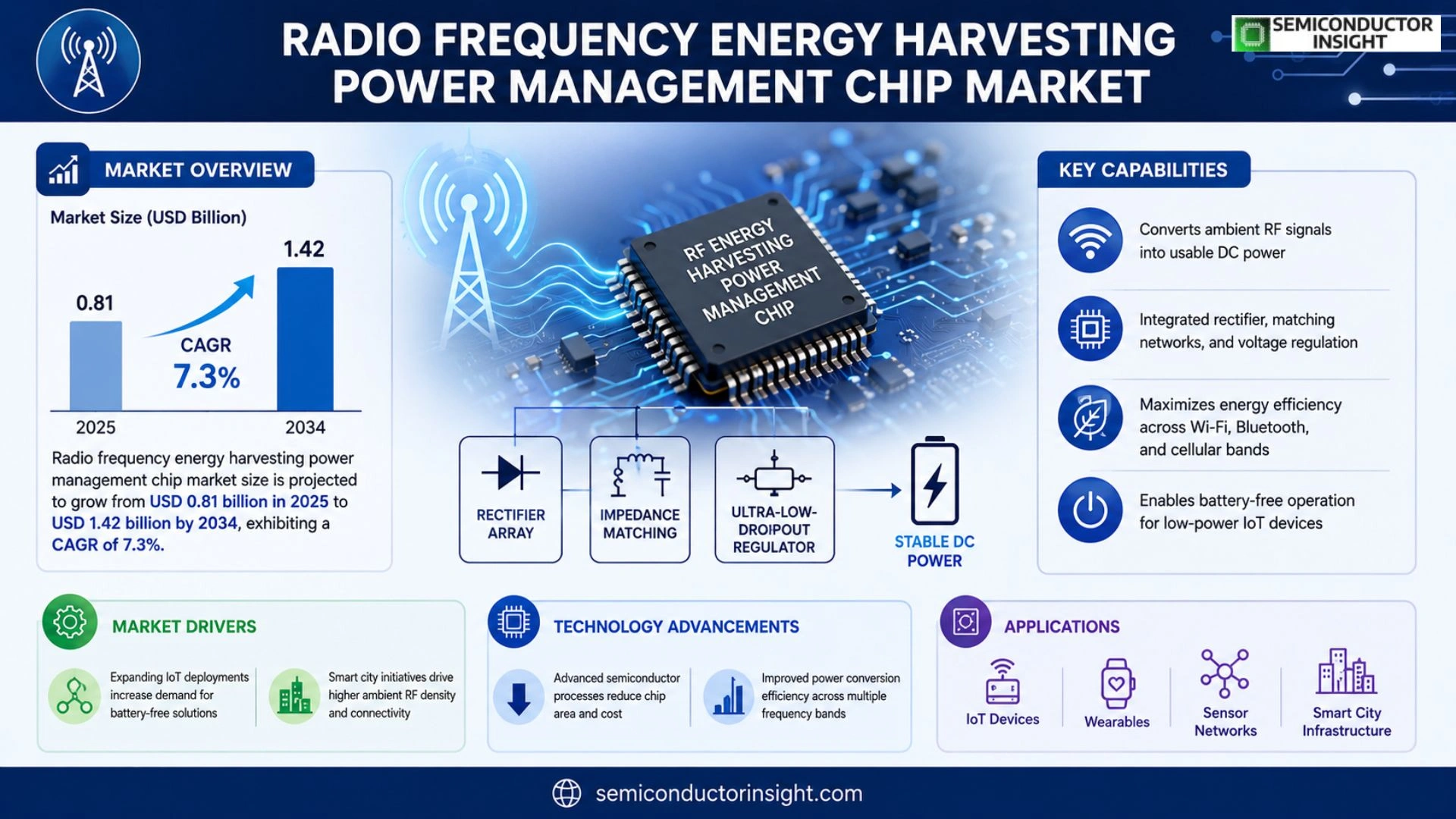
Global Radio frequency energy harvesting power management chip market size is projected to grow from USD 0.81 billion in 2025 to USD 1.42 billion by 2034, exhibiting a CAGR of 7.3% during the forecast period.
Radio frequency energy harvesting power management chips convert ambient RF signals into usable DC power and regulate voltage for low‑power IoT devices, wearables, and sensor networks. These integrated circuits combine rectifier arrays, impedance matching networks, and ultra‑low‑dropout regulators to maximize harvested energy efficiency across frequencies such as Wi‑Fi, Bluetooth, and cellular bands.
The market is accelerating because expanding IoT deployments demand battery‑free solutions, while smart‑city projects increase ambient RF density. Furthermore, advancements in semiconductor processes have reduced chip area and cost.
MARKET DRIVERS
Growing IoT Device Adoption
Radio frequency energy harvesting power management chip Market is being propelled by the rapid expansion of IoT devices, many of which operate in remote or hard‑to‑reach locations. Manufacturers are seeking self‑sustaining solutions that eliminate the need for battery replacement, and RF energy harvesting offers a viable path to achieve long‑term autonomy.
Advancements in Semiconductor Technologies
Recent breakthroughs in CMOS processes have reduced chip footprints while increasing conversion efficiency to above 60 %. These technological improvements enable integration of harvesting functions directly into system‑on‑chip (SoC) designs, lowering overall BOM costs.
➤ Industry analysts project a compound annual growth rate of roughly 12 % for the sector through 2032, driven by demand for sustainable power solutions.
Combined, these drivers create a compelling value proposition for OEMs, positioning the RF harvesting power management segment as a cornerstone of the next‑generation low‑power ecosystem.
MARKET CHALLENGES
Regulatory and Spectrum Constraints
Harvesting RF energy across multiple frequency bands must comply with national spectrum regulations, which can limit the amount of usable power in densely populated regions. Navigating these compliance hurdles adds complexity to product certification.
Other Challenges
Technology Integration
Designers often face difficulties integrating RF harvesting modules with existing power management architectures, requiring custom layout and careful impedance matching to maintain efficiency.
MARKET RESTRAINTS
High Initial Development Costs
Developing a robust RF harvesting solution involves specialized RF design expertise and costly prototype iterations, which can deter smaller startups from entering the market.
In addition, the need for extensive electromagnetic simulation tools inflates R&D expenditure, limiting rapid scalability.
Furthermore, the fragmented supply chain,spanning antenna manufacturers, semiconductor fabs, and system integrators,creates coordination challenges that can delay time‑to‑market.
MARKET OPPORTUNITIES
Emerging Smart City Infrastructure
Smart city deployments require thousands of low‑power sensors for traffic monitoring, environmental sensing, and public safety. RF energy harvesting power management chips can eliminate battery maintenance, offering a cost‑effective scaling path.
Similarly, wearable health monitors and implantable medical devices are seeking long‑lasting, wireless power sources, presenting a fast‑growing niche for the market.
Investment from venture capital and strategic partnerships between semiconductor firms and IoT platform providers are accelerating innovation pipelines, opening new revenue streams for early adopters.
Radio frequency energy harvesting power management chip Market Trends
Growing Adoption of Battery‑Free IoT Devices
Radio frequency energy harvesting power management chip Market is being propelled by the escalating deployment of low‑power Internet of Things (IoT) devices that demand battery‑free operation. Urban density and industrial sites now generate consistently higher ambient RF energy from Wi‑Fi routers, Bluetooth beacons, and cellular base stations, allowing modern harvesting PMICs to deliver continuous micro‑watt power levels sufficient for sensor nodes, wearable health monitors, and smart tags. This shift not only extends device lifespans to several years but also aligns with corporate sustainability targets by eliminating hazardous battery waste. Consequently, system architects are redesigning product roadmaps to embed RF harvesting chips at the silicon level, achieving seamless voltage regulation and impedance matching across multiple frequency bands, and unlocking new use cases such as remote structural health monitoring and autonomous inventory tracking.
Other Trends
Miniaturization and Cost Reduction
Recent semiconductor innovations have driven the size of RF energy harvesting power management chips below 1 mm², enabling integration onto flexible printed circuit boards and multi‑chip modules. The adoption of advanced CMOS nodes reduces the gate‑oxide thickness, which in turn lowers on‑resistance and improves rectifier efficiency to above 70 % across the 900 MHz to 2.4 GHz spectrum. Manufacturing economies of scale now bring unit costs under $0.30 for high‑volume batches, a price point competitive with traditional coin‑cell batteries in large deployments. The reduced footprint also facilitates stacked architectures where the harvester, ultra‑low‑dropout regulator, and energy storage capacitor occupy a single package, simplifying board layout and improving reliability for harsh environment applications.
Strategic Partnerships and Ecosystem Expansion
Industry leaders such as Texas Instruments, STMicroelectronics, Analog Devices, and NXP Semiconductors are accelerating market penetration through strategic collaborations and joint development programs. A notable example is the partnership announced in April 2024 between STMicroelectronics and Bosch, which produced an integrated RF harvester module tailored for industrial sensor networks, featuring built‑in impedance‑matching networks and adaptive regulation algorithms. These alliances also generate comprehensive design‑in kits, reference firmware, and validation laboratories that lower the entry barrier for emerging start‑ups. By fostering a robust ecosystem of silicon, software, and certification services, the market is witnessing faster time‑to‑market cycles and broader adoption across sectors including smart cities, logistics, healthcare, and agricultural monitoring.
COMPETITIVE LANDSCAPE
Key Industry Players
Radio frequency energy harvesting power management chip Market Overview
The market is anchored by a handful of large semiconductor firms that offer end‑to‑end RF harvesting solutions integrated with ultra‑low‑dropout regulators. Texas Instruments leads with its highly scalable PMIC family, leveraging a broad analog portfolio and deep IoT channel relationships. STMicroelectronics follows closely, differentiating through co‑development agreements such as its recent partnership with Bosch to deliver industrial‑grade RF harvester modules. Analog Devices and NXP Semiconductors round out the core quartet, each introducing next‑generation rectifier‑matched architectures that target wearable and sensor‑network applications. This concentration of resources enables rapid technology cycles, aggressive pricing, and extensive design‑win programs that shape the overall market structure.
Beyond the core, a diverse set of niche and emerging players expands the competitive envelope by focusing on specialized frequency bands, ultra‑compact form factors, or proprietary matching networks. Companies such as Qorvo and Skyworks contribute advanced RF front‑end modules that complement power‑management ICs, while AMS, Renesas, and Infineon address high‑precision voltage regulation for automotive‑grade harvesters. Silicon Labs, Power Integrations, and Murata bring miniaturized solutions for wearable devices, and startups like Powercast and Vishay are pushing innovation in ambient RF‑to‑DC conversion efficiency. This layered ecosystem fosters differentiation through application‑specific performance, enabling a robust pipeline of targeted products for the expanding IoT landscape.
List of Key Radio Frequency Energy Harvesting Power Management Chip Companies Profiled
- Texas Instruments
- STMicroelectronics
- Analog Devices
- NXP Semiconductors
- Qorvo
- Skyworks Solutions
- AMS AG
- Renesas Electronics
- Infineon Technologies
- Silicon Labs
- Power Integrations
- Murata Manufacturing
- Powercast Corporation
- Vishay Intertechnology
Segment Analysis:
| Segment Category | Sub-Segments | Key Insights |
| By Type |
|
Regulator Integrated Chips
|
| By Application |
|
IoT Sensors
|
| By End User |
|
Industrial IoT
|
| By Frequency Band |
|
UHF/Microwave Harvesters
|
| By Integration Approach |
|
System‑on‑Chip (SoC) Solutions
|
Regional Analysis: North America
The industrial sector is witnessing a surge in the deployment of wireless sensors and actuators, creating a substantial need for reliable and low-power energy harvesting solutions for Radio frequency energy harvesting power management chips. This trend is propelled by the pursuit of predictive maintenance and enhanced operational efficiency.
The burgeoning wearable device market, encompassing smartwatches, fitness trackers, and medical monitoring devices, is a key driver for demand. The need for extended battery life and the development of self-powered wearable solutions are creating significant opportunities for specialized power management chips.
Urban development projects focused on smart infrastructure, including intelligent street lighting, environmental monitoring systems, and smart parking solutions, are contributing to the growth of this market. The integration of wireless sensors and devices in these applications necessitates efficient energy harvesting and management.
The healthcare industry is increasingly adopting wireless medical devices for remote patient monitoring and diagnostics. These devices often require continuous power, making Radio frequency energy harvesting power management chips a crucial component for extended operational periods and reduced maintenance.
Europe
Europe presents a strong and steadily growing market for Radio frequency energy harvesting power management chips. The region’s strong emphasis on sustainability, coupled with significant investments in IoT and smart infrastructure, is driving demand. Stringent European Union regulations concerning energy efficiency further encourage the adoption of low-power technologies. The automotive sector in Europe, with its increasing focus on connected and autonomous vehicles, also contributes to this market’s growth. The demand for these chips is particularly evident in industrial automation, smart grid applications, and wearable technology segments. The region benefits from a well-developed technological infrastructure and a robust ecosystem of research institutions and industry partners.
Asia-Pacific
Asia-Pacific is anticipated to be the fastest-growing regional market for Radio frequency energy harvesting power management chips. This growth is primarily fueled by rapid industrialization and the expanding IoT landscape in countries like China, Japan, and South Korea. The increasing adoption of smart manufacturing practices and the proliferation of connected devices across various industries are key drivers. Government initiatives promoting digital transformation and the development of smart cities are further boosting market demand. The region’s cost-competitive manufacturing base also contributes to its attractiveness for chip production and deployment. The burgeoning consumer electronics market in Asia-Pacific also presents significant opportunities for these power management solutions.
South America
South America exhibits a moderate growth potential for Radio frequency energy harvesting power management chip Market. The increasing adoption of IoT in agriculture, logistics, and infrastructure development is creating some demand. However, the market is still relatively nascent compared to North America and Europe. Investments in smart grid technologies and the growing adoption of connected devices in urban areas are expected to drive future growth. Economic uncertainties in some countries within the region pose a challenge to market expansion. The focus on improving energy efficiency and reducing operational costs may further stimulate demand in the coming years.
Middle East & Africa
The Middle East & Africa represent an emerging market for Radio frequency energy harvesting power management chips. The rapid urbanization and infrastructure development in several countries within the region are fueling the adoption of IoT technologies. Investments in smart city projects, particularly in areas like transportation and utilities, are creating demand for these specialized power solutions. The growing adoption of industrial automation and the increasing focus on renewable energy sources are also contributing to market growth. However, the market is currently limited by factors such as infrastructure constraints and economic volatility in some parts of the region. Long-term prospects remain positive as the region continues its journey of modernization and digital transformation.
Report Scope
This market research report provides a comprehensive analysis of the Radio frequency energy harvesting power management chip Market , covering the forecast period 2026–2034. It offers detailed insights into market dynamics, technological advancements, competitive landscape, and key trends shaping the industry.
Key focus areas of the report include:
- Market Overview: The report begins with an overview outlining its current market scenario, key growth indicators, and industry transformation drivers. It discusses macroeconomic factors, demand–supply balance, regulatory landscape, and the strategic role of semiconductors in powering advancements across industries such as automotive, telecommunications, consumer electronics, and industrial automation.
- Market Size & Forecast: Historical data and future projections for revenue, unit shipments, and market value across major regions and segments.
- Segmentation Analysis: Detailed breakdown by product type, technology, application, and end-user industry to identify high-growth segments and investment opportunities.
- Regional Insights: Insights into market performance across North America, Europe, Asia-Pacific, Latin America, and the Middle East & Africa, including country-level analysis where relevant.
- Competitive Landscape: Profiles of leading market participants, including their product offerings, R&D focus, manufacturing capacity, pricing strategies, and recent developments such as mergers, acquisitions, and partnerships.
- Technology Trends & Innovation: Assessment of emerging technologies, integration of AI/IoT, semiconductor design trends, fabrication techniques, and evolving industry standards.
- Market Drivers & Restraints: Evaluation of factors driving market growth along with challenges, supply chain constraints, regulatory issues, and market-entry barriers.
- Stakeholder Insights: Insights for component suppliers, OEMs, system integrators, investors, and policymakers regarding the evolving ecosystem and strategic opportunities.
Primary and secondary research methods are employed, including interviews with industry experts, data from verified sources, and real-time market intelligence to ensure the accuracy and reliability of the insights presented.
FREQUENTLY ASKED QUESTIONS:
What is the current market size of Radio frequency energy harvesting power management chip Market?
-> Global radio frequency energy harvesting power management chip Market was valued at USD 0.78 billion in 2025 and is expected to reach USD 1.42 billion by 2034 with a CAGR of 7.3 %.
Which key companies operate in Radio frequency energy harvesting power management chip Market?
-> Key players include Texas Instruments, STMicroelectronics, Analog Devices, and NXP Semiconductors, among others.
What are the key growth drivers?
-> Key growth drivers include expanding IoT deployments demanding battery‑free solutions, smart‑city projects increasing ambient RF density, and advancements in semiconductor processes that reduce chip area and cost.
Which region dominates the market?
-> The reference does not specify a single dominant region; however, market activity is strong across North America, Europe, and Asia‑Pacific.
What are the emerging trends?
-> Emerging trends include multi‑band RF harvesters, integration of ultra‑low‑dropout regulators, and the use of these chips in low‑power IoT devices, wearables, and smart‑city sensor networks.

Get Sample Report PDF for Exclusive Insights
Report Sample Includes
- Table of Contents
- List of Tables & Figures
- Charts, Research Methodology, and more...
 Download Sample Report PDF