
Smart Sensing Chemistry behind the Rise of Office Desk Occupancy Sensor Market
Modern workplaces are no longer designed only around furniture and floor plans. They are built around data, energy efficiency, and adaptive infrastructure. At the centre of this transformation is the Office Desk Occupancy Sensor Market a space where chemistry, semiconductor engineering, and workplace analytics intersect.
Occupancy sensors embedded beneath desks or integrated into smart office systems detect presence through pressure, infrared radiation, ultrasonic waves, or radar-based sensing. While these devices appear compact and minimal, their performance is deeply rooted in advanced semiconductor materials, microelectronic fabrication, and chemical coatings that enhance durability and precision.
Material Science Foundations of Smart Occupancy Detection
Every desk sensor relies on a sensing element, and that element is shaped by specialized material chemistry. Passive infrared sensors typically use pyroelectric materials such as doped lithium tantalate or triglycine sulfate crystals. These materials generate electrical signals when exposed to minute temperature changes caused by human presence.
Ultrasonic and radar-based desk sensors depend on piezoelectric ceramics and silicon-based transducers. These materials convert mechanical energy into electrical signals and vice versa. The efficiency of this conversion depends heavily on crystalline alignment and impurity control during fabrication a process governed by advanced chemical deposition techniques.
Capacitive desk sensors, another growing category, utilize conductive polymers and Nano composite layers. When a person sits at a desk, the dielectric constant changes slightly. Semiconductor-grade silicon circuitry detects this shift with remarkable sensitivity.
Without precision-controlled material chemistry, these micro-variations would remain undetectable.
Semiconductor Architecture Enabling Miniaturization
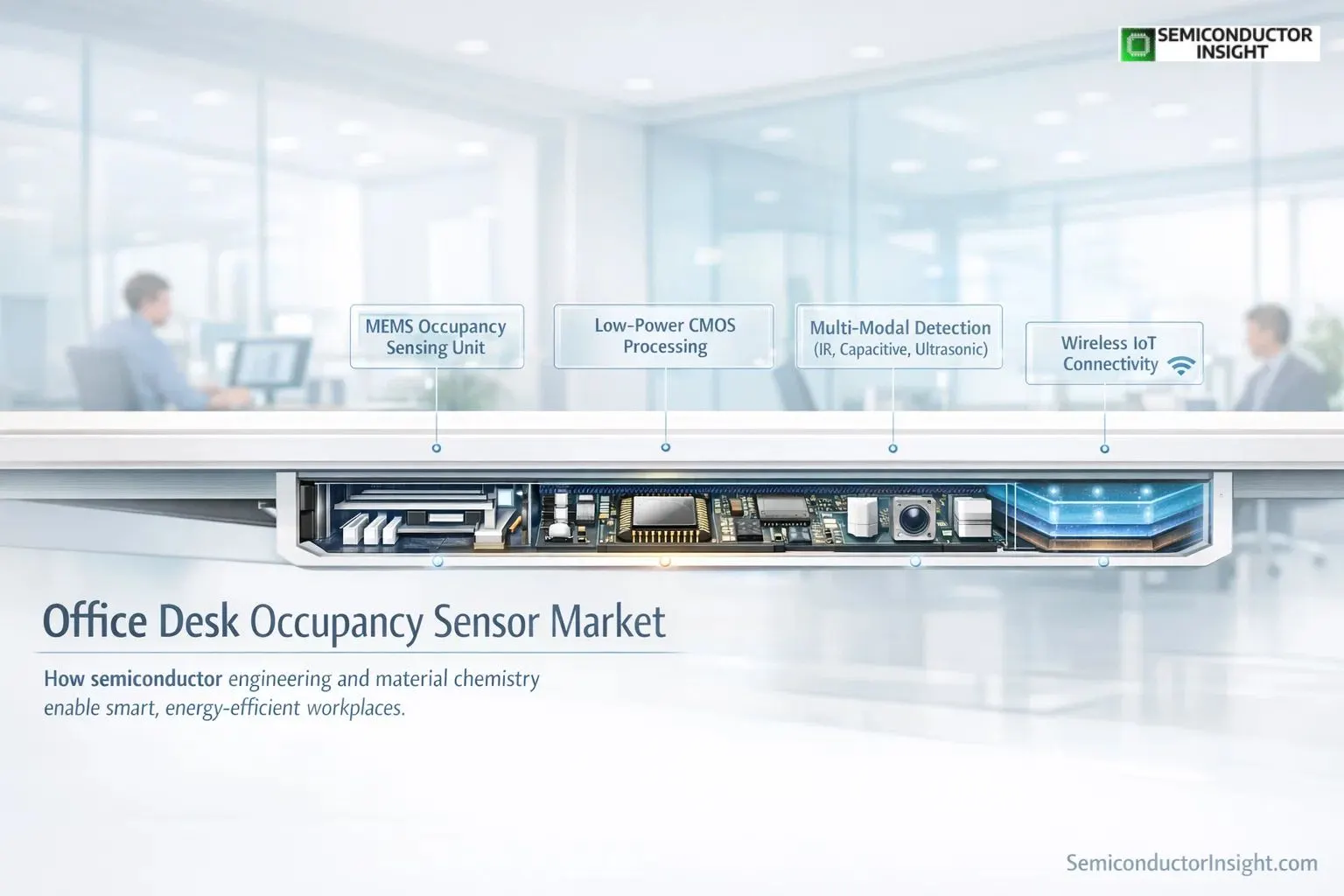
Desk occupancy sensors today are smaller, thinner, and more power-efficient than earlier building automation devices. This miniaturization is possible due to CMOS fabrication, system-on-chip integration, and low-power microcontrollers.
Most modern desk sensors integrate:
- A micro-electromechanical system (MEMS) sensing unit
- A signal conditioning amplifier
- An analog-to-digital converter
- Wireless communication modules such as BLE or Zigbee
MEMS technology, built using silicon wafer etching and thin-film deposition, allows mechanical sensing structures to be integrated directly onto semiconductor substrates. These devices are chemically etched using plasma-based processes that define micro-scale cavities and membranes.
The result is higher sensitivity with lower energy consumption critical for battery-operated desk installations.
To find out more, feel free to browse our latest updated report: https://semiconductorinsight.com/report/office-desk-occupancy-sensor-market/
Chemical Coatings and Environmental Stability
Office environments may appear stable, but sensors face constant exposure to dust, humidity variation, cleaning chemicals, and electrostatic discharge. To ensure longevity, manufacturers apply protective chemical coatings.
Common treatments include:
- Conformal polymer coatings for moisture resistance
- Hydrophobic nano-layer films to reduce particulate adhesion
- Anti-corrosion coatings on copper traces
- Flame-retardant encapsulation materials
These chemical enhancements increase operational life cycles and reduce calibration drift. Stability is particularly important in high-density commercial offices where thousands of desks may be monitored simultaneously.
Integration with Smart Building Ecosystems
Desk occupancy sensors do not function in isolation. They connect to centralized building management systems and workplace analytics platforms. Integration enables automated HVAC sensors adjustments, lighting optimization, and space utilization analysis.
For example, if desk occupancy falls below a threshold in a particular zone, the building management system can reduce airflow or lighting intensity, improving overall energy efficiency. Semiconductor-based wireless chips enable real-time data transmission with minimal latency.
Cloud integration and IoT protocols further enhance system intelligence. With embedded firmware updates and AI-assisted occupancy modeling, modern sensors evolve continuously.
Latest Industry Instances and Practical Applications
Several global technology companies are deploying advanced desk-level sensing systems in hybrid office models. Post-pandemic workplace restructuring has accelerated the adoption of hot-desking strategies, requiring real-time occupancy visibility.
In corporate campuses across North America and Europe, desk occupancy sensors are now linked with employee booking applications. Employees reserve desks through mobile platforms, and sensors confirm actual usage. If a desk remains unoccupied despite booking, it is automatically released back into the system.
In Asia-Pacific technology parks, pressure-based semiconductor sensors are integrated into ergonomic smart desks. These desks adjust height based on occupancy detection and user preference profiles.
These implementations demonstrate how chemical materials, semiconductor integration, and software intelligence converge into practical workplace optimization.
Sustainability Chemistry in Sensor Manufacturing
As global sustainability regulations tighten, manufacturers are re-evaluating the chemical composition of sensor components. Lead-free soldering materials, halogen-free flame retardants, and recyclable polymer housings are increasingly adopted.
Semiconductor fabrication facilities are also optimizing water usage and chemical waste management during wafer processing. Plasma etching gases and deposition chemicals are now monitored under stricter environmental compliance standards.
The push toward greener electronics manufacturing is shaping procurement strategies in commercial real estate projects that prioritize low-carbon infrastructure.
Data Accuracy and Calibration Chemistry
Sensor accuracy is influenced by environmental variables such as ambient temperature fluctuations, electromagnetic interference, and material fatigue. To counteract these factors, calibration algorithms are embedded within the semiconductor firmware.
Temperature compensation circuits adjust readings using integrated thermistors. Some advanced occupancy systems even combine multiple sensing modalities infrared plus capacitive detection to eliminate false positives.
This multi-sensor fusion approach enhances reliability in dynamic office settings.

Comments (0)