Market Insights
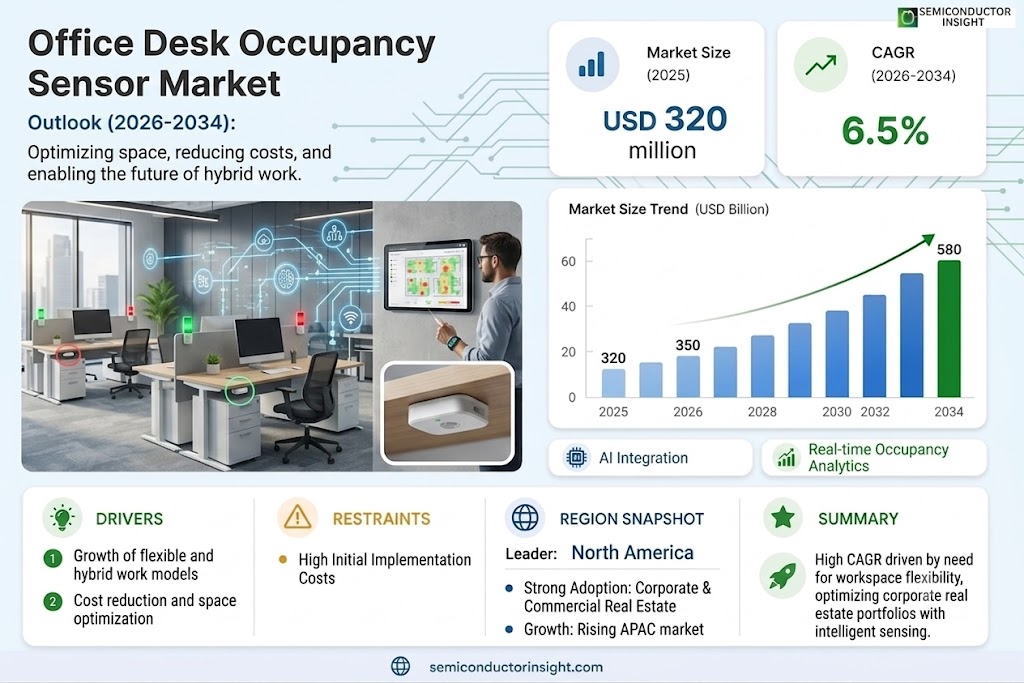
Global Office Desk Occupancy Sensor Market size was valued at USD 320 million in 2025. The market is projected to grow from USD 350 million in 2026 to USD 580 million by 2034, exhibiting a CAGR of 6.5% during the forecast period.
Office desk occupancy sensors are smart devices designed to detect and monitor workspace utilization in real time. These sensors utilize technologies such as infrared, ultrasonic, and microwave to determine whether a desk is occupied or vacant. They play a crucial role in optimizing office space management, energy efficiency, and workplace analytics by providing data on employee presence and movement patterns.
The market is experiencing steady growth due to increasing adoption of smart office solutions, rising demand for energy-efficient buildings, and the shift toward hybrid work models. Furthermore, advancements in IoT integration and cloud-based analytics are enhancing the functionality of these sensors. Key players such as Disruptive Technologies (DT), Pressac Communications, and Milesight are driving innovation with wireless and AI-powered occupancy detection solutions.
MARKET DRIVERS
Increasing Demand for Smart Office Solutions
Office Desk Occupancy Sensor Market is experiencing significant growth due to the rising adoption of smart office technologies. Businesses are investing in occupancy sensors to optimize space utilization and reduce operational costs. With hybrid work models becoming standard, companies need real-time desk availability data.
Energy Efficiency Regulations
Stringent government regulations on energy conservation are driving demand for desk occupancy sensors. These devices help organizations comply with green building standards by automatically adjusting lighting and HVAC systems based on occupancy, reducing energy waste by up to 30% in office environments.
Technological advancements in IoT and AI-powered sensors are further accelerating market adoption, enabling more accurate and predictive occupancy tracking.
MARKET CHALLENGES
High Initial Implementation Costs
While Office Desk Occupancy Sensor systems offer long-term savings, the upfront costs of installation and integration with existing building management systems can be prohibitive for small and medium enterprises. This remains a significant barrier to widespread adoption across all market segments.
Other Challenges
Data Privacy Concerns
Some organizations hesitate to implement desk sensors due to employee privacy concerns regarding movement tracking. Finding the right balance between space optimization and privacy protection remains a key challenge.
MARKET RESTRAINTS
Limited Technical Expertise
Office Desk Occupancy Sensor Market faces growth limitations due to the shortage of skilled professionals who can properly install and maintain these systems. Many facility managers lack the technical knowledge to fully leverage sensor data for space optimization.
MARKET OPPORTUNITIES
Integration with Workplace Management Software
There is significant potential for Office Desk Occupancy Sensor providers to develop solutions that seamlessly integrate with popular workplace management platforms. This would enable more comprehensive space utilization analytics and predictive scheduling capabilities.
Rise of Flexible Workspaces
The growing popularity of coworking spaces and hot-desking arrangements presents new opportunities for sensor manufacturers. These environments require advanced occupancy tracking solutions to manage shared resources efficiently.
Office Desk Occupancy Sensor Market Trends
Integration of Advanced Sensor Technologies
Office Desk Occupancy Sensor Market is witnessing significant adoption of multiple detection technologies. Infrared sensors dominate due to their cost-effectiveness, while ultrasonic and microwave sensors are gaining traction for their precision in varied office environments. Hybrid systems combining radar and infrared capabilities are emerging to improve accuracy in dynamic workspace settings.
Other Trends
Growing Demand from SMEs
Small and medium enterprises are increasingly deploying desk occupancy sensors to optimize real estate costs. The ability to monitor workspace utilization in real-time helps these businesses make data-driven decisions about office layouts and hybrid work policies. Cloud-based sensor analytics platforms are making this technology more accessible to smaller organizations.
Regional Market Developments
North America leads in Office Desk Occupancy Sensor adoption, driven by high-tech office infrastructure and corporate sustainability initiatives. Asia-Pacific shows the fastest growth, with China and Japan investing heavily in smart office technologies. European markets emphasize privacy-compliant solutions that align with GDPR regulations.
Competitive Landscape Evolution
Major players like Disruptive Technologies and Pressac Communications are focusing on developing wireless, battery-powered sensors with extended lifespans. Strategic partnerships between sensor manufacturers and workplace management software providers are creating integrated solutions for comprehensive space utilization analytics.
Regulatory and Sustainability Factors
Corporate net-zero commitments are accelerating Office Desk Occupancy Sensor deployments as part of energy efficiency programs. Emerging standards for data privacy in workplace monitoring are shaping product development, with manufacturers incorporating features like anonymized data collection and user opt-out capabilities.
COMPETITIVE LANDSCAPE
Key Industry Players
Strategic Positioning of Leading Desk Sensor Providers in Smart Office Adoption
Global Office Desk Occupancy Sensor Market is characterized by the dominance of European and North American technology firms, with Disruptive Technologies (DT) and Linepro maintaining leadership through innovative IoT solutions. These market leaders collectively held approximately 35% revenue share in 2025, leveraging advanced infrared and ultrasonic sensor technologies for workplace analytics. The competitive landscape shows vertical specialization with Pressac Communications focusing on building management system integrations while Milesight excels in wireless mesh network deployments.
Emerging players like iotspot and Coworkr are gaining traction through AI-powered occupancy analytics, particularly in the SME segment across Asia-Pacific markets. Niche specialists such as Sensiable offer hybrid sensor solutions combining microwave and infrared technologies for high-accuracy applications. The market sees increasing competition from building automation heavyweights expanding into desk-level monitoring, though pure-play sensor manufacturers maintain technological advantages in form factor and power efficiency.
List of Key Office Desk Occupancy Sensor Companies Profiled
- Linepro
- Disruptive Technologies (DT)
- Pressac Communications
- Milesight
- Disruptive Technologies Sensors
- Sensiable
- Alliot Technologies
- Coworkr
- iotspot
- Freespace
- Wevolver
- Premier Wireless
- Ahoy Systems
- TableAir
Segment Analysis:
| Segment Category | Sub-Segments | Key Insights |
| By Type |
|
Infrared Sensors dominate due to their cost-effectiveness and reliability in detecting human presence.
|
| By Application |
|
Large Enterprises lead adoption due to complex space management needs.
|
| By End User |
|
Corporate Offices represent the key adoption sector.
|
| By Installation Type |
|
Under-Desk Mounted solutions are most prevalent.
|
| By Connectivity |
|
Wireless Connectivity shows strongest growth potential.
|
Regional Analysis: North America Office Desk Occupancy Sensor Market
North America
U.S. corporations lead in deploying desk sensors with AI capabilities for space utilization analytics. Canadian firms show rapid adoption in government buildings following new green building mandates. Integrated platforms combining IoT sensors with workplace apps see highest penetration in tech sector offices.
Energy conservation policies like CALGreen in California mandate occupancy-based lighting controls. Corporate cost-cutting measures prioritize efficient space utilization through sensor data. The growing focus on employee experience metrics fuels demand for occupancy-aware workplace technologies.
Machine learning algorithms analyze occupancy patterns to optimize cleaning schedules and HVAC operations. Advanced sensors now incorporate thermal imaging and people counting for more accurate desk availability data. Startups are developing predictive models to forecast space requirements.
Established players focus on enterprise-grade solutions with cloud analytics, while startups target SMBs with affordable retrofit options. Strategic partnerships between sensor manufacturers and property tech firms are reshaping product offerings for the North American smart office market.
Europe
Europe represents the second largest market for office desk occupancy sensors, driven by strong regulatory frameworks like the EU Energy Performance of Buildings Directive. Countries like Germany and the UK lead in adoption, with particular emphasis on integrating sensors into existing building automation systems. The market sees growing interest from co-working space operators seeking dynamic space management solutions. Privacy concerns around employee monitoring present unique challenges for implementation in certain European jurisdictions.
Asia-Pacific
The APAC region shows fastest growth potential for desk occupancy sensors, with smart city initiatives in Singapore and China driving adoption. Japanese corporations pioneer innovative applications in activity-based working environments. Emerging markets face price sensitivity challenges, leading to demand for cost-effective sensor solutions. Regional manufacturers are developing customized products for high-density office layouts common in urban centers.
Middle East & Africa
Gulf Cooperation Council countries lead regional adoption through smart building projects in Dubai and Riyadh. Energy efficiency targets in commercial real estate fuel demand for occupancy monitoring solutions. The market remains concentrated in premium office spaces, with gradual expansion into mid-tier properties. Africa shows growing potential in financial and tech hubs like Johannesburg and Lagos.
Latin America
The Latin American market shows steady growth concentrated in Brazil and Mexico’s major business districts. Multinational corporations drive initial adoption, with local firms gradually implementing sensor technologies. Economic volatility impacts large-scale deployments, favoring phased implementations. Regional players focus on solutions addressing tropical climate challenges in sensor performance.
Report Scope
This market research report provides a comprehensive analysis of the Office Desk Occupancy Sensor Market, covering the forecast period 2025–2034. It offers detailed insights into market dynamics, technological advancements, competitive landscape, and key trends shaping the industry.
Key focus areas of the report include:
- Market Overview: The report begins with an overview outlining its current market scenario, key growth indicators, and industry transformation drivers. It discusses macroeconomic factors, demand–supply balance, regulatory landscape, and the strategic role of occupancy sensors in optimizing workspace utilization across industries.
- Market Size & Forecast: Historical data and future projections for revenue, unit shipments, and market value across major regions and segments.
- Segmentation Analysis: Detailed breakdown by product type (Infrared, Ultrasonic, Microwave), application (Large Enterprises, SMEs), and end-user industry to identify high-growth segments.
- Regional Insights: Insights into market performance across North America, Europe, Asia-Pacific, Latin America, and the Middle East & Africa, including country-level analysis.
- Competitive Landscape: Profiles of leading market participants, including their product offerings, R&D focus, and recent developments.
- Technology Trends & Innovation: Assessment of sensor technologies and emerging integration capabilities.
- Market Drivers & Restraints: Evaluation of factors driving market growth along with challenges and market-entry barriers.
- Stakeholder Insights: Strategic insights for manufacturers, system integrators, and investors.
Primary and secondary research methods are employed to ensure accurate and reliable market intelligence.
FREQUENTLY ASKED QUESTIONS:
What is the current market size of Office Desk Occupancy Sensor Market?
-> Office Desk Occupancy Sensor Market size was valued at USD 320 million in 2025. The market is projected to grow from USD 350 million in 2026 to USD 580 million by 2034, exhibiting a CAGR of 6.5% during the forecast period.
Which key companies operate in Office Desk Occupancy Sensor Market?
-> Key players include Linepro, Disruptive Technologies (DT), Pressac Communications, Milesight, Disruptive Technologies Sensors, Sensiable, Alliot Technologies, Coworkr, iotspot, and Freespace. The top five players accounted for approximately % market share in 2025.
What are the main product types in this market?
-> The market is segmented by technology into Infrared Sensors, Ultrasonic Sensors, and Microwave Sensors. The Infrared Sensor segment is projected to reach USD million by 2034.
Which region shows the highest growth potential?
-> The U.S. market was valued at USD million in 2025, while China is emerging as a high-growth market reaching USD million during the forecast period.
What are the key applications of desk occupancy sensors?
-> Primary applications include Large Enterprises and Small & Medium Enterprises, with enterprises increasingly adopting these solutions for workspace optimization.

Get Sample Report PDF for Exclusive Insights
Report Sample Includes
- Table of Contents
- List of Tables & Figures
- Charts, Research Methodology, and more...