
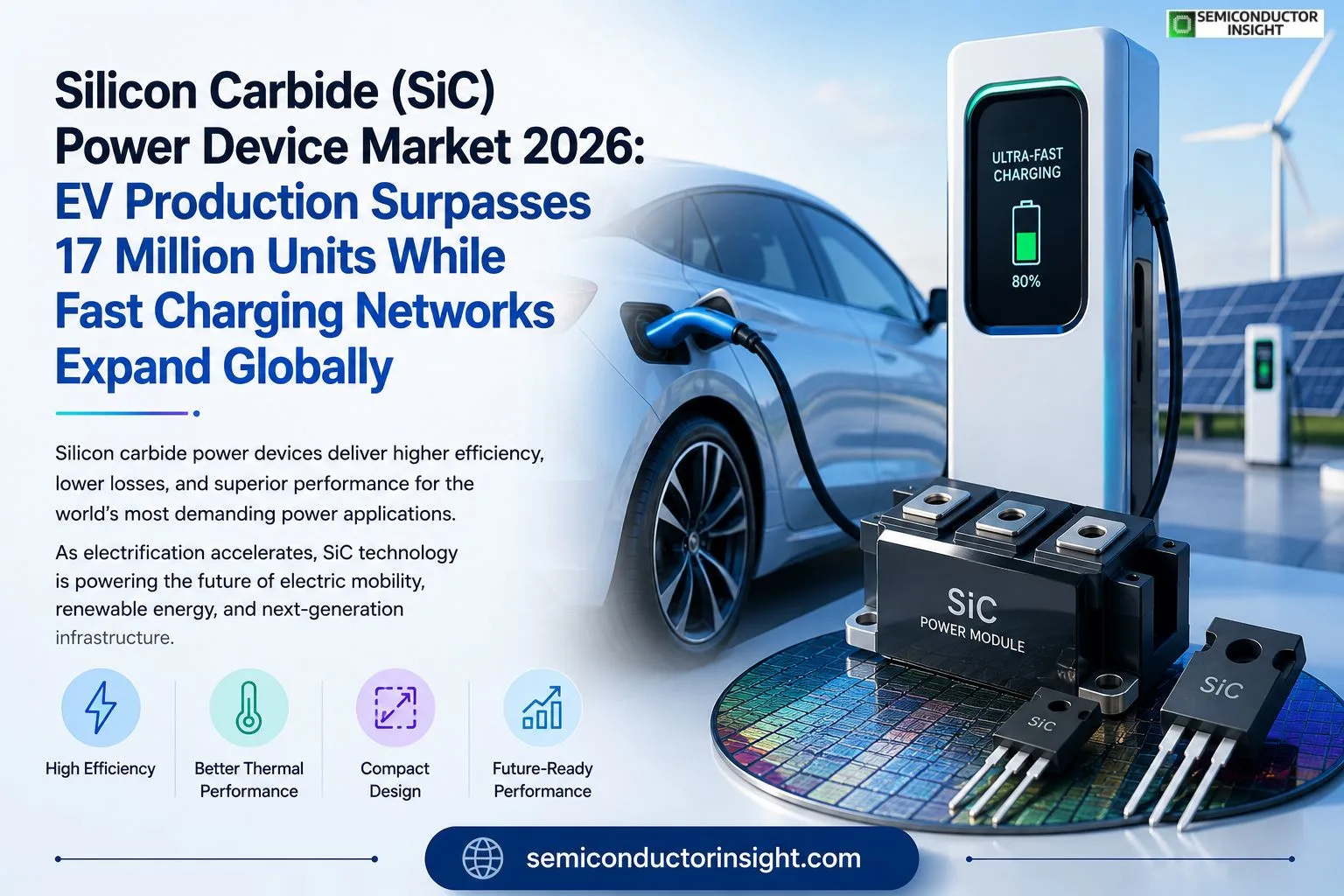
Silicon Carbide (SiC) Power Device Market 2026: EV Production Surpasses 17 Million Units While Fast Charging Networks Expand Globally
The semiconductor industry is witnessing a major technology shift as silicon carbide power devices move from niche industrial applications into mainstream electric mobility, renewable energy, and high-performance computing infrastructure. Unlike conventional silicon-based power semiconductors, SiC devices offer higher switching frequencies, lower energy losses, improved thermal conductivity, and greater voltage handling capabilities.
As global electrification accelerates, silicon carbide has become one of the most closely watched technologies in power electronics. From electric vehicle traction inverters to solar farms and ultra-fast charging stations, SiC components are increasingly enabling systems that demand higher efficiency and smaller footprints.
A Technology Map Showing Where SiC Creates Value
Raw Silicon Carbide Crystal
↓
Wafer Manufacturing
↓
Power Device Fabrication
↓
Modules and Power Electronics
↓
Electric Vehicles | Solar Inverters | Data Centers | Industrial Drives
↓
Lower Energy Losses and Higher System Efficiency
Unlike many semiconductor innovations that remain hidden from consumers, SiC directly influences charging speed, driving range, power density, and operational efficiency.
Why 800V Architectures Are Becoming the New Benchmark?
One of the strongest trends in automotive electronics is the migration toward 800V vehicle platforms.
Manufacturers such as Hyundai Motor Company, Porsche, and Mercedes-Benz Group have introduced vehicles utilizing high-voltage architectures capable of significantly reducing charging times.
Comparison of Power Device Performance
|
Parameter |
Silicon Devices |
SiC Devices |
|
Switching Speed |
Moderate |
High |
|
Heat Generation |
Higher |
Lower |
|
Voltage Capability |
Limited |
Higher |
|
System Size |
Larger Cooling Systems |
More Compact |
|
Energy Efficiency |
Lower |
Higher |
This transition is helping vehicle manufacturers reduce inverter weight while improving battery utilization.
Our most recent updated related study is available for free at this link: https://semiconductorinsight.com/report/silicon-carbide-sic-power-device-market-2/
Inside the New Generation of AI Data Centres
While electric vehicles dominate discussions around SiC, data centers are emerging as another major adoption area.
Artificial intelligence workloads require enormous computational power. As server densities increase, power conversion efficiency becomes critical. Modern facilities are exploring advanced power architectures to reduce electricity consumption and cooling requirements.
Data Centre Energy Flow
Grid Power
↓
Power Conversion
↓
Server Racks
↓
↓
Cooling Infrastructure
↓
Operational Efficiency Gains through Advanced Power Electronics
With hyperscale facilities consuming hundreds of megawatts of power, even small efficiency improvements can translate into significant energy savings.
Manufacturing Race Focuses on Larger Wafers
The silicon carbide ecosystem is currently undergoing one of the largest manufacturing expansions in semiconductor history.
The industry’s transition from 150 mm wafers to 200 mm wafers is attracting substantial investment because larger wafers increase chip output and improve manufacturing economics.
Industry Evolution Snapshot
|
Generation |
Typical Wafer Size |
|
Early Commercial Era |
100 mm |
|
Expansion Phase |
150 mm |
|
Current Investment Cycle |
200 mm |
Larger wafer production is expected to support rising demand from transportation, industrial automation, and energy infrastructure sectors.
Renewable Energy Systems Quietly Depend on SiC Innovation
Solar and energy storage projects increasingly rely on power electronics capable of handling large amounts of electricity with minimal losses.
In utility-scale installations, improved inverter efficiency can directly affect annual energy output. This has encouraged adoption of SiC-based designs in solar inverters, battery storage systems, and smart grid applications.
Renewable Energy Integration Chain
↓
SiC-Based Inverters
↓
Battery Storage
↓
Smart Grid Systems
↓
End Users
The result is more efficient electricity transmission from generation source to consumer.
What Engineers Are Talking About in 2026?
Several themes dominate technical conferences and semiconductor forums:
· 200 mm SiC wafer production expansion
· High-voltage automotive platforms
· Ultra-fast DC charging systems
· AI data center power optimization
· Grid-scale energy storage projects
· Advanced packaging for power semiconductors
· Reduction of thermal management requirements
· Industrial robotics electrification
These discussions indicate that silicon carbide is no longer viewed as an experimental alternative. It has become a foundational technology supporting the next phase of electrification, digital infrastructure development, and energy efficiency improvements across multiple industries.
As transportation, computing, and renewable energy systems become increasingly power intensive, SiC power devices are emerging as one of the semiconductor industry’s most influential building blocks.

Comments (0)