Cloud AI Accelerator Market Insights
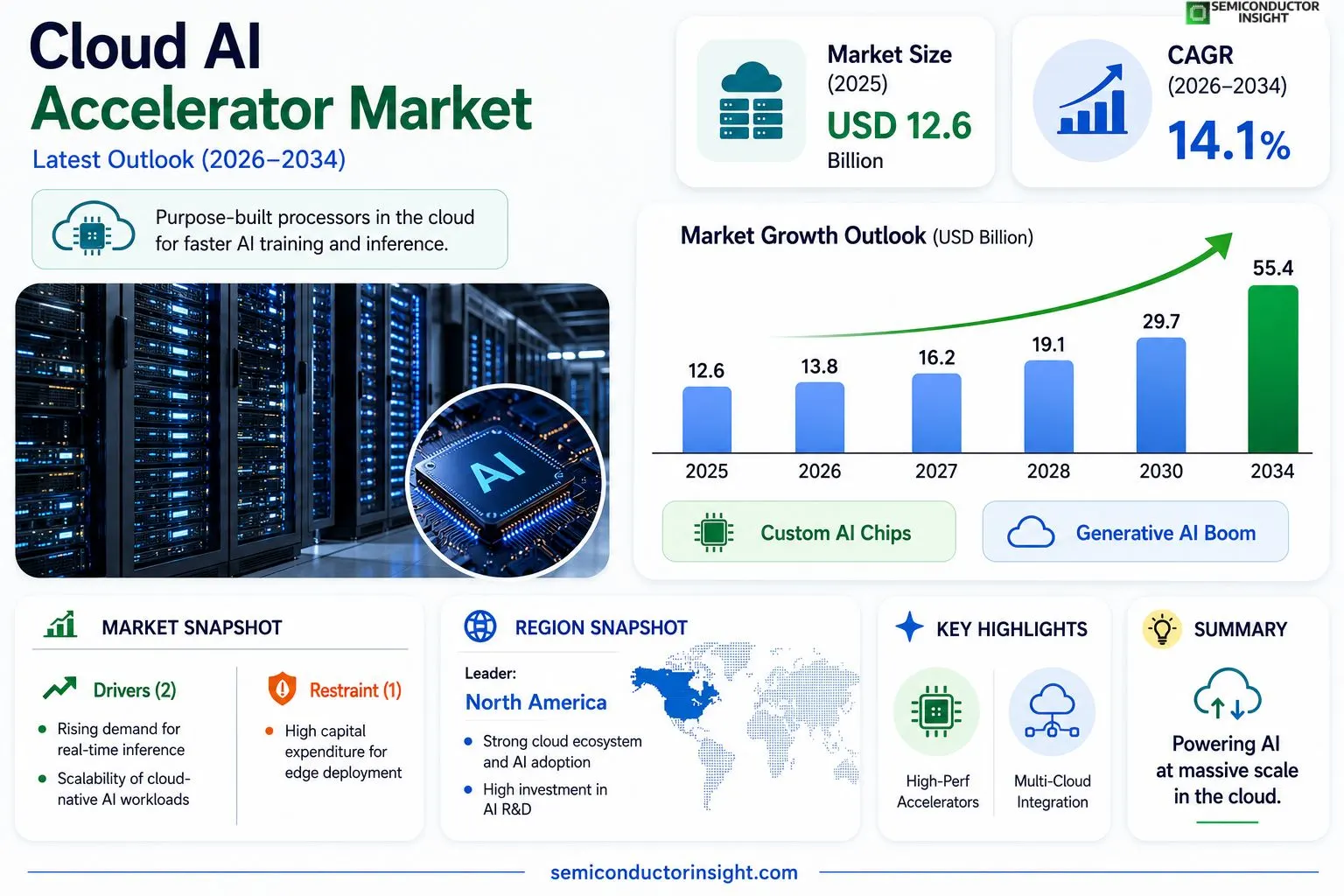
Global Cloud AI Accelerator Market size was valued at USD 12.6 billion in 2025. The market is projected to grow from USD 13.8 billion in 2026 to USD 55.4 billion by 2034, exhibiting a CAGR of approximately 14.1% during the forecast period.
Cloud AI Accelerators are purpose‑built processors,such as GPUs, TPUs, FPGAs and ASICs,deployed within public‑cloud infrastructures to accelerate machine‑learning inference and training workloads at scale. These accelerators optimize computational throughput while reducing latency and energy consumption, enabling enterprises to run complex neural‑network models without on‑premise hardware investments.The market is experiencing rapid growth due to several factors, including soaring demand for generative AI services, increased cloud‑migration initiatives across industries, and substantial capital infusion from leading hyperscale providers seeking differentiated performance offerings. Furthermore, strategic collaborations,such as Amazon Web Services’ partnership with NVIDIA on custom Inferentia chips and Google Cloud’s expansion of TPU v4 pods,are driving adoption rates among developers and enterprises alike.
MARKET DRIVERS
Increasing Demand for Real‑Time Inference
Cloud AI Accelerator Market is being propelled by enterprises that require sub‑second latency for AI‑driven services such as fraud detection, autonomous navigation, and personalized recommendation. Cloud providers are deploying specialized ASICs and GPUs that can handle billions of operations per second, enabling customers to scale inference workloads without provisioning on‑prem hardware.
Scalability of Cloud‑Native AI Workloads
Modern application architectures rely on container orchestration and serverless platforms, which demand elastic compute resources. Accelerators hosted in the cloud offer seamless scaling across regions, allowing organizations to match compute capacity with unpredictable model traffic while keeping operational costs predictable.
➤ “Enterprises that migrate AI inference to cloud accelerators report up to a 45 % reduction in total cost of ownership versus traditional GPU farms.”
Investments in high‑bandwidth interconnects and unified software stacks further reduce integration friction, encouraging more firms to adopt cloud‑based AI acceleration as a core component of their digital transformation strategies.
MARKET CHALLENGES
Integration Complexity
Despite the performance benefits, many organizations face challenges integrating cloud accelerators with legacy data pipelines. The need to refactor code for heterogeneous hardware, coupled with varying API standards across providers, can slow adoption and increase development overhead.
Other Challenges
Regulatory and Data‑Privacy Concerns
Data residency rules and industry‑specific compliance requirements limit where sensitive datasets can be processed, forcing some customers to retain inference workloads on‑prem or within restricted cloud zones, which diminishes the appeal of shared accelerator services.
MARKET RESTRAINTS
High Capital Expenditure for Edge Deployment
Deploying AI accelerators at the edge demands significant upfront investment in ruggedized hardware and localized networking. For many mid‑size firms, the cost‑benefit balance tilts toward centralized cloud solutions, limiting the growth of edge‑focused accelerator offerings.
MARKET OPPORTUNITIES
Emerging Hybrid Cloud Strategies
Hybrid architectures that combine on‑prem AI chips with cloud‑based accelerators present a compelling growth avenue. Companies can keep latency‑critical inference close to data sources while leveraging the elasticity of the cloud for burst workloads, creating new revenue streams for providers that offer seamless workload migration tools.Furthermore, the rollout of open‑source accelerator frameworks and standardized performance benchmarks is expected to lower integration barriers, encouraging broader industry participation and expanding the addressable market for cloud AI acceleration services.
Cloud AI Accelerator Market Trends
Rising Demand for Generative AI Services
The surge in generative AI services is reshaping Cloud AI Accelerator Market. Enterprises are moving large‑scale language‑model inference and training workloads to public‑cloud platforms, where purpose‑built processors deliver the necessary throughput. By leveraging GPUs, TPUs, and emerging ASICs, cloud providers can offer near‑real‑time response times while keeping operational costs manageable. This shift is reinforced by the expanding portfolio of AI‑ready instances that combine high‑bandwidth memory with optimized software stacks, allowing developers to scale models without on‑premise hardware investments. Additionally, the rise of container‑native AI runtimes and serverless inference APIs simplifies the integration of accelerator resources into existing DevOps pipelines, further accelerating adoption across retail, media, and automotive domains. Regulatory pressures for data residency are also prompting providers to localize accelerator instances within sovereign clouds, ensuring that sensitive AI workloads meet privacy standards.
Other Trends
Strategic Partnerships and Ecosystem Expansion
The market is also being shaped by strategic collaborations that integrate accelerator hardware with cloud service portfolios. Leading hyperscale providers are co‑designing custom inference chips with semiconductor firms, enabling tighter integration with orchestration layers and lower latency for end‑users. These alliances extend beyond pure hardware, encompassing joint software toolkits, model‑optimization frameworks, and managed AI services that simplify deployment for enterprises of all sizes. As a result, developer adoption accelerates, and the ecosystem surrounding cloud‑based AI workloads expands, driving broader consumption of specialized processing units across finance, healthcare, and manufacturing sectors. Finance firms are leveraging low‑latency inference chips to detect fraud in real time, while healthcare researchers use AI‑accelerated pipelines to process imaging data at scale. Educational programs and certification tracks offered by cloud vendors are raising awareness of accelerator best practices, reducing skill gaps that previously slowed deployment.
Energy‑Efficient Accelerator Designs
Energy‑efficient accelerator designs are emerging as a critical trend within Cloud AI Accelerator Market. Chip manufacturers are optimizing power‑to‑performance ratios through advanced packaging, heterogeneous integration, and low‑voltage operation modes. These improvements reduce the total cost of ownership for cloud operators while supporting the growing need for continuous, high‑throughput AI inference in edge‑connected services. The focus on sustainability is prompting providers to offer pricing models tied to compute efficiency, encouraging customers to select workloads that align with greener operational objectives. Emerging chiplet‑based architectures enable modular scaling of compute resources, allowing cloud operators to customize accelerator configurations for specific AI workloads. Such flexibility aligns with green‑cloud initiatives that prioritize power‑aware scheduling and dynamic workload placement, further reinforcing the market’s shift toward environmentally responsible AI services. These developments are reshaping Cloud AI Accelerator Market toward higher efficiency and broader accessibility.
COMPETITIVE LANDSCAPEKey Industry Players
Competitive dynamics shaping the Cloud AI Accelerator ecosystem
Cloud AI Accelerator Market is anchored by a few hyperscale cloud providers that integrate purpose‑built silicon into their public‑cloud portfolios. Amazon Web Services leads with its custom Inferentia and Trainium chips, delivering low‑latency inference for generative AI workloads. Google Cloud leverages its fourth‑generation Tensor Processing Units (TPU v4) to offer high‑throughput training at scale, while Microsoft Azure partners with Nvidia and AMD to embed GPU‑based acceleration across its AI services. Nvidia remains the dominant GPU supplier, supplying both direct‑to‑cloud instances and co‑designed ASICs such as the AWS Inferentia family. Intel’s Xeon‑based AI accelerators and Habana Labs’ Gaudi processors complement the GPU‑centric landscape, providing energy‑efficient alternatives for inference and training. Collectively, these leaders dictate pricing tiers, performance benchmarks, and the overall pace of market expansion, establishing a duopolistic structure between the biggest cloud platforms and the silicon innovators that power them.Beyond the marquee players, a vibrant cohort of niche innovators intensifies competition through differentiated architectures. Graphcore’s IPU (Intelligence Processing Unit) focuses on fine‑grained parallelism for complex graph‑based models, while Cerebras Systems offers a wafer‑scale engine that delivers petaflop‑level performance in a single chip. Tenstorrent’s flexible tensor cores target low‑power edge inference, and Baidu’s Kunlun AI chips provide strong support for Chinese‑language models within Baidu Cloud. Alibaba Cloud’s Pingtouge ASICs and Huawei Cloud’s Ascend series cater to regional enterprises, emphasizing compliance and data‑sovereignty. These specialized offerings broaden the choice set for enterprises seeking tailored performance, latency, or regulatory advantages, thereby enriching the competitive fabric of Cloud AI Accelerator Market.
List of Key Cloud AI Accelerator Companies Profiled
- Amazon Web Services (AWS)
- Google Cloud (TPU)
- Microsoft Azure
- NVIDIA
- Intel Corporation
- Habana Labs (Intel)
- Graphcore Ltd.
- Cerebras Systems
- Tenstorrent
- Baidu Cloud (Kunlun)
- Alibaba Cloud (Pingtouge)
- Huawei Cloud (Ascend)
- AMD/Xilinx
- Qualcomm AI
- Samsung Electronics (AI Chipset)
Segment Analysis:
| Segment Category | Sub-Segments | Key Insights |
| By Type |
|
GPU‑Based Accelerators are dominant due to their proven flexibility and extensive developer ecosystem. – Provide broad compatibility with diverse machine‑learning frameworks, fostering rapid adoption. – Deliver high computational density that suits both training and inference workloads. – Benefit from continuous performance improvements driven by major cloud providers and hardware vendors. |
| By Application |
|
Generative AI Services drive the most compelling demand for cloud accelerators. – Require massive parallelism to produce high‑quality outputs in real time. – Encourage providers to integrate custom‑designed chips that lower latency for large language models. – Stimulate ecosystem partnerships where software stacks are co‑optimized with hardware. |
| By End User |
|
Large Enterprises lead adoption because they seek to offload intensive AI workloads without expanding on‑premise data centers. – Leverage cloud AI accelerators to accelerate digital transformation initiatives. – Prioritize solutions that integrate seamlessly with existing cloud‑native architectures. – Favor providers offering robust security, compliance, and managed services. |
| By Deployment Model |
|
Public Cloud remains the primary deployment model for AI accelerators. – Offers on‑demand scalability that matches the bursty nature of AI workloads. – Enables customers to experiment with cutting‑edge accelerator generations without capital commitment. – Facilitates rapid integration with a broad portfolio of AI services and managed platforms. |
| By Industry Vertical |
|
Healthcare & Life Sciences exhibit heightened interest due to AI‑driven drug discovery and diagnostic imaging. – Require accelerated inference to process high‑resolution medical images in real time. – Benefit from secure, compliant cloud environments that protect patient data. – Drive collaborations between accelerator vendors and specialized AI platforms tailored for biomedical research. |
Regional Analysis: North America
United States
The expansion of data centers and the need for high-performance computing within these facilities are key drivers for Cloud AI Accelerator adoption in the United States. Businesses are investing heavily in infrastructure to support their AI initiatives, creating a significant market opportunity.
The healthcare sector in the US is increasingly utilizing AI for drug discovery, diagnostics, and personalized medicine. Cloud AI Accelerators are vital for processing the vast amounts of data generated in these applications, leading to faster breakthroughs and improved patient outcomes.
Financial institutions are leveraging AI for fraud detection, risk management, and algorithmic trading. The need for rapid processing of complex financial data is driving the adoption of Cloud AI Accelerator solutions.
The development of autonomous vehicles relies heavily on AI for perception, decision-making, and control. Cloud AI Accelerators provide the necessary computational power for training and deploying the complex AI models required for self-driving technology.
Europe
Europe is witnessing a steady rise in Cloud AI Accelerator Market, driven by increasing investments in AI research and development across various countries. While adoption rates might be slightly lower than in the US, the region presents a significant growth opportunity, particularly in sectors like manufacturing and pharmaceuticals. Government initiatives supporting AI innovation and the growing focus on data privacy are shaping the market landscape. There’s a strong emphasis on ethical AI development and responsible deployment, influencing the types of Cloud AI Accelerator solutions being adopted. The European market is characterized by a more fragmented approach, with varying levels of maturity across different countries.
Asia-Pacific
Asia-Pacific, particularly China and Japan, represents a high-growth potential market for Cloud AI Accelerators. The region’s large population, rapidly expanding digital economy, and strong government support for technological advancements are key drivers. China’s massive investments in AI infrastructure and research are creating a substantial demand for these accelerators. Japan’s focus on AI in robotics and industrial automation is also contributing to market growth. However, geopolitical factors and varying regulatory environments present challenges for market players operating in the region.
South America
Cloud AI Accelerator Market in South America is in its nascent stages but is expected to grow significantly in the coming years. Increasing internet penetration, rising adoption of cloud services, and growing investments in AI by businesses are creating a favorable environment for market expansion. The region’s dependence on resource extraction and agriculture presents specific opportunities for AI applications in optimizing operations and improving efficiency. However, infrastructure limitations and economic uncertainties pose challenges to rapid market development.
Middle East & Africa
The Middle East & Africa region is an emerging market for Cloud AI Accelerators, with significant potential for future growth. Government initiatives focused on digital transformation and artificial intelligence are driving investments in AI infrastructure. The region’s focus on sectors like energy, finance, and healthcare is creating specific use cases for AI and Cloud AI Accelerators. However, challenges related to internet connectivity, data privacy regulations, and limited AI expertise need to be addressed for sustained market development.
Report Scope
This market research report provides a comprehensive analysis of the Cloud AI Accelerator Market , covering the forecast period 2026–2034. It offers detailed insights into market dynamics, technological advancements, competitive landscape, and key trends shaping the industry.
Key focus areas of the report include:
- Market Overview: The report begins with an overview outlining its current market scenario, key growth indicators, and industry transformation drivers. It discusses macroeconomic factors, demand–supply balance, regulatory landscape, and the strategic role of semiconductors in powering advancements across industries such as automotive, telecommunications, consumer electronics, and industrial automation.
- Market Size & Forecast: Historical data and future projections for revenue, unit shipments, and market value across major regions and segments.
- Segmentation Analysis: Detailed breakdown by product type, technology, application, and end-user industry to identify high-growth segments and investment opportunities.
- Regional Insights: Insights into market performance across North America, Europe, Asia-Pacific, Latin America, and the Middle East & Africa, including country-level analysis where relevant.
- Competitive Landscape: Profiles of leading market participants, including their product offerings, R&D focus, manufacturing capacity, pricing strategies, and recent developments such as mergers, acquisitions, and partnerships.
- Technology Trends & Innovation: Assessment of emerging technologies, integration of AI/IoT, semiconductor design trends, fabrication techniques, and evolving industry standards.
- Market Drivers & Restraints: Evaluation of factors driving market growth along with challenges, supply chain constraints, regulatory issues, and market-entry barriers.
- Stakeholder Insights: Insights for component suppliers, OEMs, system integrators, investors, and policymakers regarding the evolving ecosystem and strategic opportunities.
Primary and secondary research methods are employed, including interviews with industry experts, data from verified sources, and real-time market intelligence to ensure the accuracy and reliability of the insights presented.
FREQUENTLY ASKED QUESTIONS:
What is the current market size of Cloud AI Accelerator Market?
-> Cloud AI Accelerator Market was valued at USD 12.6 billion in 2025 and is expected to reach USD 55.4 billion by 2034.
Which key companies operate in Cloud AI Accelerator Market?
-> Key players include NVIDIA, Amazon Web Services, Google Cloud, Intel, AMD, and Xilinx, among others.
What are the key growth drivers?
-> Key growth drivers include surging demand for generative AI services, accelerated cloud‑migration initiatives, substantial capital infusion from hyperscale providers, and strategic collaborations such as AWS‑NVIDIA Inferentia and Google Cloud TPU v4 pods.
Which region dominates the market?
-> The reference does not specify a single dominant region; adoption is strongest in markets where major cloud providers operate.
What are the emerging trends?
-> Emerging trends include development of custom AI inference chips, expansion of TPU pod architectures, and increasing integration of AI accelerators within multi‑cloud environments.
Get Sample Report PDF for Exclusive Insights
Report Sample Includes
- Table of Contents
- List of Tables & Figures
- Charts, Research Methodology, and more...
 Download Sample Report PDF