

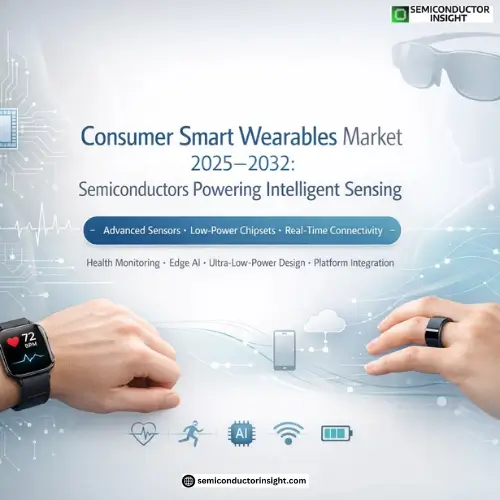
Inside the Consumer Smart Wearable Market Where Semiconductors Enable Everyday Intelligence
In the span of a decade, wristbands, smart rings, and wearable devices have evolved from niche tech accessories to integral elements of personal digital ecosystems. Today’s consumer smart wearables encompassing fitness trackers, smartwatches, AR glasses, smart textiles, and health monitors are defined by advanced sensing capabilities, real-time connectivity, and personalized user experiences. At the heart of this evolution is the semiconductor: the chipsets, sensors, and power management ICs that enable meaningful interaction between the human body and digital intelligence.
Wearables are not merely gadgets; they are personal sensing platforms that continuously interpret biological signals, motion patterns, and environmental context. As a result, the global market is expanding rapidly, reflecting both widespread adoption and increasing device sophistication.
Market Definition and Technological Scope
Consumer smart wearable refer to personal, body-worn electronic devices equipped with embedded semiconductors that support sensing, processing, connectivity, and user interaction. Unlike smartphones or tablets, these devices operate in close proximity to the human body, requiring highly efficient chips and low-power system designs.
Key semiconductor elements in wearable include:
- Microcontrollers and application processors for real-time execution
- Inertial sensors (accelerometers, gyroscopes) for motion tracking
- Optical sensors for heart rate and SpO₂ measurements
- Bluetooth/Wi-Fi modules for connectivity
- Power management ICs for extended battery life
Each hardware component must work in harmony to deliver seamless user experiences, making semiconductor integration the centrepiece of wearable design.
Growth Fueled by Health, Fitness, and Connectivity Trends
The adoption of smart wearables is being driven by multiple consumer priorities, notably health monitoring and enhanced connectivity. Industry surveys indicate that a significant share of wearable users rely on their devices to track activity levels, heart health indicators, sleep quality, and stress markers. This health-centric use is increasingly supported by continuous, non-invasive sensing technologies embedded in modern chipsets.
In addition, smart wearables have become social tools for location sharing, messaging alerts, and ecosystem integration with smartphones and smart home devices. The combination of health data and connectivity usage has created a new vector for consumer engagement, expanding wearables from occasional use to daily dependency.
For a more thorough report, please contact us using our most recent report:
https://semiconductorinsight.com/report/consumer-smart-wearables-market/
Semiconductor Innovation Driving Performance
The semiconductor industry continues to push boundaries in wearable technology. Several key trends are shaping performance and user expectations:
- Ultra-low-power designs: Wearables demand high functionality with minimal battery consumption, prompting semiconductor engineers to optimize energy efficiency at every layer.
- Miniaturization and heterogeneous integration: The move toward smaller device form factors without sacrificing performance has accelerated multi-die, 3D packaging, and System-in-Package (SiP) solutions.
- Sensor fusion and AI at the edge: Advanced signal processing and embedded machine learning engines are enabling wearables to interpret complex data patterns on-device, reducing latency and protecting privacy.
These innovations reflect a shift from merely gathering data to meaningfully interpreting and acting upon it in real time.
User Behavior and Adoption Patterns
Consumer adoption patterns reveal several noteworthy insights. Market research indicates that wearables are no longer dominated by early adopters and tech enthusiasts; instead, usage has broadened across age groups and demographics, including older adults seeking health tracking and younger generations integrating wearables into social and fitness routines.
This broader adoption is supported by:
- Improved user experience and simplified interfaces
- App ecosystems that extend wearable functionality
- Affordable entry-level devices that lower barriers to entry
As wearables become part of daily routines, the expectations for durability, comfort, and seamless connectivity continue to rise.
Connectivity and Platform Integration
Smart wearables no longer operate in isolation they interact with cloud services, mobile apps, and edge devices in real time. Connectivity standards such as Bluetooth Low Energy (BLE) and emerging ultra-short-range protocols enable continuous data exchange without significant battery drain.
Moreover, wearable platforms increasingly integrate with digital health ecosystems, allowing clinicians and wellness platforms to access user data (with consent) for personalized insights. This trend expands the role of wearables from personal trackers to tools within broader health management frameworks.
Recent Market Innovations and Feature Shifts
Several innovations are shaping the wearable market today:
- Bio-signal sensing beyond basic vitals: Wearables are incorporating electrodermal activity, ECG, and even continuous blood glucose estimation.
- Context-aware computing: Advanced sensor fusion algorithms allow devices to distinguish between activities more accurately, enabling richer insights.
- Enhanced displays and interaction: Flexible screens, tactile feedback, and voice interaction are becoming more commonplace, demanding additional processing and power optimization.
These trends reflect a maturing market where functionality depth and user experience take priority alongside traditional metrics like battery life and device longevity.
The consumer smart wearables market is entering a phase of integration and intelligence, where devices evolve from passive trackers to proactive health advisors and contextual assistants. Future growth is likely to be driven by:
- Tighter integration with digital health systems
- Personalized analytics and AI-supported inference engines
- Cross-device continuity across phones, wearables, and in-home systems
Wearables are expected to play a key role in personalized wellness, remote patient monitoring, and even early health risk prediction, further expanding their relevance beyond fitness and convenience.
In the world of consumer technology, smart wearables represent the convergence of personal experience, continuous connectivity, and intelligent sensing with semiconductors powering every leap forward. From everyday fitness tracking to sophisticated health analytics, the market trajectory underscores the transformative role these devices play in our digital lives.

Comments (0)