MARKET INSIGHTS
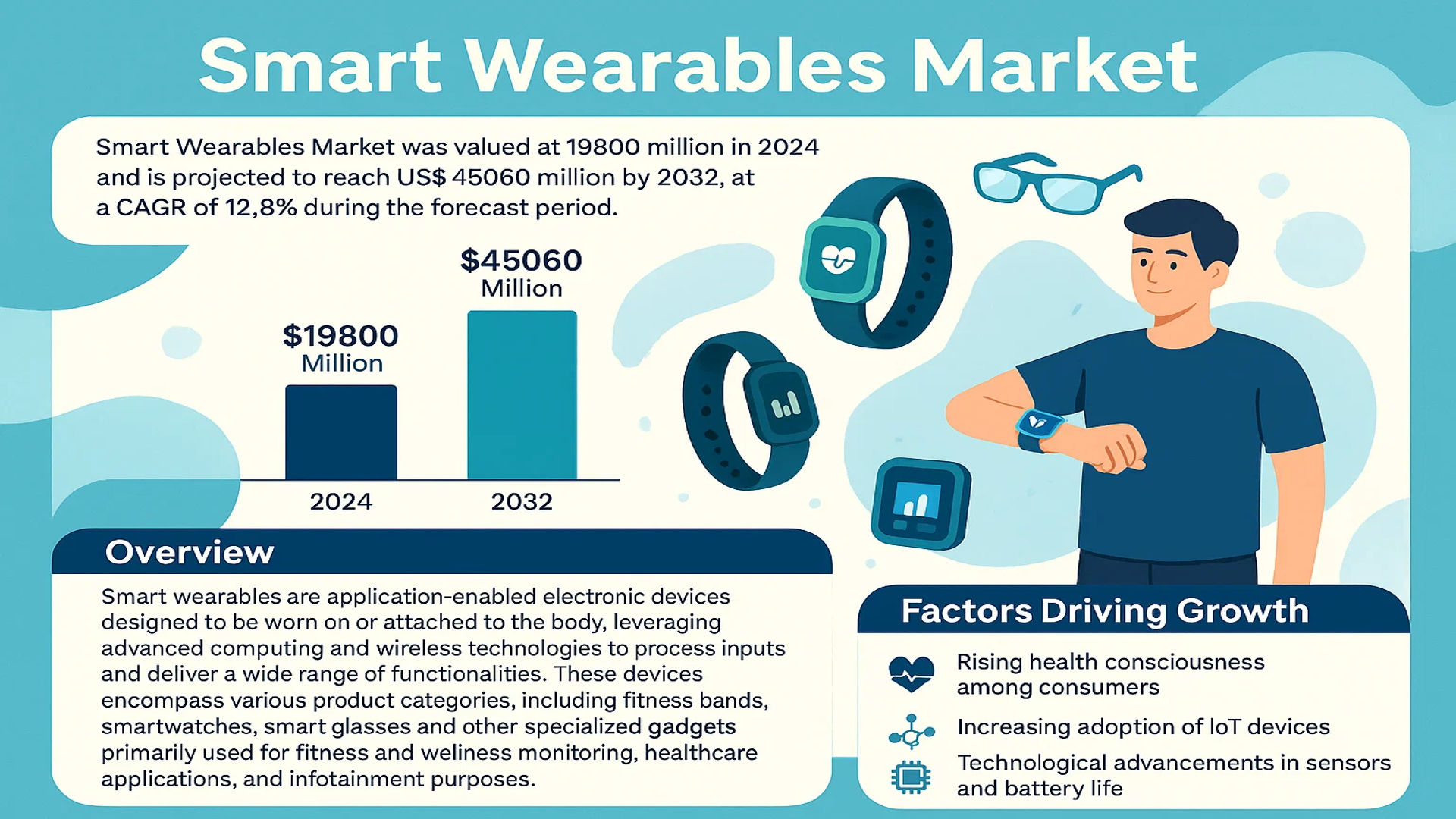
The global Smart Wearables Market was valued at 19800 million in 2024 and is projected to reach US$ 45060 million by 2032, at a CAGR of 12.8% during the forecast period.
Smart wearables are application-enabled electronic devices designed to be worn on or attached to the body, leveraging advanced computing and wireless technologies to process inputs and deliver a wide range of functionalities. These devices encompass various product categories, including fitness bands, smartwatches, smart glasses, and other specialized gadgets primarily used for fitness and wellness monitoring, healthcare applications, and infotainment purposes.
The market is experiencing robust growth driven by several key factors, including rising health consciousness among consumers, increasing adoption of IoT (Internet of Things) devices, and continuous technological advancements in sensors and battery life. Furthermore, the integration of advanced health monitoring features, such as ECG, blood oxygen saturation (SpO2) tracking, and sleep analysis, is significantly propelling consumer demand. The competitive landscape is intense, with Apple leading the market with a 37% revenue share in 2024, followed by key players like Fitbit, Samsung, and Huawei, who are consistently innovating to capture market share.
MARKET DYNAMICS
MARKET DRIVERS
Rising Health Consciousness and Fitness Trends to Propel Market Expansion
The global smart wearables market is experiencing robust growth, largely driven by increasing health consciousness among consumers and the widespread adoption of fitness-oriented lifestyles. With over 80% of wearable device users prioritizing health and fitness features, devices such as fitness bands and smartwatches have become essential tools for monitoring physical activity, heart rate, sleep patterns, and calorie expenditure. The integration of advanced sensors and artificial intelligence has enhanced the accuracy and functionality of these devices, making them indispensable for health enthusiasts. The growing prevalence of chronic diseases, coupled with a heightened focus on preventive healthcare, has further accelerated demand. For instance, devices capable of continuous glucose monitoring and ECG functionality are witnessing surging adoption, particularly among aging populations and individuals with specific health conditions.
Technological Advancements and Connectivity Enhancements to Fuel Adoption
Continuous innovation in technology is a significant catalyst for the smart wearables market. The development of more efficient processors, longer-lasting batteries, and improved display technologies has substantially enhanced user experience. The integration of 5G connectivity and IoT ecosystems allows seamless synchronization between wearables and other smart devices, creating a cohesive digital environment. Furthermore, advancements in biometric sensors enable more precise health monitoring, elevating the reliability of data collected. The incorporation of AI-driven insights provides users with personalized recommendations, fostering greater engagement and retention. These technological strides not only attract new consumers but also encourage existing users to upgrade to newer models, sustaining market momentum.
Expansion of Applications in Healthcare and Enterprise Sectors to Drive Growth
Beyond consumer fitness, smart wearables are increasingly being adopted in healthcare and enterprise environments, opening new avenues for market expansion. In healthcare, wearables are utilized for remote patient monitoring, reducing the need for frequent hospital visits and enabling timely interventions. This is particularly valuable in managing conditions such as cardiovascular diseases and diabetes. Enterprise applications include enhancing workforce safety and productivity through devices that monitor vital signs in hazardous environments or track employee activity for wellness programs. The corporate sector’s growing investment in employee health and operational efficiency is expected to significantly contribute to market growth. Additionally, partnerships between wearable technology companies and healthcare providers are fostering innovation and expanding the reach of these devices into mainstream medical practice.
MARKET CHALLENGES
High Product Costs and Limited Battery Life to Hinder Market Penetration
Despite the promising growth trajectory, the smart wearables market faces several challenges, with high product costs being a primary concern. Premium devices often come with a significant price tag, limiting accessibility for budget-conscious consumers. Additionally, the relatively short battery life of many wearables necessitates frequent charging, which can inconvenience users and reduce practicality for continuous health monitoring. While technological improvements are addressing these issues, the balance between advanced features and affordability remains a critical hurdle. Moreover, the rapid pace of innovation leads to shorter product life cycles, causing consumer hesitation due to fears of quick obsolescence.
Other Challenges
Data Privacy and Security Concerns
The collection and transmission of sensitive health data raise significant privacy and security issues. Unauthorized access to personal information could lead to misuse, eroding consumer trust. Ensuring robust encryption and compliance with data protection regulations is essential but adds complexity and cost to product development.
Interoperability and Fragmentation Issues
The lack of standardization across platforms and devices often results in compatibility problems. Users may experience difficulties syncing data between wearables and other smart devices or health applications, diminishing the overall user experience and hindering broader adoption.
MARKET RESTRAINTS
Consumer Skepticism and Accuracy Questions to Limit Market Growth
While smart wearables offer numerous benefits, consumer skepticism regarding the accuracy and reliability of data remains a restraining factor. Inconsistent readings or errors in health metrics can lead to mistrust, particularly when users rely on these devices for critical health decisions. Although regulatory approvals for certain medical-grade features are improving credibility, the majority of consumer wearables are not classified as medical devices, leading to perceptions of them as lifestyle accessories rather than essential health tools. This skepticism is compounded by a lack of clear industry standards for accuracy, making it challenging for consumers to differentiate between high- and low-quality products. Overcoming these concerns requires continuous improvement in sensor technology and transparent validation processes.
MARKET OPPORTUNITIES
Integration with AI and Predictive Analytics to Unlock New Potential
The fusion of smart wearables with artificial intelligence and predictive analytics presents substantial growth opportunities. AI algorithms can analyze vast amounts of user data to identify patterns, predict health issues, and offer proactive recommendations. This capability transforms wearables from passive data collectors to active health partners, providing users with actionable insights. For example, AI-driven wearables can alert users to potential heart anomalies or suggest adjustments in activity levels based on historical data. The expansion into predictive health not only enhances individual user experience but also holds promise for reducing healthcare costs through early intervention. As machine learning models become more sophisticated, the value proposition of smart wearables is expected to rise significantly.
Emerging Markets and Demographic Diversification to Offer Lucrative Avenues
Emerging economies represent a largely untapped market for smart wearables, offering immense growth potential. Rising disposable incomes, increasing smartphone penetration, and growing health awareness in these regions are driving demand. Additionally, demographic diversification, such as targeting older adults with devices tailored to age-related health needs, opens new segments. Companies are developing wearables with simplified interfaces and specialized features like fall detection or medication reminders to cater to this demographic. Furthermore, partnerships with local healthcare providers and insurers can facilitate broader adoption through subsidized programs or bundled offerings. These strategies not only expand market reach but also integrate wearables into broader health ecosystems.
Innovation in Material Science and Design to Enhance User Adoption
Advancements in material science and design are creating opportunities for more comfortable, durable, and aesthetically pleasing wearables. The development of flexible electronics, lightweight materials, and waterproof designs improves usability across various environments and activities. Enhanced customization options, such as interchangeable bands and personalized watch faces, appeal to fashion-conscious consumers, blurring the line between technology and accessory. Moreover, the incorporation of sustainable materials aligns with growing environmental consciousness among users. These innovations not only attract new customers but also encourage higher retention rates by addressing common usability complaints and aligning with personal style preferences.
SMART WEARABLES MARKET TRENDS
Health and Fitness Monitoring Drives Unprecedented Market Adoption
The proliferation of health-centric features has become the primary catalyst for consumer adoption in the smart wearables market. Devices now routinely include heart rate monitoring, blood oxygen saturation (SpO2) tracking, electrocardiogram (ECG) capabilities, and advanced sleep analysis, moving far beyond basic step counting. This evolution positions wearables not just as lifestyle accessories but as vital health management tools. The integration of these medical-grade features has been particularly significant because it empowers users with continuous, real-time health data, fostering a proactive approach to personal wellness. While early devices focused primarily on fitness metrics, current generations provide actionable insights that can indicate potential health issues, making them invaluable for preventive healthcare. Furthermore, the ability to share this data seamlessly with healthcare providers via connected platforms is creating a new paradigm in remote patient monitoring and telehealth services, significantly expanding the market’s reach and utility.
Other Trends
Integration with Artificial Intelligence and Predictive Analytics
The infusion of Artificial Intelligence (AI) and machine learning algorithms is fundamentally transforming wearable technology from passive data collectors to intelligent health advisors. These systems analyze vast datasets of user biometrics to identify patterns, predict potential health events, and deliver personalized recommendations. For instance, algorithms can now detect irregular heart rhythms suggestive of atrial fibrillation with clinically validated accuracy, often alerting users to seek medical attention before a serious event occurs. This predictive capability is not limited to cardiovascular health; AI-driven wearables are increasingly capable of predicting stress levels, migraines, and even potential illness onset based on subtle changes in vital signs and activity patterns. The value of this trend is immense because it shifts the focus from retrospective data reporting to forward-looking, preventative health management, creating a stickier product ecosystem and driving higher consumer retention rates.
Expansion into Enterprise and Industrial Applications
Beyond consumer markets, smart wearables are experiencing robust growth in enterprise and industrial sectors, creating a substantial new revenue stream. Industries such as manufacturing, logistics, healthcare, and field services are deploying wearables to enhance worker safety, improve operational efficiency, and enable hands-free operations. Smart glasses, for example, provide warehouse workers with real-time inventory information and picking instructions, reducing errors and training time. Wrist-worn devices monitor workers’ vital signs in hazardous environments, alerting supervisors to potential heat stress or fatigue. In healthcare settings, smart wearables enable remote patient monitoring, reducing hospital readmissions and allowing for more efficient use of clinical resources. This enterprise adoption is particularly significant because it represents a shift from discretionary consumer spending to essential business infrastructure, often involving bulk purchases and long-term service contracts, which provide more stable and predictable growth for manufacturers.
Ecosystem Integration and Interoperability Becomes Critical
The market is increasingly defined by the ability of wearables to function not as standalone devices but as integrated components within broader digital ecosystems. Consumers now expect seamless connectivity between their smartwatch, smartphone, home automation systems, and automotive interfaces. This demand for interoperability is driving manufacturers to adopt universal standards and open APIs, allowing data to flow effortlessly between platforms. The success of a wearable is now often determined by its compatibility with popular health platforms, electronic health record systems, and third-party applications. This trend favors larger technology companies that can provide comprehensive ecosystems, but it also creates opportunities for specialized players who excel at seamless integration. The emphasis on ecosystem integration is crucial because it increases the perceived value of the device, reduces friction in the user experience, and creates significant switching costs, thereby enhancing brand loyalty and recurring revenue through associated services.
COMPETITIVE LANDSCAPE
Key Industry Players
Market Leaders Leverage Innovation and Ecosystem Integration to Maintain Dominance
The global smart wearables market exhibits a dynamic and semi-consolidated competitive structure, characterized by the presence of technology giants, specialized fitness brands, and emerging players. Apple Inc. is the undisputed market leader, commanding a significant revenue share of approximately 37% in 2024. This dominance is primarily attributed to the powerful ecosystem integration of its Apple Watch series with other iOS devices, creating a sticky user experience that fosters brand loyalty and repeat purchases. The company’s focus on advanced health monitoring features, such as ECG and blood oxygen tracking, has further solidified its position in the premium segment.
Samsung Electronics and Huawei also hold considerable market shares, leveraging their strong brand presence in the consumer electronics space and extensive global distribution networks. Samsung’s strategy revolves around offering a diverse portfolio that caters to various price points and integrates seamlessly with its Galaxy smartphones. Meanwhile, Huawei has made significant inroads, particularly in the Asia-Pacific region, by offering feature-rich devices at competitive prices.
Additionally, these leading companies are aggressively pursuing growth through continuous product innovation, geographical expansion into emerging markets, and strategic partnerships with healthcare providers and insurance companies. This focus on creating a more holistic health and wellness platform, rather than just a standalone device, is expected to be a key differentiator and driver for market share growth over the forecast period.
Meanwhile, specialized players like Fitbit (a Google company) and Garmin Ltd. are strengthening their market presence by doubling down on their core competencies in health and fitness tracking. They are investing heavily in R&D to enhance the accuracy of their biometric sensors and develop proprietary algorithms. Their strategies also include forming strategic alliances with corporate wellness programs and sports organizations, ensuring their continued relevance in a highly competitive landscape that is increasingly focused on data-driven health insights.
List of Key Companies Profiled in the Smart Wearables Market
- Apple Inc. (U.S.)
- Fitbit Inc. (Google LLC) (U.S.)
- Samsung Electronics Co., Ltd. (South Korea)
- Huawei Technologies Co., Ltd. (China)
- Xiaomi Corporation (China)
- Garmin Ltd. (Switzerland)
- Fossil Group, Inc. (U.S.)
- Polar Electro Oy (Finland)
- BBK Electronics Corporation (XTC, imoo) (China)
Segment Analysis:
By Type
Smart Watches Segment Dominates the Market Due to Advanced Health Monitoring and Connectivity Features
The market is segmented based on type into:
- Smart Watches
- Fitness Bands
- Smart Glasses
- Hearables
- Others
By Application
Fitness and Wellness Segment Leads Due to Rising Global Health Consciousness and Preventive Healthcare Trends
The market is segmented based on application into:
- Fitness and Wellness
- Infotainment
- Healthcare and Medical
- Enterprise and Industrial
By End User
Consumer Segment Leads Owing to Mass Adoption for Personal Use and Lifestyle Enhancement
The market is segmented based on end user into:
- Consumer
- Healthcare
- Enterprise
By Connectivity
Bluetooth Segment Leads Due to its Low Power Consumption and Seamless Pairing with Smartphones
The market is segmented based on connectivity into:
- Bluetooth
- Wi-Fi
- Cellular
- Others
Regional Analysis: Smart Wearables Market
Asia-Pacific
The Asia-Pacific region is the undisputed leader in the global smart wearables market, accounting for the largest share of both volume and revenue. This dominance is fueled by massive populations, rapid urbanization, and a burgeoning middle class with increasing disposable income. China is the epicenter of this growth, home to manufacturing giants like Huawei and Xiaomi, which offer a wide range of competitively priced devices. The market is characterized by a strong preference for fitness bands and affordable smartwatches, driven by a cultural emphasis on health and wellness. However, the region is not monolithic; while cost sensitivity remains a key driver, there is a growing appetite for premium devices from brands like Apple and Samsung, particularly in developed markets such as Japan and South Korea. The sheer scale of manufacturing and consumption, coupled with aggressive marketing and robust e-commerce penetration, solidifies Asia-Pacific’s position as the primary engine of global market growth.
North America
North America represents a highly mature and revenue-rich market for smart wearables, characterized by high consumer spending power and early adoption of advanced technology. The United States is the key driver, with a strong focus on premium products, particularly Apple’s ecosystem of devices, which commands a significant market share. The demand is heavily skewed towards sophisticated smartwatches that offer comprehensive health monitoring features—such as ECG and blood oxygen tracking—alongside seamless integration with smartphones for infotainment. This is supported by a robust healthcare infrastructure that is increasingly incorporating wearable data for remote patient monitoring. Furthermore, a culture deeply invested in fitness and wellness creates sustained demand for devices that track physical activity and biometrics. While market growth is slower than in Asia-Pacific due to higher penetration rates, innovation in health-tech features and cellular connectivity continues to drive upgrades and new adoption.
Europe
Europe is another major and sophisticated market for smart wearables, with consumer preferences and regulatory frameworks shaping its trajectory. The region exhibits a strong demand for high-quality, stylish, and feature-rich devices, with a significant emphasis on data privacy and security under regulations like the GDPR. This has pushed manufacturers to develop products with robust data encryption and transparent user data policies. Countries like Germany, the UK, and France show a healthy mix of adoption for both fitness-oriented wearables and multifunctional smartwatches. The market is also seeing growth in the professional sector, with wearables being used for enterprise applications and occupational health monitoring. While economic fluctuations can impact consumer spending, the overall trend is towards devices that offer a blend of health functionality, aesthetic appeal, and compliance with strict European standards.
South America
The smart wearables market in South America is an emerging landscape with significant growth potential, though it faces challenges related to economic volatility and uneven income distribution. Brazil is the largest market in the region, where consumers show a growing interest in fitness trackers and entry-level smartwatches as tools for health management. However, the adoption of premium devices is limited to higher-income segments due to their cost and import taxes. The market is highly price-sensitive, creating opportunities for budget-friendly brands and fueling competition based on value. While infrastructure limitations can affect the full utilization of connected features, increasing smartphone penetration and mobile internet access are key enablers for future market expansion. The long-term outlook remains positive, driven by a young population and growing health consciousness.
Middle East & Africa
The Middle East and Africa region presents a nascent but promising market for smart wearables, with growth concentrated in more affluent Gulf Cooperation Council (GCC) nations like the UAE and Saudi Arabia. In these markets, there is a noticeable demand for luxury and high-end smartwatches, which are seen as status symbols alongside their functional benefits. The focus is often on devices that offer fitness tracking and connectivity features. In contrast, broader adoption across Africa is still in early stages, hindered by economic constraints and lower smartphone penetration in many areas. However, the continent’s young demographic profile and gradual improvement in digital infrastructure point towards long-term growth potential. The market evolution is likely to be gradual, starting with urban centers and expanding as device affordability increases.
Report Scope
This market research report provides a comprehensive analysis of the global and regional Smart Wearables markets, covering the forecast period 2025–2032. It offers detailed insights into market dynamics, technological advancements, competitive landscape, and key trends shaping the industry.
Key focus areas of the report include:
- Market Size & Forecast: Historical data and future projections for revenue, unit shipments, and market value across major regions and segments.
- Segmentation Analysis: Detailed breakdown by product type, technology, application, and end-user industry to identify high-growth segments and investment opportunities.
- Regional Outlook: Insights into market performance across North America, Europe, Asia-Pacific, Latin America, and the Middle East & Africa, including country-level analysis where relevant.
- Competitive Landscape: Profiles of leading market participants, including their product offerings, R&D focus, manufacturing capacity, pricing strategies, and recent developments such as mergers, acquisitions, and partnerships.
- Technology Trends & Innovation: Assessment of emerging technologies, integration of AI/IoT, semiconductor design trends, fabrication techniques, and evolving industry standards.
- Market Drivers & Restraints: Evaluation of factors driving market growth along with challenges, supply chain constraints, regulatory issues, and market-entry barriers.
- Stakeholder Analysis: Insights for component suppliers, OEMs, system integrators, investors, and policymakers regarding the evolving ecosystem and strategic opportunities.
Primary and secondary research methods are employed, including interviews with industry experts, data from verified sources, and real-time market intelligence to ensure the accuracy and reliability of the insights presented.
FREQUENTLY ASKED QUESTIONS:
What is the current market size of Global Smart Wearables Market?
-> Smart Wearables Market was valued at 19800 million in 2024 and is projected to reach US$ 45060 million by 2032, at a CAGR of 12.8% during the forecast period.
Which key companies operate in Global Smart Wearables Market?
-> Key players include Apple, Fitbit, Samsung, Huawei, Xiaomi, and Garmin, among others.
What are the key growth drivers?
-> Key growth drivers include rising health consciousness, technological advancements in sensors and connectivity, increasing disposable income, and integration with smartphones and IoT ecosystems.
Which region dominates the market?
-> Asia-Pacific is the fastest-growing region, while North America remains a dominant market due to high technology adoption rates.
What are the emerging trends?
-> Emerging trends include advanced health monitoring features (ECG, blood oxygen), AI-powered personalization, extended battery life technologies, and the integration of augmented reality in smart glasses.

Get Sample Report PDF for Exclusive Insights
Report Sample Includes
- Table of Contents
- List of Tables & Figures
- Charts, Research Methodology, and more...
 Download Sample Report PDF