

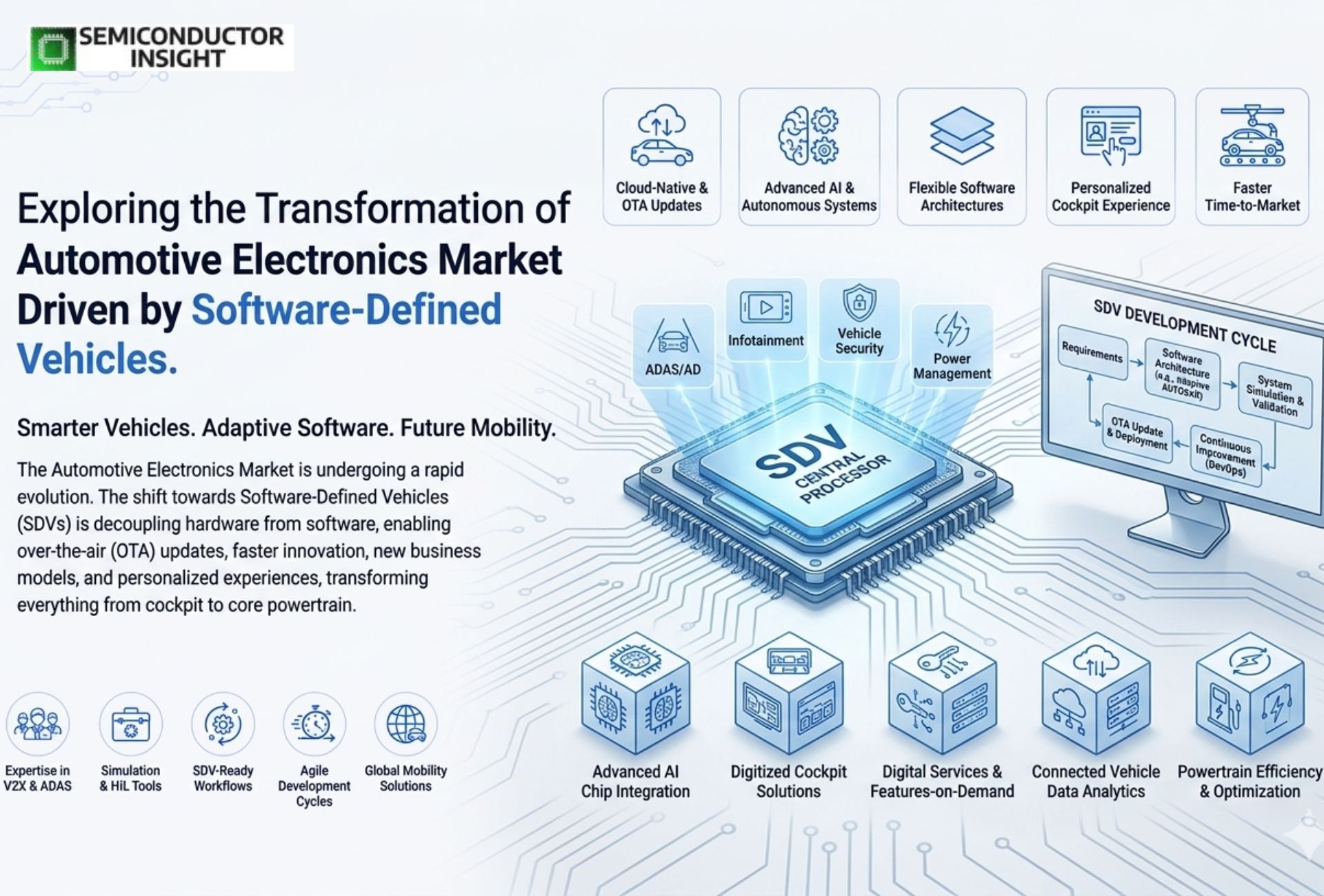
Exploring the Transformation of Automotive Electronics Market Driven by Software-Defined Vehicles
Automotive Electronics Market refers to the global industry involved in the design, development, production, and integration of electronic systems and components used in vehicles to improve safety, performance, connectivity, efficiency, and driving experience.
Cars are no longer defined only by horsepower, fuel efficiency, or exterior styling. Modern vehicles are increasingly becoming rolling semiconductor platforms filled with intelligent electronics, connected systems, sensors, and embedded computing architectures. From advanced driver assistance systems to immersive digital cockpits, automotive electronics market is transforming how vehicles operate, communicate, and protect passengers.
The shift is accelerating as automakers race to deliver electric mobility, autonomous capabilities, and software-driven vehicle experiences. Semiconductor suppliers are now among the most influential players in the automotive ecosystem because nearly every modern automotive function depends on electronic control units, sensors, processors, memory chips, and power semiconductors.
Vehicles Are Turning Into High-Performance Computing Machines
- Automotive architecture is rapidly shifting from isolated electronic modules to centralised computing systems capable of handling massive amounts of real-time data. Premium vehicles now process information from cameras, radar, LiDAR, ultrasonic sensors, navigation systems, and driver monitoring tools simultaneously.
- Companies such as NVIDIA and Qualcomm are increasingly supplying automotive computing platforms designed for AI-based driving assistance and digital cockpit experiences. Carmakers are integrating these systems to support lane centreing, adaptive cruise control, intelligent parking, and predictive navigation.
- In 2025, several next-generation electric vehicle launches from Chinese and European manufacturers introduced centralised computing platforms capable of software updates over the air. This allows automakers to improve vehicle features remotely without requiring dealership visits, similar to smartphone operating system updates.
To Know More about the Report, You Can Freely Browse Our Latest Updated Related Report: https://semiconductorinsight.com/report/automotive-electronics-printed-circuit-board-market/
Radar and Vision Chips Are Becoming Essential Safety Components
Safety electronics have become one of the fastest-evolving segments within the automotive electronics market. Advanced driver assistance systems are no longer restricted to luxury vehicles. Features such as blind spot monitoring, automatic emergency braking, and pedestrian detection are increasingly appearing in mid-range vehicle categories.
The European Union’s General Safety Regulation has accelerated the adoption of intelligent safety systems by requiring several driver assistance technologies in new vehicle models sold across Europe. These regulations are increasing demand for radar transceivers, imaging sensors, microcontrollers, and automotive-grade processors.
According to the U.S. National Highway Traffic Safety Administration, automatic emergency braking systems have shown significant potential in reducing rear-end collisions. This is encouraging automakers to expand semiconductor integration across safety architectures.
Automotive radar shipments are also climbing sharply as manufacturers push toward Level 2 and Level 3 automated driving capabilities. Semiconductor companies are developing higher-resolution radar chips that improve object detection accuracy during rain, fog, and nighttime driving conditions.
Battery Management Electronics Are Becoming the Brain of Electric Vehicles
- Electric vehicles depend heavily on sophisticated electronics for battery optimisation, charging efficiency, and thermal regulation. Battery management systems continuously monitor voltage, temperature, current flow, and charging patterns to maximise performance and safety.
- Modern EV battery packs may contain thousands of individual lithium-ion cells that require constant electronic balancing. Semiconductor-powered battery controllers help prevent overheating, improve energy efficiency, and extend battery lifespan.
- In fast charging infrastructure, silicon carbide semiconductors are gaining attention because they handle higher voltages and temperatures more efficiently than traditional silicon chips.
- Carmakers, including Tesla and BYD, are increasingly integrating silicon carbide technologies into vehicle power electronics to improve driving range and charging speed.
Digital Cockpits Are Redefining the Passenger Experience
Vehicle interiors are undergoing one of the most dramatic electronic transformations in automotive history. Touchscreen dashboards, augmented reality displays, voice recognition systems, and AI-powered infotainment platforms are becoming central selling points for new vehicles.
According to data from the Japan Automobile Manufacturers Association and multiple automotive technology publications, the number of display panels per vehicle has increased significantly over the past decade. Some premium electric vehicles now feature pillar-to-pillar digital displays combined with rear seat entertainment systems and intelligent voice assistants.
Automotive display electronics are creating new demand for graphics processors, OLED display drivers, connectivity chips, and memory components. Consumers increasingly expect vehicles to deliver digital experiences comparable to smartphones and home entertainment systems.
Several automakers are also experimenting with emotional AI systems that monitor driver fatigue, stress levels, and attention through interior sensors and facial recognition tools.
Semiconductor Supply Chains Are Becoming a National Priority
The global chip shortage that disrupted vehicle production during recent years exposed how deeply automotive manufacturing depends on semiconductor availability. According to industry reports from automotive associations and manufacturing agencies, millions of vehicles experienced delayed production because of semiconductor shortages affecting microcontrollers and power management chips.
Governments worldwide are now investing heavily in semiconductor manufacturing expansion. The United States CHIPS and Science Act, Europe’s semiconductor initiatives, and major fabrication investments across Asia are all partially influenced by the automotive sector’s rising chip demand.
Automakers are also redesigning supplier relationships by working more directly with semiconductor manufacturers to secure long-term chip supply agreements.
Cars Are Quietly Becoming Consumer Electronics Platforms
- Automotive electronics market is evolving beyond transportation engineering into a technology ecosystem shaped by software, AI, cloud connectivity, and semiconductor innovation.
- Modern vehicles increasingly resemble intelligent connected devices capable of learning driver behaviour, updating features remotely, and interacting with broader digital environments.
As electric mobility expands and autonomous technologies mature, automotive electronics will continue moving closer to the centre of vehicle identity itself. The next generation of vehicles will likely be judged less by engine specifications and more by computing capability, digital intelligence, safety automation, and connected user experience.

Comments (0)