MARKET INSIGHTS
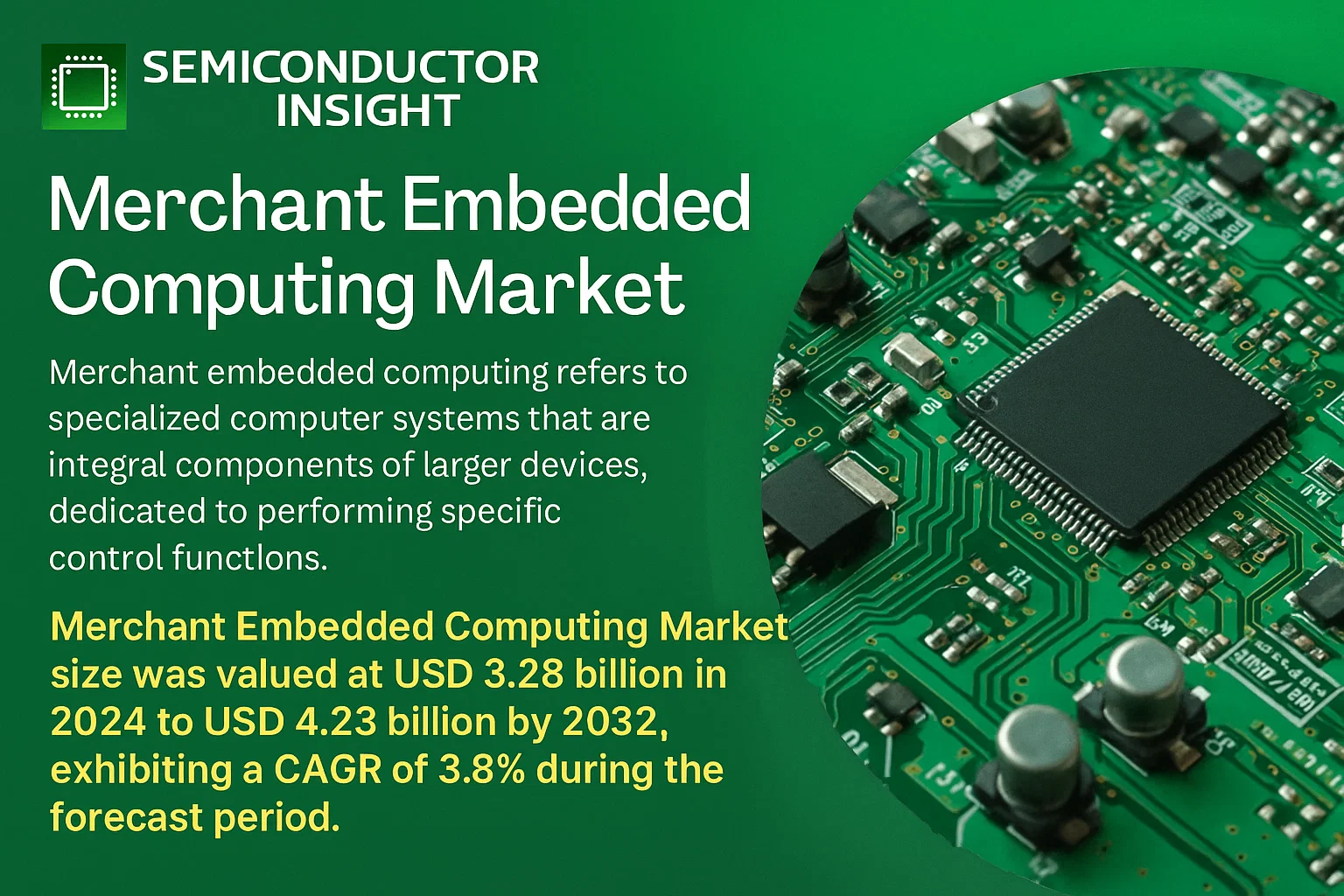
Global Merchant Embedded Computing Market size was valued at USD 3.28 billion in 2024 to USD 4.23 billion by 2032, exhibiting a CAGR of 3.8% during the forecast period.
Merchant embedded computing refers to specialized computer systems that are integral components of larger devices, dedicated to performing specific control functions. These systems consist of a microprocessor or microcontroller acting as the processing core and are designed for reliability within applications such as industrial automation, medical machinery, and automotive systems. Key product segments include ARM, X86, and PowerPC architectures.
The market is experiencing steady growth driven by increasing automation across industries and the proliferation of connected devices in the Internet of Things (IoT). While industrial automation remains the dominant application segment, significant demand also comes from defense & aerospace, communications, and medical sectors. Europe currently holds the largest regional market share at approximately 35%, followed by North America and Asia Pacific collectively accounting for over 55% of the global market.
MARKET DRIVERS
Proliferation of IoT and Edge Computing
The exponential growth of Internet of Things (IoT) deployments and the shift towards edge computing are primary forces propelling the merchant embedded computing market. As industries from manufacturing to smart cities generate massive volumes of data at the network edge, there is a critical need for robust, reliable, and compact computing solutions to process this data locally. This demand is driving the adoption of merchant embedded boards and systems designed for harsh environments and continuous operation.
Demand for AI and Machine Learning at the Edge
The integration of artificial intelligence (AI) and machine learning (ML) capabilities directly into edge devices is a significant driver. Modern applications, such as autonomous vehicles, industrial robotics, and predictive maintenance systems, require powerful, low-latency processing that only specialized embedded computing hardware can provide. This has led to increased demand for merchant solutions featuring GPUs, NPUs, and FPGAs capable of running complex inference models.
Furthermore, the continuous miniaturization of technology and the need for higher performance-per-watt are pushing innovation. Customers across sectors require smaller form factors with greater computational power, which merchant vendors are addressing with advanced System-on-Modules (SOMs) and single-board computers (SBCs).
MARKET CHALLENGES
Intense Competition and Price Pressure
The merchant embedded computing market is characterized by a high level of competition among numerous global and regional players. This environment creates significant price pressure, often squeezing profit margins. Customers, particularly high-volume OEMs, have substantial bargaining power, forcing vendors to compete aggressively on cost while maintaining high standards for quality, reliability, and long-term availability.
Other Challenges
Rapid Technological Obsolescence
The swift pace of innovation in semiconductor technology means product lifecycles are short. Vendors must continually invest in research and development to keep their product portfolios current with the latest processors, interfaces, and standards, which is a substantial and ongoing financial burden.
Supply Chain Complexities
Global supply chain disruptions, exacerbated by events like chip shortages, pose a major challenge. Securing a stable supply of critical components, such as advanced microprocessors and memory, is difficult and can lead to extended lead times and an inability to meet customer demand, impacting market growth.
MARKET RESTRAINTS
High Initial Development and Certification Costs
Developing ruggedized, reliable embedded computing solutions for critical applications in aerospace, defense, medical, and industrial automation requires significant investment in engineering, testing, and certification. Adherence to stringent standards, such as MIL-STD, IEC, and ISO, adds considerable time and cost to product development, acting as a barrier for some players and slowing down time-to-market for new solutions.
Long Product Lifecycles and Slow Replacement Cycles
Many end-market applications for merchant embedded computing, such as in industrial control or medical devices, have exceptionally long lifecycles, often exceeding ten years. Once a solution is qualified and deployed, customers are highly reluctant to change or upgrade due to the associated requalification costs and risks, which restrains the frequency of new sales opportunities for vendors.
MARKET OPPORTUNITIES
Expansion into Emerging Application Areas
Significant growth opportunities exist in emerging application areas such as autonomous mobile robots (AMRs), digital healthcare devices, and 5G infrastructure. These sectors demand specialized, high-performance embedded computing for real-time data processing, connectivity, and control, creating new revenue streams for merchants who can deliver tailored, cutting-edge solutions.
Adoption of Modular and Scalable Architectures
The growing preference for modular designs, such as COM Express and SMARC, presents a major opportunity. These standards allow for greater design flexibility, easier upgrades, and reduced development time for OEMs. Merchant vendors focusing on these scalable architectures are well-positioned to capture market share by offering future-proof solutions that protect customer investments.
Growth in Cybersecurity for Critical Infrastructure
As embedded systems become more connected and integral to critical infrastructure, the need for built-in hardware-based security features is paramount. This creates an opportunity for vendors to differentiate their offerings with advanced security functionalities, such as secure boot, trusted platform modules (TPM), and hardware-enforced isolation, catering to the demands of security-conscious markets.
The Merchant Embedded Computing Market Trends
Steady Global Growth Fueled by Diverse Applications
Global Merchant Embedded Computing Market demonstrates robust and steady growth, with a valuation of USD 3,279 million in 2024. The market is projected to expand to USD 4,228 million by 2032, representing a compound annual growth rate (CAGR) of 3.8% during the forecast period. These microcontrollers and microprocessor-based systems are integral components dedicated to performing specific tasks within larger systems across a multitude of industries. This consistent growth trajectory is underpinned by the critical role these systems play in modern technology infrastructure and automation. Their deployment in high-stakes sectors like defense, medical, and industrial automation necessitates reliable and continuous innovation and supply.
Other Trends
X86 Architecture Dominates Market Share
In terms of product architecture, the X86 segment is the clear market leader, holding approximately 65% of the global market share. This dominance is attributed to its high performance, extensive software compatibility, and established ecosystem, making it the preferred choice for demanding applications in automation, communications, and defense. Other architectures, including ARM, PowerPC, and others, cater to more specialized or power-efficient use cases but collectively represent a smaller portion of the overall market.
Regional Market Dynamics
Europe is the largest regional market for Merchant Embedded Computing, accounting for about 35% of global sales. This is closely followed by the combined markets of North America and Asia-Pacific, which together hold over 55% of the market share. The concentration in these regions reflects advanced industrial bases, significant investments in defense and aerospace, and the rapid adoption of automation technologies. The market’s geographical distribution indicates a strong correlation with global manufacturing and technological hubs.
Application-Based Market Segmentation
The Automations & Control application segment represents the largest end-use market for Merchant Embedded Computing systems. This is followed by Defense and Aerospace, Communications, Medical, and Automotive & Transport applications. The pervasive need for intelligent control and data processing in industrial settings drives the leading position of the Automations & Control sector. Each application area presents distinct requirements for reliability, performance, and environmental tolerance, shaping product development and specialization among key manufacturers. The market is characterized by a consolidated competitive landscape, with the top four manufacturers collectively holding over 30% of the market share, led by companies such as Advantech, Kontron, Abaco, and Artesyn Embedded.
COMPETITIVE LANDSCAPE
Key Industry Players
Top Four Manufacturers Command Over 30% of Global Market Share
Global Merchant Embedded Computing Market is characterized by the presence of several established players, with the top four manufacturers collectively holding a significant share exceeding 30%. Advantech stands as a prominent leader, renowned for its comprehensive portfolio of industrial computing and automation solutions. The market structure is moderately concentrated, with these leading firms leveraging strong brand reputation, extensive distribution networks, and continuous innovation in technologies like ARM and X86 architectures to maintain their positions. Competition is intense, driven by the need for high reliability and performance in critical applications across defense, automotive, and industrial automation sectors, with Europe representing the largest regional market.
Beyond the top tier, the market features a diverse range of significant niche players that cater to specialized application segments. Companies such as Mercury Systems excel in rugged, mission-critical computing for aerospace and defense, while Kontron and Abaco are key suppliers with strong footprints in telecommunications and transportation. Other notable participants like ADLINK, AAEON, and DFI focus on industrial automation and control, offering a variety of embedded boards and modules. These companies compete on factors including product customization, technological expertise, and cost-effectiveness, serving specific vertical markets and contributing to the overall dynamism and fragmentation of the broader industry landscape.
List of Key Merchant Embedded Computing Companies Profiled
- Advantech
- Kontron
- Abaco
- Artesyn Embedded (Advanced Energy)
- Curtiss Wright Controls
- ADLINK
- DFI
- MSC Technologies
- Congatec AG
- Axiomtek Co., Ltd.
- Portwell
- Radisys (Reliance Industries)
- Avalue Technology
- Mercury Systems
- IEI
Segment Analysis:
| Segment Category | Sub-Segments | Key Insights |
| By Type |
|
X86 architecture remains the dominant force in the merchant embedded computing market, primarily due to its long-standing legacy, extensive software ecosystem, and robust performance characteristics which are highly valued in complex industrial and defense applications. The architecture benefits from strong backward compatibility and widespread developer familiarity. Conversely, the ARM segment is experiencing significant growth momentum, driven by its exceptional power efficiency and scalability, making it increasingly attractive for mobile, communications, and new edge computing applications where low power consumption is a critical design constraint. |
| By Application |
|
Automations and Control stands as the leading application segment, propelled by the global industrial digitalization trend and the accelerating adoption of Industry 4.0 principles. This segment demands highly reliable and real-time computing solutions for factory automation, process control, and robotics. The Defense and Aerospace application also represents a key high-value segment, characterized by stringent requirements for ruggedness, longevity, and secure, deterministic performance in critical systems, which leads to a strong preference for proven, high-performance computing platforms from established suppliers. |
| By End User |
|
Industrial OEMs constitute the largest end-user segment, as they are the primary integrators of merchant embedded computing solutions into their machinery, equipment, and control systems for various vertical markets. Their demand is driven by the need for standardized, reliable computing cores that accelerate product development cycles. Following closely, Government & Defense Contractors represent a highly specialized and quality-focused segment, requiring solutions that meet rigorous certification standards and offer long-term availability and support for mission-critical national security and aerospace programs. |
| By Form Factor |
|
Boards & Modules, particularly Computer-on-Modules (COMs), are the leading form factor due to their design flexibility, which allows OEMs to develop custom carrier boards for specific applications while leveraging a standardized, scalable computing core. This approach significantly reduces development time and cost. The Embedded Box PCs segment is also prominent, especially for applications requiring a complete, self-contained computing solution with standard I/O interfaces, making them ideal for deployment in kiosks, digital signage, and light industrial settings without the need for extensive custom engineering. |
| By Performance Tier |
|
High-Performance Computing is the leading performance tier, driven by applications in defense, telecommunications, and advanced industrial automation that require significant processing power for tasks like signal processing, real-time data analysis, and complex algorithmic computations. However, the Low-Power & Edge Computing tier is demonstrating the most dynamic growth, fueled by the explosion of IoT deployments and the need to process data locally at the network edge to reduce latency, conserve bandwidth, and enhance operational reliability in distributed systems across smart cities, automotive, and remote monitoring applications. |
Regional Analysis: The Merchant Embedded Computing Market
The region is a global epicenter for technological R&D, with significant investments in AI, edge computing, and secure connectivity. This environment fosters the development of cutting-edge merchant embedded systems tailored for high-performance applications, keeping North American vendors ahead in the innovation curve.
Mature aerospace, defense, and industrial automation sectors demand highly reliable, ruggedized embedded computing solutions. This drives a consistent requirement for sophisticated Single Board Computers (SBCs) and modules that can operate in harsh environments, creating a stable, high-value market segment.
North American enterprises are typically early adopters of new technologies, accelerating the integration of embedded computing into IoT deployments, autonomous systems, and digital transformation initiatives. This creates a dynamic market that quickly absorbs new product generations and features.
Strict regulatory frameworks concerning safety, security, and interoperability in critical industries compel the use of certified, high-quality merchant embedded components. This reinforces the market for vendors who can meet these stringent requirements, often setting standards that are adopted globally.
Europe
Europe represents a major and highly sophisticated market for merchant embedded computing, characterized by its strong automotive industry, industrial manufacturing base, and focus on quality and precision. The region’s stringent regulations, particularly around functional safety and data privacy (e.g., GDPR), drive demand for secure and reliable embedded systems. There is significant investment in industrial IoT and automation, especially in Germany’s Industrie 4.0 initiatives, which require robust computing platforms for smart factories. The presence of leading automotive manufacturers pushes innovation in areas like Advanced Driver-Assistance Systems (ADAS), creating a specialized demand for high-performance, automotive-grade embedded solutions. Collaboration between academia, research institutions, and industry supports continuous technological advancement.
Asia-Pacific
The Asia-Pacific region is the fastest-growing market for merchant embedded computing, fueled by massive industrialization, urbanization, and government-led digitalization programs. Countries like China, Japan, South Korea, and Taiwan are powerhouses in electronics manufacturing, creating both supply and demand for embedded components. The consumer electronics sector is a massive driver, but there is rapidly increasing adoption in industrial automation, telecommunications (with 5G rollouts), and automotive applications. The region benefits from a strong manufacturing ecosystem and cost-competitive production, though there is a growing emphasis on moving up the value chain to develop more advanced, high-performance computing solutions to compete globally.
South America
The merchant embedded computing market in South America is emerging, with growth primarily driven by gradual industrial modernization and infrastructure development. Key industries such as mining, agriculture, and energy are beginning to adopt automation and IoT solutions, which in turn creates demand for basic to mid-range embedded systems. The market is characterized by price sensitivity and a focus on practical, durable solutions suited to local industrial conditions. Economic volatility can impact investment cycles, but long-term growth potential exists as countries seek to improve productivity and integrate more deeply into global supply chains, necessitating more advanced technological infrastructure.
Middle East & Africa
This region presents a diverse but growing opportunity for merchant embedded computing, largely driven by ambitious smart city projects, oil and gas automation, and telecommunications infrastructure expansion, particularly in the Gulf Cooperation Council (GCC) countries. The focus is on rugged and reliable systems capable of operating in extreme environmental conditions. In Africa, growth is more nascent, with potential in telecommunications and financial technology applications. The market is fragmented, with demand varying significantly between the oil-rich nations investing in high-tech infrastructure and developing nations where adoption is in earlier stages, often focused on essential connectivity and basic automation.
Report Scope
This market research report provides a comprehensive analysis of the Global The Merchant Embedded Computing Market, covering the forecast period 2025–2032. It offers detailed insights into market dynamics, technological advancements, competitive landscape, and key trends shaping the industry.
Key focus areas of the report include:
- Market Overview: The report begins with an overview outlining its current market scenario, key growth indicators, and industry transformation drivers. It discusses macroeconomic factors, demand–supply balance, regulatory landscape, and the strategic role of semiconductors in powering advancements across industries such as automotive, telecommunications, consumer electronics, and industrial automation.
- Market Size & Forecast: Historical data and future projections for revenue, unit shipments, and market value across major regions and segments.
- Segmentation Analysis: Detailed breakdown by product type, technology, application, and end-user industry to identify high-growth segments and investment opportunities.
- Regional Insights: Insights into market performance across North America, Europe, Asia-Pacific, Latin America, and the Middle East & Africa, including country-level analysis where relevant.
- Competitive Landscape: Profiles of leading market participants, including their product offerings, R&D focus, manufacturing capacity, pricing strategies, and recent developments such as mergers, acquisitions, and partnerships.
- Technology Trends & Innovation: Assessment of emerging technologies, integration of AI/IoT, semiconductor design trends, fabrication techniques, and evolving industry standards.
- Market Drivers & Restraints: Evaluation of factors driving market growth along with challenges, supply chain constraints, regulatory issues, and market-entry barriers.
- Stakeholder Insights: Insights for component suppliers, OEMs, system integrators, investors, and policymakers regarding the evolving ecosystem and strategic opportunities.
Primary and secondary research methods are employed, including interviews with industry experts, data from verified sources, and real-time market intelligence to ensure the accuracy and reliability of the insights presented.
FREQUENTLY ASKED QUESTIONS:
What is the current market size of The Merchant Embedded Computing Market?
-> The Global The Merchant Embedded Computing Market was valued at USD 3279 million in 2024 and is projected to reach USD 4228 million by 2032, growing at a CAGR of 3.8% during the forecast period.
Which key companies operate in The Merchant Embedded Computing Market?
-> Key players include Advantech, Kontron, Abaco, Artesyn Embedded (Advanced Energy), Curtiss Wright Controls, ADLINK, DFI, MSC Technologies, Congatec AG, and Axiomtek Co., Ltd., among others. The global top four manufacturers hold a share over 30%.
What are the key growth drivers?
-> Key growth is driven by increasing demand across key application sectors such as Defense and Aerospace, Communications, Medical, Automotive and Transport, and Automations and Control, where embedded computing systems are integral for functionality.
Which region dominates the market?
-> Europe is the largest market, with a share of about 35%, followed by North America and Asia Pacific, which together account for over 55% of the market.
What are the emerging trends?
-> Emerging trends include the increasing adoption of X86 architecture, which holds the largest product segment share of about 65%, and the expansion of embedded computing into entertainment, science, and technology applications for performing specific tasks.

Get Sample Report PDF for Exclusive Insights
Report Sample Includes
- Table of Contents
- List of Tables & Figures
- Charts, Research Methodology, and more...
 Download Sample Report PDF