Market Insights
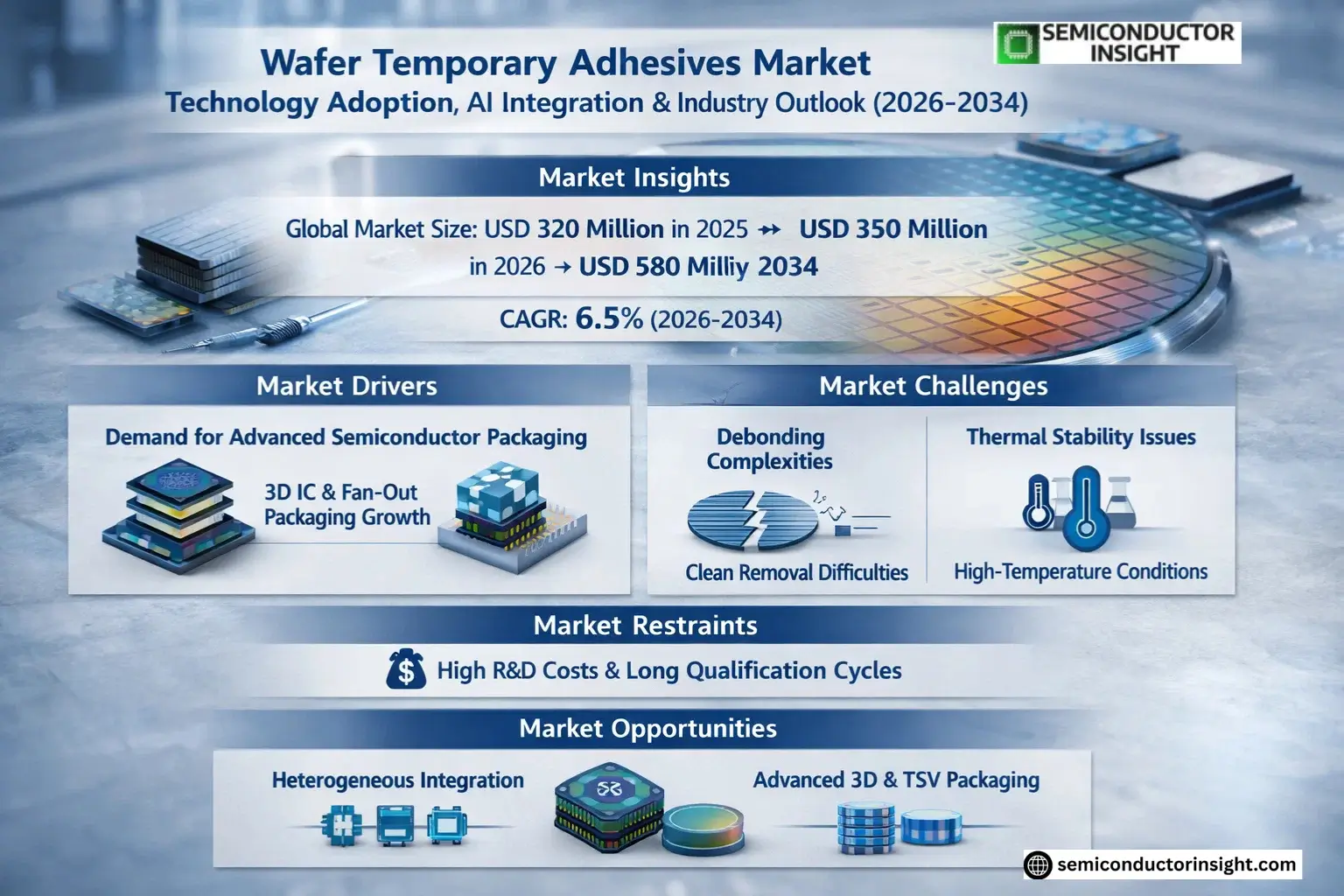
Global Wafer Temporary Adhesives Market size was valued at USD 320 million in 2025. The market is projected to grow from USD 350 million in 2026 to USD 580 million by 2034, exhibiting a CAGR of 6.5% during the forecast period.
Wafer temporary adhesives are specialized materials used in semiconductor manufacturing to temporarily bond wafers to carrier substrates during processes like thinning, grinding, and dicing. These adhesives ensure precise handling while allowing easy removal without damaging delicate semiconductor structures. Key types include UV-curable and water-soluble formulations, each offering distinct advantages for different fabrication stages.
The market growth is driven by increasing demand for advanced semiconductor packaging and the miniaturization of electronic components. However, challenges such as stringent purity requirements and thermal stability constraints impact material development. Leading players like 3M, Brewer Science, and Tokyo Ohka Kogyo are innovating low-residue adhesives to meet evolving industry standards for next-generation chip production.
MARKET DRIVERS
Growing Demand for Advanced Semiconductor Packaging
Wafer Temporary Adhesives Market is experiencing strong growth due to the rising demand for advanced semiconductor packaging solutions. With the semiconductor industry transitioning to 3D IC packaging and fan-out wafer-level packaging, temporary adhesives play a critical role in enabling thin wafer handling during processing. The market is projected to grow at a CAGR of approximately 7% over the next five years.
Expansion of MEMS and IoT Applications
Increasing adoption of MEMS devices and IoT technologies is driving demand for wafer temporary adhesives in microfabrication processes. These adhesives provide essential support for ultra-thin wafers used in sensors, actuators, and other miniaturized components. The growing automotive electronics sector is contributing significantly to this demand.
Additionally, the transition to larger wafer sizes (300mm and above) in advanced semiconductor manufacturing is requiring more sophisticated temporary bonding solutions with better thermal and mechanical stability.
MARKET CHALLENGES
Technical Complexities in Debonding Processes
One of the primary challenges in the Wafer Temporary Adhesives Market is maintaining wafer integrity during the debonding process. The need for clean separation without residue or damage becomes increasingly critical as wafer thickness decreases below 50μm. This creates significant technical hurdles for adhesive formulators and equipment manufacturers alike.
Other Challenges
Thermal Stability Requirements
As processing temperatures rise in advanced packaging applications, temporary adhesives must demonstrate exceptional thermal stability while still allowing for clean removal – a difficult balance to achieve.
MARKET RESTRAINTS
High Development Costs and Long Qualification Cycles
Wafer Temporary Adhesives Market faces restraints from the significant R&D investments required to develop new formulations. Semiconductor manufacturers’ rigorous qualification processes, which can take 12-18 months, also slow market adoption of innovative adhesive solutions.
MARKET OPPORTUNITIES
Emerging Applications in Heterogeneous Integration
The growing trend toward heterogeneous integration in semiconductor manufacturing presents significant opportunities for wafer temporary adhesives. These advanced packaging approaches require temporary bonding solutions that can accommodate different material types and thermal expansion coefficients, creating demand for specialized adhesive formulations.
Wafer Temporary Adhesives Market Trends
Rising Demand for Advanced Semiconductor Packaging Solutions
Wafer Temporary Adhesives Market is experiencing significant growth driven by increasing demand for advanced semiconductor packaging solutions. These adhesives play a crucial role in temporary wafer bonding applications, particularly in 3D IC packaging and through-silicon via (TSV) processes. Manufacturers are focusing on developing adhesives with improved thermal stability and mechanical properties to accommodate thinner wafer processing requirements.
Other Trends
Shift Toward UV-Curable Temporary Adhesives
UV-curable temporary adhesives are gaining prominence due to their efficient curing process and clean removal characteristics. This technology offers precise control over adhesion strength and enables room-temperature debonding, reducing thermal stress on delicate semiconductor wafers during processing.
Emerging Applications in MEMS Devices
The expanding MEMS (Micro-Electro-Mechanical Systems) market is creating new opportunities for wafer temporary adhesives. These adhesives are increasingly used in MEMS fabrication for temporary bonding during backside processing and packaging operations, particularly for sensitive MEMS structures.
Geographical Market Expansion
Asia-Pacific continues to dominate the Wafer Temporary Adhesives Market, with significant growth in semiconductor manufacturing activities in China, South Korea, and Taiwan. North America maintains strong demand for high-performance adhesives in advanced packaging applications, while Europe shows steady growth in specialized semiconductor manufacturing sectors.
Technological Advancements in Adhesive Formulations
Key market players are investing in research to develop adhesives with enhanced chemical resistance and lower thermal expansion coefficients. These innovations aim to address challenges in extreme processing conditions while maintaining clean debonding capabilities essential for high-yield semiconductor manufacturing.
COMPETITIVE LANDSCAPE
Key Industry Players
Technological innovation and material science expertise driving wafer adhesive competition
Global Wafer Temporary Adhesives Market is dominated by specialized chemical manufacturers with strong R&D capabilities in semiconductor materials. 3M and DELO maintain leadership positions through continuous product innovation in UV-curable and thermally releasable adhesives, collectively holding significant market share. Tokyo Ohka Kogyo (TOK) has emerged as a key Asian player with advanced water-soluble formulations, particularly for advanced packaging applications.
Niche specialists like Brewer Science and HD MicroSystems focus on application-specific solutions for wafer thinning and lithography processes. The competitive landscape also includes material science innovators such as AI Technology developing low-temperature debonding adhesives, while companies like Dynatex International specialize in precision dispensing systems compatible with these adhesives. Regional players are gaining traction with cost-effective solutions, though technology leaders maintain premium positioning through performance advantages.
List of Key Wafer Temporary Adhesives Companies Profiled
- 3M Company
- DELO Industrial Adhesives
- Tokyo Ohka Kogyo Co., Ltd. (TOK)
- AI Technology, Inc (AIT)
- Dynatex International
- Water Wash Technologies
- Brewer Science, Inc.
- Daetec LLC
- HD MicroSystems
- Valtech Corporation
- YINCAE Advanced Materials
- Micro Materials, Inc.
- Henkel Electronic Materials
- Shin-Etsu Chemical Co., Ltd.
- Dow Corning (now Dow Silicones)
Segment Analysis:
| Segment Category | Sub-Segments | Key Insights |
| By Type |
|
UV-curable Type dominates due to:
|
| By Application |
|
Wafer Thinning and Backgrinding remains the primary application due to:
|
| By End User |
|
Foundries lead adoption due to:
|
| By Technology |
|
Spin Coating maintains dominance with:
|
| By Wafer Size |
|
300mm Wafers drive demand because:
|
Regional Analysis: Asia-Pacific Wafer Temporary Adhesives Market
Taiwan’s semiconductor fabs have implemented proprietary wafer temporary adhesive formulations enabling superior thermal stability during backside processes. The region leads in developing low-temperature debonding solutions for thermally sensitive devices.
Tight integration between temporary adhesive suppliers and wafer processing equipment vendors has created optimized material-handling workflows. This ecosystem approach reduces contamination risks and improves throughput for thin wafer applications.
Growing demand for advanced packaging techniques like Fan-Out Wafer-Level Packaging (FOWLP) and 3D IC integration is propelling wafer temporary adhesive adoption. Taiwanese OSAT providers require materials enabling precise wafer stacking with minimal warpage.
R&D focus areas include laser-assisted debonding adhesives and AI-optimized material deposition systems. Emerging solutions target sub-50μm thin wafer handling with improved edge protection characteristics for next-gen devices.
South Korea
The South Korean Wafer Temporary Adhesives Market benefits from strong memory semiconductor manufacturing. Samsung and SK Hynix’s transition to advanced 3D NAND architectures has increased demand for specialized temporary bonding solutions. Local material companies have developed high-temperature resistant formulations tailored for memory wafer thinning processes. The market shows growing adoption of automated adhesive dispensing systems integrated with wafer-level packaging lines. Government semiconductor initiatives prioritize materials development for heterogeneous integration applications.
Japan
Japan’s mature semiconductor equipment sector drives demand for precision wafer temporary adhesives. Suppliers focus on ultra-clean formulations meeting stringent particle contamination requirements. The market sees increased R&D in temporary adhesives for compound semiconductor applications, particularly GaN and SiC power devices. Aging production facilities are adopting next-generation debonding technologies to maintain competitiveness in advanced packaging. Collaborative projects between material suppliers and equipment manufacturers aim to standardize bonding processes for 200mm and 300mm wafer handling.
China
China’s Wafer Temporary Adhesives Market is rapidly evolving alongside domestic semiconductor industry expansion. Local manufacturers are developing cost-competitive alternatives to imported temporary bonding materials. The government’s semiconductor self-sufficiency push has accelerated adhesive material development for MEMS and CIS applications. Emerging foundries increasingly adopt temporary adhesives suitable for mixed-process integration, combining legacy and advanced nodes. Heavy investments in R&D facilities aim to reduce dependence on foreign temporary bonding solutions by 2026.
Southeast Asia
The Southeast Asian market benefits from growing OSAT investments in Malaysia, Singapore, and Vietnam. Regional demand focuses on temporary adhesives supporting mainstream packaging technologies rather than cutting-edge nodes. Cost-sensitive manufacturers prioritize materials balancing performance and economics for mid-range semiconductor applications. The region sees increasing adoption of temporary bonding solutions for power device packaging, driven by electric vehicle component production. Local material development remains limited, with most advanced adhesives imported from Taiwan and Japan.
Report Scope
This market research report provides a comprehensive analysis of the Global Wafer Temporary Adhesives Market, covering the forecast period 2025–2034. It offers detailed insights into market dynamics, technological advancements, competitive landscape, and key trends shaping the industry.
Key focus areas of the report include:
- Market Overview: The report begins with an overview outlining its current market scenario, key growth indicators, and industry transformation drivers. It discusses macroeconomic factors, demand–supply balance, regulatory landscape, and the strategic role of semiconductors in powering advancements across industries such as automotive, telecommunications, consumer electronics, and industrial automation.
- Market Size & Forecast: Historical data and future projections for revenue, unit shipments, and market value across major regions and segments.
- Segmentation Analysis: Detailed breakdown by product type, technology, application, and end-user industry to identify high-growth segments and investment opportunities.
- Regional Insights: Insights into market performance across North America, Europe, Asia-Pacific, Latin America, and the Middle East & Africa, including country-level analysis where relevant.
- Competitive Landscape: Profiles of leading market participants, including their product offerings, R&D focus, manufacturing capacity, pricing strategies, and recent developments such as mergers, acquisitions, and partnerships.
- Technology Trends & Innovation: Assessment of emerging technologies, integration of AI/IoT, semiconductor design trends, fabrication techniques, and evolving industry standards.
- Market Drivers & Restraints: Evaluation of factors driving market growth along with challenges, supply chain constraints, regulatory issues, and market-entry barriers.
- Stakeholder Insights: Insights for component suppliers, OEMs, system integrators, investors, and policymakers regarding the evolving ecosystem and strategic opportunities.
Primary and secondary research methods are employed, including interviews with industry experts, data from verified sources, and real-time market intelligence to ensure the accuracy and reliability of the insights presented.
FREQUENTLY ASKED QUESTIONS:
What is the current market size of the Wafer Temporary Adhesives Market?
-> Wafer Temporary Adhesives Market size was valued at USD 320 million in 2025. The market is projected to grow from USD 350 million in 2026 to USD 580 million by 2034, exhibiting a CAGR of 6.5% during the forecast period.
What is the expected growth rate (CAGR) of the Wafer Temporary Adhesives Market?
-> The market is expected to grow at a CAGR of % during 2025–2034.
Which key companies operate in the Wafer Temporary Adhesives Market?
-> Key players include 3M, DELO, Tokyo Ohka Kogyo, AI Technology, Inc (AIT), Dynatex International, Water Wash Technologies, Brewer Science, Daetec, HD MicroSystems, and Valtech Corporation, among others.
What are the major applications of Wafer Temporary Adhesives?
-> Major applications include Wafer Thinning and Backgrinding, Wafer Bonding, Lithography and Patterning, and others.
Which region dominates the Wafer Temporary Adhesives Market?
-> The U.S. market is estimated at USD million in 2025, while China is projected to reach USD million during the forecast period. Asia-Pacific remains the fastest-growing region.
Get Sample Report PDF for Exclusive Insights
Report Sample Includes
- Table of Contents
- List of Tables & Figures
- Charts, Research Methodology, and more...
 Download Sample Report PDF