Market Insights
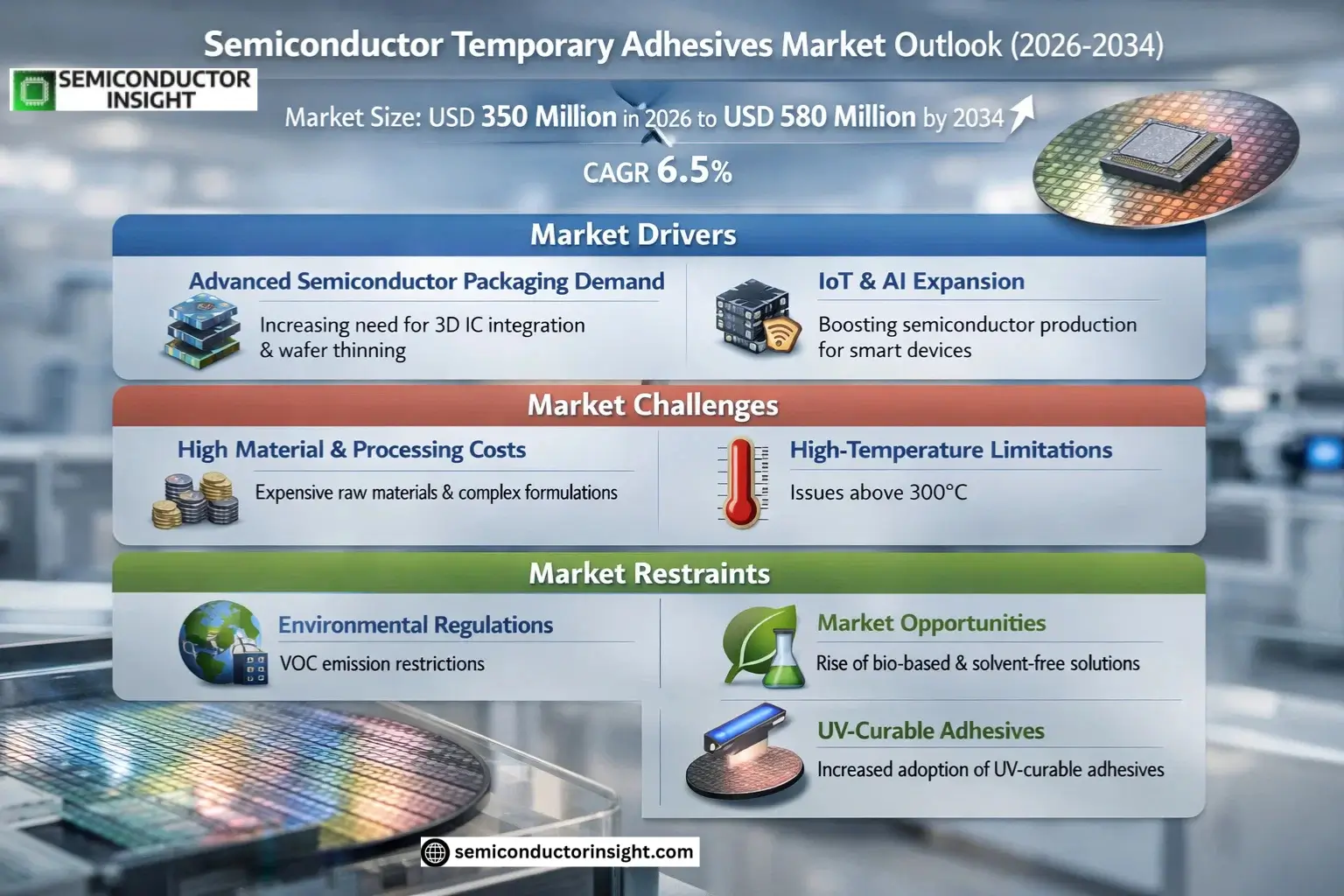
Global Semiconductor Temporary Adhesives Market size was valued at USD 320 million in 2025. The market is projected to grow from USD 350 million in 2026 to USD 580 million by 2034, exhibiting a CAGR of 6.5% during the forecast period.
Semiconductor temporary adhesives are specialized bonding materials used in chip manufacturing processes to temporarily secure wafers or dies during fabrication steps like thinning, grinding, or lithography. These advanced adhesives maintain structural integrity during processing while allowing clean removal without residue, enabling thinner wafer profiles and multi-layer stacking essential for modern semiconductor devices.
The market growth is driven by increasing demand for advanced packaging technologies and shrinking semiconductor geometries requiring precision handling solutions. While wafer-level packaging adoption accelerates growth, material compatibility challenges with emerging substrates present hurdles. Key players including Brewer Science and Tokyo Ohka Kogyo are developing low-temperature cure formulations to address thermal sensitivity in next-generation devices, with the UV-curable segment expected to capture over 60% market share by 2030 due to its processing advantages.
MARKET DRIVERS
Growing Demand for Advanced Semiconductor Packaging
Semiconductor Temporary Adhesives Market is experiencing significant growth due to the increasing demand for advanced packaging technologies. With the rising complexity of semiconductor devices, temporary bonding solutions are becoming essential for wafer thinning and 3D IC integration processes. The market is projected to grow at a CAGR of 7.2% as manufacturers seek high-performance adhesives that enable precise handling during production.
Expansion of IoT and AI Applications
The proliferation of IoT devices and AI-driven technologies is accelerating semiconductor production, directly boosting demand for temporary adhesives. These adhesives play a critical role in manufacturing sensors and memory chips used in smart devices. Leading manufacturers are investing heavily in R&D to develop adhesives with improved thermal stability and debonding efficiency.
Additionally, the shift toward miniaturization in electronics is pushing the need for temporary adhesives that can withstand extreme processing conditions while maintaining precise alignment.
MARKET CHALLENGES
High Material and Processing Costs
The development of specialized temporary adhesives requires expensive raw materials and complex formulations, leading to higher production costs. Many small-scale semiconductor manufacturers find it challenging to adopt these advanced solutions due to budget constraints. This cost barrier could limit market expansion in developing regions.
Other Challenges
Technical Limitations in High-Temperature Applications
Current temporary adhesives face performance issues in ultra-high-temperature semiconductor processes above 300°C, requiring frequent reapplications and increasing production downtime.
MARKET RESTRAINTS
Stringent Environmental Regulations
Environmental concerns regarding solvent-based temporary adhesives are prompting stricter regulations worldwide. Many regional governments are imposing limitations on volatile organic compound (VOC) emissions, forcing manufacturers to invest in costly reformulations. This regulatory pressure is slowing the adoption rate of certain adhesive technologies in the semiconductor industry.
MARKET OPPORTUNITIES
Development of Eco-Friendly Adhesive Solutions
There is growing potential for bio-based and solvent-free temporary adhesives in the semiconductor market. With sustainability becoming a key industry focus, manufacturers developing green adhesive technologies could capture significant market share. The Asia-Pacific region in particular shows strong demand for environmentally friendly semiconductor processing materials.
Semiconductor Temporary Adhesives Market Trends
Rising Demand for UV-Curable Temporary Adhesives
Semiconductor Temporary Adhesives Market is witnessing increased adoption of UV-curable types due to their faster curing times and enhanced processing efficiency. These adhesives enable precise wafer handling while allowing clean removal without residue, making them ideal for advanced semiconductor packaging applications. Manufacturers are investing in UV formulations that withstand high-temperature processes common in semiconductor fabrication.
Other Trends
Water-Soluble Adhesives Gaining Traction in Delicate Processes
Water-soluble temporary adhesives are seeing growth in applications requiring ultra-clean debonding, particularly for thin wafer processing. Their eco-friendly removal process reduces chemical usage in semiconductor manufacturing, aligning with sustainability initiatives across the electronics industry.
Asia-Pacific Emerges as Production Hub
Semiconductor Temporary Adhesives Market shows concentrated growth in Asia-Pacific, particularly China and South Korea, driven by expanding semiconductor fabrication facilities. Leading manufacturers are establishing local production centers to serve the region’s growing demand for advanced packaging solutions. This geographic shift is influencing adhesive formulations tailored to regional manufacturing specifications.
Innovations in Debonding Technology
Recent developments focus on low-stress debonding methods that preserve delicate semiconductor structures. New adhesive chemistries enable room-temperature separation, reducing thermal stress on sensitive components during the manufacturing process.
Integration with Advanced Packaging Techniques
Semiconductor Temporary Adhesives are being optimized for emerging packaging technologies like 3D IC stacking and fan-out wafer-level packaging. Manufacturers are developing specialized formulations that maintain stability during increasingly complex semiconductor fabrication processes while meeting stringent purity requirements.
COMPETITIVE LANDSCAPE
Key Industry Players
Global Semiconductor Temporary Adhesives Market Competitive Analysis 2021-2034
Global Semiconductor Temporary Adhesives Market is led by established chemical and material science companies, with 3M, DELO, and Tokyo Ohka Kogyo collectively holding a significant market share. These industry leaders offer advanced UV-curable and water-soluble adhesive formulations that meet the stringent requirements of wafer thinning, bonding, and lithography processes. The market exhibits moderate consolidation, with the top five players accounting for approximately 40% of global revenue, while specialized manufacturers cater to niche applications with customized solutions.
Emerging competitors like AI Technology and YINCAE Advanced Materials are gaining traction through innovative formulations with enhanced thermal stability and clean removal properties. Regional players such as Brewer Science in North America and HD MicroSystems in Asia are expanding their portfolios to address the growing demand for thin wafer processing in advanced semiconductor packaging. The competitive landscape is further diversified by technology-focused firms like Dynatex International and Water Wash Technologies that specialize in adhesive removal systems.
List of Key Semiconductor Temporary Adhesives Companies Profiled
- 3M
- DELO
- Tokyo Ohka Kogyo
- AI Technology, Inc (AIT)
- Dynatex International
- Water Wash Technologies
- Brewer Science
- Daetec
- HD MicroSystems
- Valtech Corporation
- YINCAE Advanced Materials
- Micro Materials
- Dow Chemical Company
- Shin-Etsu Chemical
- Henkel Electronics
Segment Analysis:
| Segment Category | Sub-Segments | Key Insights |
| By Type |
|
UV-curable Type is witnessing higher adoption due to its superior performance characteristics:
|
| By Application |
|
Wafer Thinning and Backgrinding emerges as the dominant application segment due to:
|
| By End User |
|
Foundries represent the most significant end-user segment because:
|
| By Technology |
|
Thermal Slide Debonding remains the preferred technology because:
|
| By Product Form |
|
Liquid Adhesives dominate the market due to:
|
Regional Analysis: Global Semiconductor Temporary Adhesives Market
Asia-Pacific leads in adopting UV-curable temporary adhesives for 3D IC stacking, with Japanese manufacturers pioneering low-stress formulations. The region’s focus on heterogeneous integration drives innovation in thermally stable bonding materials for chiplet architectures.
Taiwan’s vertically integrated semiconductor ecosystem enables rapid adoption of specialized adhesives. Local adhesive developers collaborate closely with foundries to customize solutions for advanced nodes below 7nm.
China’s expanding 300mm wafer capacity creates massive demand for high-volume temporary bonding solutions. Domestic adhesive suppliers are developing cost-effective alternatives to imported products for mature node applications.
South Korea’s memory giants invest heavily in temporary adhesives for ultra-thin wafer handling in DRAM packaging. National research programs support development of laser-debondable adhesives for fan-out wafer-level packaging.
North America
North America maintains technological leadership in developing specialized semiconductor temporary adhesives, with major materials companies headquartered in the region. The U.S. sees strong demand from both domestic fabs and offshore packaging partners, particularly for high-performance adhesives used in aerospace and defense applications. Silicon Valley’s ecosystem drives innovation in temporary bonding solutions for advanced 3D packaging, with particular emphasis on materials compatible with hybrid bonding workflows. Leading adhesive manufacturers collaborate closely with equipment vendors to develop integrated debonding solutions.
Europe
Europe’s Semiconductor Temporary Adhesives Market benefits from strong automotive and industrial semiconductor demand. German and French manufacturers lead in developing high-temperature stable adhesives for power electronics applications. The region shows increasing adoption of temporary bonding solutions for MEMS and sensor packaging, with stringent environmental regulations pushing development of greener adhesive chemistries. Collaborative R&D projects between material suppliers and equipment manufacturers are accelerating qualification of new adhesive systems.
Middle East & Africa
The Middle East is emerging as a strategic hub for semiconductor packaging services, creating new opportunities for temporary adhesive suppliers. Growing investments in advanced packaging facilities in Israel and the UAE are driving demand for specialized bonding solutions. The region focuses on adhesives compatible with harsh environment applications, particularly for oil and gas industry sensors. Local manufacturers are partnering with global material suppliers to establish regional technical support capabilities.
South America
South America’s growing electronics manufacturing sector is creating incremental demand for semiconductor temporary adhesives, primarily for consumer electronics applications. Brazil leads in local adhesive formulation development for lower-cost packaging solutions. The region serves as a testing ground for simplified temporary bonding systems designed for smaller-scale packaging operations, with particular focus on easy-to-implement adhesive/debonding solutions.
Report Scope
This market research report provides a comprehensive analysis of the Semiconductor Temporary Adhesives Market, covering the forecast period 2025–2034. It offers detailed insights into market dynamics, technological advancements, competitive landscape, and key trends shaping the industry.
Key focus areas of the report include:
- Market Overview: The report begins with an overview outlining its current market scenario, key growth indicators, and industry transformation drivers. It discusses macroeconomic factors, demand–supply balance, regulatory landscape, and the strategic role of semiconductor temporary adhesives in manufacturing processes across industries such as electronics, automotive, and telecommunications.
- Market Size & Forecast: Historical data and future projections for revenue, unit shipments, and market value across major regions and segments.
- Segmentation Analysis: Detailed breakdown by product type (UV-curable, Water-soluble), application (Wafer Thinning, Wafer Bonding, Lithography), and end-user industry.
- Regional Insights: Insights into market performance across North America, Europe, Asia-Pacific, Latin America, and the Middle East & Africa, including country-level analysis where relevant.
- Competitive Landscape: Profiles of leading market participants, including their product offerings, R&D focus, manufacturing capacity, pricing strategies, and recent developments such as mergers, acquisitions, and partnerships.
- Technology Trends & Innovation: Assessment of emerging technologies, fabrication techniques, and evolving industry standards in semiconductor adhesives.
- Market Drivers & Restraints: Evaluation of factors driving market growth along with challenges, supply chain constraints, regulatory issues, and market-entry barriers.
- Stakeholder Insights: Insights for component suppliers, OEMs, system integrators, investors, and policymakers regarding the evolving ecosystem and strategic opportunities.
Primary and secondary research methods are employed, including interviews with industry experts, data from verified sources, and real-time market intelligence to ensure the accuracy and reliability of the insights presented.
FREQUENTLY ASKED QUESTIONS:
What is the current market size of Semiconductor Temporary Adhesives Market?
-> Semiconductor Temporary Adhesives Market size was valued at USD 320 million in 2025. The market is projected to grow from USD 350 million in 2026 to USD 580 million by 2034, exhibiting a CAGR of 6.5% during the forecast period.
Which key companies operate in Semiconductor Temporary Adhesives Market?
-> Key players include 3M, DELO, Tokyo Ohka Kogyo, AI Technology, Inc (AIT), Dynatex International, Water Wash Technologies, Brewer Science, Daetec, HD MicroSystems, and Valtech Corporation, among others. In 2025, the global top five players had a share approximately % in terms of revenue.
What are the key growth drivers?
-> Key growth drivers include increasing demand for semiconductor components, advancements in wafer processing technologies, and rising investments in semiconductor manufacturing infrastructure.
Which region dominates the market?
-> Asia is the dominant market, with China reaching USD million and the U.S. market estimated at USD million in 2025.
What are the emerging trends?
-> Emerging trends include UV-curable adhesives (projected to reach USD million by 2034), water-soluble solutions, and advanced bonding techniques for fragile semiconductor components.
Get Sample Report PDF for Exclusive Insights
Report Sample Includes
- Table of Contents
- List of Tables & Figures
- Charts, Research Methodology, and more...
 Download Sample Report PDF