Conductive Carrier Tape Market Insights
Global conductive carrier tape market size was valued at USD 645 million in 2025. The market is projected to grow from USD 698 million in 2026 to USD 1,133 million by 2034, exhibiting a CAGR of 8.1% during the forecast period.
Conductive carrier tape is a specialized packaging solution designed for electrostatic-sensitive electronic components. It consists of plastic substrates—primarily polystyrene (PS) or polycarbonate (PC)—embedded with conductive fillers like carbon black or metal powder to achieve surface resistivity between 10⁴–10¹¹ Ω/sq. The tape features precision cavities for component placement and sprocket holes for automated handling, complying with ANSI/EIA-481 standards for compatibility with pick-and-place systems.
The market growth is driven by increasing demand for semiconductor packaging and miniaturized electronics, particularly in automotive and industrial applications. While paper carrier tapes dominate passive component packaging, plastic variants are gaining traction due to superior dimensional stability in high-precision applications. Recent advancements include the development of hybrid materials combining conductivity with moisture resistance, addressing challenges in humid operating environments.
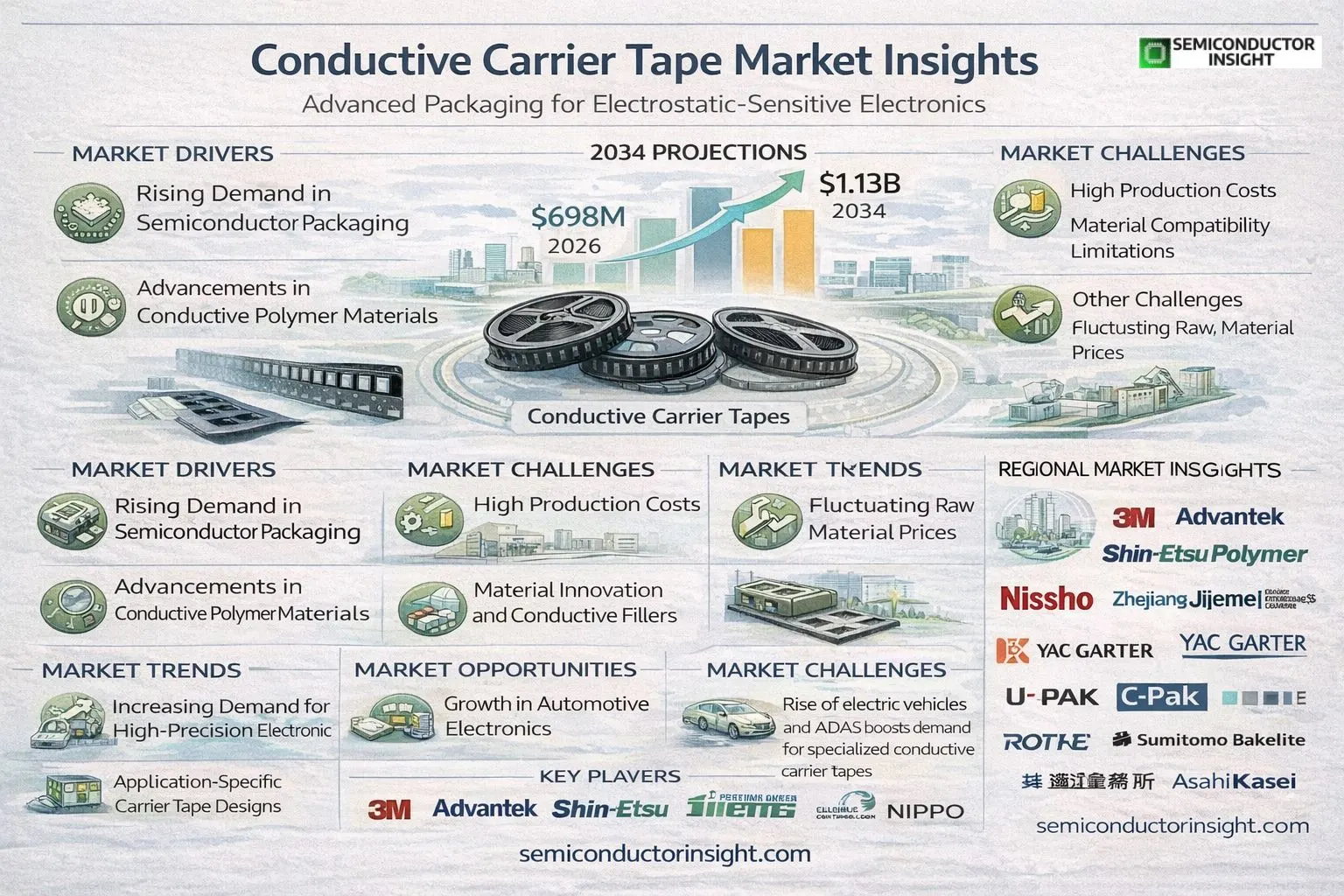
MARKET DRIVERS
Growing Demand in Semiconductor Packaging
The Conductive Carrier Tape Market is witnessing strong growth due to increasing demand in semiconductor packaging applications. As electronic components become smaller and more complex, manufacturers require reliable antic-static and conductive solutions to prevent damage during handling and transportation. The global semiconductor industry, projected to grow at 6% annually, directly fuels demand for high-performance conductive carrier tapes.
Advancements in Material Science
Recent developments in polymer composites and carbon-based materials have significantly improved the conductivity and durability of carrier tapes. These innovations allow for better protection of sensitive components while maintaining cost efficiency. Major players in the Conductive Carrier Tape Market are investing heavily in R&D to create tapes with lower resistance and higher thermal stability.
➤ The Asia-Pacific region accounts for over 60% of global conductive carrier tape consumption, driven by large-scale electronics manufacturing in China, South Korea, and Taiwan.
Stringent ESD protection regulations in the electronics industry are further propelling market growth, as manufacturers seek compliant packaging solutions for sensitive components.
MARKET CHALLENGES
High Production Costs
Manufacturing conductive carrier tapes requires specialized materials and processes, resulting in higher production costs compared to standard packaging solutions. The need for precise conductivity control and antistatic properties adds 20-30% to production expenses, which can deter price-sensitive customers.
Other Challenges
Material Compatibility Issues
Achieving optimal conductivity while maintaining compatibility with various electronic components remains a technical challenge for conductive carrier tape manufacturers. Some highly sensitive ICs require customized solutions, limiting mass-production efficiencies.
MARKET RESTRAINTS
Fluctuating Raw Material Prices
The Conductive Carrier Tape Market faces volatility in raw material costs, particularly for conductive polymers and carbon additives. Price fluctuations of up to 15% quarterly impact profit margins and make long-term pricing strategies challenging for manufacturers in this sector.
MARKET OPPORTUNITIES
Expansion in Automotive Electronics
The growing automotive electronics sector presents significant opportunities for the Conductive Carrier Tape Market. With increasing electronic content in vehicles and the rise of electric vehicles, demand for specialized component packaging is expected to grow by 8-10% annually over the next five years.
Conductive Carrier Tape Market Trends
Growing Demand for Advanced Electronic Packaging Solutions
The Conductive Carrier Tape market is witnessing steady growth driven by increasing demand for reliable electronic component packaging. These tapes provide essential electrostatic protection for sensitive semiconductor devices during transport and assembly. Manufacturers are focusing on improving material formulations to enhance conductivity while maintaining dimensional accuracy for automated placement systems.
Other Trends
Material Innovation in Conductive Carrier Tapes
Leading manufacturers are developing advanced polymer composites with optimized conductive fillers. Polycarbonate (PC) and polystyrene (PS) remain dominant base materials, but new formulations with improved antistatic properties are emerging. Carbon-based additives continue to be preferred over metal powders due to their balanced conductivity and cost-effectiveness.
Regional Market Developments
Asia-Pacific maintains its position as the largest market for Conductive Carrier Tape, driven by concentrated electronics manufacturing in China, Japan, and South Korea. North American and European markets are seeing increased demand for high-precision tapes to support advanced semiconductor packaging requirements. Emerging production hubs in Southeast Asia are creating new growth opportunities for tape suppliers.
Application-Specific Tape Development
Manufacturers are increasingly producing application-specific Conductive Carrier Tapes optimized for different component types. Specialized tape designs are being developed for power discrete devices, integrated circuits, and optoelectronic components, each requiring unique pocket configurations and conductivity levels to ensure component protection during handling.
Automation Compatibility Trends
With the continued automation of electronics assembly lines, Conductive Carrier Tape producers are enhancing their products to meet strict dimensional tolerances and feeding reliability requirements. Improved sprocket hole designs and tape stiffness characteristics are being implemented to reduce jamming in high-speed pick-and-place equipment.
COMPETITIVE LANDSCAPE
Key Industry Players
Conductive Carrier Tape Market Dominated by Specialized Packaging Giants
The global conductive carrier tape market features a mix of multinational packaging conglomerates and specialized electronic component suppliers. 3M currently leads the sector with its diversified portfolio of PS-based tapes for high-precision IC packaging, holding approximately 18% market share in 2025. Japanese players like Shin-Etsu Polymer and Sumitomo Bakelite follow closely, leveraging their advanced polycarbonate formulations for automotive electronics applications. The competitive landscape remains concentrated in Asia-Pacific, where top 5 suppliers collectively account for 52% of production capacity according to industry estimates.
Niche innovators such as Zhejiang Jiemei Electronic Technology and Jiangyin Winpack are gaining traction with cost-competitive alternatives for passive device packaging. Emerging manufacturers in Southeast Asia, including U-PAK and C-Pak, focus on localized supply chains for regional semiconductor hubs. The market sees increasing competition in high-end segments as Taiwanese firms like Taiwan Carrier Tape Enterprise introduce conductive tapes with enhanced ESD protection for 5G components.
List of Key Conductive Carrier Tape Companies Profiled
- 3M
- Advantek
- Shin-Etsu Polymer
- Nissho Corporation
- Zhejiang Jiemei Electronic Technology
- NIPPO
- YAC GARTER
- U-PAK
- C-Pak
- ePAK International
- ROTHE
- Sumitomo Bakelite
- Tek Pak
- Jiangyin Winpack
- Asahi Kasei
Segment Analysis:
| Segment Category | Sub-Segments | Key Insights |
| By Type |
|
PC Conductive Carrier Tape leads due to:
|
| By Application |
|
Integrated Circuits dominate due to:
|
| By End User |
|
Semiconductor Manufacturers are key adopters because:
|
| By Material System |
|
Carbon-Filled Systems are preferred due to:
|
| By Tape Width |
|
Standard Widths (8mm-56mm) dominate because:
|
Regional Analysis: Asia-Pacific Conductive Carrier Tape Market
Asia-Pacific Leads in Conductive Carrier Tape Adoption
Asia-Pacific accounts for over 60% of global semiconductor production, creating massive demand for high-performance conductive carrier tapes that protect sensitive components throughout the assembly process. The concentration of OSAT facilities drives continuous innovation in tape specifications.
Leading Asian electronics manufacturers are adopting conductive carrier tapes compatible with automated handling systems. Tape designs now incorporate machine-readable markings for Industry 4.0 production lines, with Japanese firms pioneering AI-assisted defect detection in conductive tape manufacturing.
Korean and Taiwanese material scientists are developing next-generation conductive carrier tapes with enhanced ESD protection and thermal stability. Recent breakthroughs include graphene-infused formulations and biodegradable conductive composites for sustainable electronics packaging.
Chinese conductive tape producers are establishing regional manufacturing clusters near major electronics hubs like the Pearl River Delta. This localized production reduces lead times and enables just-in-time delivery to semiconductor packaging lines across East Asia.
North America
The North American conductive carrier tape market benefits from strong R&D investment in advanced packaging technologies. U.S.-based semiconductor companies collaborate with local tape manufacturers to develop specialized solutions for high-frequency and high-power applications. The region sees growing adoption of conductive tapes in automotive electronics and defense applications requiring ruggedized ESD protection. Mexican manufacturing facilities are emerging as strategic suppliers to the North American free trade zone, reducing dependency on Asian imports.
Europe
European conductive carrier tape demand is driven by high-value automotive and industrial electronics applications. German engineering firms focus on precision tape solutions for automated IC handling systems, while the Nordic region emphasizes sustainable materials. The EU’s electronics packaging regulations are pushing manufacturers toward conductive tapes with reduced carbon footprints. Eastern European facilities are becoming important secondary sources for cost-sensitive applications.
South America
Brazil leads South America’s conductive carrier tape adoption through its developing electronics manufacturing sector. Local producers focus on basic ESD protection tapes for consumer electronics assembly, while imports satisfy demand for high-performance variants. Argentina shows potential as an emerging market for conductive tapes used in automotive component manufacturing, with increasing integration into global supply chains.
Middle East & Africa
The MEA conductive carrier tape market remains in nascent stages but shows growth potential through electronics manufacturing initiatives in UAE and Saudi Arabia. Israel’s strong semiconductor design ecosystem creates specialized demand for high-end conductive tape solutions. South Africa serves as a regional distribution hub, though most advanced conductive tapes are imported from Asia for critical electronics applications.
Report Scope
This market research report provides a comprehensive analysis of the Conductive Carrier Tape Market, covering the forecast period 2025–2034. It offers detailed insights into market dynamics, technological advancements, competitive landscape, and key trends shaping the industry.
Key focus areas of the report include:
- Market Overview: The report begins with an overview outlining its current market scenario, key growth indicators, and industry transformation drivers. It discusses macroeconomic factors, demand-supply balance, regulatory landscape, and the strategic role of conductive carrier tapes in powering advancements across industries such as automotive electronics, consumer electronics, and industrial automation.
- Market Size & Forecast: Historical data and future projections for revenue, unit shipments, and market value across major regions and segments.
- Segmentation Analysis: Detailed breakdown by product type, technology, application, and end-user industry to identify high-growth segments and investment opportunities.
- Regional Insights: Insights into market performance across North America, Europe, Asia-Pacific, Latin America, and the Middle East & Africa, including country-level analysis where relevant.
- Competitive Landscape: Profiles of leading market participants, including their product offerings, R&D focus, manufacturing capacity, pricing strategies, and recent developments such as mergers, acquisitions, and partnerships.
- Technology Trends & Innovation: Assessment of emerging technologies, integration of advanced materials, fabrication techniques, and evolving industry standards.
- Market Drivers & Restraints: Evaluation of factors driving market growth along with challenges, supply chain constraints, regulatory issues, and market-entry barriers.
- Stakeholder Insights: Insights for component suppliers, OEMs, system integrators, investors, and policymakers regarding the evolving ecosystem and strategic opportunities.
Primary and secondary research methods are employed, including interviews with industry experts, data from verified sources, and real-time market intelligence to ensure the accuracy and reliability of the insights presented.
FREQUENTLY ASKED QUESTIONS:
What is the current market size of Conductive Carrier Tape Market?
-> The Conductive Carrier Tape Market was valued at USD 645 million in 2025 and is projected to reach USD 1133 million by 2034, growing at a CAGR of 8.1% during the forecast period.
Which key companies operate in Conductive Carrier Tape Market?
-> Key players include 3M, Advantek, Shin-Etsu Polymer, Nissho Corporation, Zhejiang Jiemei Electronic Technology, NIPPO, YAC GARTER, U-PAK, C-Pak, ePAK International, ROTHE, Sumitomo Bakelite, among others.
What are the key growth drivers?
-> Key growth drivers include increasing demand for electronic components, advancements in AI and automotive electronics, and the need for high-precision packaging solutions.
Which region dominates the market?
-> Asia-Pacific is the dominant region, driven by strong manufacturing bases in China, Japan, and South Korea.
What are the emerging trends?
-> Emerging trends include development of high-reliability conductive tapes, adoption of bio-based materials, and integration of smart manufacturing technologies.

Get Sample Report PDF for Exclusive Insights
Report Sample Includes
- Table of Contents
- List of Tables & Figures
- Charts, Research Methodology, and more...
 Download Sample Report PDF