Key Statistics
Key Takeaways
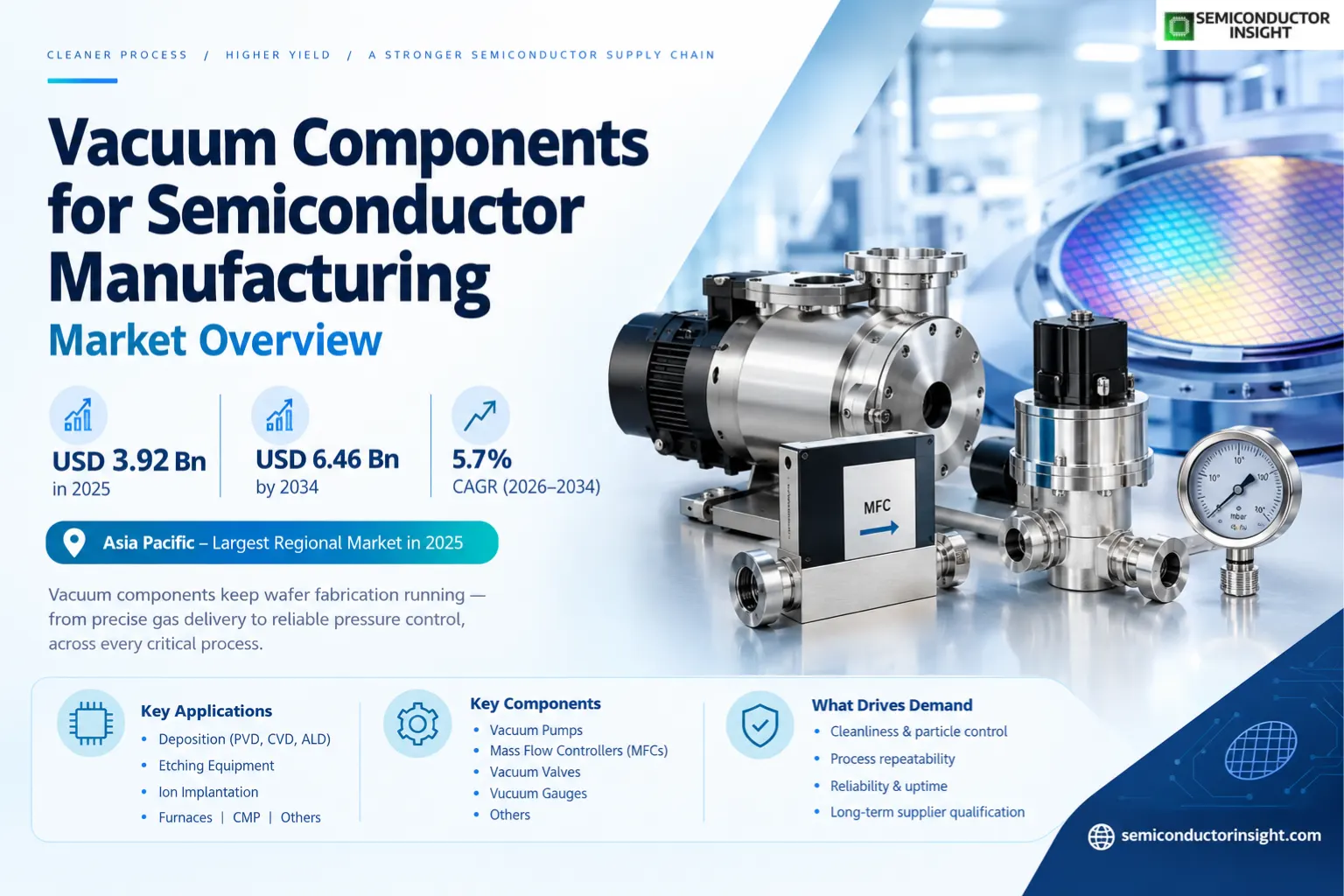
- Market size and growth: USD 3.92 billion in 2025, rising to USD 6.46 billion by 2034 at a 5.7% CAGR over 2026–2034.
- Asia Pacific is the largest regional market in 2025, supported by the location of relevant manufacturing, customers and supply chains.
- Vacuum Pumps is a core product segment, while newer or more integrated variants create higher-value growth opportunities.
- Deposition (PVD, CVD, ALD) represents an important application cluster because purchasing is directly linked to system performance and qualification requirements.
- Primary driver: SEMI’s 2026 outlook points to sustained spending on advanced logic, memory and AI-related manufacturing. Every additional deposition, etch or implant chamber creates demand for pumps, valves, flow controllers and pressure measurement.
- Structural restraint: Semiconductor-grade vacuum components must demonstrate contamination, lifetime and recipe stability before production use. Qualification can be long and expensive, slowing new-vendor entry.
Vacuum Components for Semiconductor Manufacturing Market Overview
vacuum components for semiconductor manufacturing market was valued at USD 3.92 billion in 2025 and is projected to reach USD 6.46 billion by 2034, expanding at a CAGR of 5.7% during 2026–2034. Asia Pacific is the largest regional market in 2025.
Vacuum components form the pressure-control and gas-delivery backbone of wafer fabrication equipment. Pumps establish and maintain process pressure, mass flow controllers meter precursor and process gases, valves isolate or throttle chambers, and gauges provide the pressure feedback needed for repeatable recipes. These components are embedded across deposition, dry etch, ion implantation, thermal processing and selected CMP-support systems, making component demand tightly linked to wafer-fab equipment utilization and new tool installations.
Commercial selection is driven by cleanliness, uptime, conductance, particle control, corrosion resistance and process repeatability rather than by component price alone. A valve or pump failure can interrupt a high-value process module, so device makers and equipment OEMs qualify suppliers over long cycles and often standardize components within tool families. That creates recurring aftermarket and replacement demand after the initial tool shipment, while also raising the engineering barrier for suppliers trying to displace an incumbent.
Industry investment remains a strong demand anchor. SEMI reported worldwide semiconductor manufacturing equipment sales of USD 135.1 billion in 2025 and projected continued growth in 2026 as advanced logic, memory and AI-related capacity expands. For vacuum-component suppliers, the most attractive opportunities are therefore tied to processes where pressure stability, plasma compatibility, precursor control and contamination performance directly influence device yield.
Segment Analysis: By Type
By type, the market is segmented into Vacuum Pumps, Mass Flow Controllers (MFCs), Vacuum Valves, Vacuum Gauges, Others. Product selection reflects performance, integration requirements, qualification burden and total lifecycle economics. The leading categories benefit from established installed bases, while newer technologies gain share when they solve a measurable system constraint or reduce ownership cost.
| Type | Commercial role | Market position |
|---|---|---|
| Vacuum Pumps | The largest value pool because every vacuum process module requires primary and often secondary pumping. Dry pumps and turbomolecular pumps are selected according to chamber pressure, gas chemistry, particle tolerance and duty cycle. | Core / leading segment |
| Mass Flow Controllers (MFCs) | Critical for repeatable delivery of deposition and etch gases. Higher layer counts and more complex recipes increase the number of controlled gas lines and the value of precision flow control. | High-growth segment |
| Vacuum Valves | High-value isolation and throttling components used to control chamber conductance. Semiconductor-grade valves command premiums where particle generation, actuation repeatability and corrosion resistance are tightly specified. | Established / specialized segment |
| Vacuum Gauges | Provide pressure measurement across rough, high and ultra-high vacuum ranges. Demand rises with chamber count and the need for tighter process-window control. | Established / specialized segment |
| Others | Includes fittings, traps, foreline components and related accessories that complete the vacuum architecture. | Established / specialized segment |
Segment Analysis: By Application
By application, demand spans Deposition (PVD, CVD, ALD), Etching Equipment, Ion Implantation, Semiconductor Processing Furnaces, CMP Equipment, Others. Purchasing behavior varies because operating conditions, product life, reliability thresholds and unit volumes differ by application. High-value applications emphasize qualification and engineering support, while high-volume uses add stronger cost and supply-continuity pressure.
| Application | Demand characteristics |
|---|---|
| Deposition (PVD, CVD, ALD) | A core application because deposition relies on controlled pressure and accurately metered precursors. ALD and advanced CVD place especially high value on stable gas delivery, fast valve response and contamination control. |
| Etching Equipment | One of the most demanding uses due to corrosive chemistries, plasma by-products and aggressive chamber cycling. Component life and service intervals materially affect tool availability. |
| Ion Implantation | Requires reliable high-vacuum operation around beamline and process chambers. Pumps, gauges and isolation valves are selected for stability and low contamination. |
| Semiconductor Processing Furnaces | Vacuum components support reduced-pressure thermal processing and gas handling, where repeatability and leak integrity determine process consistency. |
| CMP Equipment | Vacuum hardware is used in supporting subsystems, handling and fluid-management architectures rather than as the dominant process technology, creating a smaller but durable demand stream. |
| Others | Includes metrology, wafer handling and specialty process tools with vacuum subsystems. |
By Component Function
| Component Function | Market relevance |
|---|---|
| Evacuation | Creates a distinct design, manufacturing or procurement requirement within the market. |
| Gas Metering | Creates a distinct design, manufacturing or procurement requirement within the market. |
| Isolation & Flow Control | Creates a distinct design, manufacturing or procurement requirement within the market. |
| Pressure Measurement | Creates a distinct design, manufacturing or procurement requirement within the market. |
By Vacuum Regime
| Vacuum Regime | Market relevance |
|---|---|
| Low & Medium Vacuum | Creates a distinct design, manufacturing or procurement requirement within the market. |
| High Vacuum | Creates a distinct design, manufacturing or procurement requirement within the market. |
| Ultra-High Vacuum | Creates a distinct design, manufacturing or procurement requirement within the market. |
Regional Analysis
Asia Pacific leads the Vacuum Components for Semiconductor Manufacturing market in 2025. Regional demand differs according to manufacturing concentration, end-use investment, qualification practices and local supplier support. The largest region combines the strongest near-term demand base with established customers and supply-chain infrastructure, while other regions create opportunities around localization, research, specialty manufacturing or fast-growing end uses.
How does regional demand differ across the market?
Regional market structure is not simply a difference in size. Asia Pacific typically benefits from manufacturing density and electronics supply chains, North America from system design and advanced technology investment, Europe from specialized industrial and automotive applications, and emerging regions from selective infrastructure and localization projects. Supplier strategy therefore needs to account for qualification, service coverage, logistics and customer concentration in each geography.
| Region | Position | Growth outlook | Demand profile | What decides supplier selection |
|---|---|---|---|---|
| Asia Pacific | Largest / major | High | Manufacturing-led | Local qualification and scale |
| North America | Major | High-value | Design and investment-led | Engineering support and supply security |
| Europe | Established | Moderate | Specialty industrial-led | Quality, compliance and lifecycle support |
| South America | Emerging | Selective | Import-led | Landed cost and channel access |
| Middle East & Africa | Emerging | Selective | Project-led | Project timing and local support |
Competitive Landscape
The Vacuum Components for Semiconductor Manufacturing market is shaped by qualification depth, process know-how and customer support rather than by price alone. Leading suppliers use installed-base relationships, intellectual property, manufacturing quality and field engineering to protect design wins. Competition is strongest when customers can qualify multiple technically comparable suppliers, while highly specialized applications remain concentrated among vendors with proven reliability records.
Large suppliers typically compete across several adjacent product families, allowing them to bundle technical support and simplify customer sourcing. Specialized companies compete by focusing on a narrower technology, material set or performance envelope. In both cases, the ability to maintain consistent quality during volume production is essential because a component or material change can require renewed process qualification.
Regional presence is also strategic. Customers increasingly value local application engineering, shorter repair or replenishment cycles and geographically diversified production. This favors suppliers that can combine global process standards with local service infrastructure close to major manufacturing clusters.
| Company | Competitive position | Primary basis of competition |
|---|---|---|
| HORIBA | Tier 1 / established | Competes through qualified products, technical support and customer integration. |
| Fujikin | Tier 1 / established | Competes through qualified products, technical support and customer integration. |
| MKS Instruments | Tier 1 / established | Competes through qualified products, technical support and customer integration. |
| VAT Group | Tier 1 / established | Competes through qualified products, technical support and customer integration. |
| CKD | Established / specialized | Competes through qualified products, technical support and customer integration. |
| Azbil Corporation | Established / specialized | Competes through qualified products, technical support and customer integration. |
| Edwards Vacuum (Atlas Copco Group) | Established / specialized | Competes through qualified products, technical support and customer integration. |
| Ebara Corporation | Established / specialized | Competes through qualified products, technical support and customer integration. |
Companies Profiled
HORIBA; Fujikin; MKS Instruments; VAT Group; CKD; Azbil Corporation; Edwards Vacuum (Atlas Copco Group); Ebara Corporation; ULVAC; Pfeiffer Vacuum; Agilent Technologies; Busch Vacuum Solutions; Bronkhorst; Canon ANELVA.
Production Capacity Analysis
Production capacity is constrained less by nominal factory floor space than by precision process capability, clean manufacturing, calibrated equipment and qualified upstream materials. Expanding output therefore requires more than adding assembly stations: suppliers must preserve contamination control, statistical process capability and traceability as volume increases. Capacity decisions are also influenced by the need to remain close to key customers and reduce logistics risk.
The strongest capacity additions are likely to follow major customer clusters. This favors Asia Pacific for high-volume electronics and semiconductor production, while the United States and Europe attract selective localization in strategic technologies. Suppliers that can duplicate qualified processes across regions gain resilience, but transferring a tightly controlled process between sites can itself require customer revalidation.
Market Dynamics
Demand is shaped by wafer-fab capital intensity, process complexity and the increasing cost of unplanned chamber downtime. Advanced nodes require more process steps and tighter control of gases and pressure, while mature-node expansions add volume across a broad installed base.
Market Drivers
Drivers Impact Analysis
| Driver | Impact | Why it matters |
|---|---|---|
| Rising wafer-fab equipment investment | High | SEMI’s 2026 outlook points to sustained spending on advanced logic, memory and AI-related manufacturing. Every additional deposition, etch or implant chamber creates demand for pumps, valves, flow controllers and pressure measurement. |
| More vacuum-intensive process flows | High | Multi-patterning, 3D device structures and higher layer counts increase the number of vacuum process steps per wafer. Component demand therefore grows not only with wafer starts but also with process complexity. |
| Uptime and predictive maintenance | Medium-High | Fabs increasingly monitor pump health, valve cycles and pressure stability to prevent unscheduled downtime. Suppliers that integrate diagnostics and remote service can capture more lifecycle value. |
| Regionalization of semiconductor capacity | Medium-High | New fabs in the United States, Europe and Asia broaden the geographic service requirement. Component makers benefit when they can support OEMs and fabs close to new production clusters. |
Rising wafer-fab equipment investment
SEMI’s 2026 outlook points to sustained spending on advanced logic, memory and AI-related manufacturing. Every additional deposition, etch or implant chamber creates demand for pumps, valves, flow controllers and pressure measurement. The commercial implication is stronger design-in activity for suppliers that can translate the technical requirement into reliable volume production and responsive customer support.
More vacuum-intensive process flows
Multi-patterning, 3D device structures and higher layer counts increase the number of vacuum process steps per wafer. Component demand therefore grows not only with wafer starts but also with process complexity. The commercial implication is stronger design-in activity for suppliers that can translate the technical requirement into reliable volume production and responsive customer support.
Uptime and predictive maintenance
Fabs increasingly monitor pump health, valve cycles and pressure stability to prevent unscheduled downtime. Suppliers that integrate diagnostics and remote service can capture more lifecycle value. The commercial implication is stronger design-in activity for suppliers that can translate the technical requirement into reliable volume production and responsive customer support.
Regionalization of semiconductor capacity
New fabs in the United States, Europe and Asia broaden the geographic service requirement. Component makers benefit when they can support OEMs and fabs close to new production clusters. The commercial implication is stronger design-in activity for suppliers that can translate the technical requirement into reliable volume production and responsive customer support.
Market Restraints
Restraints Impact Analysis
| Restraint | Impact | Commercial effect |
|---|---|---|
| Qualification cycles and switching costs | High | Semiconductor-grade vacuum components must demonstrate contamination, lifetime and recipe stability before production use. Qualification can be long and expensive, slowing new-vendor entry. |
| Exposure to wafer-fab equipment cycles | Medium | Orders are sensitive to capital-spending swings. A pause in new tool installations can reduce original-equipment demand even while aftermarket demand remains resilient. |
| Corrosive process environments | Medium | Etch and deposition by-products accelerate wear on pumps, seals and valves. Materials selection and service intervals raise lifecycle costs for both suppliers and fabs. |
Qualification cycles and switching costs
Semiconductor-grade vacuum components must demonstrate contamination, lifetime and recipe stability before production use. Qualification can be long and expensive, slowing new-vendor entry. This restraint does not eliminate demand, but it changes the pace of adoption and favors suppliers with stronger balance sheets, technical data and established qualification histories.
Exposure to wafer-fab equipment cycles
Orders are sensitive to capital-spending swings. A pause in new tool installations can reduce original-equipment demand even while aftermarket demand remains resilient. This restraint does not eliminate demand, but it changes the pace of adoption and favors suppliers with stronger balance sheets, technical data and established qualification histories.
Corrosive process environments
Etch and deposition by-products accelerate wear on pumps, seals and valves. Materials selection and service intervals raise lifecycle costs for both suppliers and fabs. This restraint does not eliminate demand, but it changes the pace of adoption and favors suppliers with stronger balance sheets, technical data and established qualification histories.
Market Opportunities
Smart vacuum subsystems
Condition monitoring, digital pressure control and predictive service can convert a discrete component sale into a higher-value lifecycle relationship. The opportunity is strongest where the supplier can document a system-level benefit and support the customer through integration, qualification and scale-up.
EUV and advanced-node process support
Leading-edge fabs require extremely clean, stable vacuum architectures for deposition, etch and supporting process steps, rewarding suppliers with low-particle and high-repeatability products. The opportunity is strongest where the supplier can document a system-level benefit and support the customer through integration, qualification and scale-up.
Service localization near new fabs
New manufacturing clusters create demand for local repair, spare-parts depots and field engineering, especially where downtime costs are high. The opportunity is strongest where the supplier can document a system-level benefit and support the customer through integration, qualification and scale-up.
Energy-efficient pumping
Fabs are under pressure to reduce facility power consumption. More efficient pumps and intelligent idle modes can deliver measurable operating-cost savings. The opportunity is strongest where the supplier can document a system-level benefit and support the customer through integration, qualification and scale-up.
Supply Chain Analysis
Stage 1 — High-purity metals, fluoropolymers, ceramics and precision sensors: Value capture depends on process control, yield and the ability to meet downstream qualification requirements. Bottlenecks at this stage can propagate quickly because customers often depend on validated materials, calibrated components or approved production routes rather than interchangeable spot-market supply.
Stage 2 — Precision machining, coating, actuator and electronics manufacturing: Value capture depends on process control, yield and the ability to meet downstream qualification requirements. Bottlenecks at this stage can propagate quickly because customers often depend on validated materials, calibrated components or approved production routes rather than interchangeable spot-market supply.
Stage 3 — Vacuum component assembly, calibration and contamination control: Value capture depends on process control, yield and the ability to meet downstream qualification requirements. Bottlenecks at this stage can propagate quickly because customers often depend on validated materials, calibrated components or approved production routes rather than interchangeable spot-market supply.
Stage 4 — OEM integration, fab qualification, field service and replacement: Value capture depends on process control, yield and the ability to meet downstream qualification requirements. Bottlenecks at this stage can propagate quickly because customers often depend on validated materials, calibrated components or approved production routes rather than interchangeable spot-market supply.
Recent Developments
Report Scope & Segmentation
| Attribute | Coverage |
|---|---|
| Market | Vacuum Components for Semiconductor Manufacturing |
| Base Year | 2025 |
| Estimated Year | 2026 |
| Forecast Period | 2026–2034 |
| 2025 Market Size | USD 3.92 billion |
| 2034 Projected Market Size | USD 6.46 billion |
| CAGR (2026–2034) | 5.7% |
| Largest Market in 2025 | Asia Pacific |
| By Type | Vacuum Pumps, Mass Flow Controllers (MFCs), Vacuum Valves, Vacuum Gauges, Others |
| By Application | Deposition (PVD, CVD, ALD), Etching Equipment, Ion Implantation, Semiconductor Processing Furnaces, CMP Equipment, Others |
| By Component Function | Evacuation, Gas Metering, Isolation & Flow Control, Pressure Measurement |
| By Vacuum Regime | Low & Medium Vacuum, High Vacuum, Ultra-High Vacuum |
| Companies Profiled | HORIBA, Fujikin, MKS Instruments, VAT Group, CKD, Azbil Corporation, Edwards Vacuum (Atlas Copco Group), Ebara Corporation, ULVAC, Pfeiffer Vacuum, Agilent Technologies, Busch Vacuum Solutions, Bronkhorst, Canon ANELVA |
| Regions | North America; Europe; Asia Pacific; South America; Middle East & Africa |
Frequently Asked Questions
What is the Vacuum Components for Semiconductor Manufacturing market size in 2025?
The global Vacuum Components for Semiconductor Manufacturing market is valued at USD 3.92 billion in 2025.
What is the projected Vacuum Components for Semiconductor Manufacturing market size by 2034?
The market is projected to reach USD 6.46 billion by 2034.
What is the CAGR of the Vacuum Components for Semiconductor Manufacturing market from 2026 to 2034?
The market is projected to expand at a 5.7% CAGR during 2026–2034.
Which region leads the Vacuum Components for Semiconductor Manufacturing market?
Asia Pacific is the largest market in 2025.
What are the main product types?
Vacuum Pumps, Mass Flow Controllers (MFCs), Vacuum Valves, Vacuum Gauges, Others.
What are the key applications?
Deposition (PVD, CVD, ALD), Etching Equipment, Ion Implantation, Semiconductor Processing Furnaces, CMP Equipment, Others.
What is the main growth driver?
SEMI’s 2026 outlook points to sustained spending on advanced logic, memory and AI-related manufacturing. Every additional deposition, etch or implant chamber creates demand for pumps, valves, flow controllers and pressure measurement.
What is the main restraint?
Semiconductor-grade vacuum components must demonstrate contamination, lifetime and recipe stability before production use. Qualification can be long and expensive, slowing new-vendor entry.
Where are the strongest opportunities?
Condition monitoring, digital pressure control and predictive service can convert a discrete component sale into a higher-value lifecycle relationship. Leading-edge fabs require extremely clean, stable vacuum architectures for deposition, etch and supporting process steps, rewarding suppliers with low-particle and high-repeatability products.
Which companies are active in the market?
HORIBA, Fujikin, MKS Instruments, VAT Group, CKD, Azbil Corporation, Edwards Vacuum (Atlas Copco Group), Ebara Corporation are among the companies active in the market.
Research Sources & Evidence Base
View primary and official sources used in this overview
- SEMI — Global Semiconductor Equipment Sales Forecast to Reach a Record $229 Billion in 2028. Equipment spending and wafer-fab investment outlook.
- SEMI — Global Semiconductor Equipment Billings Increased 23% Year-Over-Year in Q2 2026. Near-term equipment billings.
- VAT Group — Full-Year 2025 Results. Semiconductor vacuum-valve application and market context.

Get Sample Report PDF for Exclusive Insights
Report Sample Includes
- Table of Contents
- List of Tables & Figures
- Charts, Research Methodology, and more...
 Download Sample Report PDF