Market Insights
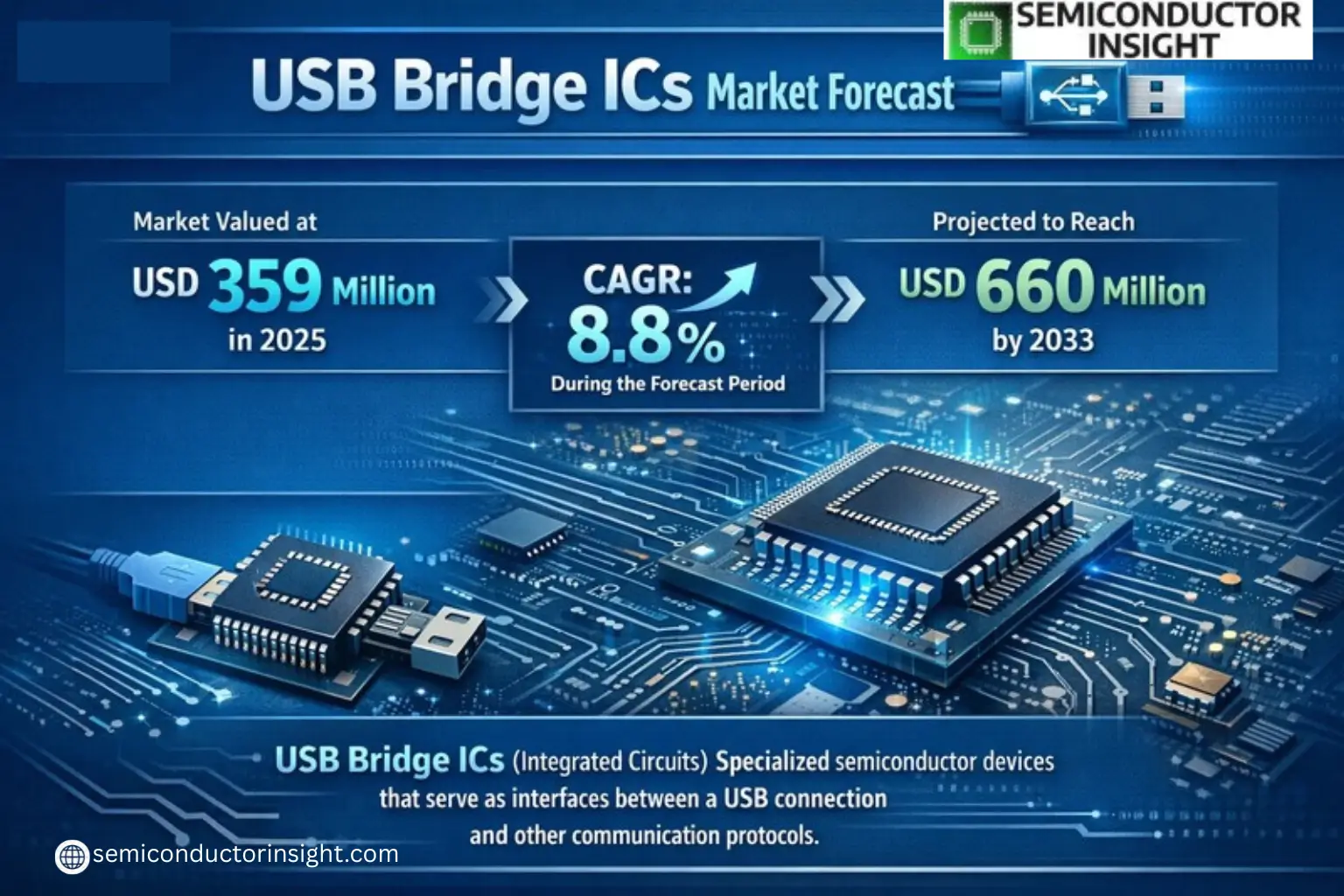
Global USB Bridge Ics Market was valued at USD 359 million in 2025 and is projected to reach USD 660 million by 2033, exhibiting a CAGR of 8.8% during the forecast period.
USB Bridge ICs (Integrated Circuits) are specialized semiconductor devices that serve as interfaces between a USB (Universal Serial Bus) connection and other communication protocols or peripheral interfaces. These components enable seamless data conversion, allowing USB-enabled hosts such as PCs or embedded systems to communicate with non-USB devices. Key applications include bridging USB to UART, SPI, I2C, SATA, and other standards.
The market growth is driven by increasing demand for high-speed data transmission, proliferation of smart devices, and advancements in interface technologies like USB Type-C. The consumer electronics sector dominates the market with a 36% share, while China leads geographically with 31% of global demand. Major players such as FTDI, Silicon Labs, and Texas Instruments collectively hold around 40% market share.
MARKET DRIVERS
Growing Demand for Connectivity Solutions
USB Bridge Ics Market is experiencing significant growth due to the rising demand for seamless connectivity between legacy and modern devices. With over 20 billion USB devices shipped annually, the need for efficient bridging solutions has become critical. The proliferation of IoT devices and industrial automation further fuels this demand.
Advancements in USB Technology
The transition to USB4 and USB-C standards is driving innovation in USB Bridge ICs. Manufacturers are developing chips that support higher data transfer rates up to 40Gbps while maintaining backward compatibility. This technological evolution is creating new opportunities for USB Bridge IC applications in consumer electronics and enterprise solutions.
Additionally, the miniaturization trend in electronics is pushing the development of compact, power-efficient USB Bridge ICs that meet the requirements of mobile and wearable devices.
MARKET CHALLENGES
Technical Complexity of Interface Conversion
Developing USB Bridge ICs that support multiple protocols (USB to SPI, I2C, UART) while maintaining signal integrity presents significant engineering challenges. The need to comply with evolving USB specifications adds complexity to chip design and validation processes.
Other Challenges
Power Consumption Constraints
Designing energy-efficient USB Bridge ICs for battery-powered devices requires careful optimization of power management circuits, often increasing development costs and time-to-market.
MARKET RESTRAINTS
High Development Costs
The semiconductor shortage and increasing IP licensing fees are impacting USB Bridge IC development costs. Small and medium manufacturers face challenges in keeping their solutions price-competitive while maintaining quality standards.
MARKET OPPORTUNITIES
Emerging Applications in Automotive Sector
The automotive industry’s rapid digital transformation is creating new opportunities for USB Bridge ICs, particularly in advanced driver-assistance systems (ADAS) and in-vehicle infotainment. The demand for high-speed data bridges between sensors and processors is expected to grow substantially.
USB Bridge Ics Market Trends
Steady Market Expansion Driven by Digital Transformation
Global USB Bridge Ics Market, valued at USD 359 million in 2025, is projected to grow at an 8.8% CAGR to reach USD 660 million by 2033. This growth is primarily fueled by accelerating digital transformation across industries, requiring reliable data transmission solutions. USB Bridge ICs facilitate seamless connectivity between USB hosts and non-USB devices, making them indispensable in modern electronic ecosystems.
Other Trends
Interface Standardization Boosts Adoption
The standardization of USB interfaces, particularly USB 3.0/3.1/3.2 and USB Type-C technologies, has significantly enhanced data transmission rates and power delivery capabilities. This evolution directly benefits USB Bridge IC adoption, with USB to UART being the dominant segment (25% market share). The proliferation of smart devices and Industrial IoT further drives demand for these interface solutions.
Regional Market Dynamics and Competitive Landscape
China leads the USB Bridge Ics Market with 31% global share, followed by North America (22%) and Taiwan (12%). The competitive landscape remains consolidated, with the top five manufacturers – FTDI, Silicon Labs, TI, Fujitsu, and Infineon – controlling approximately 40% of the market. FTDI maintains the largest individual share at 15%, benefiting from its extensive product portfolio and technological expertise.
Segment Growth in Consumer Electronics
Consumer electronics currently account for 36% of the USB Bridge Ics Market, reflecting the high demand for interconnected devices. This segment continues to expand as manufacturers integrate USB Bridge ICs into smartphones, wearables, and smart home devices. Concurrently, industrial and automotive applications are emerging as significant growth areas for USB interface solutions.
COMPETITIVE LANDSCAPE
Key Industry Players
USB Bridge ICs Market Dominated by Semiconductor Giants and Specialized Providers
USB Bridge Ics Market is characterized by a mix of established semiconductor leaders and specialized interface solution providers. FTDI Chip dominates with approximately 15% market share, leveraging its patented USB protocol expertise. Silicon Labs and Texas Instruments follow closely, offering robust USB conversion solutions across industrial and consumer applications. The top five manufacturers collectively control about 40% of the global market, with Fujitsu and Infineon completing this leadership group through their automotive and industrial-focused offerings.
Niche players like JMicron Technology and ASMedia Technology have carved significant positions in specific segments such as USB-to-SATA and USB 3.0 bridging solutions. Chinese manufacturers including Nanjing Qinheng Microelectronics are gaining traction in regional markets through cost-competitive offerings. Emerging demand for USB Type-C and Thunderbolt compatibility has driven innovation across the competitive landscape, with companies like ASIX Electronics and Microchip expanding their high-speed interface portfolios.
List of Key USB Bridge ICs Companies Profiled
- FTDI Chip
- Silicon Labs
- Texas Instruments
- Fujitsu Semiconductor
- Infineon Technologies
- Silicon Motion
- ASMedia Technology
- JMicron Technology
- Nanjing Qinheng Microelectronics
- Hangzhou Hualan Microelectronics
- Holtek Semiconductor
- MaxLinear
- ASIX Electronics
- Microchip Technology
- Toshiba Electronic Devices
Segment Analysis:
| Segment Category | Sub-Segments | Key Insights |
| By Type |
|
USB to UART dominates due to its broad compatibility with legacy systems and microcontroller communication.
|
| By Application |
|
Consumer Electronics leads with continuous innovation in smart devices and peripherals.
|
| By End User |
|
OEMs represent the primary demand source due to volume production needs.
|
| By Technology Generation |
|
USB Type-C Bridges show strongest growth trajectory in the market.
|
| By Integration Level |
|
Embedded Solutions are gaining momentum with device miniaturization trends.
|
Regional Analysis: Global USB Bridge ICs Market
Asia-Pacific hosts concentrated USB Bridge IC manufacturing clusters, particularly in China’s Pearl River Delta and Yangtze River Delta regions. The area benefits from complete supply chain ecosystems including raw material suppliers, foundries, and assembly/test facilities.
Regional players are pioneering cost-effective USB 3.2 and USB4 bridge solutions with improved power efficiency. Local R&D centers focus on reducing latency and enhancing data throughput for emerging applications in IoT and edge computing devices.
Massive production volumes of smartphones, tablets, and laptops drive USB Bridge IC adoption. Regional brands increasingly integrate advanced USB solutions to support fast charging, display connectivity, and peripheral expansion.
Semiconductor industry policies in China and South Korea provide tax incentives and funding for USB interface technology development. These initiatives accelerate domestic USB Bridge IC capabilities across automotive and industrial sectors.
North America
North America remains a key innovation hub for high-performance USB Bridge IC solutions, particularly in the United States. The region leads in developing advanced USB4 and Thunderbolt-compatible bridge technologies for professional applications. Silicon Valley-based semiconductor firms drive architecture innovation, focusing on enterprise storage solutions and professional AV equipment. Strong demand exists from data center operators upgrading to USB4 infrastructure and automotive manufacturers implementing advanced in-vehicle connectivity systems.
Europe
European USB Bridge IC market growth stems from industrial automation and automotive applications. Germany and France see rising adoption in manufacturing equipment requiring robust industrial USB interfaces. The region’s stringent electromagnetic compatibility regulations push development of specialized USB bridging solutions meeting EN safety standards. Medical device manufacturers increasingly incorporate USB Bridge ICs for diagnostic equipment connectivity, with Switzerland and UK leading this vertical adoption.
Middle East & Africa
The MEA region shows accelerating USB Bridge IC deployment in telecom infrastructure and smart city projects. GCC countries invest heavily in industrial USB solutions for oil/gas automation, while South Africa sees growing demand from consumer electronics assembly. Market development is constrained by limited local semiconductor expertise but benefits from increasing technology transfers through Chinese and European partnerships.
South America
Brazil and Mexico drive USB Bridge IC market expansion in Latin America, primarily serving domestic electronics manufacturing. The region benefits from proximity to North American supply chains while developing cost-competitive USB 2.0 solutions for basic connectivity needs. Growing automotive production creates opportunities for USB bridging in vehicle infotainment systems, though adoption of advanced standards lags behind other regions.
Report Scope
This market research report provides a comprehensive analysis of the USB Bridge ICs Market, covering the forecast period 2025–2033. It offers detailed insights into market dynamics, technological advancements, competitive landscape, and key trends shaping the industry.
Key focus areas of the report include:
- Market Overview: The report begins with an overview outlining its current market scenario, key growth indicators, and industry transformation drivers. It discusses macroeconomic factors, demand–supply balance, regulatory landscape, and the strategic role of semiconductors in powering advancements across industries such as automotive, telecommunications, consumer electronics, and industrial automation.
- Market Size & Forecast: Historical data and future projections for revenue, unit shipments, and market value across major regions and segments.
- Segmentation Analysis: Detailed breakdown by product type, technology, application, and end-user industry to identify high-growth segments and investment opportunities.
- Regional Insights: Insights into market performance across North America, Europe, Asia-Pacific, Latin America, and the Middle East & Africa, including country-level analysis where relevant.
- Competitive Landscape: Profiles of leading market participants, including their product offerings, R&D focus, manufacturing capacity, pricing strategies, and recent developments such as mergers, acquisitions, and partnerships.
- Technology Trends & Innovation: Assessment of emerging technologies, integration of AI/IoT, semiconductor design trends, fabrication techniques, and evolving industry standards.
- Market Drivers & Restraints: Evaluation of factors driving market growth along with challenges, supply chain constraints, regulatory issues, and market-entry barriers.
- Stakeholder Insights: Insights for component suppliers, OEMs, system integrators, investors, and policymakers regarding the evolving ecosystem and strategic opportunities.
Primary and secondary research methods are employed, including interviews with industry experts, data from verified sources, and real-time market intelligence to ensure the accuracy and reliability of the insights presented.
FREQUENTLY ASKED QUESTIONS:
What is the current market size of USB Bridge ICs Market?
-> USB Bridge Ics Market was valued at USD 359 million in 2025 and is projected to reach USD 660 million by 2033, exhibiting a CAGR of 8.8% during the forecast period.
Which key companies operate in USB Bridge ICs Market?
-> Key players include FTDI, Silicon Labs, TI, Fujitsu, Infineon, Silicon Motion, ASMedia Technology, JMicron Technology, Nanjing Qinheng Microelectronics, Hangzhou Hualanmicroelectronique, Holtek, MaxLinear, ASIX, Microchip, Toshiba, NXP, and Broadcom.
What are the key growth drivers?
-> Key growth drivers include rising demand for data transmission, device interconnection, technological advancements in USB standards (such as USB 3.0/3.1/3.2 and USB Type-C), and increasing adoption of smart devices including smartphones, wearables, and Industrial IoT (IIoT).
Which region dominates the market?
-> China is the largest market for USB Bridge ICs, accounting for 31% of the market share, followed by North America (22%) and Taiwan, China (12%).
What are the major application segments?
-> The largest application segment is consumer electronics (36% market share). Other key segments include communication, industrial, medical, and automotive.
What is the dominant product type in USB Bridge Ics Market?
-> USB to UART is the largest segment, holding about 25% of the market share.

Get Sample Report PDF for Exclusive Insights
Report Sample Includes
- Table of Contents
- List of Tables & Figures
- Charts, Research Methodology, and more...
 Download Sample Report PDF