Key Statistics
Key Takeaways
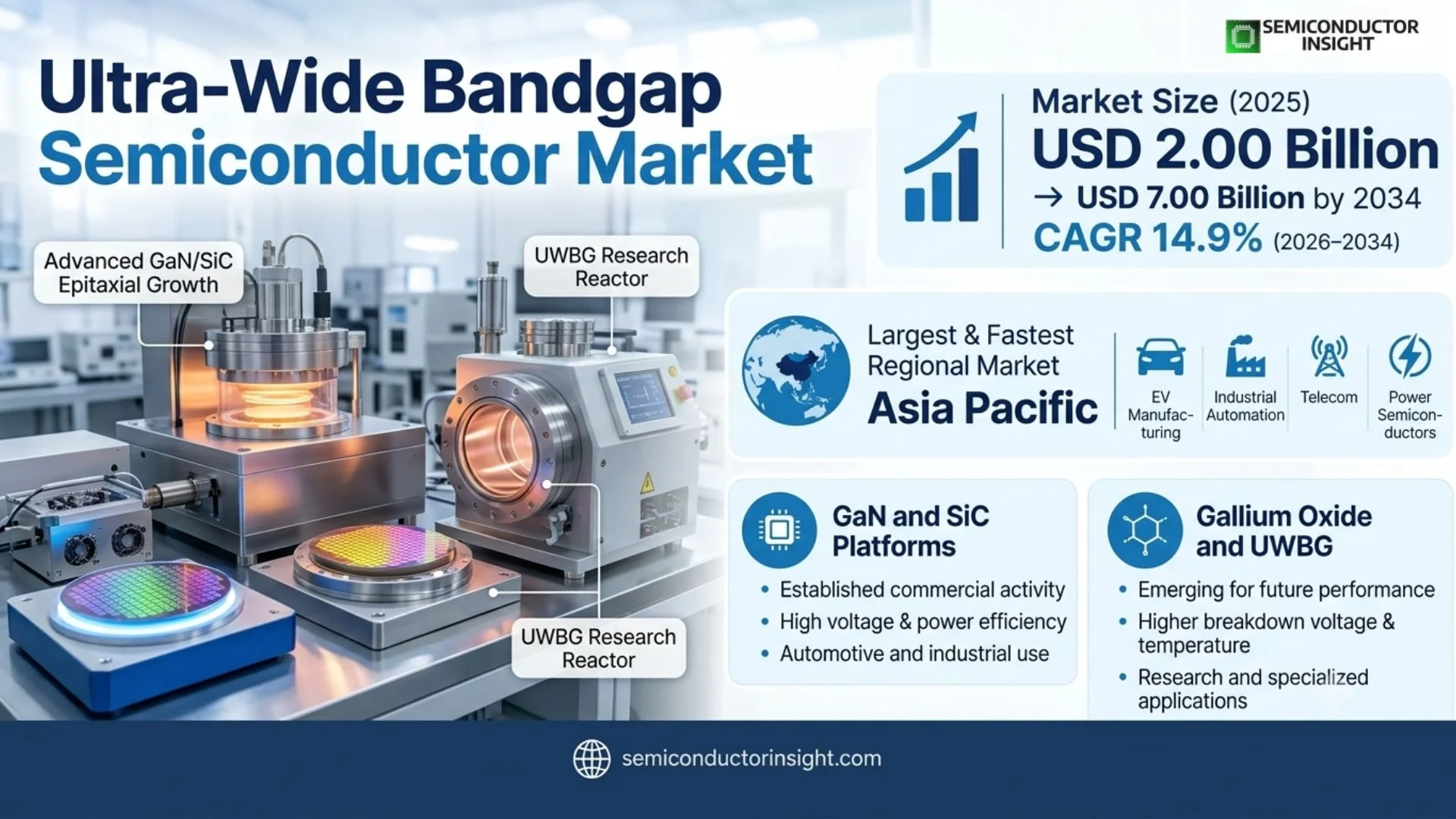
- Market size: The market is valued at USD 2.00 billion in 2025 and is projected to reach USD 7.00 billion by 2034, representing a 14.9% CAGR during 2026–2034.
- Power electronics is the principal demand engine, with high-voltage conversion, electric vehicles, industrial drives and data-center power supplies rewarding lower switching loss and higher operating temperature.
- Asia Pacific is the largest and fastest-growing region because China, Japan and South Korea combine EV manufacturing, power-electronics capacity and strong semiconductor supply chains.
- Gallium oxide is the most important next-wave UWBG material, offering a bandgap near 4.9 eV and very high theoretical breakdown field, but commercial devices still face thermal, p-type doping and reliability challenges.
- Manufacturing yield and substrate economics remain the main commercialization constraints, especially as emerging materials move from research wafers toward multi-kilovolt production devices.
Ultra-Wide Bandgap Semiconductor Market Overview
Ultra-Wide Bandgap Semiconductor Market is valued at USD 2.00 billion in 2025 and is projected to reach USD 7.00 billion by 2034, expanding at a 14.9% CAGR during 2026–2034. The 2026 market level is USD 2.30 billion. Asia Pacific leads the market through EV, industrial, telecom and power-semiconductor manufacturing. Commercial activity spans established GaN and SiC platforms alongside emerging gallium oxide and other ultra-wide-bandgap materials that target higher breakdown voltage, temperature and frequency than conventional silicon.
Ultra-wide bandgap semiconductors are materials engineered for operation at electric fields, temperatures and frequencies beyond conventional silicon. The commercial landscape currently includes advanced GaNand SiC power and RF devices, while emerging materials such as beta-gallium oxide and diamond target even higher theoretical breakdown fields. Device selection depends on voltage, switching frequency, thermal environment, substrate cost, packaging and the ability to manufacture low-defect epitaxial structures at scale.
Gallium oxide has become a central research focus because its bandgap is close to 4.9 eV and its theoretical breakdown field is materially higher than GaN and SiC. NIST has highlighted its potential for high-power and RF electronics, while also identifying thermal management, defect control and the lack of practical p-type doping as unresolved barriers. These issues explain why near-term revenue remains concentrated in more mature wide-bandgap platforms even as UWBG R&D accelerates.
Commercial adoption is strongest when material advantages reduce system cost rather than only improve a device datasheet. Higher switching frequency can shrink magnetics and passive components, while higher temperature tolerance can reduce cooling requirements. Automotive traction inverters, onboard chargers, renewable-energy converters, industrial motor drives, RF amplifiers and data-center power systems therefore provide the most compelling value pools for advanced bandgap materials.
Segment Analysis: By Type
By type, the reference segmentation is divided into Gallium Nitride and Silicon Carbide. GaN is especially strong in high-frequency and lower-to-medium-voltage switching, while SiC dominates higher-voltage traction, industrial and grid applications. Emerging UWBG materials such as gallium oxide and diamond are treated as strategic extensions of the technology landscape rather than separate revenue segments in the source segmentation.
| Type | Commercial role |
|---|---|
| Gallium Nitride (GaN) | High-frequency, high-electron-mobility devices used in fast chargers, data-center power, RF and selected automotive systems. |
| Silicon Carbide (SiC) | High-voltage MOSFETs and diodes used in EV traction, renewable energy, industrial drives and other high-power systems. |
Additional Segmentation: By End User
End-user demand is concentrated in automotive, aerospace and defense, and industrial automation. Automotive customers value efficiency and compact power electronics, aerospace and defense prioritize high-temperature and radiation-tolerant operation, and industrial users focus on lower energy loss, smaller cooling systems and long service life. Each group has different qualification, reliability and cost thresholds, which shapes the pace of adoption.
| End User | Demand characteristics |
|---|---|
| Automotive | Traction inverters, onboard chargers, DC/DC converters and auxiliary power systems. |
| Aerospace & Defense | High-temperature, high-voltage, RF and extreme-environment electronics. |
| Industrial Automation | Motor drives, robotics, power supplies and energy-conversion systems requiring high efficiency. |
Segment Analysis: By Application
By application, power electronics is the largest segment, followed by RF systems and electric-vehicle applications. Power devices benefit directly from higher critical electric field and faster switching, while RF systems use the high-frequency capability of GaN-class materials. Electric vehicles are commercially important because efficiency improvements can reduce thermal burden, improve driving range and enable smaller power modules.
| Application | Demand characteristics |
|---|---|
| Power Electronics | High-efficiency switching in power supplies, industrial converters, renewable-energy inverters and grid systems. |
| Radio Frequency (RF) Systems | High-power amplifiers, 5G base stations, radar and communications equipment. |
| Electric Vehicles | Traction inverters, onboard chargers and DC/DC conversion with strong efficiency and thermal requirements. |
| Others | Aerospace, pulsed power, sensing and specialized high-temperature or high-voltage electronics. |
Additional Segmentation: By Power Rating
Power rating separates low-power consumer and communications applications from medium-power industrial systems and high-power automotive, grid and traction applications. GaN is particularly competitive in compact low- and medium-power converters, while SiC is widely deployed in multi-kilowatt and higher-voltage systems. Emerging UWBG materials are targeting the high-power end of the market where theoretical breakdown strength can create the largest system-level advantage.
| Power Rating | Commercial relevance |
|---|---|
| Low Power (<1kW) | Chargers, adapters, telecom point-of-load and compact high-frequency power systems. |
| Medium Power (1–10kW) | Industrial supplies, server power, onboard charging and distributed energy conversion. |
| High Power (>10kW) | Traction, grid, renewable energy, rail and high-voltage industrial conversion. |
Regional Analysis
Asia Pacific is the largest and fastest-growing regional market because China, Japan and South Korea combine EV manufacturing, semiconductor capacity and large industrial-electronics supply chains. North America is important for gallium oxide research, aerospace, data-center and power-electronics innovation, while Europe contributes automotive, industrial and renewable-energy demand. South America and the Middle East & Africa remain smaller downstream markets.
Why does regional demand differ across the Ultra-Wide Bandgap Semiconductor market?
Regional demand depends on where power devices are manufactured and qualified rather than only where end products are sold. Asia Pacific benefits from the strongest combination of wafer supply, device fabrication and EV production, North America contributes leading research and data-center demand, and Europe brings high-value automotive and industrial applications. Emerging UWBG commercialization will favor regions able to connect materials R&D with qualified device manufacturing.
| Region | Position | Demand profile | Key commercial factor |
|---|---|---|---|
| Asia Pacific | Largest / fastest growth | EVs, power electronics, telecom | Manufacturing scale and supply-chain integration |
| North America | High-value | R&D, data centers, aerospace | Materials innovation and qualification |
| Europe | Strategic | Automotive, industrial, renewables | Reliability and energy efficiency |
| South America | Emerging | Industrial and renewable energy | Imported device availability |
| Middle East & Africa | Emerging | Infrastructure, power, telecom | Project economics and supplier access |
Competitive Landscape
The competitive landscape spans established SiC and GaN leaders together with emerging UWBG research and device specialists. Infineon, Wolfspeed, STMicroelectronics, ROHM, onsemi, Qorvo, Navitas, EPC, Mitsubishi Electric and Sumitomo Electric participate across power and RF markets. Their advantages come from wafer access, epitaxy, device design, packaging and long OEM qualification histories.
Competition is shifting from device-level performance toward complete system economics. Automotive and industrial customers increasingly evaluate module integration, thermal design, gate driving, reliability data and long-term supply. This favors vertically integrated suppliers and companies able to provide validated reference designs rather than discrete transistors alone. For commercial buyers in the Ultra-Wide Bandgap Semiconductor market, purchasing decisions also depend on qualification history, integration effort, supply continuity, lifecycle support, operating reliability and measurable system-level value.
Gallium oxide and other next-wave UWBG materials remain earlier in commercialization. Research results continue to improve breakdown voltage and interface performance, but thermal conductivity, p-type doping and manufacturing yield must improve before they can displace mature SiC or GaN platforms in high-volume power systems. For commercial buyers in the Ultra-Wide Bandgap Semiconductor market, purchasing decisions also depend on qualification history, integration effort, supply continuity, lifecycle support, operating reliability and measurable system-level value.
| Competitive tier | Representative companies | Primary differentiation |
|---|---|---|
| Global power-semiconductor leaders | Infineon, Wolfspeed, STMicroelectronics, ROHM, onsemi | SiC/GaN device scale, automotive qualification and broad module portfolios. |
| GaN and RF specialists | Navitas, EPC, Qorvo, MACOM | High-frequency power conversion and RF performance. |
| Emerging UWBG ecosystem | Research institutes and gallium-oxide device developers | Ga2O3, diamond and next-generation high-field devices. |
Key companies profiled
Infineon Technologies, Wolfspeed, NXP Semiconductors, STMicroelectronics, ROHM Semiconductor, onsemi, Qorvo, Navitas Semiconductor, Skyworks Solutions, MACOM Technology Solutions, Efficient Power Conversion, GeneSiC, Mitsubishi Electric, Sumitomo Electric Industries and Fujitsu are included in the competitive scope. Their commercial positions differ across SiC, GaN, RF and emerging ultra-wide-bandgap technologies. For commercial buyers in the Ultra-Wide Bandgap Semiconductor market, purchasing decisions also depend on qualification history, integration effort, supply continuity, lifecycle support, operating reliability and measurable system-level value.
Production Capacity Analysis
Production capacity is constrained by substrate supply, epitaxial quality, wafer-fab yield and advanced packaging. SiC supply has historically been limited by crystal-growth economics, while GaN capacity depends on qualified epitaxy on silicon, SiC or other substrates. Emerging gallium-oxide devices face an additional challenge because device-quality material, thermal design and process maturity are still developing.
Effective capacity should therefore be measured by qualified saleable devices rather than nominal wafer starts. Early production ramps can show materially lower yield than mature silicon processes, and customers may require lengthy reliability testing before approving new wafers or fabs. Vertical integration and long-term substrate agreements remain important tools for reducing supply risk.
Market Dynamics
The market is pulled upward by electrification, renewable energy, high-power data centers and RF infrastructure, while restrained by substrate cost, yield, packaging complexity and qualification time. The central commercial question is whether advanced bandgap devices reduce total system cost enough to justify a higher semiconductor price. Emerging UWBG materials can extend performance further, but their commercial timing depends on solving thermal and materials challenges.
Market Drivers
| Driver | Impact | Commercial mechanism |
|---|---|---|
| Automotive electrification | High | EV traction and charging need efficient high-voltage switches. |
| Data-center power density | High | AI infrastructure increases the value of compact efficient conversion. |
| Renewable and industrial power | Medium-High | Grid and motor systems reward lower loss and higher temperature capability. |
| Materials innovation | Medium | Gallium oxide and other UWBG materials extend the theoretical performance envelope. |
Automotive electrification
Electric vehicles create one of the largest commercial opportunities because lower switching and conduction losses can improve range, reduce cooling and shrink inverter size. SiC already has meaningful traction-inverter penetration, while GaN is expanding in charging and auxiliary conversion. Future UWBG materials target even higher voltage and temperature operation. For commercial buyers in the Ultra-Wide Bandgap Semiconductor market, purchasing decisions also depend on qualification history, integration effort, supply continuity, lifecycle support, operating reliability and measurable system-level value.
Data-center power density
AI accelerators are raising rack power density, making every conversion stage more important. Higher switching frequency can shrink magnetics and improve power density, which supports GaN and other advanced materials in server power supplies, intermediate-bus converters and future high-voltage architectures. For commercial buyers in the Ultra-Wide Bandgap Semiconductor market, purchasing decisions also depend on qualification history, integration effort, supply continuity, lifecycle support, operating reliability and measurable system-level value.
Renewable and industrial power
Solar inverters, storage converters and industrial drives operate for long hours, so efficiency gains create measurable energy savings. Advanced bandgap devices can also reduce heatsink size and increase switching frequency, improving total equipment economics in high-utilization installations. For commercial buyers in the Ultra-Wide Bandgap Semiconductor market, purchasing decisions also depend on qualification history, integration effort, supply continuity, lifecycle support, operating reliability and measurable system-level value.
Materials innovation
Research into beta-gallium oxide, diamond and AlGaN aims to exceed the electric-field limits of existing SiC and GaN. Successful commercialization could open multi-kilovolt and extreme-environment applications, but the near-term impact remains concentrated in research, pilot devices and specialized programs. For commercial buyers in the Ultra-Wide Bandgap Semiconductor market, purchasing decisions also depend on qualification history, integration effort, supply continuity, lifecycle support, operating reliability and measurable system-level value.
Market Restraints
| Restraint | Impact | Commercial consequence |
|---|---|---|
| Substrate and manufacturing cost | High | Advanced materials remain more expensive than silicon. |
| Yield and defect control | Medium-High | Defects and process variability raise cost during production ramps. |
| Thermal management | Medium-High | Some UWBG materials have excellent electric-field strength but poor thermal conductivity. |
| Qualification time | Medium | Automotive and industrial customers require long reliability evidence. |
Substrate and manufacturing cost
SiC substrates, GaN epitaxy and emerging UWBG wafers require specialized growth and processing. Higher device price can be justified only when the system saves enough cost in magnetics, cooling, energy or size. Price-sensitive applications therefore transition more slowly than premium automotive, industrial or data-center systems. For commercial buyers in the Ultra-Wide Bandgap Semiconductor market, purchasing decisions also depend on qualification history, integration effort, supply continuity, lifecycle support, operating reliability and measurable system-level value.
Yield and defect control
Wide-bandgap and UWBG materials require demanding epitaxy, contacts and dielectric interfaces. Early production can suffer lower yields, and each defect can erase the theoretical device advantage. Manufacturing learning and metrology therefore remain essential before new materials can scale. For commercial buyers in the Ultra-Wide Bandgap Semiconductor market, purchasing decisions also depend on qualification history, integration effort, supply continuity, lifecycle support, operating reliability and measurable system-level value.
Thermal management
Beta-gallium oxide is attractive electrically but comparatively difficult thermally. High-power devices need substrates, packaging or heat-spreading approaches that remove heat efficiently. Without a system-level thermal solution, very high breakdown voltage does not automatically produce a competitive commercial device. For commercial buyers in the Ultra-Wide Bandgap Semiconductor market, purchasing decisions also depend on qualification history, integration effort, supply continuity, lifecycle support, operating reliability and measurable system-level value.
Qualification time
Power semiconductors operate under high voltage, temperature cycling and switching stress for many years. OEMs therefore require extensive qualification before changing technology or supplier. New UWBG materials face an especially high barrier because field data is limited. For commercial buyers in the Ultra-Wide Bandgap Semiconductor market, purchasing decisions also depend on qualification history, integration effort, supply continuity, lifecycle support, operating reliability and measurable system-level value.
Market Opportunities
Gallium oxide power devices
Beta-Ga2O3 offers a very high theoretical critical electric field and can be grown from melt, creating long-term potential for multi-kilovolt devices if thermal and doping challenges are solved. For commercial buyers in the Ultra-Wide Bandgap Semiconductor market, purchasing decisions also depend on qualification history, integration effort, supply continuity, lifecycle support, operating reliability and measurable system-level value.
Diamond and hybrid thermal structures
Diamond combines an ultra-wide bandgap with exceptional thermal conductivity. Hybrid Ga2O3-diamond and GaN-diamond approaches could reduce thermal constraints in high-power devices and open specialized aerospace or RF applications. For commercial buyers in the Ultra-Wide Bandgap Semiconductor market, purchasing decisions also depend on qualification history, integration effort, supply continuity, lifecycle support, operating reliability and measurable system-level value.
AI data-center power conversion
Rising rack power creates a premium market for high-frequency, high-efficiency switches. Suppliers that combine devices, drivers and packaging can capture greater value than standalone transistor vendors. For commercial buyers in the Ultra-Wide Bandgap Semiconductor market, purchasing decisions also depend on qualification history, integration effort, supply continuity, lifecycle support, operating reliability and measurable system-level value.
Extreme-environment electronics
Aerospace, defense and pulsed-power systems need high-voltage operation under high temperature and radiation. Government-funded programs can accelerate emerging UWBG devices where commercial volumes are smaller but performance value is high. For commercial buyers in the Ultra-Wide Bandgap Semiconductor market, purchasing decisions also depend on qualification history, integration effort, supply continuity, lifecycle support, operating reliability and measurable system-level value.
Supply Chain Analysis
Materials. The value chain begins with high-purity substrates and epitaxial layers. SiC crystal growth, GaN epitaxy and emerging gallium-oxide or diamond materials each require different equipment and defect-control methods. Wafer quality determines the maximum device voltage, yield and reliability that can be achieved downstream. For commercial buyers in the Ultra-Wide Bandgap Semiconductor market, purchasing decisions also depend on qualification history, integration effort, supply continuity, lifecycle support, operating reliability and measurable system-level value.
Device fabrication. Lithography, etch, implantation, contacts, dielectrics and metallization convert epitaxial wafers into MOSFETs, HEMTs, diodes and RF devices. New materials often require process recipes that differ from silicon, which increases development time and reduces the ability to reuse mature fab flows without modification. For commercial buyers in the Ultra-Wide Bandgap Semiconductor market, purchasing decisions also depend on qualification history, integration effort, supply continuity, lifecycle support, operating reliability and measurable system-level value.
Packaging. Wide-bandgap performance can be lost if package inductance or thermal resistance is too high. Advanced modules use low-inductance layouts, sintered die attach, high-temperature materials and strong thermal interfaces. Packaging is therefore part of the technology platform rather than a simple back-end step. For commercial buyers in the Ultra-Wide Bandgap Semiconductor market, purchasing decisions also depend on qualification history, integration effort, supply continuity, lifecycle support, operating reliability and measurable system-level value.
Systems. OEMs integrate devices into inverters, chargers, RF amplifiers and power supplies. Gate driving, control algorithms and passive components must be optimized around switching behavior. The largest commercial gains occur when the entire system is redesigned to exploit the faster switching and higher temperature capability of the semiconductor. For commercial buyers in the Ultra-Wide Bandgap Semiconductor market, purchasing decisions also depend on qualification history, integration effort, supply continuity, lifecycle support, operating reliability and measurable system-level value.
Recent Developments in the Ultra-Wide Bandgap Semiconductor Market
Developments tracked through September 2026 and limited to events that materially affect technology, capacity, adoption or competition.
- 24 July 2026
A peer-reviewed 2.7-kV beta-gallium-oxide vertical Schottky barrier diode study reported a breakdown voltage of 2.78 kV and a power figure of merit above 1 GW/cm², demonstrating continued progress in high-voltage UWBG device structures. Source - 7 May 2025
A U.S. Air Force SBIR topic called for vertical beta-Ga2O3 devices on 4-inch wafers with multi-kilovolt breakdown, radiation hardness and operation above 300°C for extreme-environment power converters. Source - 18 December 2023
NIST published a technical review of beta-Ga2O3 field-effect transistors, highlighting the material’s 4.9 eV bandgap, theoretical 6–8 MV/cm breakdown field and the remaining commercialization issues around defects, thermal management and p-type doping. Source
Report Scope & Segmentation
| Attribute | Scope |
|---|---|
| Base year | 2025 |
| Estimated year | 2026 |
| Forecast period | 2026–2034 |
| 2025 market size | USD 2.00 billion |
| 2026 estimated size | USD 2.30 billion |
| 2034 projected size | USD 7.00 billion |
| CAGR (2026–2034) | 14.9% |
| Largest market in 2025 | Asia Pacific |
| By Type | Gallium Nitride (GaN); Silicon Carbide (SiC) |
| By Application | Power Electronics; Radio Frequency (RF) Systems; Electric Vehicles; Others |
| By End User | Automotive; Aerospace & Defense; Industrial Automation |
| By Power Rating | Low Power (<1kW); Medium Power (1–10kW); High Power (>10kW) |
| Companies profiled | Infineon; Wolfspeed; NXP; STMicroelectronics; ROHM; onsemi; Qorvo; Navitas; Skyworks; MACOM; EPC; GeneSiC; Mitsubishi Electric; Sumitomo Electric; Fujitsu |
Frequently Asked Questions
What is the ultra-wide bandgap semiconductor market size in 2025?
The global market is valued at USD 2.00 billion in 2025 across advanced GaN, SiC and emerging ultra-wide-bandgap semiconductor applications.
What is the market forecast for 2034?
The market is projected to reach USD 7.00 billion by 2034, representing a 14.9% CAGR during 2026–2034. The corresponding 2026 market level is USD 2.30 billion.
Which region leads the market?
Asia Pacific leads because China, Japan and South Korea combine electric-vehicle production, industrial electronics and semiconductor manufacturing.
Which material technologies are most important?
GaN and SiC dominate current commercial revenue, while beta-gallium oxide, diamond and other UWBG materials represent the next development wave.
Why is gallium oxide important?
Beta-Ga2O3 offers a bandgap near 4.9 eV and very high theoretical breakdown field, creating potential for high-voltage devices if thermal and doping issues are solved.
What are the main applications?
Power electronics, RF systems, electric vehicles, data centers, renewable-energy converters and extreme-environment electronics are the main application areas.
What limits commercialization?
Substrate cost, yield, defect control, thermal management and long reliability qualification remain the most important barriers.
Who are the major companies?
The competitive scope includes Infineon, Wolfspeed, STMicroelectronics, ROHM, onsemi, Qorvo, Navitas, EPC and other global power-semiconductor suppliers.
How does AI infrastructure affect demand?
AI data centers increase rack power density, raising the value of high-frequency and high-efficiency power-conversion devices that can reduce losses and shrink passive components.
What will drive growth through 2034?
EV electrification, AI data-center power, renewable-energy conversion, industrial efficiency and progress in gallium oxide and other UWBG materials will drive expansion.
Research Sources & Evidence Base
View research sources used in this market overview
- NIST – Progress in Gallium Oxide Field-Effect Transistors. Material properties, device progress and commercialization challenges for beta-Ga2O3.
- U.S. SBIR / Air Force – Vertical beta-Ga2O3 device development for extreme environment power converters. 2025 government development target for 4-inch, multi-kilovolt UWBG devices.
- U.S. Department of Energy – Wide Bandgap Power Electronics Strategic Framework. Strategic context for GaN, SiC and UWBG material development.
Get Sample Report PDF for Exclusive Insights
Report Sample Includes
- Table of Contents
- List of Tables & Figures
- Charts, Research Methodology, and more...
 Download Sample Report PDF