Key Statistics
Key Takeaways
- SiC Power Devices remain the dominant technology segment because high-voltage traction inverters, onboard chargers, industrial drives and renewable-energy converters already use SiC at scale.
- GaN Power Devices are expanding rapidly in fast charging, server power, telecom and new automotive power stages where high switching frequency and compact magnetics create strong system-level value.
- Automotive & Mobility is the most important application because SiC is deeply established in EV traction and GaN is moving into onboard chargers and DC/DC conversion.
- Asia Pacific leads through EV manufacturing, consumer-electronics production, compound-semiconductor supply chains and a growing base of regional GaN and SiC suppliers.
- AI data-center power is becoming a major second growth engine. Vendors are targeting 800 VDC and higher distribution architectures with both GaN and SiC devices.
- Voltage capability is moving upward. New 1300 V SiC automotive modules and 1700–2200 V GaN technology are expanding wide-bandgap adoption into applications previously reserved for lower-frequency silicon or SiC-only solutions.
GaN and SiC Power Semiconductor Market Overview
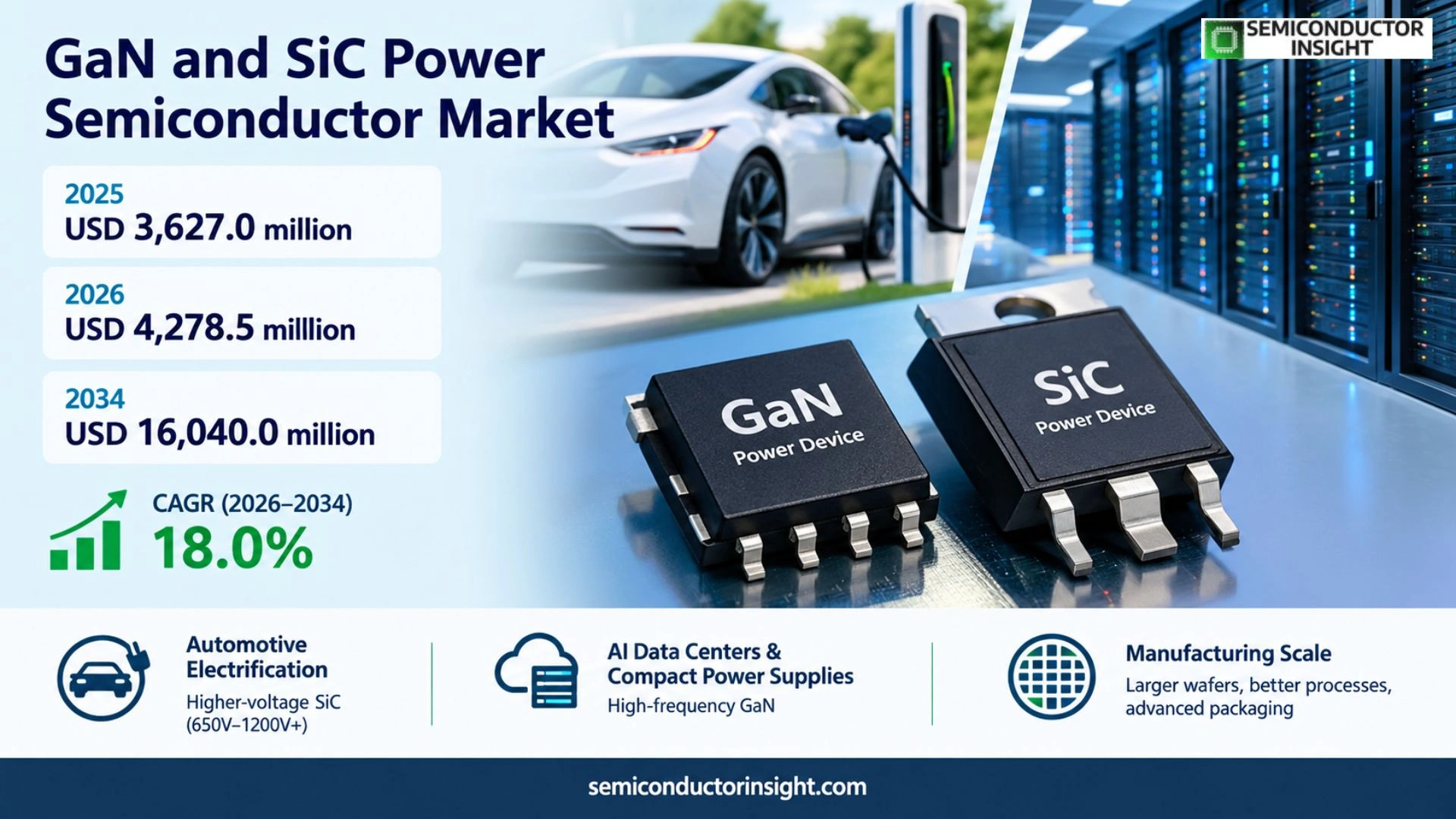
GaN and SiC Power Semiconductor Market is valued at USD 3,627.0 million in 2025, is estimated at USD 4,278.5 million in 2026, and is projected to reach USD 16,040.0 million by 2034, representing a CAGR of 18.0% during 2026–2034. Asia Pacific is the 2025 market-position reference used in this overview.
Base year: 2025 · Estimated year: 2026 · Forecast period: 2026–2034 · Values in USD million unless otherwise stated
Gallium nitride and silicon carbide are wide-bandgap semiconductor materials used to build power switches and rectifiers that operate with lower switching loss, higher electric-field strength and higher temperature capability than conventional silicon devices. GaN is especially attractive for high-frequency conversion at low and medium power, while SiC is strongly positioned in high-voltage, high-power applications such as traction inverters, industrial drives, charging infrastructure and grid conversion.
The market is being reshaped by two simultaneous transitions. Automotive electrification increases demand for 650 V, 750 V, 1200 V and higher-voltage SiC devices, while AI data centers and compact power supplies increase demand for high-frequency GaN. The result is not a single technology replacing the other, but a broader portfolio shift in which device selection depends on bus voltage, switching frequency, thermal limits, power density and total system cost.
Manufacturing scale remains a decisive competitive factor. SiC requires high-quality substrates, epitaxy and defect control, while GaN power devices are commonly built on silicon or other substrates using specialized epitaxial processes. Suppliers are investing in larger wafers, vertically integrated capacity, advanced packaging and application-specific modules to reduce cost and improve reliability.
Segment Analysis: By Type
By type, the market is segmented into GaN Power Devices and SiC Power Devices. SiC Power Devices hold the larger current market position because adoption is already broad in EV traction, industrial and renewable-energy systems, while GaN is growing quickly in high-frequency applications.
| Segment Category | Sub-Segments | Key Insights |
|---|---|---|
| By Type | GaN Power Devices | High switching frequency, low gate charge and compact power-stage design support fast chargers, server PSUs, telecom, AI infrastructure and emerging automotive power conversion. |
| By Type | SiC Power Devices | Higher-voltage capability, low switching loss and high-temperature performance support EV traction inverters, OBCs, industrial drives, solar, storage and charging infrastructure. |
Why are GaN and SiC winning in different voltage and power ranges?
GaN excels where switching frequency can be increased enough to shrink magnetics and improve power density, while SiC offers a strong combination of voltage capability, ruggedness and thermal performance for high-power conversion. New product developments are narrowing the traditional boundary: high-voltage GaN is moving upward, while SiC packaging and module integration continue improving system density at high power.
Segment Analysis: By Application
By application, the market covers Automotive & Mobility, EV Charging, Consumer Electronics, Industrial Motor/Drive, PV, Energy Storage, Wind Power, UPS, Data Center & Server, Rail Transport, Defense & Aerospace, and Others. Automotive & Mobility is the leading strategic application.
| Application | Demand characteristics | Key Insights |
|---|---|---|
| Automotive & Mobility | Traction inverters, onboard chargers and DC/DC converters use SiC to reduce switching and conduction losses; GaN is moving into auxiliary and charger functions. | The leading strategic application with long design cycles, large unit volumes and strict reliability requirements. |
| EV Charging | Fast chargers need high-voltage, efficient PFC and DC/DC stages with reduced cooling and smaller passive components. | A major SiC opportunity with growing GaN participation in selected conversion stages. |
| Consumer Electronics | USB-C chargers, laptop adapters and gaming power supplies use GaN to reduce size and improve efficiency. | A key high-volume GaN segment where fast product cycles and cost reduction drive adoption. |
| Industrial Motor/Drive | Factory automation, robotics and variable-speed drives use wide-bandgap devices to raise switching frequency and reduce thermal loss. | A strong value segment with long equipment lifecycles and high reliability requirements. |
| PV, Energy Storage, Wind Power | Inverters and bidirectional converters benefit from lower switching loss, higher voltage and improved efficiency. | A durable energy-transition growth segment, especially for SiC. |
| UPS, Data Center & Server | AI racks and server power systems require higher efficiency and power density from grid input to low-voltage rails. | A rapidly expanding market for both high-voltage GaN and SiC. |
| Rail Transport | Traction converters and auxiliary power systems require high voltage, ruggedness and efficiency. | A premium long-lifecycle SiC application. |
| Defense & Aerospace | Compact, lightweight and high-temperature power conversion is valuable in mission and aerospace systems. | A high-value niche with strong qualification barriers. |
| Others | Includes telecom, medical and specialty power systems. | Selective opportunities where efficiency and size justify wide-bandgap cost. |
Why is AI infrastructure becoming as important as EVs for wide-bandgap power?
AI data centers are moving toward much higher rack power and higher-voltage distribution to reduce copper loss. This creates demand for efficient conversion at every stage from grid input to accelerator rails. GaN can deliver very high switching frequency and power density, while SiC supports higher-voltage front-end conversion and energy storage interfaces. Current 800 VDC and future 1500 V architectures are therefore expanding the addressable power-semiconductor opportunity.
Regional Analysis
Asia Pacific leads the GaN and SiC Power Semiconductor market through its concentration of electric-vehicle production, consumer-electronics manufacturing and semiconductor supply chains. North America and Europe remain major innovation and high-value automotive markets.
How do the regional wide-bandgap ecosystems differ?
Asia Pacific combines manufacturing scale, EV demand and regional semiconductor suppliers. North America is strong in GaN innovation, AI infrastructure and power-semiconductor design. Europe has deep automotive, industrial and energy-conversion expertise. South America and the Middle East & Africa are mainly demand markets where adoption follows renewable energy, EV infrastructure, telecom and industrial modernization.
| Region | Position | Growth outlook | Demand profile | What decides supplier selection |
|---|---|---|---|---|
| Asia Pacific | Largest | Very strong | EVs, consumer electronics and manufacturing scale | Cost, capacity, local supply and automotive qualification |
| North America | Innovation & AI power market | Strong | AI data centers, industrial, EV and defense | Device performance, ecosystem and supply security |
| Europe | Automotive & industrial stronghold | Strong | EV traction, industrial drives and renewables | Reliability, qualification and energy efficiency |
| South America | Developing adoption market | Selective | Renewables, industrial and EV charging | Cost, imported supply and local support |
| Middle East & Africa | Infrastructure-led growth market | Selective high growth | Data centers, renewables and industrial power | Availability, system integration and efficiency |
Competitive Landscape
The market includes STMicroelectronics, Infineon Technologies, Wolfspeed, ROHM, onsemi, Innoscience, BYD Semiconductor, Renesas, Navitas Semiconductor, Power Integrations, Efficient Power Conversion, Mitsubishi Electric, Fuji Electric, Microchip and Semikron Danfoss.
SiC competition is led by vertically integrated suppliers with control over substrates, epitaxy, device fabrication and modules. Infineon, ST, ROHM, Wolfspeed and onsemi compete heavily in automotive and industrial design wins.
GaN competition is more fragmented and includes pure-play manufacturers, fabless specialists and diversified power-semiconductor companies. Innoscience has emphasized large-scale GaN-on-silicon manufacturing, while Power Integrations, Navitas and EPC differentiate through system architecture and device integration.
The competitive boundary is increasingly application specific. Automotive programs reward reliability and long supply agreements, AI infrastructure rewards power density and high-voltage capability, and consumer fast charging rewards cost, integration and compact packaging.
| Competitive tier | Representative companies | Commercial basis |
|---|---|---|
| Global SiC leaders | Infineon; STMicroelectronics; ROHM; onsemi; Wolfspeed | Vertical integration, automotive modules, high-voltage portfolios and global OEM relationships. |
| GaN specialists and high-volume players | Innoscience; Navitas; EPC; Power Integrations | High-frequency GaN devices, integrated power ICs and fast-growing consumer/AI applications. |
| Diversified power suppliers | Renesas; Mitsubishi Electric; Fuji Electric; Microchip; Semikron Danfoss | Broad industrial, automotive and module portfolios with wide-bandgap expansion. |
Key Participants
STMicroelectronics, Infineon Technologies, Wolfspeed, ROHM, onsemi, Innoscience, BYD Semiconductor, Renesas Electronics, Navitas Semiconductor, Power Integrations, Efficient Power Conversion, Mitsubishi Electric, Fuji Electric, Microchip Technology, Semikron Danfoss.
Production Capacity Analysis
Production capacity spans SiC substrate growth and epitaxy, GaN epitaxy, wafer fabrication, device packaging and power-module assembly. Cost reduction depends on larger wafers, higher yield, lower defect density and packaging that captures the switching advantage without adding excessive parasitic inductance.
SiC begins with crystal growth and substrate preparation, followed by epitaxy and MOSFET or diode fabrication. Crystal defects and wafer cost strongly influence device economics, which is why substrate strategy remains a competitive differentiator.
GaN power devices are commonly manufactured on silicon wafers using epitaxial layers engineered for high electron mobility and breakdown. Large 8-inch GaN-on-silicon production helps reduce cost and improves compatibility with established semiconductor manufacturing infrastructure.
Packaging is critical for both technologies. High switching speed can be lost through package inductance and thermal resistance, so top-side cooling, molded power modules, Kelvin-source connections and low-inductance layouts are increasingly important.
| Capacity layer | Where it concentrates | Commercial constraint |
|---|---|---|
| SiC substrate & epitaxy | United States, Europe, Japan and Asia | Crystal defects, boule yield, wafer size and long-term capacity. |
| GaN epitaxy & wafer fabrication | China, Taiwan, Europe and global foundries | Epitaxial quality, 8-inch scale, threshold stability and cost. |
| Discrete / module packaging | Asia, Europe and North America | Thermal resistance, inductance, automotive qualification and power density. |
| System qualification | Automotive, industrial and data-center ecosystems | Gate drive, EMI, thermal design, safety and long-lifecycle validation. |
Market Dynamics
The market grows through electrification and higher power density, but adoption remains application specific. SiC has a mature automotive path, while GaN is expanding from consumer adapters into server, industrial and vehicle power.
Market Drivers
| Factor | Directional impact | Why it matters |
|---|---|---|
| EV electrification | High | Traction inverters, OBCs and DC/DC converters reward lower loss and higher voltage. |
| AI data-center power | High | Higher rack power and 800 VDC architectures create new wide-bandgap demand. |
| Fast charging & compact adapters | High | GaN supports high frequency and smaller magnetics. |
| Renewable energy & storage | Medium-High | Inverters and bidirectional converters gain from lower switching losses. |
EV efficiency directly converts into range and thermal savings
Lower switching loss can reduce inverter cooling demand and improve vehicle efficiency. This makes SiC economically attractive even when device cost is higher than silicon.
AI infrastructure raises the value of every efficiency point
Megawatt-scale racks amplify conversion losses into major facility power and cooling burdens. GaN and SiC therefore gain value as system-level power density rises.
Fast chargers favor high-frequency GaN
GaN allows smaller transformers, inductors and capacitors while maintaining high efficiency, enabling compact USB-C adapters and higher-power consumer supplies.
Renewable-energy converters need bidirectional high-efficiency power
Solar, storage and wind systems increasingly use wide-bandgap devices to reduce switching loss and increase converter density.
Market Restraints
| Factor | Directional impact | Why it matters |
|---|---|---|
| Higher device cost | High | Wide-bandgap wafers and processing remain more expensive than mature silicon. |
| Qualification and design-in complexity | High | Gate drive, EMI and thermal behavior differ from conventional silicon. |
| Capacity and yield risk | Medium-High | SiC substrate and GaN epitaxy quality affect manufacturing economics. |
| Silicon competition | Medium | IGBTs and superjunction MOSFETs remain cost effective in many applications. |
Cost remains the main barrier outside performance-critical applications
Silicon devices still provide acceptable performance at lower price in many low-duty-cycle or cost-sensitive systems.
Faster switching can create new EMI and layout problems
Wide-bandgap devices require tighter gate loops, better grounding and more careful PCB or module parasitic control.
Manufacturing quality directly affects reliability
Defects in SiC substrates or GaN epitaxy can reduce yield and long-term robustness, increasing the value of supplier process maturity.
Incumbent silicon ecosystems retain design inertia
Engineers have decades of experience with silicon IGBTs and MOSFETs, and redesign is difficult to justify when system-level benefit is small.
Market Opportunities
800 VDC and higher AI power
GaN and SiC can reduce conversion loss across high-power data-center architectures.
Next-generation EV inverters
Higher-voltage SiC modules can increase power density and reduce cooling.
Automotive GaN OBC / DC-DC
GaN can expand beyond consumer charging into vehicle auxiliary and charging systems.
High-voltage GaN
1700–2200 V devices open applications historically served only by SiC or slower silicon technologies.
Supply Chain Analysis
Substrates & Epitaxy. Material quality sets a large part of cost and yield. Suppliers with secure SiC boule capacity or high-volume GaN epitaxy can scale more predictably.
Wafer Fabrication. Device architecture determines on-resistance, breakdown, switching behavior and threshold stability. Larger wafers are important to cost reduction.
Packaging & Modules. Fast edges and high current demand low-inductance interconnect and strong thermal paths. Packaging innovation is therefore a core performance lever.
OEM Integration. Customers evaluate efficiency, EMI, thermal behavior, lifetime and supply assurance at the complete converter level rather than accepting device specifications alone.
Recent Developments in the GaN and SiC Power Semiconductor Market
Developments tracked to September 2026. Entries use official publication dates where available.
-
August 2026TechnologyPower Integrations demonstrated 2200 V PowiGaN technology for future high-voltage power systems. The platform targets AI data centers, EVs, solar, HVDC and industrial power.
-
9 July 2026Automotive GaNInnoscience reported market recognition for its automotive-grade SolidGaN device. The award highlighted commercialization and customer adoption of integrated GaN power technology.
-
26 June 2026AI infrastructureSTMicroelectronics highlighted SiC and GaN as key power technologies for Cloud AI infrastructure. The company linked wide-bandgap devices to higher-voltage and higher-density data-center power architectures.
-
9 June 2026PackagingROHM introduced the TSC3PAK top-side-cooled package for SiC MOSFETs. The package targets EV onboard chargers, compressors, server power supplies and PV inverters.
-
29 May 2026Automotive SiCInfineon launched a 1300 V HybridPACK Drive SiC module capable of continuous operation at 205°C. The device targets higher power density in EV traction inverters.
Report Scope & Segmentation
| Attribute | Coverage |
|---|---|
| Report title | GaN and SiC Power Semiconductor Market Size, Trends, Business Strategies 2026-2034 |
| Base Year | 2025 |
| Estimated Year | 2026 |
| Forecast Period | 2026–2034 |
| By Type | GaN Power Devices; SiC Power Devices |
| By Application | Automotive & Mobility; EV Charging; Consumer Electronics; Industrial Motor/Drive; PV, Energy Storage, Wind Power; UPS, Data Center & Server; Rail Transport; Defense & Aerospace; Others |
| By End User | Automotive OEMs & Tier-1 Suppliers; Industrial Equipment Manufacturers; Consumer Electronics Brands; Energy/Infrastructure Providers; IT & Data Center Operators |
| By Technology Readiness & Adoption Wave | High-Volume Mainstream; Rapid Growth/Niche Dominance; Emerging/Pilot Phase |
| Regions | North America; Europe; Asia Pacific; South America; Middle East & Africa |
| Companies | STMicroelectronics; Infineon Technologies; Wolfspeed; ROHM; onsemi; Innoscience; BYD Semiconductor; Renesas Electronics; Navitas Semiconductor; Power Integrations; Efficient Power Conversion; Mitsubishi Electric; Fuji Electric; Microchip Technology; Semikron Danfoss |
| Customization scope | Country, segment, company, application, technology, production and competitive-detail customization available within the study scope. |
Frequently Asked Questions
What is the size of the GaN and SiC Power Semiconductor market?
The market is valued at USD 3,627.0 million in 2025, is estimated at USD 4,278.5 million in 2026, and is projected to reach USD 16,040.0 million by 2034, representing a 18.0% CAGR during 2026–2034. This point remains commercially relevant because qualification, lifecycle support, supply continuity and system-level performance can materially affect supplier selection during the 2026–2034 forecast period. For the GaN and SiC Power Semiconductor market, this also affects supplier qualification, product positioning and purchasing decisions across the 2026–2034 forecast period.
Which region leads the market?
Asia Pacific leads through EV manufacturing, consumer-electronics production, wide-bandgap supply chains and large regional semiconductor capacity. This point remains commercially relevant because qualification, lifecycle support, supply continuity and system-level performance can materially affect supplier selection during the 2026–2034 forecast period. Buyers therefore evaluate lifecycle support, technical fit, application performance and supply continuity alongside the headline device or system specification. This remains commercially important because successful design-in decisions can persist for several product generations once performance, reliability and availability are validated.
Which technology segment is larger?
SiC Power Devices remain larger because automotive traction, industrial drives and high-voltage energy conversion already use SiC at significant scale. This point remains commercially relevant because qualification, lifecycle support, supply continuity and system-level performance can materially affect supplier selection during the 2026–2034 forecast period. This remains commercially important because successful design-in decisions can persist for several product generations once performance, reliability and availability are validated.
Which application is most important?
Automotive & Mobility is the leading strategic application, supported by traction inverters, onboard chargers and DC/DC converters. This point remains commercially relevant because qualification, lifecycle support, supply continuity and system-level performance can materially affect supplier selection during the 2026–2034 forecast period. For the GaN and SiC Power Semiconductor market, this also affects supplier qualification, product positioning and purchasing decisions across the 2026–2034 forecast period. Buyers therefore evaluate lifecycle support, technical fit, application performance and supply continuity alongside the headline device or system specification.
Why is GaN growing in AI data centers?
GaN enables high switching frequency and compact high-density power stages, and new 1250 V, 1700 V and 2200 V developments are expanding GaN into higher-voltage distribution architectures. This point remains commercially relevant because qualification, lifecycle support, supply continuity and system-level performance can materially affect supplier selection during the 2026–2034 forecast period. Buyers therefore evaluate lifecycle support, technical fit, application performance and supply continuity alongside the headline device or system specification.
Why is SiC important in EVs?
SiC lowers switching and conduction losses at high voltage and temperature, helping traction inverters and chargers reduce cooling, improve efficiency and support higher-power vehicle systems. This point remains commercially relevant because qualification, lifecycle support, supply continuity and system-level performance can materially affect supplier selection during the 2026–2034 forecast period. This remains commercially important because successful design-in decisions can persist for several product generations once performance, reliability and availability are validated.
What are the main restraints?
Higher device cost, qualification complexity, materials and yield challenges, and strong silicon competition remain the main restraints. This point remains commercially relevant because qualification, lifecycle support, supply continuity and system-level performance can materially affect supplier selection during the 2026–2034 forecast period. For the GaN and SiC Power Semiconductor market, this also affects supplier qualification, product positioning and purchasing decisions across the 2026–2034 forecast period. Buyers therefore evaluate lifecycle support, technical fit, application performance and supply continuity alongside the headline device or system specification.
Who are the major companies?
Major companies include STMicroelectronics, Infineon, Wolfspeed, ROHM, onsemi, Innoscience, Renesas, Navitas, Power Integrations, EPC and Microchip. This point remains commercially relevant because qualification, lifecycle support, supply continuity and system-level performance can materially affect supplier selection during the 2026–2034 forecast period. Buyers therefore evaluate lifecycle support, technical fit, application performance and supply continuity alongside the headline device or system specification. This remains commercially important because successful design-in decisions can persist for several product generations once performance, reliability and availability are validated.
How is packaging changing the market?
Low-inductance modules, top-side cooling and compact molded packages allow wide-bandgap devices to preserve their switching advantage while carrying more current and operating at higher temperature. This point remains commercially relevant because qualification, lifecycle support, supply continuity and system-level performance can materially affect supplier selection during the 2026–2034 forecast period. This remains commercially important because successful design-in decisions can persist for several product generations once performance, reliability and availability are validated.
Where are the strongest opportunities?
The strongest opportunities are in AI power infrastructure, next-generation EV inverters, automotive GaN, renewable-energy conversion and high-voltage GaN. This point remains commercially relevant because qualification, lifecycle support, supply continuity and system-level performance can materially affect supplier selection during the 2026–2034 forecast period. For the GaN and SiC Power Semiconductor market, this also affects supplier qualification, product positioning and purchasing decisions across the 2026–2034 forecast period.
Research Sources & Evidence Base
Get Sample Report PDF for Exclusive Insights
Report Sample Includes
- Table of Contents
- List of Tables & Figures
- Charts, Research Methodology, and more...
 Download Sample Report PDF