Transistor Inverter Market, Trends, Business Strategies 2025-2032

Transistor Inverter Market size was valued at US$ 1.45 billion in 2024 and is projected to reach US$ 2.67 billion by 2032, at a CAGR of 9.1% during the forecast period 2025-2032

PDF Icon Download Sample Report PDF
  • Quick Dispatch

    All Orders

  • Secure Payment

    100% Secure Payment

Price range: $1,500.00 through $4,250.00

Clear

MARKET INSIGHTS

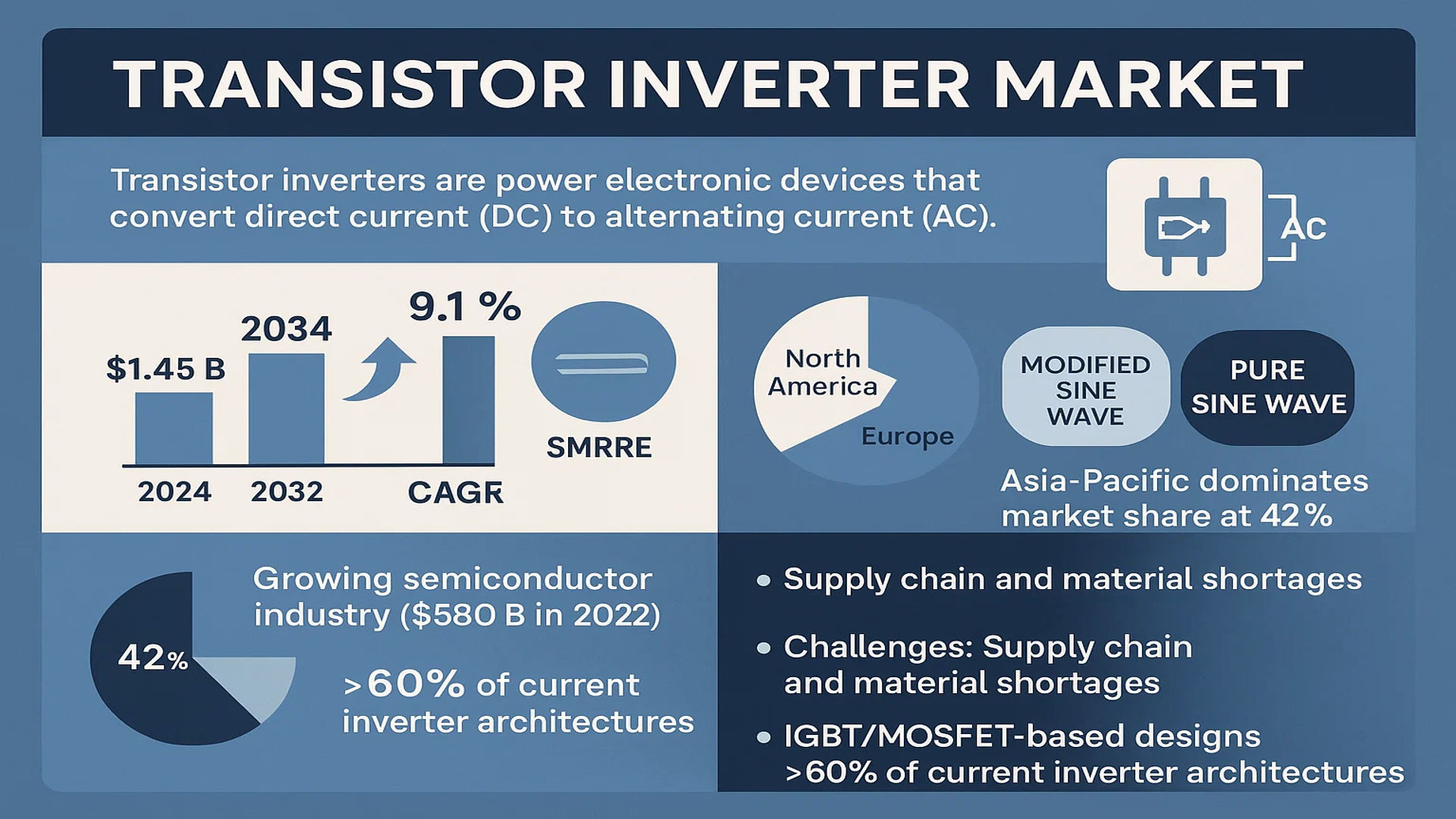
The global Transistor Inverter Market size was valued at US$ 1.45 billion in 2024 and is projected to reach US$ 2.67 billion by 2032, at a CAGR of 9.1% during the forecast period 2025-2032.

Transistor inverters are power electronic devices that convert direct current (DC) to alternating current (AC). These semiconductor-based systems are fundamental components in applications ranging from industrial motor drives to renewable energy systems and consumer electronics. The market is segmented into modified sine wave and pure sine wave inverters, with the latter gaining traction due to superior power quality and compatibility with sensitive electronics.

While the Asia-Pacific region currently dominates market share at 42%, North America and Europe are witnessing accelerated adoption in electric vehicle charging infrastructure. The growing semiconductor industry, which reached USD 580 billion globally in 2022, provides a strong foundation for inverter component availability. However, supply chain disruptions and material shortages pose challenges, particularly for IGBT and MOSFET-based designs that constitute over 60% of current inverter architectures.
Transistor Inverter Market

MARKET DYNAMICS

MARKET DRIVERS

Rising Demand for Energy-Efficient Electronics Strengthens Transistor Inverter Adoption

The global push toward energy efficiency is accelerating demand for advanced power conversion technologies like transistor inverters. With electronic devices consuming approximately 15% of global electricity, manufacturers are increasingly adopting efficient inverter solutions to reduce power losses. The transition from traditional mechanical inverters to solid-state transistor-based systems has demonstrated efficiency improvements of up to 30%, making them indispensable in modern power electronics. This shift is particularly evident in consumer electronics, where strict energy regulations continue to tighten worldwide.

Expanding Renewable Energy Sector Fuels Market Expansion

Global renewable energy capacity additions reached approximately 295 GW in 2022, creating unprecedented demand for power conversion equipment. Transistor inverters serve as critical components in solar photovoltaic systems and wind power installations, converting DC to AC power with minimal energy loss. The solar inverter market alone is projected to maintain a compound annual growth rate of over 5% through 2030, directly benefiting transistor inverter manufacturers. As governments worldwide accelerate renewable energy deployment to meet decarbonization targets, this segment continues to drive significant market growth.

Automotive Electrification Creates New Application Horizons

The electric vehicle revolution is reshaping power electronics demand, with transistor inverters playing a pivotal role in traction motor control systems. With electric car sales surpassing 10 million units globally in 2022, automotive inverters have emerged as a high-growth segment. Advanced wide-bandgap semiconductor materials are enabling inverter systems that are up to 30% smaller and 50% more efficient than conventional designs. This technological evolution, combined with the automotive industry’s rapid electrification timeline, positions transistor inverters for sustained market expansion.

MARKET RESTRAINTS

Supply Chain Vulnerabilities Challenge Production Consistency

The semiconductor shortage crisis exposed critical vulnerabilities in the transistor inverter supply chain. With approximately 70% of power semiconductor production concentrated in Asia, geopolitical tensions and trade restrictions have created substantial market uncertainties. Lead times for certain high-performance IGBT modules extended beyond 52 weeks during the peak of the shortage, forcing manufacturers to delay production schedules. This concentration risk continues to restrain market growth potential as companies work to establish more resilient supply networks.

Thermal Management Limitations Impact Performance Thresholds

While transistor inverters offer superior efficiency, thermal dissipation remains a significant technical constraint. Power densities in modern inverters frequently exceed 100W/cm², pushing existing cooling solutions to their operational limits. Approximately 20% of inverter failures are attributed to thermal stress, creating reliability concerns in mission-critical applications. The industry faces mounting pressure to develop advanced thermal interface materials and cooling architectures that can support next-generation power requirements without compromising size or cost targets.

MARKET OPPORTUNITIES

Wide Bandgap Semiconductor Adoption Opens New Frontiers

The transition to silicon carbide (SiC) and gallium nitride (GaN) power devices represents a transformative opportunity for the transistor inverter market. Wide bandgap semiconductors enable inverter systems that operate at higher temperatures, voltages, and switching frequencies. Industry adoption rates for these advanced materials are accelerating, with SiC-based inverter sales growing at nearly 30% annually. This technological shift is particularly impactful in electric vehicle powertrains and industrial motor drives, where efficiency gains translate directly into competitive advantages.

Smart Grid Modernization Drives Innovation Demand

Global investments in smart grid infrastructure surpassed $50 billion in 2023, creating significant opportunities for intelligent inverter solutions. Modern grid-tied inverters increasingly incorporate advanced features like reactive power control, fault ride-through capability, and grid-forming functionality. This evolution aligns with renewable integration requirements and distributed energy resource management needs. As utilities worldwide prioritize grid modernization, the demand for sophisticated transistor inverter systems with enhanced communication and control capabilities continues to expand.

MARKET CHALLENGES

Design Complexity Increases Time-to-Market Pressures

The relentless demand for higher power density and efficiency has dramatically increased inverter design complexity. Developing optimized gate driver circuits, achieving effective electromagnetic interference (EMI) suppression, and implementing robust protection mechanisms require extensive engineering resources. Many manufacturers report product development cycles extending beyond 24 months for advanced inverter platforms, making it challenging to keep pace with rapidly evolving market requirements and technology standards.

Cost Competition Intensifies Across Application Segments

While premium applications like automotive and industrial sectors tolerate higher inverter costs, consumer markets remain extremely price-sensitive. Chinese manufacturers have captured significant market share by offering inverter solutions at 30-40% lower price points than European and American counterparts. This pricing pressure forces established players to optimize manufacturing processes and supply chain strategies while maintaining quality standards, creating ongoing profitability challenges across the industry.

TRANSISTOR INVERTER MARKET TRENDS

Rising Demand for Energy-Efficient Power Conversion Solutions Driving Market Growth

The global transition toward energy-efficient technologies continues to bolster demand for transistor inverters, particularly in industrial and consumer applications. The market, valued at several million dollars in 2024, is projected to exhibit steady growth as industries prioritize power optimization and renewable energy integration. With a compound annual growth rate (CAGR) expected to remain in the single digits, manufacturers are focusing on high-performance insulated-gate bipolar transistors (IGBTs) and silicon carbide (SiC) MOSFETs, which offer superior switching efficiency compared to traditional silicon-based components. The semiconductor industry’s resilience, despite global economic fluctuations, ensures a stable supply chain for these critical components, with regional markets such as the Americas and Europe showing double-digit growth in semiconductor sales.

Other Trends

Expansion of Renewable Energy Infrastructure

As governments and corporations accelerate investments in renewable energy, transistor inverters—key components in solar and wind power systems—are witnessing heightened adoption. The shift from centralized power generation to distributed energy resources necessitates advanced inverters capable of handling variable loads with minimal energy loss. For instance, modern pure sine wave inverters are increasingly favored in photovoltaic systems due to their ability to deliver stable AC power with reduced harmonic distortion. Meanwhile, the Asia-Pacific region, despite a recent temporary slowdown, remains a dominant force in semiconductor production, supporting local and global inverter manufacturing.

Technological Advancements in Semiconductor Materials

Innovations in semiconductor materials, including the wider adoption of gallium nitride (GaN) and silicon carbide, are reshaping the transistor inverter landscape. These materials enable higher switching frequencies and lower thermal losses, making them ideal for electric vehicles (EVs) and high-power industrial applications. While SiC-based inverters currently account for a smaller market share, their penetration is growing rapidly due to superior breakdown voltage and efficiency in high-temperature environments. Concurrently, the integration of smart features—such as real-time monitoring and AI-driven predictive maintenance—is transforming inverters into intelligent power management systems, further expanding their applications in IoT-enabled environments.

COMPETITIVE LANDSCAPE

Key Industry Players

Leading Semiconductor Firms Compete Through Innovation and Strategic Expansion

The global transistor inverter market remains highly competitive, dominated by established semiconductor manufacturers and emerging specialized players. Infineon Technologies leads the market with its advanced power semiconductor solutions, holding an estimated 18% revenue share in 2024. The company’s strong position stems from its vertically integrated manufacturing capabilities and broad product portfolio catering to automotive, industrial, and consumer electronics applications.

ABB and Vishay Intertechnology constitute the second-tier leaders, collectively accounting for approximately 25% market share. Both companies have strategically expanded their transistor inverter offerings through acquisitions and technological partnerships. ABB’s recent $2.9 billion investment in power electronics R&D highlights the growing importance of energy-efficient inverter solutions.

Meanwhile, mid-sized competitors like Powerex and Littelfuse are gaining traction by focusing on niche applications. Powerex has successfully penetrated the renewable energy sector, while Littelfuse’s acquisition of IXYS Corporation significantly strengthened its power semiconductor portfolio. These developments indicate an industry trend towards specialization within the transistor inverter space.

The competitive landscape continues evolving as Chinese manufacturers like Jiangsu Yangjie Runau Semiconductor increase production capabilities. With China accounting for 40% of global semiconductor consumption, domestic suppliers are well-positioned to capture market share through cost-competitive offerings. However, quality concerns and geopolitical factors may constrain their global expansion in the short term.

List of Key Transistor Inverter Manufacturers

  • Infineon Technologies AG (Germany)
  • ABB Ltd. (Switzerland)
  • Vishay Intertechnology, Inc. (U.S.)
  • Powerex Inc. (U.S.)
  • Littelfuse, Inc. (U.S.)
  • Rosen Technology (Germany)
  • Jiangsu Yangjie Runau Semiconductor Co. (China)
  • NFE Corporation (Japan)
  • TTI, Inc. (U.S.)
  • Poseico Electronics (South Korea)

Segment Analysis:

By Type

Pure Sine Wave Segment Leads the Market Due to Superior Performance in Sensitive Electronics

The market is segmented based on type into:

  • Modified Sine Wave
    • Subtypes: Low Frequency, High Frequency, and others
  • Pure Sine Wave
    • Subtypes: Single Phase, Three Phase, and others
  • Others

By Application

Electronics Industry Segment Dominates Owing to Expanding Consumer Electronics Market

The market is segmented based on application into:

  • Electronics Industry
    • Subtypes: Consumer Electronics, Industrial Electronics, and others
  • Communications Industry
    • Subtypes: Telecommunication Equipment, Networking Devices, and others
  • Others

By Power Rating

Medium Power Segment Shows Significant Growth for Industrial Applications

The market is segmented based on power rating into:

  • Low Power (up to 1 kW)
  • Medium Power (1 kW to 5 kW)
  • High Power (above 5 kW)

By Technology

IGBT Technology Holds Major Share Due to High Efficiency in Power Conversion

The market is segmented based on technology into:

  • MOSFET
  • IGBT
  • Bipolar Transistor
  • Others

Regional Analysis: Transistor Inverter Market

North America
The North American transistor inverter market is driven by technological advancements and substantial investments in renewable energy integration. The U.S. leads the region with a robust semiconductor industry, accounting for approximately 32% of global semiconductor sales. The increasing demand for energy-efficient power conversion systems in industries such as automotive, telecommunications, and industrial automation is propelling market growth. Government initiatives like the CHIPS and Science Act, which allocates $52 billion for domestic semiconductor manufacturing, further solidify market expansion. However, supply chain disruptions and high production costs remain challenges for manufacturers.

Europe
Europe’s transistor inverter market is characterized by stringent energy efficiency regulations and a strong emphasis on sustainability. The EU’s commitment to achieving net-zero emissions by 2050 has accelerated the adoption of advanced inverter technologies in solar and wind energy applications. Germany and France dominate the regional market, supported by their well-established automotive and industrial sectors. The demand for pure sine wave inverters is rising in residential and commercial applications due to their superior performance. While the market is growing, competition from Asian manufacturers and complex regulatory frameworks pose challenges for local players.

Asia-Pacific
As the largest and fastest-growing market for transistor inverters, the Asia-Pacific region benefits from rapid industrialization and urbanization. China, Japan, and South Korea are key contributors, leveraging their strong semiconductor manufacturing capabilities. The region’s dominance in consumer electronics and electric vehicle production fuels demand for efficient power conversion solutions. However, price sensitivity and the prevalence of low-cost alternatives hinder the widespread adoption of high-end inverter technologies. Despite this, government incentives for renewable energy projects and smart grid development continue to drive long-term growth.

South America
South America’s transistor inverter market is emerging, with Brazil and Argentina leading regional demand. The growth is primarily driven by expanding telecommunications infrastructure and increasing investments in renewable energy projects. While the market is still in its nascent stage, the rising adoption of solar energy systems offers significant opportunities. Economic instability and inconsistent regulatory policies, however, create uncertainties for investors. Local manufacturers face challenges in competing with imported products, but partnerships with global players could help bridge the technological gap.

Middle East & Africa
The Middle East & Africa region is witnessing gradual growth in the transistor inverter market, driven by infrastructure development and renewable energy initiatives. Countries like Saudi Arabia, the UAE, and South Africa are investing heavily in solar power plants and smart city projects. While the lack of local manufacturing capabilities and reliance on imports slow down market expansion, increasing foreign investments and government support for clean energy are expected to accelerate adoption. The market’s long-term potential remains high, particularly in off-grid and hybrid power solutions.

Report Scope

This market research report provides a comprehensive analysis of the global and regional Transistor Inverter markets, covering the forecast period 2025–2032. It offers detailed insights into market dynamics, technological advancements, competitive landscape, and key trends shaping the industry.

Key focus areas of the report include:

  • Market Size & Forecast: Historical data and future projections for revenue, unit shipments, and market value across major regions and segments.
  • Segmentation Analysis: Detailed breakdown by product type (Modified Sine Wave, Pure Sine Wave), application (Electronics Industry, Communications Industry, Others), and end-user industry to identify high-growth segments.
  • Regional Outlook: Insights into market performance across North America, Europe, Asia-Pacific, Latin America, and the Middle East & Africa, with country-level analysis for key markets.
  • Competitive Landscape: Profiles of leading market participants including ABB, Infineon, Vishay, and Powerex, covering product portfolios, R&D investments, and strategic initiatives.
  • Technology Trends & Innovation: Assessment of semiconductor design advancements, power efficiency improvements, and integration with smart grid technologies.
  • Market Drivers & Restraints: Evaluation of factors including renewable energy adoption, industrial automation growth, and supply chain challenges.
  • Stakeholder Analysis: Strategic insights for semiconductor manufacturers, component suppliers, system integrators, and investors.

The research methodology combines primary interviews with industry experts and analysis of verified market data from authoritative sources to ensure accuracy and reliability.

FREQUENTLY ASKED QUESTIONS:

What is the current market size of Global Transistor Inverter Market?

-> Transistor Inverter Market size was valued at US$ 1.45 billion in 2024 and is projected to reach US$ 2.67 billion by 2032, at a CAGR of 9.1% during the forecast period 2025-2032.

Which key companies operate in Global Transistor Inverter Market?

-> Key players include ABB, Infineon, Vishay, Powerex, Littelfuse, and Rosen Technology, collectively holding over 45% market share.

What are the key growth drivers?

-> Key growth drivers include rising demand for renewable energy systems, industrial automation, and increasing adoption of power electronics in consumer devices.

Which region dominates the market?

-> Asia-Pacific accounts for 42% of global demand, led by China’s electronics manufacturing sector, while North America shows strong growth in industrial applications.

What are the emerging trends?

-> Emerging trends include wide-bandgap semiconductors (SiC/GaN), smart inverters with IoT connectivity, and miniaturization of power electronics.

Transistor Inverter Market, Trends, Business Strategies 2025-2032

Get Sample Report PDF for Exclusive Insights

Report Sample Includes

  • Table of Contents
  • List of Tables & Figures
  • Charts, Research Methodology, and more...
PDF Icon Download Sample Report PDF

Download Sample Report

Table of Content

1 Introduction to Research & Analysis Reports
1.1 Transistor Inverter Market Definition
1.2 Market Segments
1.2.1 Segment by Type
1.2.2 Segment by Application
1.3 Global Transistor Inverter Market Overview
1.4 Features & Benefits of This Report
1.5 Methodology & Sources of Information
1.5.1 Research Methodology
1.5.2 Research Process
1.5.3 Base Year
1.5.4 Report Assumptions & Caveats
2 Global Transistor Inverter Overall Market Size
2.1 Global Transistor Inverter Market Size: 2024 VS 2032
2.2 Global Transistor Inverter Market Size, Prospects & Forecasts: 2020-2032
2.3 Global Transistor Inverter Sales: 2020-2032
3 Company Landscape
3.1 Top Transistor Inverter Players in Global Market
3.2 Top Global Transistor Inverter Companies Ranked by Revenue
3.3 Global Transistor Inverter Revenue by Companies
3.4 Global Transistor Inverter Sales by Companies
3.5 Global Transistor Inverter Price by Manufacturer (2020-2025)
3.6 Top 3 and Top 5 Transistor Inverter Companies in Global Market, by Revenue in 2024
3.7 Global Manufacturers Transistor Inverter Product Type
3.8 Tier 1, Tier 2, and Tier 3 Transistor Inverter Players in Global Market
3.8.1 List of Global Tier 1 Transistor Inverter Companies
3.8.2 List of Global Tier 2 and Tier 3 Transistor Inverter Companies
4 Sights by Product
4.1 Overview
4.1.1 Segment by Type – Global Transistor Inverter Market Size Markets, 2024 & 2032
4.1.2 Modified Sine Wave
4.1.3 Pure Sine Wave
4.2 Segment by Type – Global Transistor Inverter Revenue & Forecasts
4.2.1 Segment by Type – Global Transistor Inverter Revenue, 2020-2025
4.2.2 Segment by Type – Global Transistor Inverter Revenue, 2026-2032
4.2.3 Segment by Type – Global Transistor Inverter Revenue Market Share, 2020-2032
4.3 Segment by Type – Global Transistor Inverter Sales & Forecasts
4.3.1 Segment by Type – Global Transistor Inverter Sales, 2020-2025
4.3.2 Segment by Type – Global Transistor Inverter Sales, 2026-2032
4.3.3 Segment by Type – Global Transistor Inverter Sales Market Share, 2020-2032
4.4 Segment by Type – Global Transistor Inverter Price (Manufacturers Selling Prices), 2020-2032
5 Sights by Application
5.1 Overview
5.1.1 Segment by Application – Global Transistor Inverter Market Size, 2024 & 2032
5.1.2 Electronics Industry
5.1.3 Communications Industry
5.1.4 Other
5.2 Segment by Application – Global Transistor Inverter Revenue & Forecasts
5.2.1 Segment by Application – Global Transistor Inverter Revenue, 2020-2025
5.2.2 Segment by Application – Global Transistor Inverter Revenue, 2026-2032
5.2.3 Segment by Application – Global Transistor Inverter Revenue Market Share, 2020-2032
5.3 Segment by Application – Global Transistor Inverter Sales & Forecasts
5.3.1 Segment by Application – Global Transistor Inverter Sales, 2020-2025
5.3.2 Segment by Application – Global Transistor Inverter Sales, 2026-2032
5.3.3 Segment by Application – Global Transistor Inverter Sales Market Share, 2020-2032
5.4 Segment by Application – Global Transistor Inverter Price (Manufacturers Selling Prices), 2020-2032
6 Sights by Region
6.1 By Region – Global Transistor Inverter Market Size, 2024 & 2032
6.2 By Region – Global Transistor Inverter Revenue & Forecasts
6.2.1 By Region – Global Transistor Inverter Revenue, 2020-2025
6.2.2 By Region – Global Transistor Inverter Revenue, 2026-2032
6.2.3 By Region – Global Transistor Inverter Revenue Market Share, 2020-2032
6.3 By Region – Global Transistor Inverter Sales & Forecasts
6.3.1 By Region – Global Transistor Inverter Sales, 2020-2025
6.3.2 By Region – Global Transistor Inverter Sales, 2026-2032
6.3.3 By Region – Global Transistor Inverter Sales Market Share, 2020-2032
6.4 North America
6.4.1 By Country – North America Transistor Inverter Revenue, 2020-2032
6.4.2 By Country – North America Transistor Inverter Sales, 2020-2032
6.4.3 United States Transistor Inverter Market Size, 2020-2032
6.4.4 Canada Transistor Inverter Market Size, 2020-2032
6.4.5 Mexico Transistor Inverter Market Size, 2020-2032
6.5 Europe
6.5.1 By Country – Europe Transistor Inverter Revenue, 2020-2032
6.5.2 By Country – Europe Transistor Inverter Sales, 2020-2032
6.5.3 Germany Transistor Inverter Market Size, 2020-2032
6.5.4 France Transistor Inverter Market Size, 2020-2032
6.5.5 U.K. Transistor Inverter Market Size, 2020-2032
6.5.6 Italy Transistor Inverter Market Size, 2020-2032
6.5.7 Russia Transistor Inverter Market Size, 2020-2032
6.5.8 Nordic Countries Transistor Inverter Market Size, 2020-2032
6.5.9 Benelux Transistor Inverter Market Size, 2020-2032
6.6 Asia
6.6.1 By Region – Asia Transistor Inverter Revenue, 2020-2032
6.6.2 By Region – Asia Transistor Inverter Sales, 2020-2032
6.6.3 China Transistor Inverter Market Size, 2020-2032
6.6.4 Japan Transistor Inverter Market Size, 2020-2032
6.6.5 South Korea Transistor Inverter Market Size, 2020-2032
6.6.6 Southeast Asia Transistor Inverter Market Size, 2020-2032
6.6.7 India Transistor Inverter Market Size, 2020-2032
6.7 South America
6.7.1 By Country – South America Transistor Inverter Revenue, 2020-2032
6.7.2 By Country – South America Transistor Inverter Sales, 2020-2032
6.7.3 Brazil Transistor Inverter Market Size, 2020-2032
6.7.4 Argentina Transistor Inverter Market Size, 2020-2032
6.8 Middle East & Africa
6.8.1 By Country – Middle East & Africa Transistor Inverter Revenue, 2020-2032
6.8.2 By Country – Middle East & Africa Transistor Inverter Sales, 2020-2032
6.8.3 Turkey Transistor Inverter Market Size, 2020-2032
6.8.4 Israel Transistor Inverter Market Size, 2020-2032
6.8.5 Saudi Arabia Transistor Inverter Market Size, 2020-2032
6.8.6 UAE Transistor Inverter Market Size, 2020-2032
7 Manufacturers & Brands Profiles
7.1 ABB
7.1.1 ABB Company Summary
7.1.2 ABB Business Overview
7.1.3 ABB Transistor Inverter Major Product Offerings
7.1.4 ABB Transistor Inverter Sales and Revenue in Global (2020-2025)
7.1.5 ABB Key News & Latest Developments
7.2 Poseico
7.2.1 Poseico Company Summary
7.2.2 Poseico Business Overview
7.2.3 Poseico Transistor Inverter Major Product Offerings
7.2.4 Poseico Transistor Inverter Sales and Revenue in Global (2020-2025)
7.2.5 Poseico Key News & Latest Developments
7.3 Powerex
7.3.1 Powerex Company Summary
7.3.2 Powerex Business Overview
7.3.3 Powerex Transistor Inverter Major Product Offerings
7.3.4 Powerex Transistor Inverter Sales and Revenue in Global (2020-2025)
7.3.5 Powerex Key News & Latest Developments
7.4 Vishay
7.4.1 Vishay Company Summary
7.4.2 Vishay Business Overview
7.4.3 Vishay Transistor Inverter Major Product Offerings
7.4.4 Vishay Transistor Inverter Sales and Revenue in Global (2020-2025)
7.4.5 Vishay Key News & Latest Developments
7.5 Rosen Technology
7.5.1 Rosen Technology Company Summary
7.5.2 Rosen Technology Business Overview
7.5.3 Rosen Technology Transistor Inverter Major Product Offerings
7.5.4 Rosen Technology Transistor Inverter Sales and Revenue in Global (2020-2025)
7.5.5 Rosen Technology Key News & Latest Developments
7.6 Jiangsu Yangjie Runau Semiconducter Co
7.6.1 Jiangsu Yangjie Runau Semiconducter Co Company Summary
7.6.2 Jiangsu Yangjie Runau Semiconducter Co Business Overview
7.6.3 Jiangsu Yangjie Runau Semiconducter Co Transistor Inverter Major Product Offerings
7.6.4 Jiangsu Yangjie Runau Semiconducter Co Transistor Inverter Sales and Revenue in Global (2020-2025)
7.6.5 Jiangsu Yangjie Runau Semiconducter Co Key News & Latest Developments
7.7 Littelfuse
7.7.1 Littelfuse Company Summary
7.7.2 Littelfuse Business Overview
7.7.3 Littelfuse Transistor Inverter Major Product Offerings
7.7.4 Littelfuse Transistor Inverter Sales and Revenue in Global (2020-2025)
7.7.5 Littelfuse Key News & Latest Developments
7.8 NFE
7.8.1 NFE Company Summary
7.8.2 NFE Business Overview
7.8.3 NFE Transistor Inverter Major Product Offerings
7.8.4 NFE Transistor Inverter Sales and Revenue in Global (2020-2025)
7.8.5 NFE Key News & Latest Developments
7.9 TTI,Inc
7.9.1 TTI,Inc Company Summary
7.9.2 TTI,Inc Business Overview
7.9.3 TTI,Inc Transistor Inverter Major Product Offerings
7.9.4 TTI,Inc Transistor Inverter Sales and Revenue in Global (2020-2025)
7.9.5 TTI,Inc Key News & Latest Developments
7.10 Infineon
7.10.1 Infineon Company Summary
7.10.2 Infineon Business Overview
7.10.3 Infineon Transistor Inverter Major Product Offerings
7.10.4 Infineon Transistor Inverter Sales and Revenue in Global (2020-2025)
7.10.5 Infineon Key News & Latest Developments
8 Global Transistor Inverter Production Capacity, Analysis
8.1 Global Transistor Inverter Production Capacity, 2020-2032
8.2 Transistor Inverter Production Capacity of Key Manufacturers in Global Market
8.3 Global Transistor Inverter Production by Region
9 Key Market Trends, Opportunity, Drivers and Restraints
9.1 Market Opportunities & Trends
9.2 Market Drivers
9.3 Market Restraints
10 Transistor Inverter Supply Chain Analysis
10.1 Transistor Inverter Industry Value Chain
10.2 Transistor Inverter Upstream Market
10.3 Transistor Inverter Downstream and Clients
10.4 Marketing Channels Analysis
10.4.1 Marketing Channels
10.4.2 Transistor Inverter Distributors and Sales Agents in Global
11 Conclusion
12 Appendix
12.1 Note
12.2 Examples of Clients
12.3 DisclaimerList of Tables
Table 1. Key Players of Transistor Inverter in Global Market
Table 2. Top Transistor Inverter Players in Global Market, Ranking by Revenue (2024)
Table 3. Global Transistor Inverter Revenue by Companies, (US$, Mn), 2020-2025
Table 4. Global Transistor Inverter Revenue Share by Companies, 2020-2025
Table 5. Global Transistor Inverter Sales by Companies, (K Units), 2020-2025
Table 6. Global Transistor Inverter Sales Share by Companies, 2020-2025
Table 7. Key Manufacturers Transistor Inverter Price (2020-2025) & (US$/Unit)
Table 8. Global Manufacturers Transistor Inverter Product Type
Table 9. List of Global Tier 1 Transistor Inverter Companies, Revenue (US$, Mn) in 2024 and Market Share
Table 10. List of Global Tier 2 and Tier 3 Transistor Inverter Companies, Revenue (US$, Mn) in 2024 and Market Share
Table 11. Segment by Type – Global Transistor Inverter Revenue, (US$, Mn), 2024 & 2032
Table 12. Segment by Type – Global Transistor Inverter Revenue (US$, Mn), 2020-2025
Table 13. Segment by Type – Global Transistor Inverter Revenue (US$, Mn), 2026-2032
Table 14. Segment by Type – Global Transistor Inverter Sales (K Units), 2020-2025
Table 15. Segment by Type – Global Transistor Inverter Sales (K Units), 2026-2032
Table 16. Segment by Application – Global Transistor Inverter Revenue, (US$, Mn), 2024 & 2032
Table 17. Segment by Application – Global Transistor Inverter Revenue, (US$, Mn), 2020-2025
Table 18. Segment by Application – Global Transistor Inverter Revenue, (US$, Mn), 2026-2032
Table 19. Segment by Application – Global Transistor Inverter Sales, (K Units), 2020-2025
Table 20. Segment by Application – Global Transistor Inverter Sales, (K Units), 2026-2032
Table 21. By Region – Global Transistor Inverter Revenue, (US$, Mn), 2025-2032
Table 22. By Region – Global Transistor Inverter Revenue, (US$, Mn), 2020-2025
Table 23. By Region – Global Transistor Inverter Revenue, (US$, Mn), 2026-2032
Table 24. By Region – Global Transistor Inverter Sales, (K Units), 2020-2025
Table 25. By Region – Global Transistor Inverter Sales, (K Units), 2026-2032
Table 26. By Country – North America Transistor Inverter Revenue, (US$, Mn), 2020-2025
Table 27. By Country – North America Transistor Inverter Revenue, (US$, Mn), 2026-2032
Table 28. By Country – North America Transistor Inverter Sales, (K Units), 2020-2025
Table 29. By Country – North America Transistor Inverter Sales, (K Units), 2026-2032
Table 30. By Country – Europe Transistor Inverter Revenue, (US$, Mn), 2020-2025
Table 31. By Country – Europe Transistor Inverter Revenue, (US$, Mn), 2026-2032
Table 32. By Country – Europe Transistor Inverter Sales, (K Units), 2020-2025
Table 33. By Country – Europe Transistor Inverter Sales, (K Units), 2026-2032
Table 34. By Region – Asia Transistor Inverter Revenue, (US$, Mn), 2020-2025
Table 35. By Region – Asia Transistor Inverter Revenue, (US$, Mn), 2026-2032
Table 36. By Region – Asia Transistor Inverter Sales, (K Units), 2020-2025
Table 37. By Region – Asia Transistor Inverter Sales, (K Units), 2026-2032
Table 38. By Country – South America Transistor Inverter Revenue, (US$, Mn), 2020-2025
Table 39. By Country – South America Transistor Inverter Revenue, (US$, Mn), 2026-2032
Table 40. By Country – South America Transistor Inverter Sales, (K Units), 2020-2025
Table 41. By Country – South America Transistor Inverter Sales, (K Units), 2026-2032
Table 42. By Country – Middle East & Africa Transistor Inverter Revenue, (US$, Mn), 2020-2025
Table 43. By Country – Middle East & Africa Transistor Inverter Revenue, (US$, Mn), 2026-2032
Table 44. By Country – Middle East & Africa Transistor Inverter Sales, (K Units), 2020-2025
Table 45. By Country – Middle East & Africa Transistor Inverter Sales, (K Units), 2026-2032
Table 46. ABB Company Summary
Table 47. ABB Transistor Inverter Product Offerings
Table 48. ABB Transistor Inverter Sales (K Units), Revenue (US$, Mn) and Average Price (US$/Unit) & (2020-2025)
Table 49. ABB Key News & Latest Developments
Table 50. Poseico Company Summary
Table 51. Poseico Transistor Inverter Product Offerings
Table 52. Poseico Transistor Inverter Sales (K Units), Revenue (US$, Mn) and Average Price (US$/Unit) & (2020-2025)
Table 53. Poseico Key News & Latest Developments
Table 54. Powerex Company Summary
Table 55. Powerex Transistor Inverter Product Offerings
Table 56. Powerex Transistor Inverter Sales (K Units), Revenue (US$, Mn) and Average Price (US$/Unit) & (2020-2025)
Table 57. Powerex Key News & Latest Developments
Table 58. Vishay Company Summary
Table 59. Vishay Transistor Inverter Product Offerings
Table 60. Vishay Transistor Inverter Sales (K Units), Revenue (US$, Mn) and Average Price (US$/Unit) & (2020-2025)
Table 61. Vishay Key News & Latest Developments
Table 62. Rosen Technology Company Summary
Table 63. Rosen Technology Transistor Inverter Product Offerings
Table 64. Rosen Technology Transistor Inverter Sales (K Units), Revenue (US$, Mn) and Average Price (US$/Unit) & (2020-2025)
Table 65. Rosen Technology Key News & Latest Developments
Table 66. Jiangsu Yangjie Runau Semiconducter Co Company Summary
Table 67. Jiangsu Yangjie Runau Semiconducter Co Transistor Inverter Product Offerings
Table 68. Jiangsu Yangjie Runau Semiconducter Co Transistor Inverter Sales (K Units), Revenue (US$, Mn) and Average Price (US$/Unit) & (2020-2025)
Table 69. Jiangsu Yangjie Runau Semiconducter Co Key News & Latest Developments
Table 70. Littelfuse Company Summary
Table 71. Littelfuse Transistor Inverter Product Offerings
Table 72. Littelfuse Transistor Inverter Sales (K Units), Revenue (US$, Mn) and Average Price (US$/Unit) & (2020-2025)
Table 73. Littelfuse Key News & Latest Developments
Table 74. NFE Company Summary
Table 75. NFE Transistor Inverter Product Offerings
Table 76. NFE Transistor Inverter Sales (K Units), Revenue (US$, Mn) and Average Price (US$/Unit) & (2020-2025)
Table 77. NFE Key News & Latest Developments
Table 78. TTI,Inc Company Summary
Table 79. TTI,Inc Transistor Inverter Product Offerings
Table 80. TTI,Inc Transistor Inverter Sales (K Units), Revenue (US$, Mn) and Average Price (US$/Unit) & (2020-2025)
Table 81. TTI,Inc Key News & Latest Developments
Table 82. Infineon Company Summary
Table 83. Infineon Transistor Inverter Product Offerings
Table 84. Infineon Transistor Inverter Sales (K Units), Revenue (US$, Mn) and Average Price (US$/Unit) & (2020-2025)
Table 85. Infineon Key News & Latest Developments
Table 86. Transistor Inverter Capacity of Key Manufacturers in Global Market, 2023-2025 (K Units)
Table 87. Global Transistor Inverter Capacity Market Share of Key Manufacturers, 2023-2025
Table 88. Global Transistor Inverter Production by Region, 2020-2025 (K Units)
Table 89. Global Transistor Inverter Production by Region, 2026-2032 (K Units)
Table 90. Transistor Inverter Market Opportunities & Trends in Global Market
Table 91. Transistor Inverter Market Drivers in Global Market
Table 92. Transistor Inverter Market Restraints in Global Market
Table 93. Transistor Inverter Raw Materials
Table 94. Transistor Inverter Raw Materials Suppliers in Global Market
Table 95. Typical Transistor Inverter Downstream
Table 96. Transistor Inverter Downstream Clients in Global Market
Table 97. Transistor Inverter Distributors and Sales Agents in Global Market

List of Figures
Figure 1. Transistor Inverter Product Picture
Figure 2. Transistor Inverter Segment by Type in 2024
Figure 3. Transistor Inverter Segment by Application in 2024
Figure 4. Global Transistor Inverter Market Overview: 2024
Figure 5. Key Caveats
Figure 6. Global Transistor Inverter Market Size: 2024 VS 2032 (US$, Mn)
Figure 7. Global Transistor Inverter Revenue: 2020-2032 (US$, Mn)
Figure 8. Transistor Inverter Sales in Global Market: 2020-2032 (K Units)
Figure 9. The Top 3 and 5 Players Market Share by Transistor Inverter Revenue in 2024
Figure 10. Segment by Type – Global Transistor Inverter Revenue, (US$, Mn), 2024 & 2032
Figure 11. Segment by Type – Global Transistor Inverter Revenue Market Share, 2020-2032
Figure 12. Segment by Type – Global Transistor Inverter Sales Market Share, 2020-2032
Figure 13. Segment by Type – Global Transistor Inverter Price (US$/Unit), 2020-2032
Figure 14. Segment by Application – Global Transistor Inverter Revenue, (US$, Mn), 2024 & 2032
Figure 15. Segment by Application – Global Transistor Inverter Revenue Market Share, 2020-2032
Figure 16. Segment by Application – Global Transistor Inverter Sales Market Share, 2020-2032
Figure 17. Segment by Application -Global Transistor Inverter Price (US$/Unit), 2020-2032
Figure 18. By Region – Global Transistor Inverter Revenue, (US$, Mn), 2025 & 2032
Figure 19. By Region – Global Transistor Inverter Revenue Market Share, 2020 VS 2024 VS 2032
Figure 20. By Region – Global Transistor Inverter Revenue Market Share, 2020-2032
Figure 21. By Region – Global Transistor Inverter Sales Market Share, 2020-2032
Figure 22. By Country – North America Transistor Inverter Revenue Market Share, 2020-2032
Figure 23. By Country – North America Transistor Inverter Sales Market Share, 2020-2032
Figure 24. United States Transistor Inverter Revenue, (US$, Mn), 2020-2032
Figure 25. Canada Transistor Inverter Revenue, (US$, Mn), 2020-2032
Figure 26. Mexico Transistor Inverter Revenue, (US$, Mn), 2020-2032
Figure 27. By Country – Europe Transistor Inverter Revenue Market Share, 2020-2032
Figure 28. By Country – Europe Transistor Inverter Sales Market Share, 2020-2032
Figure 29. Germany Transistor Inverter Revenue, (US$, Mn), 2020-2032
Figure 30. France Transistor Inverter Revenue, (US$, Mn), 2020-2032
Figure 31. U.K. Transistor Inverter Revenue, (US$, Mn), 2020-2032
Figure 32. Italy Transistor Inverter Revenue, (US$, Mn), 2020-2032
Figure 33. Russia Transistor Inverter Revenue, (US$, Mn), 2020-2032
Figure 34. Nordic Countries Transistor Inverter Revenue, (US$, Mn), 2020-2032
Figure 35. Benelux Transistor Inverter Revenue, (US$, Mn), 2020-2032
Figure 36. By Region – Asia Transistor Inverter Revenue Market Share, 2020-2032
Figure 37. By Region – Asia Transistor Inverter Sales Market Share, 2020-2032
Figure 38. China Transistor Inverter Revenue, (US$, Mn), 2020-2032
Figure 39. Japan Transistor Inverter Revenue, (US$, Mn), 2020-2032
Figure 40. South Korea Transistor Inverter Revenue, (US$, Mn), 2020-2032
Figure 41. Southeast Asia Transistor Inverter Revenue, (US$, Mn), 2020-2032
Figure 42. India Transistor Inverter Revenue, (US$, Mn), 2020-2032
Figure 43. By Country – South America Transistor Inverter Revenue Market Share, 2020-2032
Figure 44. By Country – South America Transistor Inverter Sales, Market Share, 2020-2032
Figure 45. Brazil Transistor Inverter Revenue, (US$, Mn), 2020-2032
Figure 46. Argentina Transistor Inverter Revenue, (US$, Mn), 2020-2032
Figure 47. By Country – Middle East & Africa Transistor Inverter Revenue, Market Share, 2020-2032
Figure 48. By Country – Middle East & Africa Transistor Inverter Sales, Market Share, 2020-2032
Figure 49. Turkey Transistor Inverter Revenue, (US$, Mn), 2020-2032
Figure 50. Israel Transistor Inverter Revenue, (US$, Mn), 2020-2032
Figure 51. Saudi Arabia Transistor Inverter Revenue, (US$, Mn), 2020-2032
Figure 52. UAE Transistor Inverter Revenue, (US$, Mn), 2020-2032
Figure 53. Global Transistor Inverter Production Capacity (K Units), 2020-2032
Figure 54. The Percentage of Production Transistor Inverter by Region, 2024 VS 2032
Figure 55. Transistor Inverter Industry Value Chain
Figure 56. Marketing Channels