Touch Screen Control Chip Market Insights
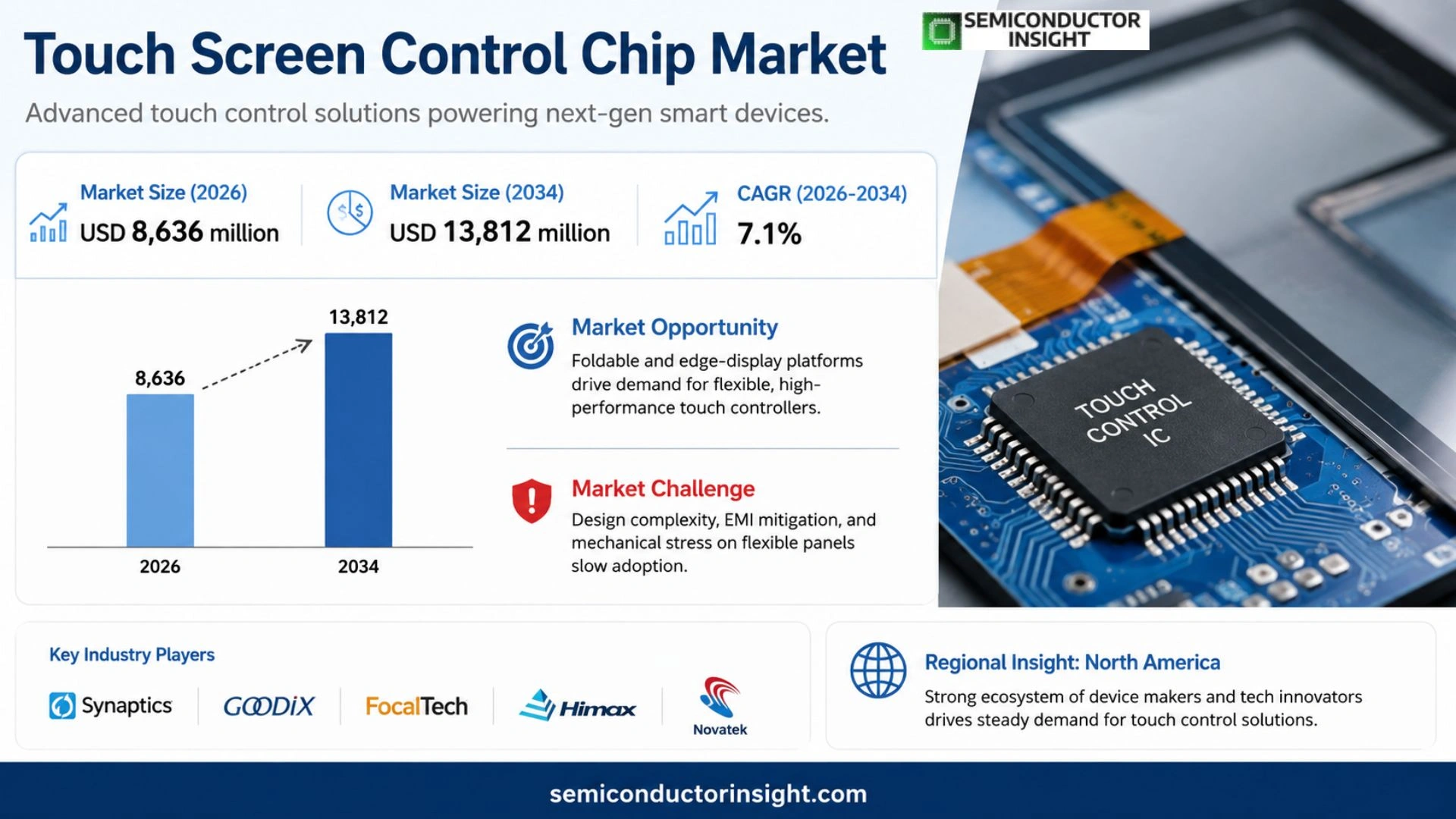
Touch Screen Control Chip market is projected to grow from USD 8,636 million in 2026 to USD 13,812 million by 2034, exhibiting a CAGR of 7.1% during the forecast period.
Touch screen control chips, also known as touch controller ICs, are semiconductor devices that detect and process user inputs on capacitive or resistive panels. They translate analog signals into digital data and communicate with host processors, enabling multi‑touch detection, gesture recognition, noise filtering and palm rejection across smartphones, tablets, automotive infotainment systems and industrial panels.
The market is gaining momentum because device manufacturers are integrating touch controllers with display drivers (TDDI), reducing component count and supporting thinner form factors. Automotive adoption adds demand for robust chips that operate under extreme temperatures and support glove touch. Recent activity includes Synaptics’ launch of a low‑power TDDI solution for foldable phones in March 2024 and Goodix’s partnership with a major Chinese OEM to supply high‑resolution controllers for electric‑vehicle dashboards.
MARKET DRIVERS
Growing Demand for High‑Resolution Interactive Devices
The proliferation of premium smartphones, automotive infotainment panels, and industrial HMIs has pushed OEMs to seek controllers that can translate finer touch inputs into seamless user experiences. Touch Screen Control Chip Market suppliers that deliver sub‑micron latency and robust multi‑touch handling are being selected because they directly influence perceived device quality and brand differentiation.
Cost‑Effective Integration of Advanced Controllers
Manufacturers are consolidating component families to reduce board real estate and simplify firmware stacks. Chips that combine capacitive sensing, gesture recognition, and power‑management on a single die lower bill‑of‑materials and accelerate time‑to‑market, which is especially valuable in price‑sensitive consumer electronics.
➤ Clients that adopt integrated touch controllers can shave up to 15 % off total system cost while preserving performance margins.
From a strategic viewpoint, these dynamics encourage vendors to invest in next‑generation silicon that supports higher pixel densities and AI‑enhanced touch profiling, driving a virtuous cycle of innovation and market expansion.
MARKET CHALLENGES
Design Complexity Limits Adoption
Engineering teams often confront steep learning curves when incorporating ultra‑thin glass substrates or curved panels. The need for precise impedance matching and electromagnetic interference mitigation raises development risk, causing some manufacturers to postpone redesigns until proven reference designs become available.
Other Challenges
Supply Chain Volatility
Geopolitical tensions and semiconductor fab capacity constraints have introduced lead‑time uncertainty. Companies that lack diversified sourcing strategies may experience production bottlenecks, directly affecting Touch Screen Control Chip Market rollout schedule.
MARKET RESTRAINTS
Regulatory Hurdles in Safety‑Critical Sectors
Medical and automotive applications demand compliance with stringent functional‑safety standards such as IEC 62304 and ISO 26262. Achieving certification requires extensive validation cycles and documentation, which inflates development budgets and can deter smaller players from entering Touch Screen Control Chip Market.
MARKET OPPORTUNITIES
Emergence of Foldable and Edge‑Display Platforms
Flexible OLED and edge‑to‑edge glass technologies open new form‑factor possibilities, yet they impose unique mechanical stress on touch sensing layers. Controllers engineered to adapt to curvature and repeated flex cycles will become a differentiator, offering suppliers a clear pathway to capture premium segments within Touch Screen Control Chip Market.
Touch Screen Control Chip Market Trends
Integration of Touch Controllers with Display Drivers
The industry is consolidating the touch sensing function with display‑driver circuitry, a configuration commonly referred to as TDDI. By merging these blocks on a single die, manufacturers lower component count, tighten signal paths, and achieve slimmer profiles that suit premium smartphones and tablets. The reduction in inter‑connect complexity also curtails manufacturing variance, translating into higher yields for high‑volume fabs. For OEMs, the shift means faster time‑to‑market for next‑generation devices and a clearer route to differentiate products through tighter bezel designs and improved touch latency.
Other Trends
Expansion into Automotive and Large‑Format Displays
Automotive infotainment consoles and industrial control panels demand touch controllers that can tolerate wide temperature swings, electromagnetic interference, and glove‑touch operation. Suppliers are therefore hardening silicon, adding redundant filtering stages, and qualifying parts to automotive‑grade reliability schedules. The move toward larger screen real estate in vehicles,often exceeding 12 inches,requires scaling of sensor matrices while preserving low power draw. This convergence pushes design houses to offer families of chips that span from consumer‑grade to robust automotive variants, creating a broader addressable base for Touch Screen Control Chip Market.
Power Efficiency and Adaptive Sensing for Emerging Form Factors
High‑refresh‑rate displays, stylus support, and always‑on sensing impose stricter power budgets on touch controllers. Designers are adopting dynamic scaling algorithms that throttle sampling rates based on user activity, and incorporating on‑chip voltage regulation to minimize standby draw. Simultaneously, foldable and curved OLED panels introduce mechanical stress that can affect sensor uniformity. To counter this, manufacturers embed calibration routines that adjust for curvature‑induced capacitance shifts, ensuring consistent accuracy across flexible form factors. The combined emphasis on energy conservation and adaptive algorithms equips device makers with the tools to launch innovative products without compromising battery endurance.
COMPETITIVE LANDSCAPE
Key Industry Players
Touch Screen Control Chip Market – Competitive Overview
The market is dominated by a handful of firms that control the bulk of high‑volume shipments to smartphone OEMs and automotive infotainment suppliers. Synaptics sustains its lead through a broad portfolio that couples capacitive sensing with advanced gesture algorithms, allowing Tier‑1 device makers to consolidate components and reduce board space. Goodix, leveraging deep relationships with Chinese smartphone manufacturers, captures a comparable share in the mid‑range segment by offering cost‑effective solutions that still meet stringent latency requirements. Both companies benefit from vertically integrated design teams, which accelerate time‑to‑market for emerging form factors such as foldable displays. Their scale also pressures margins, prompting continuous investment in integration technologies like TDDI to stay ahead of cost‑sensitive customers.
Beyond the two leaders, a diverse set of specialists occupies niche but strategically important positions. FocalTech and Elan Microelectronics focus on automotive and industrial panels where temperature tolerance and glove‑touch capability are decisive. Himax and Chipone target premium consumer devices, differentiating with high‑resolution multi‑touch and stylus support. Meanwhile, players such as Renesas, STMicroelectronics, and NXP embed touch controllers within broader system‑on‑chip offerings, appealing to OEMs seeking unified hardware platforms. Smaller entrants,Silicon Works, ROHM Semiconductor, and Microchip Technology,concentrate on low‑power applications for wearables and smart‑home interfaces, where battery life outweighs raw performance. This layered competitive structure creates a dynamic where scale, specialization, and integration pathways each generate distinct business opportunities.
List of Key Touch Screen Control Chip Companies Profiled
- Synaptics
- Goodix Technology
- FocalTech Systems
- Elan Microelectronics
- Chipone Technology
- Himax Technologies
- Novatek Microelectronics
- Silicon Works
- Renesas Electronics
- Microchip Technology
- STMicroelectronics
- Cypress Semiconductor (Infineon)
- ROHM Semiconductor
- NXP Semiconductors
- Texas Instruments
Segment Analysis:
| Segment Category | Sub-Segments | Key Insights |
| By Type |
|
Capacitive Touch Controller IC is the dominant sub‑segment because it offers superior sensitivity, multi‑touch capability, and compatibility with modern thin‑glass displays.
|
| By Application |
|
Consumer Electronics drives the market as manufacturers embed touch controllers in smartphones, tablets, laptops, and emerging foldable devices.
|
| By End User |
|
Smartphones & Tablets remain the primary end user due to the pervasive adoption of touch interfaces across personal devices.
|
Regional Analysis: Touch Screen Control Chip Market
North America
The United States market shows a persistent appetite for ultra‑responsive touch interfaces, prompting chip makers to prioritize high‑frequency scanning and seamless multitouch support. Manufacturers of flagship smartphones and tablets view control chips as a differentiator, pushing vendors to deliver tighter integration with UI frameworks and faster firmware cycles.
Canadian factories are embedding touch‑screen control chips into human‑machine interfaces for process control, valuing rugged designs that tolerate temperature swings and vibration. The trend encourages suppliers to certify chips against industrial standards and to offer extended service‑life warranties.
Silicon Valley designers experiment with on‑chip neural processing, enabling local gesture classification without cloud reliance. This shift reduces latency and preserves bandwidth, a compelling proposition for privacy‑sensitive applications such as medical diagnostics and secure kiosks.
The Federal Communications Commission’s electromagnetic‑emission guidelines influence layout decisions, prompting manufacturers to adopt shielding techniques that balance performance with compliance, especially for automotive infotainment units that share space with radar and lidar sensors.
Europe
European manufacturers place a premium on sustainability, steering Touch Screen Control Chip Market toward energy‑efficient architectures that meet stringent Ecodesign directives. German automakers, for instance, require chips that can operate reliably across a broad thermal envelope while consuming minimal power, a need that fuels collaborations between chip designers and automotive suppliers. In parallel, French consumer‑electronics firms prioritize chips that support localized language processing, fostering a niche for firmware that can be adapted quickly for regional markets. The convergence of environmental regulation and multilingual requirements drives a differentiated product strategy across the continent.
Asia‑Pacific
The Asia‑Pacific region exhibits a dense concentration of contract manufacturers, creating a unique pressure on chip vendors to deliver flexible design‑for‑assembly solutions. Taiwanese and South Korean OEMs seek control chips that can be integrated into a wide array of devices from low‑cost wearables to high‑end foldable displays. Rapid adoption of 5G infrastructure also accelerates demand for chips that can handle higher data rates while maintaining touch precision. Suppliers that can offer modular solutions, allowing OEMs to customize sensor resolution and power profiles, gain a competitive edge in this fast‑moving environment.
South America
In South America, market growth is anchored by expanding retail penetration of affordable smart devices. Brazilian and Argentine manufacturers focus on cost‑effective touch solutions that do not compromise basic durability. The regional emphasis on price sensitivity leads chip makers to streamline packaging and to leverage standard interfaces that simplify integration for local assemblers. At the same time, emerging interest in agriculture‑tech applications is prompting exploration of rugged chips capable of withstanding outdoor conditions, opening a modest yet strategic niche.
Middle East & Africa
The Middle East & Africa segment is characterized by a growing appetite for premium hospitality and transportation infotainment systems. Operators in the Gulf region invest in touch‑screen control chips that support high‑resolution graphics and robust security features, reflecting the premium expectations of their clientele. African markets, while still price‑focused, are beginning to adopt touch interfaces in educational tablets and mobile health devices, driving demand for chips that balance affordability with reliable performance under varied climatic conditions. This dual dynamic encourages vendors to adopt tiered product portfolios that can address both premium and entry‑level needs across the region.
Report Scope
This market research report provides a comprehensive analysis of the Touch Screen Control Chip Market , covering the forecast period 2026–2034. It offers detailed insights into market dynamics, technological advancements, competitive landscape, and key trends shaping the industry.
Key focus areas of the report include:
- Market Overview: The report begins with an overview outlining its current market scenario, key growth indicators, and industry transformation drivers. It discusses macroeconomic factors, demand–supply balance, regulatory landscape, and the strategic role of semiconductors in powering advancements across industries such as automotive, telecommunications, consumer electronics, and industrial automation.
- Market Size & Forecast: Historical data and future projections for revenue, unit shipments, and market value across major regions and segments.
- Segmentation Analysis: Detailed breakdown by product type, technology, application, and end-user industry to identify high-growth segments and investment opportunities.
- Regional Insights: Insights into market performance across North America, Europe, Asia-Pacific, Latin America, and the Middle East & Africa, including country-level analysis where relevant.
- Competitive Landscape: Profiles of leading market participants, including their product offerings, R&D focus, manufacturing capacity, pricing strategies, and recent developments such as mergers, acquisitions, and partnerships.
- Technology Trends & Innovation: Assessment of emerging technologies, integration of AI/IoT, semiconductor design trends, fabrication techniques, and evolving industry standards.
- Market Drivers & Restraints: Evaluation of factors driving market growth along with challenges, supply chain constraints, regulatory issues, and market-entry barriers.
- Stakeholder Insights: Insights for component suppliers, OEMs, system integrators, investors, and policymakers regarding the evolving ecosystem and strategic opportunities.
Primary and secondary research methods are employed, including interviews with industry experts, data from verified sources, and real-time market intelligence to ensure the accuracy and reliability of the insights presented.
FREQUENTLY ASKED QUESTIONS:
What is the current market size of Touch Screen Control Chip Market?
-> Touch Screen Control Chip market is projected to grow from USD 8,636 million in 2026 to USD 13,812 million by 2034, exhibiting a CAGR of 7.1%.
Which key companies operate in Touch Screen Control Chip Market?
-> Key players include Synaptics, Goodix Technology, FocalTech Systems, Elan Microelectronics, Chipone Technology, Himax Technologies, Novatek Microelectronics, Silicon Works, Renesas Electronics, Microchip Technology, STMicroelectronics, Cypress Semiconductor (Infineon), ROHM Semiconductor, and NXP Semiconductors.
What are the key growth drivers?
-> Key growth drivers include rising screen penetration across smartphones, tablets, automotive infotainment, and industrial displays; growing demand for higher‑integration solutions such as TDDI; increasing adoption of foldable and flexible form‑factors; and the push for lower power consumption and higher performance in high‑refresh‑rate and stylus‑enabled devices.
Which region dominates the market?
-> Asia-Pacific leads the market, driven by large consumer‑electronics production bases in China, South Korea, and Japan, as well as rapid expansion of automotive and industrial touch applications in the region.
What are the emerging trends?
-> Emerging trends include integration of touch controllers with display drivers (TDDI architecture), development of robust chips for automotive and large‑size panels, enhanced power‑efficiency algorithms for always‑on sensing, and support for emerging form factors such as foldable, flexible OLED, and curved displays.

Get Sample Report PDF for Exclusive Insights
Report Sample Includes
- Table of Contents
- List of Tables & Figures
- Charts, Research Methodology, and more...
 Download Sample Report PDF