Thread & Matter (IoT Connectivity) SoC Market Insights
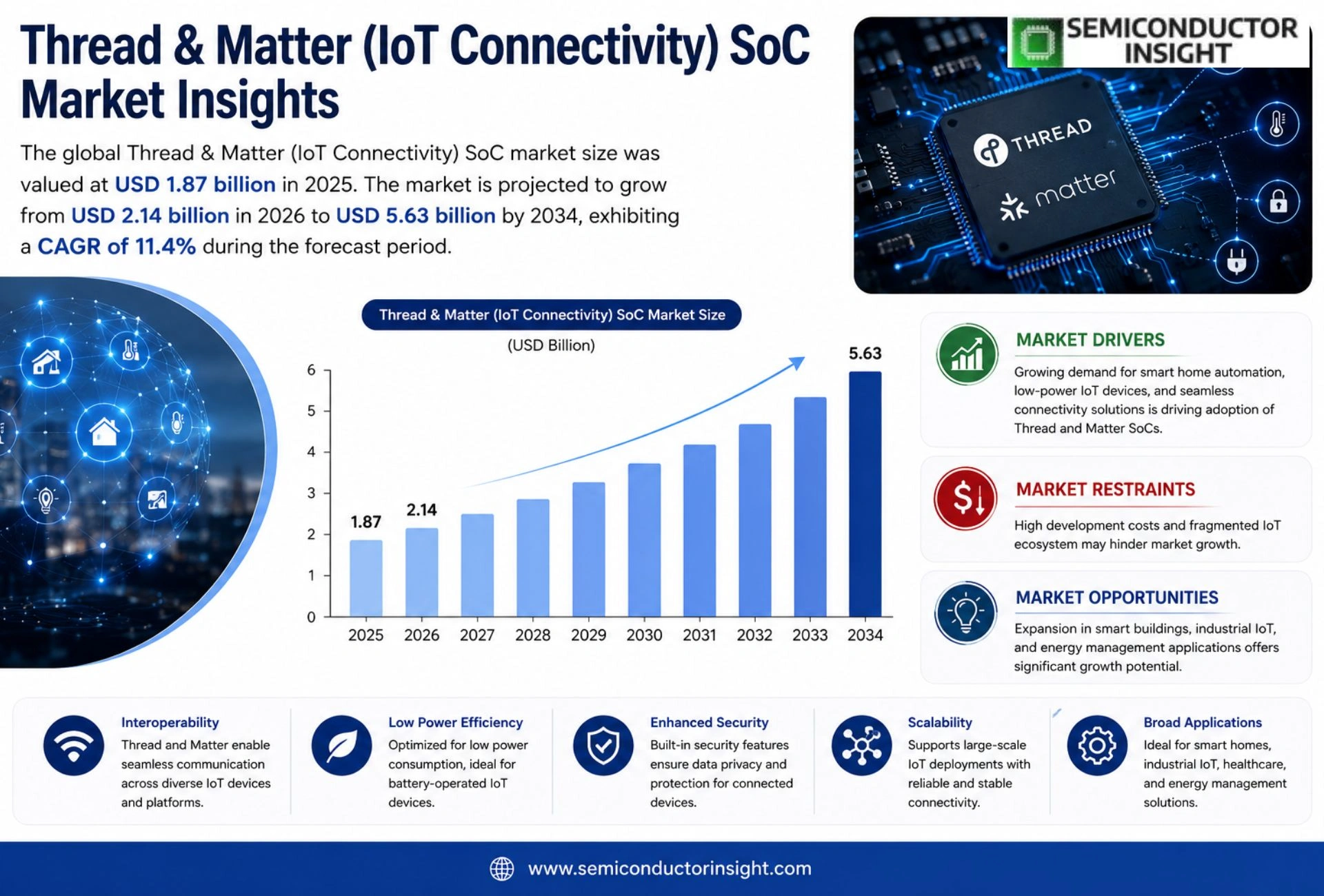
Global Thread & Matter (IoT Connectivity) SoC Market size was valued at USD 1.87 billion in 2025. The market is projected to grow from USD 2.14 billion in 2026 to USD 5.63 billion by 2034, exhibiting a CAGR of 11.4% during the forecast period.
Thread & Matter (IoT Connectivity) System-on-Chip (SoC) solutions are highly integrated semiconductor devices engineered to enable seamless, secure, and interoperable wireless communication across smart home and IoT ecosystems. These chips consolidate multiple functions , including the IEEE 802.15.4 radio, microcontroller core, memory, and security hardware , into a single package, supporting both the Thread mesh networking protocol and the Matter application layer standard. The Thread & Matter SoC portfolio spans a range of product types, including single-protocol and multi-protocol variants capable of supporting Thread, Bluetooth Low Energy (BLE), Zigbee, and Wi-Fi simultaneously.
The market is witnessing accelerated momentum driven by the rapid proliferation of smart home devices, growing industry convergence around the Matter standard , co-developed by the Connectivity Standards Alliance (CSA) with backing from Apple, Google, Amazon, and Samsung , and increasing demand for low-power, low-latency mesh networking. Furthermore, major semiconductor companies are actively expanding their Thread & Matter SoC offerings. For instance, Nordic Semiconductor, Silicon Laboratories, and NXP Semiconductors have all launched dedicated multi-protocol SoCs optimized for Matter-over-Thread deployments, reinforcing competitive momentum across the value chain.
MARKET DRIVERS
Accelerating Smart Home Adoption Driving Demand for Thread & Matter SoC Integration
The rapid proliferation of smart home ecosystems has emerged as one of the most significant forces propelling growth withThread & Matter (IoT Connectivity) SoC Market. As consumers increasingly demand seamless interoperability between devices from different manufacturers, the Matter protocol,built atop the Thread networking layer,has positioned itself as the definitive open standard for smart home connectivity. System-on-Chip vendors are responding by embedding dual-protocol support directly into silicon, eliminating the need for separate bridging hardware. This architectural convergence is reducing bill-of-materials costs and accelerating time-to-market for device makers, thereby stimulating broader ecosystem expansion.
Cross-Platform Ecosystem Support from Major Technology Alliances
The Connectivity Standards Alliance (CSA), which governs the Matter specification, has secured backing from industry leaders including Apple, Google, Amazon, and Samsung. This institutional support has created a reliable long-term roadmap for Thread & Matter (IoT Connectivity) SoC vendors, encouraging sustained R&D investment. As Matter certification programs expand and Thread Border Router capabilities become standard features in consumer gateways and smart speakers, SoC manufacturers are incorporating hardware-accelerated cryptographic engines and low-power mesh networking cores to meet the protocol’s stringent security and reliability requirements. This multi-stakeholder alignment is a structural driver that reduces market fragmentation and encourages volume production commitments.
➤ The Matter 1.3 specification update, which extended support to energy management devices and additional appliance categories, has directly expanded the addressable device segment for Thread & Matter (IoT Connectivity) SoC vendors, unlocking new design win opportunities across white goods, HVAC, and energy monitoring applications.
Energy efficiency requirements are also acting as a compelling driver for Thread-based SoC adoption. Thread’s IPv6-based mesh architecture supports sleepy end-device operation, enabling coin-cell battery lifespans measured in years rather than months. This characteristic makes Thread & Matter (IoT Connectivity) SoC solutions particularly attractive for sensor nodes, door locks, window sensors, and occupancy detectors,device categories where wired power is impractical. Semiconductor vendors are competing aggressively on sleep current specifications and radio sensitivity figures, driving a cycle of continuous silicon optimization that is raising the performance baseline across the competitive landscape.
MARKET CHALLENGES
Complexity of Multi-Protocol SoC Development Constraining Smaller Vendors
Despite strong adoption momentum, developing a production-ready Thread & Matter (IoT Connectivity) SoC entails substantial engineering investment. Supporting both Thread’s mesh networking stack and Matter’s application layer simultaneously requires careful coexistence management, particularly in the 2.4 GHz band where Thread, Zigbee, Wi-Fi, and Bluetooth all operate. SoC designers must implement sophisticated radio arbitration algorithms and interference mitigation strategies to ensure reliable performance in dense RF environments such as apartment buildings and commercial spaces. This technical complexity raises the barrier to entry and has concentrated competitive activity among a relatively small number of well-capitalized semiconductor companies, potentially limiting supply chain diversity for device OEMs.
Other Challenges
Matter Certification and Compliance Overhead
Device manufacturers integrating Thread & Matter (IoT Connectivity) SoC solutions must navigate a rigorous CSA certification process that adds cost and calendar time to product development cycles. Each new Matter device category extension requires updated SDK support from SoC vendors, creating a continuous software maintenance obligation. Smaller OEMs with limited firmware engineering resources may struggle to keep pace with specification revisions, potentially delaying market entry or creating fragmentation between certified and non-certified product variants in distribution channels.
Interoperability Gaps in Deployed Infrastructure
While Matter promises universal interoperability, real-world deployments have revealed edge cases where firmware implementation differences across SoC vendors produce inconsistent device behavior within otherwise standardized ecosystems. Consumers experiencing these interoperability gaps may develop negative perceptions that slow household penetration rates. For Thread & Matter (IoT Connectivity) SoC suppliers, resolving such issues demands ongoing investment in conformance testing, interoperability labs, and over-the-air update infrastructure,operational costs that weigh on margins, particularly in cost-sensitive consumer product segments.
MARKET RESTRAINTS
Intensifying Price Pressure in Consumer IoT Segments Compressing SoC Margins
The consumer smart home market is characterized by aggressive retail price competition, which transmits margin pressure through the value chain to Thread & Matter (IoT Connectivity) SoC suppliers. Device OEMs operating in high-volume, price-sensitive categories such as smart plugs, light bulbs, and simple sensors routinely impose stringent cost-down requirements on their semiconductor partners. This dynamic constrains the ability of SoC vendors to recover the full R&D investment embedded in advanced Thread radio architectures and hardware-accelerated Matter security engines. As a result, profitability remains concentrated in premium segments such as commercial building automation and healthcare monitoring, where buyers prioritize reliability and certification over unit price.
Fragmented Regulatory Landscape Creating Compliance Uncertainty
The global regulatory environment for IoT devices encompasses radio frequency certification, cybersecurity requirements, and product safety standards that vary significantly across jurisdictions. Regulations such as the EU Cyber Resilience Act and emerging IoT security frameworks in North America and Asia-Pacific impose software update, vulnerability disclosure, and documentation obligations that affect the total cost of deploying Thread & Matter (IoT Connectivity) SoC-based products. SoC vendors are increasingly expected to provide long-term software support commitments and security patch guarantees, extending their post-sale obligations well beyond the traditional semiconductor model. This regulatory complexity acts as a restraint by increasing compliance costs and creating uncertainty around product lifecycle management strategies, particularly for vendors serving multiple geographic markets simultaneously.
MARKET OPPORTUNITIES
Expansion into Commercial Building Automation and Industrial IoT Segments
While residential smart home applications have historically anchored Thread & Matter (IoT Connectivity) SoC market development, commercial building automation represents a substantial and relatively underpenetrated growth frontier. Facilities managers in office, retail, healthcare, and hospitality environments increasingly seek wireless sensor networks capable of supporting thousands of nodes with deterministic latency and enterprise-grade security,requirements that align closely with Thread’s mesh architecture strengths. As Matter extends its device type library to cover commercial HVAC controllers, lighting systems, and access control endpoints, SoC vendors have a clear pathway to address this higher-value segment with differentiated, feature-rich silicon offerings that command superior average selling prices compared to consumer-grade counterparts.
Integration of AI Inference Capabilities within Thread & Matter SoC Platforms
The convergence of edge AI inference and IoT connectivity within a single SoC represents a compelling next-generation opportunity for Thread & Matter (IoT Connectivity) SoC vendors. Embedding lightweight neural processing units alongside Thread radio cores enables on-device anomaly detection, predictive maintenance alerts, and context-aware automation without routing sensitive data through cloud infrastructure. This architectural approach addresses both latency requirements and data privacy concerns that are increasingly prominent in enterprise and healthcare deployments. Vendors that successfully integrate neural network acceleration with certified Thread & Matter connectivity stacks will be positioned to capture premium design wins in smart building, medical monitoring, and industrial condition-monitoring applications where edge intelligence delivers measurable operational value.
Growth in Energy Management and Grid-Edge Applications Leveraging Matter’s Energy Domain Extensions
The global transition toward distributed energy resources, smart meters, and demand-response programs is creating a new category of grid-edge IoT devices that require secure, low-power, and standards-based connectivity. Matter’s energy management device type extensions position the Thread & Matter (IoT Connectivity) SoC ecosystem to serve EV charger controllers, smart circuit breakers, solar inverter monitors, and home energy management systems. Utilities and energy technology vendors entering this space are actively evaluating Thread-capable SoC platforms as a standardized connectivity foundation, offering semiconductor vendors the opportunity to establish long-term supply relationships in a segment characterized by higher reliability requirements, longer product lifecycles, and stronger margin profiles than conventional consumer smart home applications.
Trends
Rising Adoption of the Matter Standard Reshaping Thread & Matter (IoT Connectivity) SoC Market
Thread & Matter (IoT Connectivity) SoC Market is undergoing a significant transformation as the Matter application layer standard gains widespread industry backing. Co-developed by the Connectivity Standards Alliance (CSA) with active support from Apple, Google, Amazon, and Samsung, the Matter protocol is emerging as the de facto interoperability framework for smart home ecosystems. This convergence is compelling semiconductor manufacturers to realign their product roadmaps around Thread and Matter-compatible SoC architectures, accelerating design cycles and consolidating demand across the value chain. As smart home device deployments scale globally, the need for highly integrated, secure, and low-power SoC solutions that natively support Matter-over-Thread is becoming a central procurement criterion for OEMs and device manufacturers alike.
Other Trends
Multi-Protocol SoC Integration Gaining Traction
One of the most prominent trends shaping the Thread & Matter IoT connectivity SoC landscape is the rapid shift toward multi-protocol chip architectures. Leading semiconductor companies including Nordic Semiconductor, Silicon Laboratories, and NXP Semiconductors have launched dedicated multi-protocol SoCs capable of simultaneously supporting Thread, Bluetooth Low Energy (BLE), Zigbee, and Wi-Fi. This integration reduces bill-of-materials complexity for device manufacturers while enabling broader interoperability across heterogeneous IoT environments. The consolidation of multiple wireless stacks , including the IEEE 802.15.4 radio, microcontroller core, memory, and security hardware , into a single package is proving critical to cost efficiency and time-to-market for smart home product developers.
Security Hardware Becoming a Core Differentiator
As IoT deployments expand in scale and sensitivity, embedded hardware security features within Thread & Matter SoCs are increasingly influencing vendor selection decisions. Device manufacturers and enterprise buyers are prioritizing SoC solutions that incorporate secure boot, hardware-based key storage, and cryptographic acceleration aligned with Matter’s security requirements. This trend is prompting semiconductor vendors to differentiate their offerings not only on radio performance and power efficiency but also on the depth and certification readiness of their integrated security subsystems.
Low-Power Mesh Networking Demand Fueling SoC Innovation
The growing deployment of battery-operated smart home devices , including sensors, locks, lighting controls, and environmental monitors , is intensifying demand for Thread-based SoCs optimized for ultra-low power consumption. Thread’s mesh networking architecture, which enables device-to-device communication without a central hub, is particularly well-suited for energy-constrained applications. Semiconductor vendors are responding by engineering SoCs with aggressive sleep-state power profiles and efficient duty-cycling capabilities, enabling years of operation on coin-cell batteries. This focus on low-power, low-latency mesh connectivity continues to be a decisive product development direction within the Thread & Matter IoT connectivity SoC market.
COMPETITIVE LANDSCAPE
Key Industry Players
Thread & Matter (IoT Connectivity) SoC Market , Competitive Dynamics and Leading Semiconductor Innovators
Global Thread & Matter (IoT Connectivity) SoC Market is characterized by intense competition among established semiconductor giants and specialized wireless connectivity vendors. Nordic Semiconductor, Silicon Laboratories, and NXP Semiconductors have emerged as frontrunners, each having launched dedicated multi-protocol SoCs optimized for Matter-over-Thread deployments. These companies leverage deep RF expertise, robust software development ecosystems, and strategic alignment with the Connectivity Standards Alliance (CSA) , the governing body behind the Matter standard , to maintain competitive differentiation. Qualcomm and Texas Instruments further reinforce the upper tier of the competitive landscape, offering highly integrated SoC platforms that consolidate IEEE 802.15.4 radio, microcontroller cores, memory, and hardware security engines into single-package solutions capable of simultaneously supporting Thread, Bluetooth Low Energy (BLE), Zigbee, and Wi-Fi protocols. The convergence of these capabilities within a unified silicon architecture is increasingly becoming a baseline requirement as smart home OEMs demand seamless interoperability across ecosystems backed by Apple, Google, Amazon, and Samsung.
Beyond the top-tier players, a strong cohort of niche and regional semiconductor companies is actively expanding their presence in the Thread & Matter SoC space. Companies such as Espressif Systems, Telink Semiconductor, and Qorvo have carved out meaningful market positions by offering cost-competitive, low-power multi-protocol SoCs that cater to high-volume smart home device manufacturers. MediaTek and Infineon Technologies are also reinforcing their IoT connectivity portfolios with Matter-compliant silicon, targeting mid-range smart home and building automation segments. Meanwhile, players like STMicroelectronics and Renesas Electronics are integrating Thread and Matter support into their broader microcontroller and wireless SoC lineups, appealing to industrial IoT and mixed smart-home deployments. The competitive environment continues to intensify as the Matter standard gains wider adoption, prompting both incumbents and emerging vendors to accelerate product roadmaps, expand certification programs, and deepen partnerships across the IoT value chain.
List of Key Thread & Matter (IoT Connectivity) SoC Companies Profiled
- Nordic Semiconductor
- Silicon Laboratories
- NXP Semiconductors
- Qualcomm Technologies
- Texas Instruments
- Espressif Systems
- Telink Semiconductor
- Qorvo
- MediaTek
- Infineon Technologies
- STMicroelectronics
- Renesas Electronics
- Broadcom
- Amazon (Alexa Connect Kit SDK)
Segment Analysis:
| Segment Category | Sub-Segments | Key Insights |
| By Type |
|
Multi-Protocol SoC is the leading segment in the Thread & Matter SoC market, driven by the growing demand for devices that can simultaneously support Thread, Bluetooth Low Energy, Zigbee, and Wi-Fi within a single integrated chip.
|
| By Application |
|
Smart Lighting & Controls stands as the leading application segment within the Thread & Matter SoC market, benefiting from the high device density typical of residential and commercial lighting deployments that makes Thread’s mesh networking architecture particularly well-suited.
|
| By End User |
|
Residential / Smart Home represents the dominant end-user segment, as the rapid proliferation of connected consumer devices and the broad industry push behind the Matter interoperability standard have made Thread-enabled SoCs central to modern smart home infrastructure.
|
| By Power Architecture |
|
Ultra-Low Power SoC is the leading segment within the power architecture classification, reflecting the fundamental design requirements of Thread-based IoT deployments where battery-constrained endpoints such as door locks, environmental sensors, and occupancy detectors must operate reliably for extended periods without a wired power source.
|
| By Security Feature |
|
Hardware Secure Element (HSE) Integrated SoC is emerging as the leading security feature segment, underpinned by the Matter standard’s foundational requirement for device attestation and secure commissioning, which mandates robust hardware-rooted trust mechanisms to authenticate devices joining a Matter fabric.
|
Regional Analysis: Thread & Matter (IoT Connectivity) SoC Market
North America
North America’s dominance Thread & Matter (IoT Connectivity) SoC Market is anchored by its leadership in defining and advancing open interoperability standards. Home automation alliances and industry consortiums headquartered in the region have played a pivotal role in shaping the Matter protocol roadmap, ensuring that regional semiconductor suppliers are first-to-market with compliant SoC solutions that address evolving consumer and enterprise connectivity demands.
The residential smart home segment in North America represents one of the most advanced deployment environments globally for Thread & Matter (IoT Connectivity) SoC technology. Widespread consumer familiarity with voice assistants, smart speakers, and connected lighting has created a self-reinforcing demand cycle, with hardware manufacturers increasingly prioritizing Thread mesh networking capabilities as a baseline requirement across mid-range and premium product tiers.
Beyond residential applications, North American enterprises are increasingly deploying Thread & Matter (IoT Connectivity) SoC-based solutions across commercial real estate, healthcare facilities, and retail environments. The demand for reliable, low-power mesh networking in building automation systems , covering HVAC control, occupancy sensing, and energy management , is driving procurement of specialized SoC components capable of operating seamlessly within large-scale, multi-vendor deployments.
North America hosts a dense concentration of fabless semiconductor companies and integrated device manufacturers that are actively advancing Thread & Matter (IoT Connectivity) SoC design capabilities. Significant R&D investment is being directed toward ultra-low-power SoC architectures, multi-protocol chip designs, and enhanced security implementations, positioning the region as the primary source of next-generation IoT connectivity silicon for global markets.
Europe
Europe represents a strategically significant regional market for Thread & Matter (IoT Connectivity) SoC Market, characterized by strong regulatory tailwinds and a deeply embedded culture of energy efficiency and sustainability. The European Union’s progressive smart building directives and energy performance mandates are compelling both residential developers and commercial property operators to adopt interoperable IoT connectivity solutions, creating consistent demand for Thread-enabled SoC components. Germany, the United Kingdom, the Netherlands, and the Nordic countries are at the forefront of smart home adoption across the continent, with consumer awareness of connected device security and data privacy acting as a differentiating factor. The EU’s Cyber Resilience Act and related IoT security frameworks are expected to favor Matter-certified solutions, as the protocol’s built-in security architecture aligns well with legislative requirements. European manufacturing clusters and industrial IoT deployments further extend the addressable market for Thread & Matter (IoT Connectivity) SoC providers operating in the region.
Asia-Pacific
Asia-Pacific is emerging as one of the fastest-growing regional markets in the global Thread & Matter (IoT Connectivity) SoC landscape, propelled by the sheer scale of consumer electronics manufacturing, rapid urbanization, and expanding middle-class adoption of smart home technologies. China, Japan, South Korea, India, and Australia each present distinct demand profiles, yet collectively form a powerful growth engine for Thread & Matter (IoT Connectivity) SoC Market participants. China’s vast electronics supply chain and domestic smart home platform ecosystems are increasingly incorporating Matter compatibility, while Japan and South Korea continue to push premium connected home experiences with a strong emphasis on reliability and miniaturization. India’s smart city program and growing residential construction activity represent a significant long-term opportunity, and regional contract manufacturers are beginning to integrate Thread & Matter (IoT Connectivity) SoC components into next-generation IoT device designs destined for both domestic and export markets.
South America
South America occupies a developing yet progressively important position within Global Thread & Matter (IoT Connectivity) SoC Market. Brazil leads the regional landscape, supported by a sizeable consumer electronics market and growing interest from telecommunications providers seeking to deliver integrated smart home service bundles. While economic volatility and infrastructure constraints have historically moderated the pace of IoT adoption across the continent, improving broadband penetration, the expansion of mobile connectivity, and the gradual decline in the cost of Matter-certified devices are collectively lowering adoption barriers. Utilities and energy companies in several South American nations are exploring smart metering and grid modernization initiatives that could incorporate Thread-based mesh networking, offering a complementary growth vector for Thread & Matter (IoT Connectivity) SoC vendors willing to invest in the region’s emerging ecosystem.
Middle East & Africa
The Middle East & Africa region presents a nascent but increasingly strategic opportunity withThread & Matter (IoT Connectivity) SoC Market, underpinned by ambitious smart city development programs, particularly across Gulf Cooperation Council nations. Saudi Arabia’s Vision 2030 initiative and the UAE’s sustained investment in intelligent urban infrastructure are generating meaningful demand for interoperable, low-power IoT connectivity solutions in both new construction and retrofit applications. The adoption of Matter-certified smart home devices is gradually gaining traction among affluent urban consumers in the Gulf, while South Africa represents the primary growth market on the African continent. Across the broader region, telecommunications operators and government-affiliated digital transformation agencies are becoming key catalysts, supporting the gradual proliferation of Thread & Matter (IoT Connectivity) SoC-based deployments as connected infrastructure investment continues to accelerate through the 2026 to 2034 forecast horizon.
Report Scope
This market research report provides a comprehensive analysis of the Thread & Matter (IoT Connectivity) SoC Market , covering the forecast period 2026–2034. It offers detailed insights into market dynamics, technological advancements, competitive landscape, and key trends shaping the industry.
Key focus areas of the report include:
- Market Overview: The report begins with an overview outlining its current market scenario, key growth indicators, and industry transformation drivers. It discusses macroeconomic factors, demand–supply balance, regulatory landscape, and the strategic role of semiconductors in powering advancements across industries such as automotive, telecommunications, consumer electronics, and industrial automation.
- Market Size & Forecast: Historical data and future projections for revenue, unit shipments, and market value across major regions and segments.
- Segmentation Analysis: Detailed breakdown by product type, technology, application, and end-user industry to identify high-growth segments and investment opportunities.
- Regional Insights: Insights into market performance across North America, Europe, Asia-Pacific, Latin America, and the Middle East & Africa, including country-level analysis where relevant.
- Competitive Landscape: Profiles of leading market participants, including their product offerings, R&D focus, manufacturing capacity, pricing strategies, and recent developments such as mergers, acquisitions, and partnerships.
- Technology Trends & Innovation: Assessment of emerging technologies, integration of AI/IoT, semiconductor design trends, fabrication techniques, and evolving industry standards.
- Market Drivers & Restraints: Evaluation of factors driving market growth along with challenges, supply chain constraints, regulatory issues, and market-entry barriers.
- Stakeholder Insights: Insights for component suppliers, OEMs, system integrators, investors, and policymakers regarding the evolving ecosystem and strategic opportunities.
Primary and secondary research methods are employed, including interviews with industry experts, data from verified sources, and real-time market intelligence to ensure the accuracy and reliability of the insights presented.
FREQUENTLY ASKED QUESTIONS:
What is the current market size of Thread & Matter (IoT Connectivity) SoC Market?
-> Thread & Matter (IoT Connectivity) SoC Market was valued at USD 1.87 billion in 2025 and is expected to reach USD 5.63 billion by 2034, growing at a CAGR of 11.4% during the forecast period from 2026 to 2034.
Which key companies operate Thread & Matter (IoT Connectivity) SoC Market?
-> Key players include Nordic Semiconductor, Silicon Laboratories, and NXP Semiconductors, among others, all of which have launched dedicated multi-protocol SoCs optimized for Matter-over-Thread deployments.
What are the key growth drivers?
-> Key growth drivers include rapid proliferation of smart home devices, growing industry convergence around the Matter standard co-developed by the Connectivity Standards Alliance (CSA) with backing from Apple, Google, Amazon, and Samsung, and increasing demand for low-power, low-latency mesh networking.
Which region dominates the market?
-> Asia-Pacific is the fastest-growing region, driven by large-scale smart home adoption and semiconductor manufacturing capabilities, while North America remains a significant market due to strong IoT ecosystem development.
What are the emerging trends?
-> Emerging trends include multi-protocol SoC integration supporting Thread, Bluetooth Low Energy (BLE), Zigbee, and Wi-Fi simultaneously, adoption of the Matter application layer standard, and consolidation of IEEE 802.15.4 radio, microcontroller core, memory, and security hardware into single-package solutions.

Get Sample Report PDF for Exclusive Insights
Report Sample Includes
- Table of Contents
- List of Tables & Figures
- Charts, Research Methodology, and more...
 Download Sample Report PDF