Key Statistics
Key Takeaways
- Wafer-format TGV substrates remain the principal commercial format because they align with semiconductor process tooling and RF packaging flows.
- 2.5D/3D packaging and RF front-end applications are the largest near-term demand pools, while photonics is an emerging high-growth use case.
- Asia Pacific is the largest region, supported by semiconductor packaging and substrate production in Japan, South Korea, China and Taiwan.
- High aspect-ratio vias and finer pitch are the main technology development priorities as TGV moves toward more demanding interposer applications.
- Cost remains the principal restraint, with the client evidence noting TGV substrates remain materially more expensive than conventional organic alternatives.
TGV Substrate Market Overview
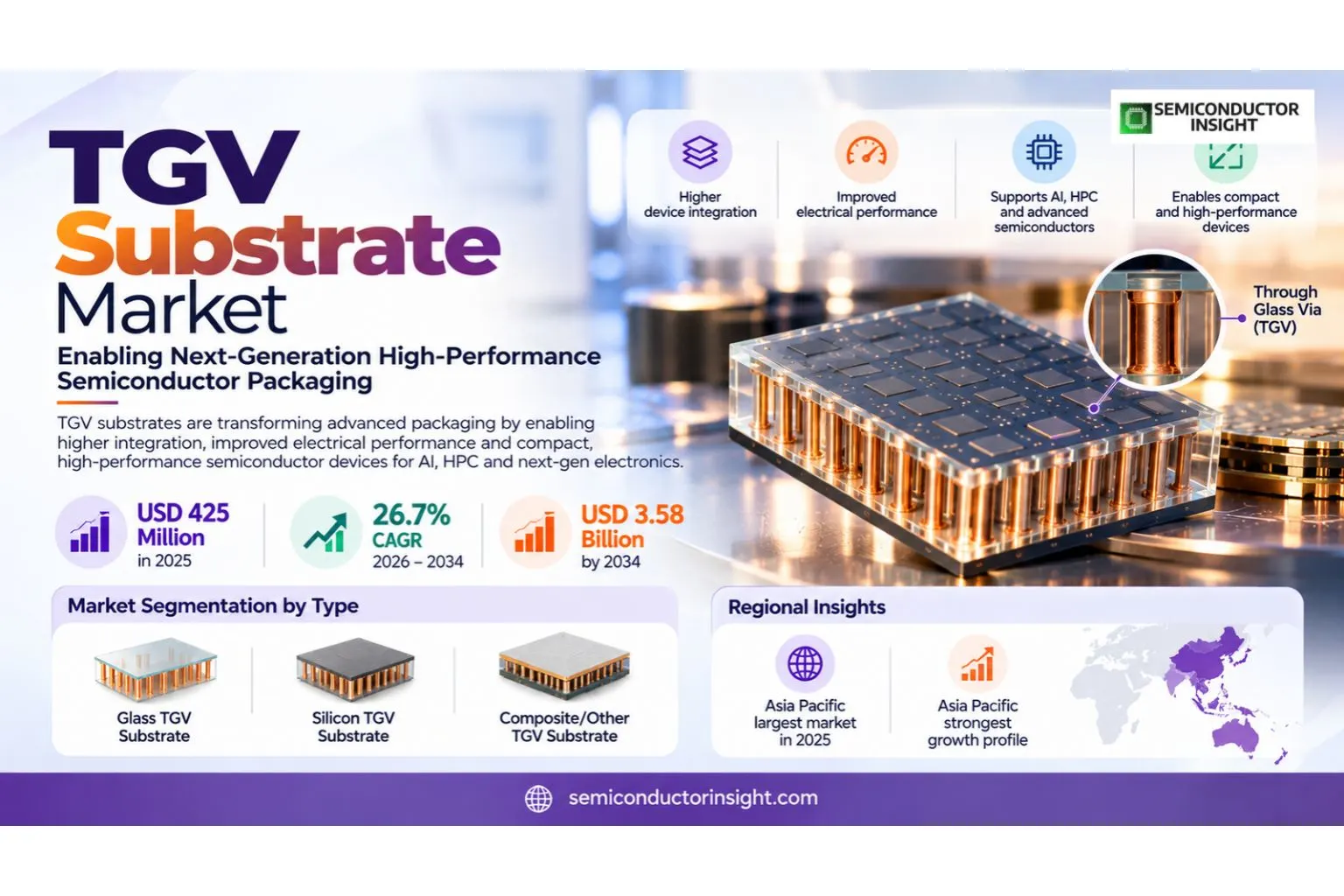
TGV substrate market was valued at USD 425 million in 2025 and is projected to reach USD 3.58 billion by 2034, growing at a CAGR of 26.7% over the 2026–2034 forecast period. Asia Pacific held the largest regional position in 2025, while Asia Pacific has the strongest growth profile.
The TGV substrate market tGV substrates use precision vias formed through glass to create vertical electrical interconnections for RF devices, MEMS, photonics and advanced semiconductor packaging. Glass offers low electrical loss, adjustable coefficient of thermal expansion and panel-format scaling, making it attractive where silicon or organic substrates create electrical or dimensional trade-offs.
The client evidence values the market at USD 425 million in 2025 and projects USD 2.196 billion by 2033. Growth is being pulled by high-performance computing, RF packaging, 5G, photonics and heterogeneous integration, with glass increasingly evaluated as an interposer and package-core material. Commercial decisions in the TGV Substrate market therefore depend on system integration, qualification effort, reliability, lifecycle support and measurable operating value rather than on one specification alone.
Corning states that precision TGV glass can support wafer and panel formats, thicknesses down to 100 µm and low-loss high-frequency applications. Commercial expansion depends on via formation, metallization, glass handling and reliability becoming repeatable at high volume. Supplier selection also reflects manufacturing consistency, regional technical support, product availability and the ability to sustain qualified designs through multi-year customer programs.
Segment Analysis: By Type
TGV substrate market was valued at USD 425 million in 2025 and is projected to reach USD 3.58 billion by 2034, growing at a CAGR of 26.7% over the 2026–2034 forecast period. Asia Pacific held the largest regional position in 2025, while Asia Pacific has the strongest growth profile.
| Type | Function | Market position |
|---|---|---|
| Wafer-Format TGV | Glass wafers with through vias designed for semiconductor-compatible processing. | Largest current format because it fits existing wafer-level process infrastructure. |
| Panel-Format TGV | Larger glass panels that can improve area utilization and cost per package. | High long-term potential if panel handling and metallization scale reliably. |
| Glass Interposer | TGV glass used as an interposer for die-to-die routing and heterogeneous integration. | Premium segment tied to 2.5D/3D packaging and RF performance. |
Pricing by type
Wafer-format products carry mature process economics but remain expensive relative to organic substrates. Panel formats target lower unit cost through larger-area processing, while high-density interposers command premium pricing because they require tighter via geometry, metallization and reliability control. Adoption varies by customer architecture and replacement cycle, so demand is strongest where the technology solves a clear performance, reliability or integration problem.
Segment Analysis: By Application
By application, the market is segmented into RF Front End, 2.5D / 3D Packaging, MEMS, Photonics, Sensors & Antennas. Application economics differ by qualification, lifecycle, reliability and system-level value, so each row below uses context specific to that application rather than mechanically repeating headline evidence. That market structure favors suppliers able to combine product performance with stable supply, application engineering and documented quality across the intended operating environment.
| Application | Demand characteristics |
|---|---|
| RF Front End | Low-loss routing, filters, antennas and high-frequency interconnects. |
| 2.5D / 3D Packaging | Vertical interconnect and redistribution for chiplets and heterogeneous systems. |
| MEMS | Hermetic, sensor and micro-system packaging requiring stable glass structures. |
| Photonics | Optical interposers and data-center connectivity where glass transparency and dimensional control are useful. |
| Sensors & Antennas | Miniaturized modules with integrated passive or antenna structures. |
Regional Analysis
Asia Pacific is the largest region because semiconductor packaging, RF component manufacturing and advanced substrate investment are concentrated in Japan, South Korea, Taiwan and China. North America remains important in technology development and high-performance packaging design. Commercial decisions in the TGV Substrate market therefore depend on system integration, qualification effort, reliability, lifecycle support and measurable operating value rather than on one specification alone.
How does regional demand differ across the TGV substrate market?
Regional demand follows advanced-packaging R&D, RF-module production and glass-processing capability. Asia Pacific leads commercial manufacturing, North America contributes significant system and packaging innovation, and Europe has strong materials and photonics research. Supplier selection also reflects manufacturing consistency, regional technical support, product availability and the ability to sustain qualified designs through multi-year customer programs.
| Region | Position | Growth outlook | Demand profile | What decides supplier selection |
|---|---|---|---|---|
| Asia Pacific | Largest | Highest in market | Packaging and substrate led | Process yield and local supply |
| North America | Second | High | Technology development led | Advanced packaging qualification |
| Europe | Third | High | Photonics and R&D led | Materials performance and process integration |
| South America | Small | Emerging | Import dependent | Cost and access to qualified suppliers |
| Middle East & Africa | Smallest base | Emerging | Research/project led | Specialist supplier access |
Key TGV Substrate Manufacturers and Competitive Landscape
The TGV substrate market includes glass manufacturers, via-processing specialists, substrate houses and advanced packaging suppliers. SCHOTT, Corning, AGC, NEG, LPKF, Absolics, Samsung Electro-Mechanics, JNTC, DNP, TOPPAN and other specialists participate across different parts of the value chain. Supplier selection also reflects manufacturing consistency, regional technical support, product availability and the ability to sustain qualified designs through multi-year customer programs.
Competition centers on glass composition, via diameter, aspect ratio, positional accuracy, metallization compatibility and the ability to move from wafer to panel-scale production. Few companies control the complete flow, so partnerships across glass, via drilling and metallization are common. Buyers increasingly compare total system impact, implementation complexity and long-term service requirements alongside component price, which creates room for technically differentiated suppliers.
Tier structure
| Tier | Companies | Basis of competition |
|---|---|---|
| Tier 1 | Corning, SCHOTT, AGC, NEG | Glass science, substrate quality and global materials capability. |
| Tier 2 | LPKF, Absolics, Samsung Electro-Mechanics, JNTC | Via processing, panel-scale packaging and advanced substrate development. |
| Tier 3 | DNP, TOPPAN and specialist processors | Application-specific interposers, metallization and regional development. |
Key companies profiled
- Corning
- SCHOTT
- AGC
- Nippon Electric Glass
- LPKF
- Absolics
- Samsung Electro-Mechanics
- JNTC
- DNP
- TOPPAN
TGV Substrate Production Capacity Analysis
Capacity is still transitioning from development-scale to commercial production. TGV manufacturing requires precision glass supply, via formation, metallization, wafer or panel handling, inspection and downstream redistribution. Adoption varies by customer architecture and replacement cycle, so demand is strongest where the technology solves a clear performance, reliability or integration problem. That market structure favors suppliers able to combine product performance with stable supply, application engineering and documented quality across the intended operating environment.
Corning states that TGV solutions are available in wafer and panel formats and that glass can be supplied as thin as 100 µm. Commercial scale depends on maintaining via positional accuracy and substrate strength across larger areas. Commercial decisions in the TGV Substrate market therefore depend on system integration, qualification effort, reliability, lifecycle support and measurable operating value rather than on one specification alone.
Panel-format production is strategically important because it can improve process economics, but panel handling, warpage and metallization yield must be controlled before cost advantages become repeatable. Supplier selection also reflects manufacturing consistency, regional technical support, product availability and the ability to sustain qualified designs through multi-year customer programs. Buyers increasingly compare total system impact, implementation complexity and long-term service requirements alongside component price, which creates room for technically differentiated suppliers.
TGV Substrate Market Dynamics: Drivers, Restraints and Opportunities
Growth is driven by high-performance packaging, RF, MEMS and photonics, while the main restraints are cost, process integration and manufacturing yield. The strongest opportunity is using glass where its electrical and dimensional properties create a clear system advantage over silicon or organic substrates. Adoption varies by customer architecture and replacement cycle, so demand is strongest where the technology solves a clear performance, reliability or integration problem.
MARKET DRIVERS
Drivers Impact Analysis*
| Driver | (~) % impact on CAGR forecast | Geographic relevance | Impact timeline |
|---|---|---|---|
| Industrial automation and machine-building investment | +1.3% | Asia Pacific, North America, Europe | Medium term (2–4 years) |
| Building energy codes mandating scheduled HVAC and lighting operation | +1.1% | Europe, North America, developed Asia Pacific | Medium term (2–4 years) |
| Mix shift to multifunction devices lifting average selling price | +0.9% | Global, distributor-led markets first | Short term (≤ 2 years) |
| Commercial HVAC retrofit and control panel rebuild cycle | +0.8% | North America, Europe | Short term (≤ 2 years) |
| Municipal water and wastewater infrastructure investment | +0.6% | Asia Pacific, Middle East and Africa, South America | Long term (≥ 4 years) |
| New panel-build demand from manufacturing relocation | +0.5% | India, Vietnam, Thailand, Mexico | Long term (≥ 4 years) |
| Advanced packaging demand | +4.2% | Asia Pacific, North America | Medium term |
| RF/5G applications | +2.7% | Asia Pacific, global | Near to medium term |
| Photonics integration | +2.1% | North America, Europe, Asia Pacific | Medium term |
Industrial automation investment sustains baseline demand
Chiplets and heterogeneous integration increase interest in glass interposers because they can combine low electrical loss with adjustable CTE and fine vertical interconnects. That market structure favors suppliers able to combine product performance with stable supply, application engineering and documented quality across the intended operating environment. Commercial decisions in the TGV Substrate market therefore depend on system integration, qualification effort, reliability, lifecycle support and measurable operating value rather than on one specification alone.
Building energy regulation drives HVAC and lighting demand
RF front-end and antenna applications benefit from glass because it is an electrical insulator with low high-frequency loss, supporting integrated passive structures. Supplier selection also reflects manufacturing consistency, regional technical support, product availability and the ability to sustain qualified designs through multi-year customer programs. Buyers increasingly compare total system impact, implementation complexity and long-term service requirements alongside component price, which creates room for technically differentiated suppliers.
Inventory consolidation favours multifunction devices
Photonics is an emerging growth area because glass can combine optical properties with electrical vias and fine redistribution for compact optoelectronic modules. Adoption varies by customer architecture and replacement cycle, so demand is strongest where the technology solves a clear performance, reliability or integration problem. That market structure favors suppliers able to combine product performance with stable supply, application engineering and documented quality across the intended operating environment.
MARKET RESTRAINTS
Restraints Impact Analysis*
| Restraint | (~) % impact on CAGR forecast | Geographic relevance | Impact timeline |
|---|---|---|---|
| PLC substitution of discrete timing functions | −1.4% | Global, developed markets first | Long term (≥ 4 years) |
| Price competition from value-segment suppliers | −0.9% | Europe, North America, South America | Short term (≤ 2 years) |
| Networked lighting control absorbing discrete timing | −0.5% | Developed markets, new construction | Medium term (2–4 years) |
| VFD and soft-starter adoption reducing star-delta demand | −0.4% | Global, new installations | Long term (≥ 4 years) |
| Microcontroller supply disruption extending lead times | −0.2% | Global, programmable device tier only | Short term (≤ 2 years) |
| High production cost | -2.0% | Global | Ongoing |
| Metallization and yield complexity | -1.4% | Global | Medium term |
| Competing substrate technologies | -0.9% | Global | Ongoing |
Substitution by programmable logic controllers
The client evidence notes TGV substrates remain materially more expensive than conventional organic substrates, limiting price-sensitive adoption. Commercial decisions in the TGV Substrate market therefore depend on system integration, qualification effort, reliability, lifecycle support and measurable operating value rather than on one specification alone. Supplier selection also reflects manufacturing consistency, regional technical support, product availability and the ability to sustain qualified designs through multi-year customer programs.
Price competition in the commodity tier
Via formation alone is not enough: filling, metallization, redistribution and reliability must achieve high yield across the full substrate area. Buyers increasingly compare total system impact, implementation complexity and long-term service requirements alongside component price, which creates room for technically differentiated suppliers. Adoption varies by customer architecture and replacement cycle, so demand is strongest where the technology solves a clear performance, reliability or integration problem.
Displacement by networked control in lighting
Silicon interposers, organic substrates and fan-out packaging continue to improve, so TGV must win on total system cost or performance rather than novelty. That market structure favors suppliers able to combine product performance with stable supply, application engineering and documented quality across the intended operating environment. Commercial decisions in the TGV Substrate market therefore depend on system integration, qualification effort, reliability, lifecycle support and measurable operating value rather than on one specification alone.
MARKET OPPORTUNITIES
Communication-enabled devices
Panel-scale TGV is the largest cost-reduction opportunity because larger substrates can improve throughput and area utilization when process yield is controlled. Supplier selection also reflects manufacturing consistency, regional technical support, product availability and the ability to sustain qualified designs through multi-year customer programs. Buyers increasingly compare total system impact, implementation complexity and long-term service requirements alongside component price, which creates room for technically differentiated suppliers.
Water and wastewater infrastructure
High-aspect-ratio and fine-pitch vias can expand TGV use in denser chiplet and photonic packages. Adoption varies by customer architecture and replacement cycle, so demand is strongest where the technology solves a clear performance, reliability or integration problem. That market structure favors suppliers able to combine product performance with stable supply, application engineering and documented quality across the intended operating environment.
Emerging-market panel building
Co-design with RF and photonic systems can unlock applications where glass simultaneously serves structural, electrical and optical functions. Commercial decisions in the TGV Substrate market therefore depend on system integration, qualification effort, reliability, lifecycle support and measurable operating value rather than on one specification alone. Supplier selection also reflects manufacturing consistency, regional technical support, product availability and the ability to sustain qualified designs through multi-year customer programs.
TGV Substrate Supply Chain Analysis
Upstream. Specialty glass composition and precision substrate forming establish CTE, thickness, surface quality and electrical properties. Buyers increasingly compare total system impact, implementation complexity and long-term service requirements alongside component price, which creates room for technically differentiated suppliers. Adoption varies by customer architecture and replacement cycle, so demand is strongest where the technology solves a clear performance, reliability or integration problem.
Via formation. Laser or other precision processes create through holes with controlled diameter, pitch and positional accuracy. That market structure favors suppliers able to combine product performance with stable supply, application engineering and documented quality across the intended operating environment. Commercial decisions in the TGV Substrate market therefore depend on system integration, qualification effort, reliability, lifecycle support and measurable operating value rather than on one specification alone.
Metallization and redistribution. Vias are plated or filled and connected to redistribution layers or embedded passive structures. Supplier selection also reflects manufacturing consistency, regional technical support, product availability and the ability to sustain qualified designs through multi-year customer programs. Buyers increasingly compare total system impact, implementation complexity and long-term service requirements alongside component price, which creates room for technically differentiated suppliers.
Downstream. Interposers and substrates are integrated into RF modules, MEMS, photonics and advanced semiconductor packages. Adoption varies by customer architecture and replacement cycle, so demand is strongest where the technology solves a clear performance, reliability or integration problem. That market structure favors suppliers able to combine product performance with stable supply, application engineering and documented quality across the intended operating environment.
Downstream. Panel builders and machine OEMs are the primary specifying customers, followed by electrical contractors working on building services and by facility maintenance teams handling replacement. The specification decision is usually made once, at panel design, and then repeats for the life of the design — which makes design-in position considerably more valuable than any individual transaction.
Recent Developments in the TGV Substrate Market
Developments tracked through September 2026. Items are selected for direct relevance to product technology, deployment or standards. Commercial decisions in the TGV Substrate market therefore depend on system integration, qualification effort, reliability, lifecycle support and measurable operating value rather than on one specification alone. Supplier selection also reflects manufacturing consistency, regional technical support, product availability and the ability to sustain qualified designs through multi-year customer programs.
- 2026 Current
Corning TGV commercialization Corning markets precision glass with precision vias for RF and interposer applications, including wafer and panel formats. Source - 2026 Current
Glass interconnect scaling Corning highlights low electrical loss, adjustable CTE and thin glass as advantages for TGV packaging. Source - 2026 Current
High-density packaging TGV development is increasingly aligned with RF, MEMS, photonics and heterogeneous integration rather than one single end market. Source
REPORT SCOPE & SEGMENTATION
| Attribute | Details |
|---|---|
| Study Period | 2021–2034 |
| Base Year | 2025 |
| Estimated Year | 2026 |
| Forecast Period | 2026–2034 |
| Historical Period | 2021–2025 |
| Market Size 2025 | USD 425 million |
| Market Size 2034 | USD 3.58 billion |
| Growth Rate | CAGR of 26.7% from 2026–2034 |
| Unit | Value (USD Million) |
| Segmentation | By Type, By Application, By Glass Thickness, By Via Diameter, and By Region |
| By Type | Wafer-Format TGV · Panel-Format TGV · Glass Interposer |
| By Application | RF Front End · 2.5D / 3D Packaging · MEMS · Photonics · Sensors & Antennas |
| By Via Diameter | Below 30 µm · 30-100 µm · Above 100 µm |
| By Glass Thickness | Below 100 µm · 100-300 µm · Above 300 µm |
| By Region | Each region analysed by Type, Application and Country North AmericaU.S., Canada, Mexico EuropeGermany, France, U.K., Italy, Russia, Nordic Countries, Benelux AsiaChina, Japan, South Korea, India, Southeast Asia South AmericaBrazil, Argentina, Rest of South America Middle East & AfricaTurkey, Israel, Saudi Arabia, UAE, Rest of MEA |
| Key Companies Profiled | Corning, SCHOTT, AGC, Nippon Electric Glass, LPKF, Absolics, Samsung Electro-Mechanics, JNTC, DNP, TOPPAN |
| Customization Scope | Free report customization (equivalent to up to 4 analyst working days) with purchase. Addition or alteration to country, regional and segment scope. |
Frequently Asked Questions
What is the current size of the TGV substrate market?
The market is valued at USD 425 million in 2025 and is projected to reach USD 3.58 billion by 2034, expanding at a 26.7% CAGR during 2026–2034.
Which companies lead the TGV substrate market?
Key participants include Corning, SCHOTT, AGC, Nippon Electric Glass, LPKF, Absolics, Samsung Electro-Mechanics, JNTC, DNP and TOPPAN.
What is a TGV substrate?
A through-glass-via substrate is a precision glass wafer or panel containing metallized vertical vias that route electrical signals through the thickness of the glass.
What are the main types of TGV substrate?
The market includes wafer-format TGV, panel-format TGV and glass-interposer implementations.
What are the key applications?
RF front ends, 2.5D/3D packaging, MEMS, photonics, sensors and antenna modules are the principal applications.
Which region leads the market?
Asia Pacific is the largest region because advanced packaging and substrate manufacturing are concentrated in Japan, South Korea, Taiwan and China.
What drives market growth?
Advanced packaging, RF/5G, photonics and chiplet integration are the main growth drivers.
What are the main challenges?
High production cost, metallization yield, glass handling and competition from silicon and organic substrates are the principal challenges.
Research Sources & Evidence Base
Get Sample Report PDF for Exclusive Insights
Report Sample Includes
- Table of Contents
- List of Tables & Figures
- Charts, Research Methodology, and more...
 Download Sample Report PDF