Surface Acoustic Wave (SAW) Delay Line Market Insights
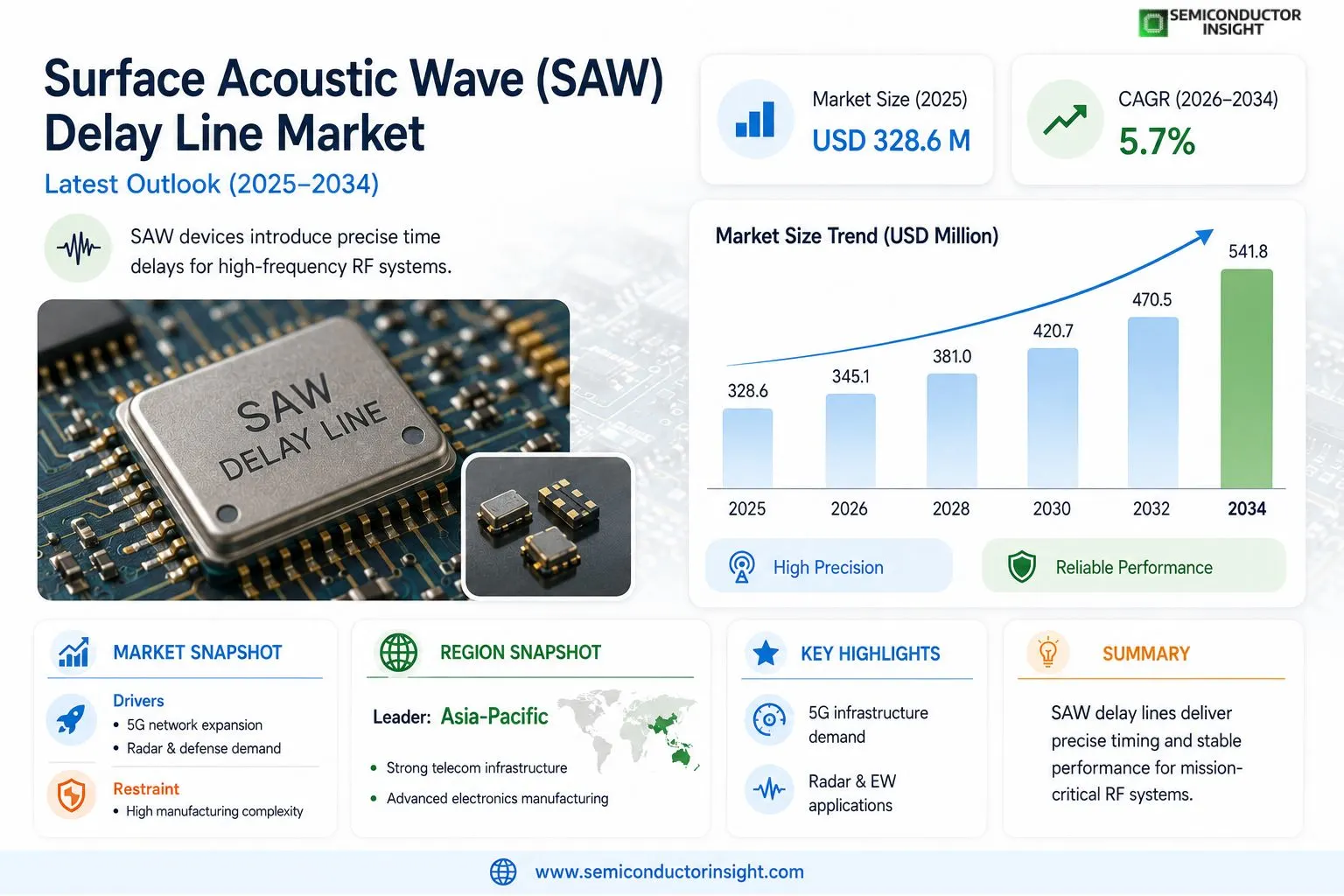
Global Surface Acoustic Wave (SAW) Delay Line market size was valued at USD 312.4 million in 2024. The market is projected to grow from USD 328.6 million in 2025 to USD 541.8 million by 2034, exhibiting a CAGR of 5.7% during the forecast period.
Surface Acoustic Wave (SAW) delay lines are electronic components that exploit acoustic waves propagating along the surface of a piezoelectric substrate , typically quartz, lithium niobate, or lithium tantalate , to introduce a precise time delay in signal processing. These devices are fundamental building blocks in radar systems, telecommunications infrastructure, military electronic warfare, and sensor technologies. The product range encompasses single-phase unidirectional transducers, bidirectional delay lines, dispersive delay lines, and temperature-compensated variants, each engineered to meet stringent frequency stability and signal integrity requirements across a broad operating temperature range.
The market is gaining momentum driven by escalating demand for advanced radar and electronic warfare systems, rapid expansion of wireless communication networks, and growing adoption of SAW-based sensors in industrial and automotive applications. Furthermore, the proliferation of 5G infrastructure globally is creating substantial demand for high-frequency, low-insertion-loss delay line components. Key industry participants including Murata Manufacturing Co., Ltd., TDK Corporation, and Skyworks Solutions, Inc. maintain strong market positions through continuous R&D investment and diversified product portfolios catering to both commercial and defense-grade applications.
MARKET DRIVERS
Rising Demand for Advanced Wireless Communication Infrastructure
Surface Acoustic Wave (SAW) Delay Line Market is experiencing sustained growth driven by the accelerating global deployment of 5G networks and next-generation wireless communication systems. SAW delay line devices are integral components in signal processing applications, offering precise time-delay functionality that is critical for radar systems, telecommunications equipment, and electronic warfare platforms. As mobile network operators continue to invest heavily in infrastructure upgrades, the demand for high-frequency, low-insertion-loss SAW components has intensified across both consumer electronics and industrial segments.
Expansion of Defense and Aerospace Electronics Applications
Defense modernization programs across North America, Europe, and the Asia-Pacific region are contributing significantly to the growth of Surface Acoustic Wave (SAW) Delay Line Market. SAW delay lines are widely utilized in phased-array radar systems, electronic countermeasure equipment, and secure communication platforms due to their compact form factor, temperature stability, and reliable signal processing capabilities. Governments across major economies are allocating increased defense budgets toward upgrading electronic warfare and surveillance systems, creating a robust and sustained demand pipeline for SAW delay line components in mission-critical applications.
➤ The integration of SAW delay line technology in modern radar and signal intelligence systems underscores its strategic importance in defense electronics, where precision timing and signal fidelity are non-negotiable operational requirements.
Furthermore, the growing adoption of Internet of Things (IoT) devices and smart industrial automation systems is reinforcing the market’s expansion trajectory. SAW delay lines are increasingly being incorporated into sensor modules and wireless data transmission systems operating across industrial environments. The convergence of miniaturization trends with the need for high-performance signal processing solutions is compelling manufacturers in Surface Acoustic Wave (SAW) Delay Line Market to invest in research and development, driving both product innovation and competitive differentiation across the value chain.
MARKET CHALLENGES
Technical Complexity in High-Frequency SAW Device Fabrication
One of the primary challenges facing Surface Acoustic Wave (SAW) Delay Line Market is the inherent technical complexity involved in fabricating devices that operate reliably at increasingly higher frequency ranges. As system designers push SAW delay line specifications to meet the demands of millimeter-wave and sub-6 GHz 5G applications, achieving consistent photolithographic precision at the submicron level becomes a significant manufacturing obstacle. Variations in piezoelectric substrate quality, electrode geometry, and thin-film deposition processes can introduce performance inconsistencies that compromise signal integrity, requiring manufacturers to maintain stringent process controls that elevate production costs.
Other Challenges
Competition from Alternative Technologies
Surface Acoustic Wave (SAW) Delay Line Market faces competitive pressure from bulk acoustic wave (BAW) filters and microelectromechanical systems (MEMS)-based delay line technologies, particularly in high-frequency applications above 3 GHz. BAW devices offer certain performance advantages in terms of power handling and out-of-band rejection at elevated frequencies, prompting some system designers to evaluate these alternatives. This technological competition requires SAW delay line manufacturers to continuously improve device performance and cost-effectiveness to retain design-win opportunities in next-generation communication and defense platforms.
Supply Chain Vulnerabilities for Piezoelectric Substrates
The production of SAW delay line devices is critically dependent on high-purity piezoelectric substrate materials, particularly lithium niobate and lithium tantalate crystals, Global supply of which is concentrated among a limited number of producers. Geopolitical tensions, trade restrictions, and logistical disruptions have exposed vulnerabilities in the specialty materials supply chain that supports Surface Acoustic Wave (SAW) Delay Line Market. These supply chain risks can lead to material cost inflation and extended lead times, creating operational challenges for device manufacturers attempting to fulfill growing customer demand in a timely and cost-efficient manner.
MARKET RESTRAINTS
Performance Limitations at Elevated Operating Temperatures and Frequencies
A notable restraint impacting Surface Acoustic Wave (SAW) Delay Line Market is the inherent sensitivity of SAW devices to temperature fluctuations, which can induce frequency drift and degrade time-delay accuracy in demanding operational environments. While temperature-compensated SAW (TC-SAW) designs have partially addressed this limitation, achieving stable performance across wide industrial temperature ranges without compromising insertion loss or size efficiency remains a technical constraint. This restricts the applicability of standard SAW delay line solutions in certain high-temperature industrial, automotive, and aerospace-grade applications where alternative technologies may present a more viable option.
High Initial Capital Investment and Intellectual Property Barriers
Surface Acoustic Wave (SAW) Delay Line Market is characterized by significant barriers to entry, primarily driven by the substantial capital investment required for advanced wafer fabrication facilities, cleanroom infrastructure, and specialized photolithography equipment. Established market participants hold extensive intellectual property portfolios covering SAW design architectures, substrate processing techniques, and packaging methodologies, which create formidable competitive barriers for emerging manufacturers and regional players seeking to enter or expand within the market. These factors collectively constrain the pace of new capacity additions and limit competitive diversification, potentially restricting overall market scalability in the medium term.
MARKET OPPORTUNITIES
Growing Adoption in Automotive Radar and Vehicle-to-Everything (V2X) Communication Systems
The rapid advancement of autonomous vehicle technology and intelligent transportation systems presents a compelling growth opportunity for Surface Acoustic Wave (SAW) Delay Line Market. SAW delay line components are increasingly being evaluated for integration into automotive radar modules, tire pressure monitoring systems (TPMS), and V2X communication platforms that require reliable, compact, and low-power signal processing solutions. As global automotive OEMs accelerate the development of advanced driver assistance systems (ADAS) and fully autonomous driving capabilities, the demand for precision electronic components including SAW delay lines is expected to grow meaningfully within this end-use segment.
Emerging Opportunities in Industrial IoT and Smart Sensing Networks
The ongoing industrial digital transformation, characterized by the widespread deployment of smart factory systems, predictive maintenance platforms, and Industrial IoT (IIoT) sensor networks, is opening new application avenues for Surface Acoustic Wave (SAW) Delay Line Market. SAW-based delay line sensors offer distinct advantages in wireless passive sensing applications, enabling real-time monitoring of physical parameters such as temperature, pressure, and torque without requiring onboard power sources. This capability positions SAW delay line technology as a strategically attractive solution for harsh industrial environments where conventional wired sensing infrastructure is impractical, thereby broadening the addressable market beyond traditional communication and defense segments.
Technological Innovation in Substrate Materials and Packaging Miniaturization
Ongoing research into novel piezoelectric substrate materials, including scandium-doped aluminum nitride and advanced composite crystal structures, is creating opportunities for next-generation SAW delay line devices with improved frequency range, reduced temperature sensitivity, and enhanced power handling characteristics. Simultaneously, advancements in wafer-level packaging and flip-chip bonding technologies are enabling significant reductions in component footprint, aligning with the miniaturization requirements of modern consumer electronics and wearable device platforms. These technological developments are expected to expand the performance envelope and application scope of Surface Acoustic Wave (SAW) Delay Line Market, supporting sustained innovation-led growth across multiple end-use industries over the coming years.
Surface Acoustic Wave (SAW) Delay Line Market Trends
Rising Demand for Advanced Radar and Electronic Warfare Systems Drives SAW Delay Line Adoption
Surface Acoustic Wave (SAW) Delay Line Market is witnessing accelerated growth driven by increasing deployment of advanced radar systems and electronic warfare platforms across defense sectors worldwide. SAW delay lines, which utilize acoustic waves propagating along piezoelectric substrates such as quartz, lithium niobate, and lithium tantalate, provide precise signal timing and high-frequency stability essential for modern radar and electronic countermeasure systems. Defense modernization programs across North America, Europe, and Asia-Pacific are directly fueling procurement of high-performance SAW-based components engineered for stringent military-grade operating conditions.
Other Trends
5G Infrastructure Expansion Creating New Demand Channels
Global rollout of 5G wireless communication networks is emerging as a significant growth driver for Surface Acoustic Wave (SAW) Delay Line Market. High-frequency, low-insertion-loss SAW delay line components are critical in 5G base stations and telecommunications infrastructure to maintain signal integrity across dense network environments. As telecom operators continue deploying next-generation networks, demand for compact, thermally stable SAW delay line devices engineered for high-frequency bands is intensifying, prompting manufacturers like Murata Manufacturing Co., Ltd., TDK Corporation, and Skyworks Solutions, Inc. to expand their product portfolios accordingly.
Growing Integration in Automotive and Industrial Sensor Applications
Beyond defense and telecommunications, Surface Acoustic Wave (SAW) Delay Line Market is experiencing notable traction in automotive and industrial sensor segments. SAW-based sensing technologies are increasingly adopted for pressure, torque, and temperature measurement in automotive systems, benefiting from their passive, wireless operation capability and resilience in harsh environments. Industrial automation and condition monitoring applications are similarly driving adoption of temperature-compensated SAW delay line variants that deliver reliable performance across broad operating temperature ranges.
Continuous R&D Investment and Product Diversification Shaping Competitive Landscape
Leading participants in Surface Acoustic Wave (SAW) Delay Line Market are sustaining competitive advantage through continuous research and development investment targeting improved frequency stability, miniaturization, and enhanced signal processing performance. The product landscape spans single-phase unidirectional transducers, bidirectional delay lines, dispersive delay lines, and temperature-compensated variants, each designed to address specific application requirements across commercial and defense-grade markets. This product diversification strategy enables key manufacturers to serve a broad customer base ranging from consumer electronics to mission-critical defense and telecommunications infrastructure, reinforcing long-term market resilience and demand stability.
COMPETITIVE LANDSCAPE
Key Industry Players
Surface Acoustic Wave (SAW) Delay Line Market: Competitive Dynamics and Leading Manufacturer Profiles
Global Surface Acoustic Wave (SAW) Delay Line market is characterized by a moderately consolidated competitive landscape, with a handful of large-scale, vertically integrated electronic component manufacturers commanding significant market share. Murata Manufacturing Co., Ltd. stands as the dominant force in this space, leveraging its extensive piezoelectric substrate expertise, global manufacturing footprint, and deep R&D capabilities to serve telecommunications, defense, and industrial end-markets. TDK Corporation and Skyworks Solutions, Inc. also maintain commanding positions, continuously expanding their SAW delay line portfolios to address the high-frequency, low-insertion-loss requirements driven by 5G infrastructure rollout and advanced radar system development. These tier-one players differentiate themselves through proprietary substrate technologies , including quartz, lithium niobate, and lithium tantalate , stringent quality controls for defense-grade applications, and long-term supply agreements with leading OEMs across North America, Europe, and Asia-Pacific.
Beyond the market leaders, a number of specialized and regionally significant players contribute meaningfully to the SAW delay line ecosystem. Companies such as Qorvo, Inc. and Taiyo Yuden Co., Ltd. have carved out strong niches in wireless communication and sensor-grade SAW components, while Epson Toyocom Corporation and NDK (Nihon Dempa Kogyo Co., Ltd.) are well-regarded for their precision frequency control products used in military electronic warfare and industrial sensing applications. Emerging participants from China, including Skycom Electronic Technology, are intensifying competitive pressure through cost-competitive manufacturing. The overall competitive environment is driven by continuous innovation in temperature-compensated SAW designs, miniaturization for automotive ADAS integration, and the push toward higher operating frequencies demanded by next-generation radar and 5G network architectures.
List of Key Surface Acoustic Wave (SAW) Delay Line Companies Profiled
- Murata Manufacturing Co., Ltd.
- TDK Corporation
- Skyworks Solutions, Inc.
- Qorvo, Inc.
- Taiyo Yuden Co., Ltd.
- Epson Toyocom Corporation
- NDK (Nihon Dempa Kogyo Co., Ltd.)
- API Technologies Corp.
- Qualtre, Inc.
- Transense Technologies plc
- Vectron International
- Tai-Saw Technology Co., Ltd.
- Crystek Corporation
- Phonon Corporation
Segment Analysis:
| Segment Category | Sub-Segments | Key Insights |
| By Type |
|
Temperature-Compensated Delay Lines represent the leading segment within the type category, owing to their ability to maintain consistent signal integrity and frequency stability across wide operating temperature ranges.
|
| By Application |
|
Radar Systems constitute the dominant application segment for SAW delay lines, driven by sustained investment in both military and civilian radar infrastructure across the globe.
|
| By End User |
|
Defense and Military end users represent the most strategically significant and consistently high-value segment within the SAW delay line market.
|
| By Substrate Material |
|
Lithium Niobate (LiNbO₃) stands out as the leading substrate material in the SAW delay line market, favored for its high electromechanical coupling coefficient that enables efficient energy transduction and broad bandwidth performance.
|
| By Frequency Range |
|
High Frequency (1 GHz – 3 GHz) delay lines currently lead the market in terms of demand and commercial relevance, propelled by their central role in modern cellular infrastructure, satellite communication payloads, and advanced radar front-end modules.
|
Regional Analysis: Surface Acoustic Wave (SAW) Delay Line Market
Asia-Pacific
Asia-Pacific hosts a vertically integrated supply chain for SAW delay line components, from raw piezoelectric substrate sourcing to final device packaging. This end-to-end ecosystem reduces production costs and shortens lead times, giving regional manufacturers a decisive competitive advantage in meeting the high-volume demands of consumer electronics and telecommunications equipment producers across global markets.
The accelerating deployment of advanced wireless network infrastructure across Asia-Pacific nations is a primary catalyst for SAW delay line demand. As mobile network densification and broadband connectivity initiatives expand into rural and semi-urban areas, the need for precise signal processing and frequency filtering components , core functions of SAW delay lines , continues to grow at a notable pace across the region.
Leading economies within Asia-Pacific, particularly Japan and South Korea, maintain robust research and development ecosystems dedicated to advancing SAW device miniaturization, frequency performance, and temperature stability. Collaborative initiatives between academic institutions, government bodies, and private enterprises continuously push the boundaries of SAW delay line technology, ensuring the region retains its innovation leadership on Global stage.
Beyond consumer electronics, Asia-Pacific is witnessing rising adoption of SAW delay line components in industrial automation, precision sensing, and defense electronics applications. Government-backed modernization programs for radar systems, electronic warfare platforms, and smart manufacturing environments are creating new and diversified demand channels, broadening the overall market opportunity for SAW delay line suppliers operating throughout the region.
North America
North America represents a highly mature and technologically sophisticated segment of Global Surface Acoustic Wave (SAW) Delay Line Market. The United States leads regional demand, underpinned by its advanced defense and aerospace sectors, which rely on SAW delay line components for radar signal processing, electronic countermeasure systems, and secure communication platforms. The presence of established defense contractors and a robust ecosystem of specialized component suppliers ensures steady procurement activity. Beyond defense, the region’s thriving consumer electronics, automotive radar, and industrial sensing industries contribute meaningfully to overall SAW delay line consumption. North American universities and national research laboratories also play a pivotal role in advancing SAW technology fundamentals, with research outcomes frequently translating into commercially relevant product improvements. The region’s stringent quality standards and certification requirements further encourage innovation among domestic and international SAW device manufacturers seeking access to lucrative North American contracts. Surface Acoustic Wave (SAW) Delay Line Market in North America is expected to sustain stable growth, with defense modernization and next-generation wireless communication upgrades serving as primary long-term demand drivers throughout the forecast horizon.
Europe
Europe occupies a strategically important position in Global Surface Acoustic Wave (SAW) Delay Line Market, characterized by strong demand from automotive, industrial, and telecommunications end-use sectors. Germany, France, and the United Kingdom are among the most active national markets, where the automotive industry’s shift toward advanced driver-assistance systems and vehicle-to-everything communication technologies has generated notable requirements for high-performance SAW-based frequency control and signal processing solutions. European manufacturers are recognized for their engineering precision and adherence to rigorous industry standards, qualities that make them preferred suppliers for demanding applications in industrial automation and medical sensing equipment. The region’s emphasis on sustainable manufacturing and energy-efficient electronics design is also influencing product development trajectories within the SAW delay line space. Regulatory frameworks promoting domestic technology sovereignty and reducing dependency on external supply chains are encouraging strategic investments in European SAW component production capacity. As connectivity infrastructure continues to evolve and smart industry initiatives gain momentum, Surface Acoustic Wave (SAW) Delay Line Market across Europe is anticipated to maintain a steady and resilient growth trajectory.
South America
South America represents an emerging and gradually expanding frontier within Global Surface Acoustic Wave (SAW) Delay Line Market. Brazil stands as the region’s largest economy and primary technology adopter, where ongoing telecommunications infrastructure upgrades and growing consumer electronics penetration are beginning to generate incremental demand for SAW delay line components. While the region currently accounts for a comparatively modest share of global market activity, increasing mobile broadband adoption and government-supported digital transformation initiatives are laying the groundwork for longer-term market development. Industrial sectors in Brazil, Argentina, and Colombia are progressively modernizing operational infrastructure, creating new touchpoints for SAW-enabled sensing and signal processing solutions. Import dependency on Asian and North American SAW component suppliers remains a defining characteristic of the South American market, though localized assembly and distribution capabilities are gradually improving. As regional economies stabilize and technology adoption accelerates, Surface Acoustic Wave (SAW) Delay Line Market in South America is positioned for measured but consistent expansion throughout the forecast period.
Middle East & Africa
The Middle East and Africa region occupies a nascent but increasingly noteworthy position in Global Surface Acoustic Wave (SAW) Delay Line Market. Gulf Cooperation Council nations, particularly the United Arab Emirates and Saudi Arabia, are at the forefront of regional technology adoption, channeling substantial investment into telecommunications network modernization, smart city development, and defense capability enhancement , all of which create demand pathways for advanced SAW delay line components. Large-scale infrastructure projects and national digital transformation strategies across the Gulf states are fostering an environment conducive to the broader adoption of sophisticated electronic components. In Africa, mobile connectivity expansion initiatives and the proliferation of affordable smart devices are gradually stimulating market interest, though infrastructure constraints continue to temper the pace of adoption. The region’s overall SAW delay line consumption remains heavily reliant on imports, with limited local manufacturing presence. Nevertheless, as investment in technology infrastructure deepens and regional economic diversification programs mature, Surface Acoustic Wave (SAW) Delay Line Market across the Middle East and Africa is expected to develop steadily over the coming forecast years.
Report Scope
This market research report provides a comprehensive analysis of the Surface Acoustic Wave (SAW) Delay Line Market , covering the forecast period 2026–2034. It offers detailed insights into market dynamics, technological advancements, competitive landscape, and key trends shaping the industry.
Key focus areas of the report include:
- Market Overview: The report begins with an overview outlining its current market scenario, key growth indicators, and industry transformation drivers. It discusses macroeconomic factors, demand–supply balance, regulatory landscape, and the strategic role of semiconductors in powering advancements across industries such as automotive, telecommunications, consumer electronics, and industrial automation.
- Market Size & Forecast: Historical data and future projections for revenue, unit shipments, and market value across major regions and segments.
- Segmentation Analysis: Detailed breakdown by product type, technology, application, and end-user industry to identify high-growth segments and investment opportunities.
- Regional Insights: Insights into market performance across North America, Europe, Asia-Pacific, Latin America, and the Middle East & Africa, including country-level analysis where relevant.
- Competitive Landscape: Profiles of leading market participants, including their product offerings, R&D focus, manufacturing capacity, pricing strategies, and recent developments such as mergers, acquisitions, and partnerships.
- Technology Trends & Innovation: Assessment of emerging technologies, integration of AI/IoT, semiconductor design trends, fabrication techniques, and evolving industry standards.
- Market Drivers & Restraints: Evaluation of factors driving market growth along with challenges, supply chain constraints, regulatory issues, and market-entry barriers.
- Stakeholder Insights: Insights for component suppliers, OEMs, system integrators, investors, and policymakers regarding the evolving ecosystem and strategic opportunities.
Primary and secondary research methods are employed, including interviews with industry experts, data from verified sources, and real-time market intelligence to ensure the accuracy and reliability of the insights presented.
FREQUENTLY ASKED QUESTIONS:
What is the current market size of Surface Acoustic Wave (SAW) Delay Line Market?
-> Surface Acoustic Wave (SAW) Delay Line Market was valued at USD 328.6 million in 2025 and is expected to reach USD 541.8 million by 2034, exhibiting a CAGR of 5.7% during the forecast period.
Which key companies operate in Surface Acoustic Wave (SAW) Delay Line Market?
-> Key players include Murata Manufacturing Co., Ltd., TDK Corporation, and Skyworks Solutions, Inc., among others, who maintain strong market positions through continuous R&D investment and diversified product portfolios catering to both commercial and defense-grade applications.
What are the key growth drivers?
-> Key growth drivers include escalating demand for advanced radar and electronic warfare systems, rapid expansion of wireless communication networks, growing adoption of SAW-based sensors in industrial and automotive applications, and the proliferation of 5G infrastructure globally creating substantial demand for high-frequency, low-insertion-loss delay line components.
Which region dominates the market?
-> Asia-Pacific is the fastest-growing region driven by expanding telecommunications infrastructure and electronics manufacturing, while North America remains a significant market owing to strong defense and radar system investments.
What are the emerging trends?
-> Emerging trends include temperature-compensated SAW delay line variants, integration of SAW components in 5G infrastructure, advancement of single-phase unidirectional transducers, and growing use of dispersive delay lines in military electronic warfare and next-generation radar systems.

Get Sample Report PDF for Exclusive Insights
Report Sample Includes
- Table of Contents
- List of Tables & Figures
- Charts, Research Methodology, and more...
 Download Sample Report PDF