Substrate-like PCB (SLP) for SiP Market Insights
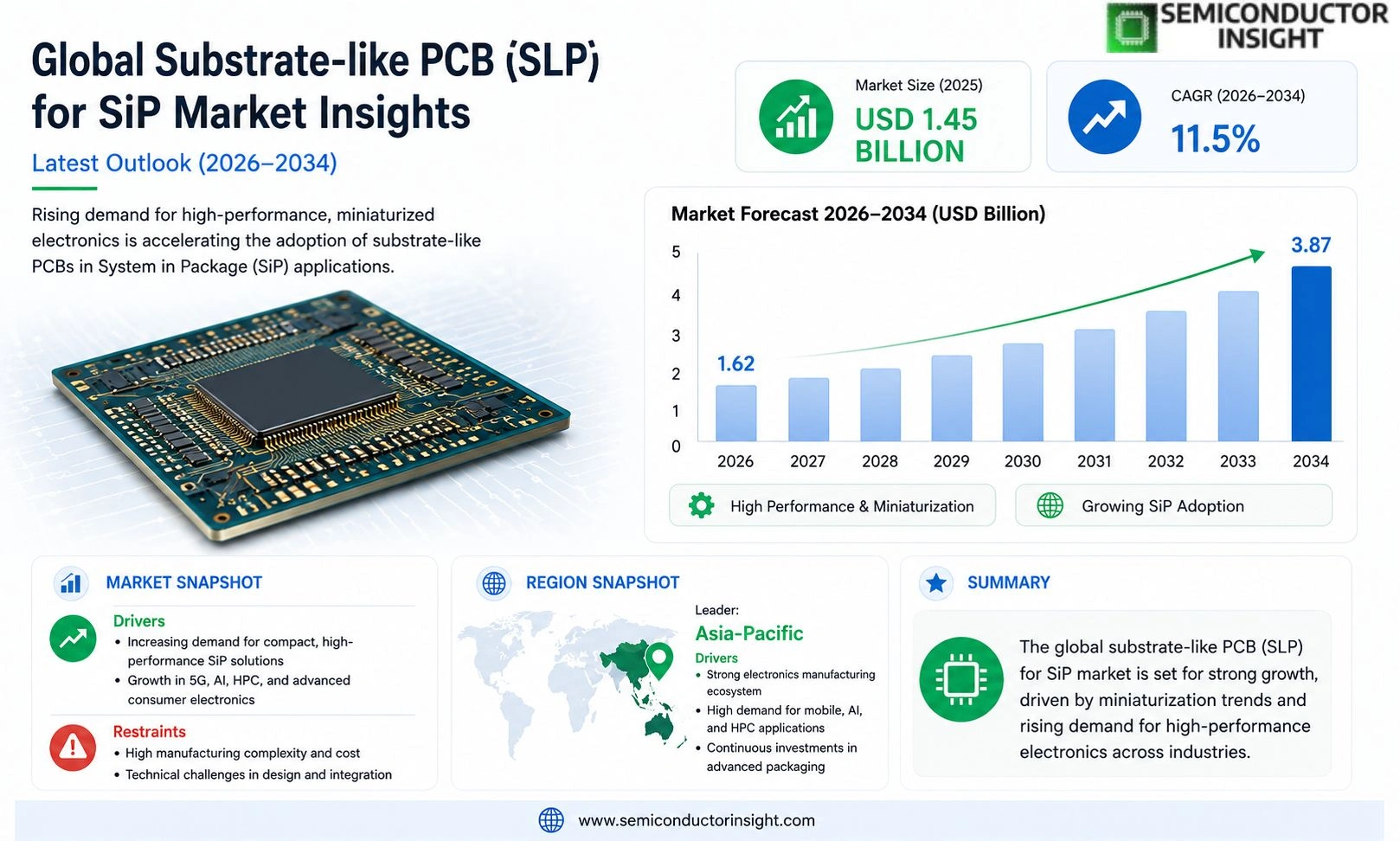
Global Substrate-like PCB (SLP) for SiP market size was valued at USD 1.45 billion in 2025. The market is projected to grow from USD 1.62 billion in 2026 to USD 3.87 billion by 2034, exhibiting a CAGR of 11.5% during the forecast period.
Substrate-like PCBs (SLPs) for System-in-Package (SiP) are advanced printed circuit boards designed to bridge the gap between traditional PCBs and high-density semiconductor substrates. These ultra-thin, fine-pitch substrates enable miniaturization, improved electrical performance, and enhanced thermal management in compact electronic devices. SLPs support high I/O density with line/space dimensions as tight as 15/15 µm, making them ideal for applications in smartphones, wearables, IoT devices, and automotive electronics. Unlike conventional PCBs, SLPs incorporate features such as embedded passives, stacked vias, and low-loss dielectric materials, which are critical for next-generation packaging technologies like fan-out wafer-level packaging (FOWLP) and chiplet integration.
The rapid adoption of SLPs is driven by the surging demand for high-performance computing, 5G infrastructure, and AI-enabled devices, where space constraints and signal integrity are paramount. Leading manufacturers such as Shinko Electric Industries, Ibiden Co., Ltd., and Unimicron Technology Corporation are investing heavily in R&D to enhance SLP capabilities, including the development of coreless substrates and hybrid organic-inorganic materials. Furthermore, strategic collaborations,such as ASE Group’s partnership with substrate suppliers to optimize SiP solutions,are accelerating market growth by addressing scalability challenges in consumer electronics and automotive sectors.
MARKET DRIVERS
Surge in Mobile and Consumer Electronics Demand
The primary force propelling Substrate-like PCB (SLP) for SiP Market is the relentless miniaturization trend in consumer electronics. As smartphone manufacturers strive to deliver devices that are thinner, lighter, and more powerful, the demand for high-density interconnects has skyrocketed. SLP technology effectively bridges the gap between standard organic substrates and semiconductor packaging, offering superior performance without the prohibitive costs typically associated with System-in-Package solutions.
Enhanced Signal Integrity and Performance
Another critical driver is the need for high-speed data transmission and superior electrical performance. Traditional PCBs struggle with signal attenuation and crosstalk as frequencies increase. Substrate-like PCB (SLP) for SiP Market benefits significantly from the material properties of SLPs, which allow for reduced signal loss and better thermal management at smaller pitch sizes. This capability is essential for the next generation of 5G-enabled devices and advanced AI processors.
➤ Expert Insight: The shift towards heterogeneous integration requires substrates that can physically support multiple dies without compromising signal fidelity, acting as the backbone of modern SoC and SiP designs.
Furthermore, the expansion into the automotive IoT sector is creating new volume tiers for SLP manufacturers, driven by the high reliability standards required for intelligent transportation systems.
MARKET CHALLENGES
Stringent Cost Structures and Manufacturing Complexity
The adoption of SLP technology faces significant hurdles due to the specialized fabrication requirements and high capital expenditure. Unlike conventional copper-clad laminates, Substrate-like PCBs require process steps borrowed from semiconductor manufacturing, such as double-sided patterning and thin dielectric layers. This complexity results in higher per-unit costs, which can be a deterrent for cost-sensitive markets, despite the performance gains offered by the technology.
Other Challenges
Yield Rates and Defect Sensitivity
The manufacturing yield rates for Substrate-like PCBs are currently lower than those for traditional organic boards. The extreme miniaturization of features,sometimes as small as 30 microns,makes the production process extremely sensitive to defect formation, such as particles and alignment errors. This variability impacts the bottom line and necessitates rigorous quality control measures, slowing down the overall mass production scalability.
Material Limitations
The availability of advanced stacking dielectric films and high-performance ABF (Ajinomoto Build-up Film) materials is often a bottleneck, as these are patented and produced predominantly by a few key suppliers.
MARKET RESTRAINTS
Proliferation of Alternative Packaging Technologies
The growth of Substrate-like PCB (SLP) for SiP Market is tempered by the competitive landscape of packaging technologies. Competing solutions such as Fan-Out Wafer Level Packaging (FO-WLP) are gaining traction as they offer similar integration levels with potentially lower costs and higher throughput. Additionally, the industry continues to explore 2.5D and 3D stacking solutions, which may offer flexible configurations that overshadow the fixed footprint advantages of traditional SLPs.
Supply Chain Vulnerabilities
The Substrate-like PCB supply chain remains highly concentrated, with raw material suppliers and capital equipment providers playing a dominant role. Any disruption in the supply of critical base materials, such as advanced ceramics or polyimide films, can directly impact the market’s ability to meet rising demand. This fragility creates a significant restraint for market players attempting to maintain steady production levels and inventory turnover.
MARKET OPPORTUNITIES
Expanding Applications in AI and Edge Computing
Substrate-like PCB (SLP) for SiP Market offers immense growth potential through the integration of these technologies into advanced System-in-Package solutions for artificial intelligence and edge computing. As the computational requirements for AI processors increase, the need for high-speed interconnects and thermal management platforms becomes paramount. SLPs provide the necessary performance envelope to support these energy-intensive applications in compact form factors.
Automotive and Healthcare Integration
There is a significant opportunity for market penetration in the automotive and healthcare sectors. Automotive Electronic Control Units (ECUs) are increasingly relying on SiP architectures for safety-critical functions, which requires the reliability and miniaturization offered by SLP substrates. Similarly, in healthcare, wearable medical devices demand high-density, stable PCB solutions to ensure accurate sensing and long-term battery life.
Additionally, the continuous innovation in dielectric materials and low-loss copper alloys presents opportunities for manufacturers to differentiate their products and drive down costs through process optimization.
Trends
Primary Trend Heading Here
Substrate-like PCBs (SLPs) for System-in-Package (SiP) are gaining significant traction in the electronics industry. These advanced printed circuit boards are designed to offer a compelling alternative to traditional PCBs, particularly in applications demanding miniaturization and high performance. Global Substrate-like PCB (SLP) for SiP Market was valued at USD 1.45 billion in 2025 and is projected for substantial growth, reaching USD 3.87 billion by 2034, indicating a robust expansion.
Other Trends
Miniaturization and High-Density Integration
A primary driver for the adoption of SLPs is the escalating need for device miniaturization. With the proliferation of smartphones, wearables, and IoT devices, there’s a constant push to embed more functionality into smaller spaces. SLPs, with their ultra-thin profiles and fine-pitch capabilities (as tight as 15/15 µm), facilitate this trend. This enables better integration of components and enhances overall system density. The enhanced electrical performance and improved thermal management offered by SLPs are crucial for these compact electronic devices.
Advanced Packaging Technologies
The development of next-generation packaging technologies is closely intertwined with the growth of the SLP market. SLPs are essential for supporting advanced packaging solutions like fan-out wafer-level packaging (FOWLP) and chiplet integration. Features such as embedded passives, stacked vias, and low-loss dielectric materials make them ideally suited for these complex assembly processes. These technologies are critical for meeting the performance demands of high-performance computing and AI applications.
Demand from High-Performance Applications
The surging demand for high-performance computing, 5G infrastructure, and AI-enabled devices is fueling the growth of Substrate-like PCB (SLP) for SiP Market. These applications require high bandwidth, low latency, and efficient power delivery, all of which SLPs can effectively provide. The ability of SLPs to support high I/O density is paramount in these demanding environments. Significant investments are being made in R&D to further enhance the capabilities of these critical components.
Strategic Collaborations and R&D Investments
Strategic partnerships and substantial investments in research and development are accelerating market growth. Collaborations between substrate suppliers and companies like ASE Group are optimizing SiP solutions and addressing scalability challenges. Furthermore, leading manufacturers are actively developing coreless substrates and hybrid organic-inorganic materials to improve SLP performance and manufacturing efficiency.
COMPETITIVE LANDSCAPE
Key Industry Players
Key Industry Players Substrate-like PCB (SLP) for SiP Market
Global Substrate-like PCB (SLP) for SiP Market has witnessed significant growth, valued at USD 1.45 billion in 2025 and projected to reach USD 3.87 billion by 2034, exhibiting a CAGR of 11.5%. This growth is primarily driven by the increasing demand for miniaturization, enhanced performance, and improved thermal management in electronic devices such as smartphones, wearables, IoT devices, and automotive electronics. Key players in this competitive landscape are focused on technological advancements, including the development of coreless substrates and hybrid materials to meet the evolving needs of the SiP market.
Several companies are actively involved in the manufacturing and development of SLPs for SiP, contributing to market expansion through R&D investments and strategic partnerships. These efforts are aimed at addressing scalability challenges and optimizing solutions for various applications. The focus on high I/O density and advanced packaging technologies like FOWLP and chiplet integration further fuels the demand for sophisticated SLP solutions. The competitive dynamics are characterized by innovation in material science, manufacturing processes, and design capabilities.
List of Key [Industry] Companies Profiled
- Shinko Electric Industries Co., Ltd.
- Ibiden Co., Ltd.
- Unimicron Technology Corporation
- Ammag Electronics Co., Ltd.
- Taconic Technology, Inc.
- Epcos (Murata Manufacturing)
- Vishay Intertechnology, Inc.
- Kingsmead Electronics Ltd.
- Nan Ya Printed Circuit Board Corp.
- Hastings Technology Group, Inc.
- Kyocera Corporation
- Sierra Circuits Inc.
- Advanced Semiconductor Materials, Inc.
- Formosa Electronics Corporation
- Lingtai Microelectronics Co., Ltd.
Segment Analysis:
| Segment Category | Sub-Segments | Key Insights |
| By Type |
|
Leading Segment: Coreless substrates are gaining traction due to their enhanced thermal conductivity and reduced weight, aligning with the miniaturization trends in SiP applications. This drives performance improvements in devices like smartphones and wearables. |
| By Application |
|
Leading Segment: The automotive electronics sector is a significant driver for SLP adoption, particularly in advanced driver-assistance systems (ADAS) and electric vehicle (EV) components. The need for robust and high-performance packaging in these applications fuels demand for SLPs. |
| By End User |
|
Leading Segment: Consumer electronics manufacturers are key end users, leveraging SLPs for miniaturizing and enhancing the performance of their devices. The demand for smaller, more powerful smartphones and wearables directly impacts the growth of this segment. |
| By Packaging Technology |
|
Leading Segment: Chiplet integration is emerging as a critical application for SLPs, enabling the creation of complex SiP designs with improved performance and scalability. The ability to integrate multiple functional blocks into a single package is driving adoption in high-performance computing and AI applications. |
| By Layer Count |
|
Leading Segment: The demand for higher layer count SLPs (6+ layers) is increasing significantly, driven by the need for greater interconnect density and improved signal integrity in advanced SiP designs. This trend supports the development of more complex and powerful electronic devices. |
Regional Analysis:
United States
The automotive sector is rapidly integrating sophisticated electronic systems, creating substantial demand for compact and reliable SLPs to support advanced driver-assistance systems (ADAS) and autonomous driving technologies. The stringent performance and reliability requirements of automotive applications are driving innovation in SLP materials and design.
The ongoing deployment of 5G networks and the expansion of data centers are creating significant demand for high-speed and low-latency interconnect solutions. SLPs play a crucial role in enabling the performance and reliability of telecommunications infrastructure, particularly in demanding environments.
The aerospace and defense industries require robust and high-reliability electronic systems. SLPs are essential for supporting the stringent performance and thermal management demands of these applications, contributing to the development of advanced aerospace and defense technologies.
Increasingly sophisticated industrial automation systems rely on compact and high-performance electronic components. SLPs are enabling the miniaturization and enhanced capabilities of industrial control systems.
Europe
Europe represents a significant and mature market for SLPs in the SiP market. Key drivers for growth include the automotive industry’s transition towards electric vehicles and advanced driver-assistance systems, as well as the expansion of the industrial automation sector. Stringent data privacy regulations and a focus on energy efficiency are influencing the development and adoption of SLP technologies in the region. The strong presence of established semiconductor manufacturers and a well-developed supply chain contribute to the competitiveness of the European SLP market. Regional initiatives promoting technological innovation and sustainable manufacturing practices are further supporting growth. The demand for SLPs in IoT devices and smart infrastructure is also contributing to market expansion across Europe.
Asia-Pacific
Asia-Pacific is emerging as the fastest-growing market for SLPs for SiP in the global SiP market. The rapid expansion of the consumer electronics industry, particularly in China and Southeast Asia, is driving significant demand. The region’s strong manufacturing base and government initiatives promoting technological development are further fueling growth. The increasing adoption of 5G technology and the proliferation of IoT devices are also contributing to market expansion. While competition is intense, the Asia-Pacific region presents substantial opportunities for SLP manufacturers with innovative solutions and competitive pricing. The focus on high-volume production and cost optimization is shaping the SLP market dynamics in this region.
South America
South America presents a moderately growing market for SLPs in the SiP market. The growth is primarily driven by the expansion of the telecommunications sector and increasing adoption of automotive electronics. The region’s developing industrial base and rising disposable incomes are contributing to demand for sophisticated electronic systems. Government investments in infrastructure projects and technological development are expected to further support market expansion. However, economic uncertainties and challenging regulatory landscapes pose some obstacles to growth in the region.
Middle East & Africa
The Middle East and Africa represent a relatively nascent but potentially high-growth market for SLPs in the SiP market. The increasing focus on infrastructure development, particularly in the telecommunications and transportation sectors, is driving demand. Rising disposable incomes and growing adoption of consumer electronics are also contributing to market growth. Government initiatives promoting technological advancement and industrial diversification are expected to further support market expansion. However, limited manufacturing capabilities and infrastructural challenges currently constrain the SLP market in this region.
Report Scope
This market research report provides a comprehensive analysis of the Substrate-like PCB (SLP) for SiP Market , covering the forecast period 2026–2034. It offers detailed insights into market dynamics, technological advancements, competitive landscape, and key trends shaping the industry.
Key focus areas of the report include:
- Market Overview: The report begins with an overview outlining its current market scenario, key growth indicators, and industry transformation drivers. It discusses macroeconomic factors, demand–supply balance, regulatory landscape, and the strategic role of semiconductors in powering advancements across industries such as automotive, telecommunications, consumer electronics, and industrial automation.
- Market Size & Forecast: Historical data and future projections for revenue, unit shipments, and market value across major regions and segments.
- Segmentation Analysis: Detailed breakdown by product type, technology, application, and end-user industry to identify high-growth segments and investment opportunities.
- Regional Insights: Insights into market performance across North America, Europe, Asia-Pacific, Latin America, and the Middle East & Africa, including country-level analysis where relevant.
- Competitive Landscape: Profiles of leading market participants, including their product offerings, R&D focus, manufacturing capacity, pricing strategies, and recent developments such as mergers, acquisitions, and partnerships.
- Technology Trends & Innovation: Assessment of emerging technologies, integration of AI/IoT, semiconductor design trends, fabrication techniques, and evolving industry standards.
- Market Drivers & Restraints: Evaluation of factors driving market growth along with challenges, supply chain constraints, regulatory issues, and market-entry barriers.
- Stakeholder Insights: Insights for component suppliers, OEMs, system integrators, investors, and policymakers regarding the evolving ecosystem and strategic opportunities.
Primary and secondary research methods are employed, including interviews with industry experts, data from verified sources, and real-time market intelligence to ensure the accuracy and reliability of the insights presented.
FREQUENTLY ASKED QUESTIONS:
What is the current market size of Substrate-like PCB (SLP) for SiP Market?
-> Substrate-like PCB (SLP) for SiP Market was valued at USD 1.45 billion in 2025 and is expected to reach USD 3.87 billion by 2034.
Which key companies operate Substrate-like PCB (SLP) for SiP Market?
-> Key players include Shinko Electric Industries, Ibiden Co., Ltd., and Unimicron Technology Corporation, among others.
What are the key growth drivers?
-> Key growth drivers include high‑performance computing, 5G infrastructure, and AI‑enabled devices.
Which region dominates the market?
-> The provided reference does not specify a dominant region for Substrate-like PCB (SLP) for SiP Market.
What are the emerging trends?
-> Emerging trends include ultra‑thin fine‑pitch designs, embedded passives, stacked vias, low‑loss dielectric materials, and development of core‑less or hybrid organic‑inorganic substrates.

Get Sample Report PDF for Exclusive Insights
Report Sample Includes
- Table of Contents
- List of Tables & Figures
- Charts, Research Methodology, and more...
 Download Sample Report PDF