Key Statistics
Key Takeaways
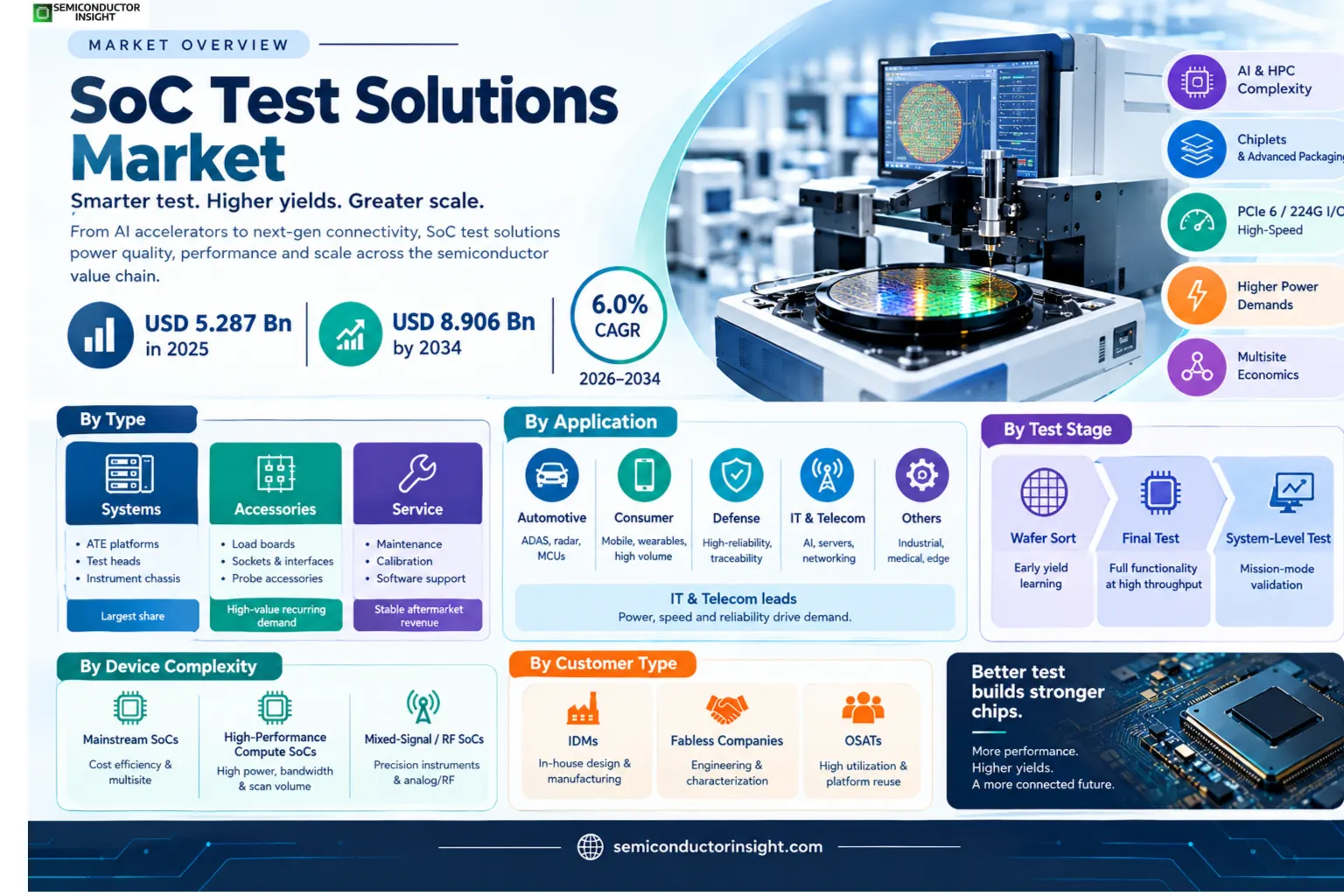
- Market size and growth: the market is valued at USD 5.287 billion in 2025 and is projected to reach USD 8.906 billion by 2034, with a 6.0% CAGR over 2026–2034.
- Systems leads by type because automated test equipment platforms represent the largest capital component and determine throughput, pin count, signal performance and multisite capability.
- IT & Telecommunications is the principal application because AI, networking and high-speed compute SoCs require extremely high pin counts, power delivery and serial-interface test coverage.
- North America is the largest regional market, while Asia Pacific has the strongest incremental growth profile.
- Primary driver: AI, automotive and high-speed SoCs require more pins, more current, more serial bandwidth and higher test coverage
- Structural restraint: advanced ATE systems are capital intensive and longer test times can raise cost per device faster than semiconductor selling prices
Market Overview
The SoC test solutions market was valued at USD 5.287 billion in 2025 and is projected to reach USD 8.906 billion by 2034, expanding at a 6.0% CAGR over 2026–2034. North America leads in 2025, while the market is being reshaped by AI and HPC device complexity, chiplets, PCIe 6/224G I/O, higher device power and stronger multisite economics..
SoC test solutions include automated test equipment, interfaces, instruments, handlers, probe-related accessories, software and maintenance services used to validate system-on-chip devices from characterization through high-volume production. Modern SoCs combine digital logic, analog, RF, memory interfaces, high-speed serial links and very high current demand, making test architecture more heterogeneous than a conventional single-function IC tester.
Leading platforms illustrate how rapidly requirements are expanding. Advantest’s V93000 EXA Scale addresses advanced digital devices with high scan volumes, high pin counts and extreme power needs, while Teradyne’s UltraFLEXplus adds 224G PAM4 high-speed I/O capability and up to 1,280 A of device power per instrument. These capabilities align with AI accelerators, server processors, ADAS and next-generation networking silicon.
Economics are as important as raw capability. Semiconductor customers measure cost per tested device, so higher site count, faster data transfer and reusable hardware can materially improve return on ATE investment. The market therefore rewards scalable platforms that can move from engineering to production and be reconfigured across multiple product families instead of being dedicated to one device generation.
Segment Analysis: By Type
By type, the market is segmented into Systems, Accessories, Service. Systems leads the current mix, while suppliers differentiate through performance, reliability, manufacturability and system-level economics.
| Type | Function / role | Market position |
|---|---|---|
| Systems | ATE platforms, test heads and instrument chassis for device characterization and production. | Largest type because the tester is the central capital asset and determines performance and throughput. |
| Accessories | Load boards, sockets, interfaces, probe interfaces and supporting instrumentation. | Recurring high-value demand because every device family requires application-specific interfacing. |
| Service | Maintenance, calibration, software support and field engineering. | Stable aftermarket revenue tied to the installed tester base and uptime requirements. |
Commercial implications by type
The systems segment drives capital spending, but accessories and service improve lifetime economics for suppliers. A platform with long compatibility can generate repeated load-board, instrument and software revenue as customers introduce new SoCs. This encourages vendors to maintain backward compatibility and scalable instrument roadmaps rather than force full tester replacement.
Segment Analysis: By Application
By application, the market includes Automotive, Consumer, Defense, IT & Telecommunications, Others. IT & Telecommunications represents the largest demand pool because the technology directly affects system performance, reliability, power or cost.
| Application | Demand characteristics |
|---|---|
| Automotive | ADAS processors, MCUs, radar and battery devices require functional safety, mixed-signal and long qualification. |
| Consumer | Mobile and wearable SoCs create high volume and aggressive cost-of-test targets. |
| Defense | High-reliability devices require specialized screening, traceability and low-volume flexibility. |
| IT & Telecommunications | Largest application; AI, server, networking and telecom SoCs need extreme power and high-speed I/O test. |
| Others | Industrial, medical and edge devices create diversified mixed-signal test demand. |
By Test Stage
| Test Stage | Commercial relevance |
|---|---|
| Wafer Sort | Probe-stage test screens die before packaging and supports early yield learning. |
| Final Test | Packaged-device test validates full functionality at high throughput. |
| System-Level Test | Mission-mode workloads catch defects not exposed by conventional structural tests. |
By Device Complexity
| Device Complexity | Commercial relevance |
|---|---|
| Mainstream SoCs | Moderate pin counts and power prioritize multisite cost efficiency. |
| High-Performance Compute SoCs | Very high power, serial bandwidth and scan volume demand advanced ATE. |
| Mixed-Signal / RF SoCs | Integrated analog and RF blocks require precision instrumentation alongside digital test. |
By Customer Type
| Customer Type | Commercial relevance |
|---|---|
| IDMs | Own device design and manufacturing and require broad internal test capability. |
| Fabless Companies | Rely on OSAT and foundry ecosystems but still drive engineering and characterization requirements. |
| OSATs | Operate high-volume tester fleets and prioritize utilization, multisite and platform reuse. |
Regional Analysis
North America leads the market because the United States has a large base of fabless AI and compute designers, ATE innovation and advanced semiconductor R&D, supporting high-value test-system demand. Asia Pacific has the strongest expansion profile as demand rises through Taiwan, South Korea, China and Southeast Asia contain major foundry, OSAT and electronics manufacturing capacity that is expanding advanced test infrastructure.
How does regional demand differ across this market?
North America is the leading high-value design and engineering market, while Asia Pacific is the largest manufacturing and fastest-expanding production-test region. Europe is strong in automotive and industrial semiconductors. South America and the Middle East & Africa remain smaller, with demand tied to local electronics, defense and emerging semiconductor initiatives. Regional economics depend heavily on where wafer fabrication, packaging and OSAT operations are located.
| Region | Position | Growth outlook | Demand profile | Supplier selection |
|---|---|---|---|---|
| North America | Largest | Strong | AI, compute and engineering | Capability, reuse, software |
| Asia Pacific | Second | Fastest | Foundry and OSAT production | Throughput, multisite, installed base |
| Europe | Third | Moderate | Automotive and industrial | Precision, safety, lifecycle |
| South America | Smaller | Selective | Electronics and automotive | Cost and service |
| Middle East & Africa | Emerging | Project-led | Strategic semiconductor programs | Training and support |
Competitive Landscape
The market is led by a small number of ATE vendors with deep digital, analog and RF instrumentation portfolios, large installed bases and global field-service organizations.
Advantest and Teradyne dominate leading-edge SoC ATE through V93000 EXA Scale and UltraFLEXplus. Both platforms emphasize scalable instruments, high site count and software compatibility so customers can preserve test IP as device requirements change.
Advantest’s V93000 adds high-current and high-speed serial instruments for AI, HPC and ADAS devices, while Teradyne supports PCIe 6 and 224G PAM4 testing. These capabilities show how device power and serial bandwidth are now central test-platform differentiators.
Cohu, Chroma and regional Chinese suppliers compete in mainstream and mixed-signal segments, while probe, handler and interface companies capture adjacent value. The strongest competitive advantage is not a single instrument but the breadth of a platform that can support engineering, wafer sort and high-volume final test.
| Competitive tier | Representative participants | Competitive focus |
|---|---|---|
| Leading ATE platforms | Advantest, Teradyne | Advanced digital, RF, analog and high-power SoC testing |
| Broad test suppliers | Cohu, Chroma ATE, Tokyo Seimitsu | Handlers, mixed-signal test and production solutions |
| Regional challengers | Changchuan, Huafeng Test & Control, Hon Precision | Cost-competitive systems and localized support |
Companies Profiled
Advantest, Teradyne, Cohu, Tokyo Seimitsu, Hangzhou Changchuan Technology, Tokyo Electron, Beijing Huafeng Test & Control Technology, Hon Precision, Chroma ATE, SPEA
Production Capacity Analysis
Capacity depends on precision instrument manufacturing, test-head integration, calibration, software releases, load-board supply and field-service engineering rather than semiconductor wafer starts alone.
ATE platforms contain thousands of precision channels, high-current power supplies and high-speed data paths that must be calibrated and thermally stable. Manufacturing scale therefore depends on specialized electronic assembly and test rather than commodity production lines.
The effective installed capacity is also constrained by applications engineering. Each SoC requires sockets, load boards, test programs and correlation work before a tester can run at production efficiency. Vendors with large field teams and reusable software infrastructure can help customers reach volume faster.
Market Dynamics
The market grows as device complexity raises test intensity, but customers simultaneously demand lower cost of test.
This tension drives higher parallelism, faster scan transfer and reusable tester architectures. A platform can create value even when its purchase price is high if it tests more devices per hour or avoids duplicate equipment. Chiplets and advanced packaging add further pressure because known-good-die strategies require test coverage earlier in the manufacturing flow.
Market Drivers
Drivers Impact Analysis
| Driver | Impact | Commercial mechanism |
|---|---|---|
| AI and HPC complexity | High | Large SoCs require extreme power, scan bandwidth and high-speed I/O test. |
| Automotive electronics | High | Safety-critical controllers need high coverage and mixed-signal precision. |
| Chiplets and advanced packaging | High | Known-good-die testing becomes more important when multiple expensive dies are assembled together. |
| High-speed serial interfaces | High | PCIe 6, 112G/224G SerDes and PAM4 require new instrumentation. |
AI and HPC complexity
Large SoCs require extreme power, scan bandwidth and high-speed I/O test.
Automotive electronics
Safety-critical controllers need high coverage and mixed-signal precision.
Chiplets and advanced packaging
Known-good-die testing becomes more important when multiple expensive dies are assembled together.
High-speed serial interfaces
PCIe 6, 112G/224G SerDes and PAM4 require new instrumentation.
Market Restraints
Restraints Impact Analysis
| Restraint | Impact | Commercial mechanism |
|---|---|---|
| Capital cost | High | Leading-edge ATE systems and instruments require significant upfront investment. |
| Longer test time | High | More coverage can increase seconds per device and reduce tester throughput. |
| Interface complexity | Medium | Sockets and load boards must handle very high current and signal bandwidth. |
| Engineering skill shortage | Medium | Test-program development requires specialized mixed hardware-software expertise. |
Capital cost
Leading-edge ATE systems and instruments require significant upfront investment.
Longer test time
More coverage can increase seconds per device and reduce tester throughput.
Interface complexity
Sockets and load boards must handle very high current and signal bandwidth.
Engineering skill shortage
Test-program development requires specialized mixed hardware-software expertise.
Market Opportunities
Known-good-die test
Chiplet packages increase the economic value of identifying bad dies before assembly.
224G and PCIe 6 test
AI and network silicon require next-generation serial characterization at production scale.
AI-driven yield analytics
Machine learning can prioritize diagnostics and shorten yield-learning cycles.
System-level test integration
Mission-mode testing can catch defects that structural test misses in complex SoCs.
Supply Chain Analysis
DAC/ADC, power supplies, RF and high-speed instruments
Tester chassis, test head, software
Load boards, sockets, probe interfaces
Handlers, probers, OSAT and fab workflows
Instrumentation
Measurement accuracy, current delivery and timing performance define tester capability.
ATE platform
Scalable architecture and software compatibility determine asset reuse across device generations.
Interfaces
High-current and high-speed sockets become critical as SoC package power and pin counts rise.
Production integration
Handlers, probers and factory software determine real throughput and utilization.
Recent Developments
2026 — Advantest V93000 EXA Scale expands advanced SoC test capability
The platform supports extreme device power, high pin counts, RF, analog and high-speed serial testing. Source
2026 — Teradyne UltraFLEXplus supports PCIe 6 and 224G PAM4
Current instruments address high-speed serial interfaces and very high device power for leading SoCs. Source
2026 — Teradyne extends UltraFLEXplus into silicon photonics and co-packaged optics
The platform is positioned for integrated optical-electronic test in AI and data-center applications. Source
Report Scope & Segmentation
| Attribute | Coverage |
|---|---|
| Market | SoC Test Solutions |
| Base Year | 2025 |
| Estimated Year | 2026 |
| Forecast Period | 2026–2034 |
| 2025 Market Size | USD 5.287 billion |
| 2026 Estimated Size | USD 5.602 billion |
| 2034 Forecast Size | USD 8.906 billion |
| CAGR | 6.0% (2026–2034) |
| By Type | Systems, Accessories, Service |
| By Application | Automotive, Consumer, Defense, IT & Telecommunications, Others |
| By Test Stage | Wafer Sort, Final Test, System-Level Test |
| By Device Complexity | Mainstream SoCs, High-Performance Compute SoCs, Mixed-Signal / RF SoCs |
| By Customer Type | IDMs, Fabless Companies, OSATs |
| Regions | North America, Asia Pacific, Europe, South America, Middle East & Africa |
| Companies Profiled | Advantest, Teradyne, Cohu, Tokyo Seimitsu, Hangzhou Changchuan Technology, Tokyo Electron, Beijing Huafeng Test & Control Technology, Hon Precision, Chroma ATE, SPEA |
Frequently Asked Questions
What is the SoC test solutions market size in 2025?
The market is valued at USD 5.287 billion in 2025.
What is the projected market size by 2034?
The market is projected to reach USD 8.906 billion by 2034.
What is the CAGR from 2026 to 2034?
The market is expected to expand at a 6.0% CAGR over 2026–2034.
Which region leads the market?
North America is the largest geographic market in 2025.
Which type leads the market?
Systems is the leading type.
Which application leads demand?
IT & Telecommunications is the leading application.
What is the main growth driver?
AI, automotive and high-speed SoCs require more pins, more current, more serial bandwidth and higher test coverage.
What is the main restraint?
advanced ATE systems are capital intensive and longer test times can raise cost per device faster than semiconductor selling prices.
Where are the strongest opportunities?
chiplet known-good-die testing, 224G interfaces, AI-driven diagnostics and flexible system-level test.
Which companies are active in the market?
Advantest, Teradyne, Cohu, Tokyo Seimitsu, Hangzhou Changchuan Technology, Tokyo Electron, Beijing Huafeng Test & Control Technology, Hon Precision.
Research Sources & Evidence Base
View primary and official evidence used in this overview
- Advantest: V93000 EXA Scale — Current leading-edge SoC test architecture and instruments.
- Teradyne: UltraFLEXplus — High-current, PCIe 6 and 224G test capabilities.
- Teradyne: Silicon Photonics Test — Advanced photonic and co-packaged-optics test applications.
Get Sample Report PDF for Exclusive Insights
Report Sample Includes
- Table of Contents
- List of Tables & Figures
- Charts, Research Methodology, and more...
 Download Sample Report PDF